


Likes
Comments
Share


@SomeLikeItGrow
Follow
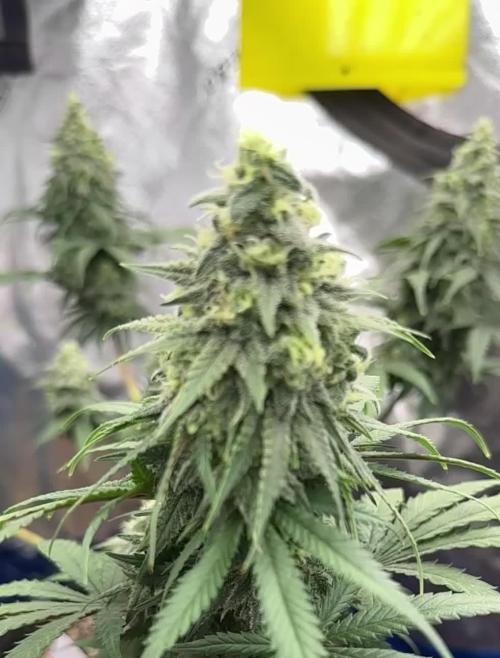
Has a big and heavy buds, some branches falling down because of their heavy weights. Perfect strain for the daytime and creative jobs. If you like a clean high daytime this one is definitely for you 😊 Peace and Love to everybody!0



Likes
31
Share


@Endriu
Follow
Hello Bros&Sis! Ciao!😊
this time I've decided to made a video update, from the start of the week to the finish, we're gonna see some BIG differences! (The longest is from the end)
About the ladies:
Girls in coco
Royal AK- she's drinking every single drop op solution and has literally exploded! I'm really happy about her training (top/lst/hst). A very strong strain.
OG Kush- I don't get this girl, she's definitely not an heavy drinker.
Speedy Chile FF- when I re-potted her into 6lt pot, some of my Bros hoped for a Baobab, what do you think?😂 (has some mutations, has a growth of 3 leaves and then 2 branches have joined together and the other has grown normally)
Ladies in Soil:
UK Cheese auto- I've broke a branch due to heavy crop. Lesson learned.
Pink Doc CBD auto- she's growing good, finally! The only thing I'm worried about is that she will not grow so much, because switch is near.
Candy Kush Express- A really nice lady, not too tall, good side branches and she take everything with no care less (one of the most "broken" in the tent)
Special Kush#1- She likes her new pot, but there's something wrong (see leaves) maybe related to VPD or RU?
I've used different techniques on this ladies, but the one I like the most is cropping the branches and the main stems and also broke the branches where meets the stems, to give'em more power, and more "space" for nutrients transports in sight of bloom!
That's all mate, we will see soon for the next update! Ciao!😙
(hey @Growdiaries if you want to use my video, feel free to do it, but please, don't change the music, it's already on YT and for CC use)


Likes
5
Share


@BB_UK
Follow
Well these beauties are stood at a whopping 42" and are now working on their flowers in full effect! I'm quite sure at this point all these clones are the same strain of sugar bomb punch 😁 so ending up with the favourite in their! She reminds me of runtz muffin because of the orange punch in her genetics!

Likes
15
Share


@Mrs_Larimar
Follow
2022-11-21
Those Plants are frosty like winter.
holy moly
I got 4 female Plants and 2 Phenos
One is shorter, the other one larger, but both are fantastic frosty
tomorrow i show you the ones in the Urban Chili, thses Pics are fro My Floweringroom
Iam using the urban Chili 2.0 and the urban Chili 3.0
the biggest Difference is the Light
the urban Chili 3.0 has 20 watts more
https://urbanchili.eu/en/growbox-specification/
All Plants look fine, lets see what the next Week brings.
so far so good
Likes
5
Share


@CalGonJim
Follow
1/27 2am Monday 👍👍👍🤩🤩
1/28 3am
1/30 flipping to flower soon added more dirt, trimmed up a bit.
2/1 3am SUNDAY. I did NOT expect the extra plant so I will cut it to 4 colas. Taking cuttings today!!!! I dont need the extra plants but Im going to experiment with cuttings and cloning today!!!! gReatest day of my life. 830am got the plants all cleaned up ready to flower!!!!!
I dont have space for the cuttings so Im throwing away an infinite amount of plants....booooooo
1230pm Ready to flip to flower 🌺 Monday!!!!!! I started the 12/12 tonight!!!!!
2/2 4pm SUNDAY.


Likes
9
Share


@BeanCrop420
Follow
During week 7 I accidentally snapped one of the branches while defoliating. It was a clean break but nearly snapped clean off. I have managed to prop and strap it up so hopefully with a bit of care she can hold on. It's now been 5 days since it snapped and seems to still look healthy so keeping my fingers crossed 🤞 Other than that this girl seems to be coming along really well. She has a lot of bud sites and seems to be taking nicely to my DIY Aero/Hydroponic system. I'm really pleased with how she is turning out for my first ever grow and I'm looking forward to seeing her at harvest!
Happy growing 🌱

Likes
8
Share


@Oldwied
Follow
Day 37
Everything is going wonderfully.
The flowers are getting thicker and thicker and the smell is getting stronger and stronger.
Deficiency symptoms from Happiness have not increased any more.

Likes
4
Share

@Beastmaster
Follow
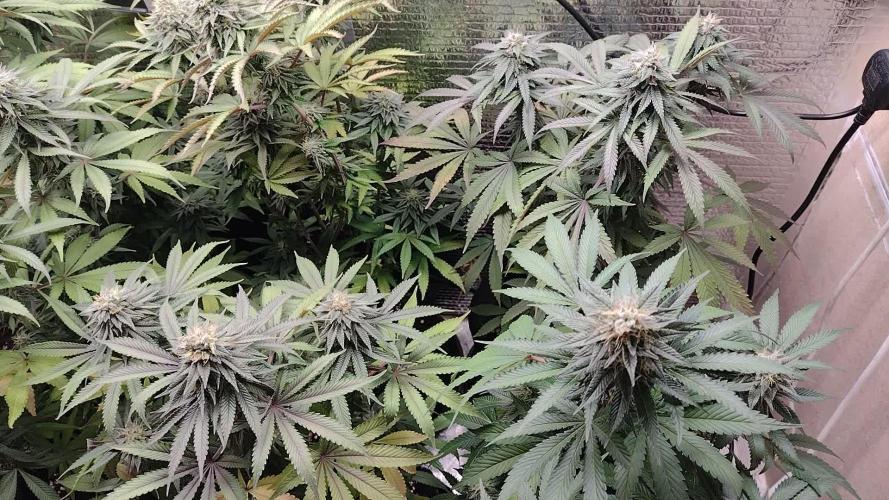
I had one nana on one plant and removed it, hopefully a one off. Buds are fattening up well.

Likes
15
Share


@420DeepGrow
Follow
Gracias al equipo de Seedsman y XpertNutrients sin ellos esto no sería posible.
💐🍁 Alaskan Do-Si-Dos:
Alaskan Do-Si-Dos ha sido desarrollada por expertos como una versión mejorada de la siempre popular variedad Alaskan Purple de Seedsman. La introducción de la genética Do-Si-Dos en la Alaskan Purple ha creado un híbrido índica/sativa que aumenta la potencia y el rendimiento al mismo tiempo que mejora el perfil de sabor y sigue siendo versátil en lo que respecta al cultivo en exterior.
La Alaskan Do-Si-Dos está destinada principalmente al cultivo al aire libre y en invernaderos. Las plantas crecen altas y prosperan en climas fríos, templados, cálidos y secos, al mismo tiempo que se desempeñan bien en altitud. Esto no impide que se cultive en interior, pero estas plantas grandes necesitarán mucho espacio. Las plantas muestran una resistencia moderada al moho pero, si se cultivan en interiores, hay que tener en cuenta que son RUIDOSAS, por lo que se beneficiará del uso de filtros de aire de carbón. En exterior, en latitudes septentrionales, la cosecha está prevista para finales de septiembre, mientras que en interior las plantas tardarán entre 8 y 10 semanas en completar la floración. Los rendimientos en exterior son muy altos y pueden superar fácilmente los 750gr/planta, mientras que en interior los rendimientos son elevados, hasta 600gr/m2. Los cogollos maduros tienen una densidad media y mantienen un color verde medio.
🌻🚀 Consigue aqui tus semillas:
https://www.seedsman.com/eu-es/alaskan-do-si-dos-feminised-seeds-sman-aldsd-fem
🍣🍦🌴 Xpert Nutrients es una empresa especializada en la producción y comercialización de fertilizantes líquidos y tierras, que garantizan excelentes cosechas y un crecimiento activo para sus plantas durante todas las fases de cultivo.
Consigue aqui tus Nutrientes:
https://xpertnutrients.com/es/shop/
📆 Semana 3:
Ha sido una buena semana, ella ha dado un gran cambio en su lugar definitivo 😎.
Se le ha aplicado un tratamiento insecticida con agua + tierra de diatomeas ( 1 cucharadita por litro de agua), también se le aplica un tratamiento fungicida con una infusión de cola de caballo para evitar futuro moho.
A partir de ahora se riega manualmente con las dosis recomendadas por el fabricante.
Likes
5
Share


@Saintgrower
Follow
Still picking a couple leaves here and there every couple of days, they are a very bushy plant I can already see trimming is going to be fun…NOT!! Aw well. Not had much to do this week on cruise control really. Temps risen slightly higher than I’d like but after this week gonna start dimming my lights so that should sort


Likes
21
Share


@MadeInGermany
Follow
Hey everyone :-).
This week she continued to develop very nicely 😍.
I started with LST training and topping 😊.
The training took it very well and after 1-2 days it grew again immediately 👍.
This time it will be an extreme bush 😂👍.
It was poured once this week with 1.2 l.
Otherwise there is nothing to report this week.
I wish you all a lot of fun until the next update. stay healthy and let it grow 😀
You can buy this Strain at
https://www.amsterdamgenetics.com/product/kosher-tangie-kush/
Type:
Kosher Tangie Kush
☝️🏼
Genetics:
Kosher Kush
X
Tangie
👍
Vega lamp:
2 x Todogrow Led
Quantum Board 100 W
💡
Bloom Lamp :
2 x Todogrow Led
Cxb 3590 COB 3500 K 205W
💡💡☝️🏼
Soil :
Canna Coco Professional +
☝️🏼
Fertilizer:
Green House Powder Feeding
☝️🏼🌱
Water:
Osmosis water mixed with normal water (24 hours stale that the chlorine evaporates) to 0.2 EC. Add Cal / Mag to 0.4 Ec Ph with Organic Ph - to 5.5 - 5.8 .





Likes
Comments
Share

@Grow4ever
Follow
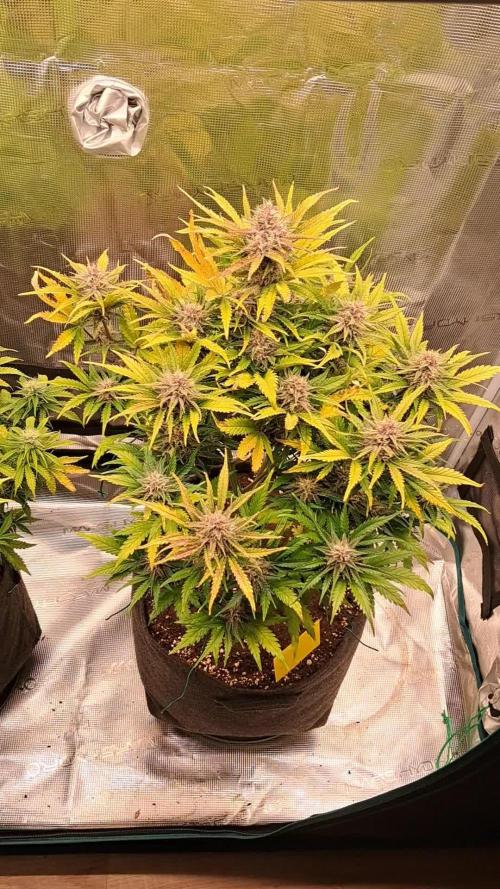
Die PH Probleme machten sich bei allen Pflanzen deutlich bemerkbar. Trotzdem war Sie wirklich vom Geruch ein wahrer Traum. Süßliche, fruchtige Note mit einem gassigen Aromer.
Likes
23
Share

@MadeInGermany
Follow
Hey guys :-)
This week she has developed very well.
For reasons of time, I topped them again on all the drives that were already high :-)
Unfortunately, there is still some time until there is room in the blossom tent.
That's why I'll have to train them a little more 😂.
Was poured 3 times this week with 1 l each. (nutrients see table above)
Since there are still trips in the vegetarian tent, the next few weeks will be treated again with nematodes and neem oil :-( .
Otherwise everything was cleaned.
Have fun with the update and stay healthy 💚🙏🏻
👇🏼👇🏼👇🏼👇🏼👇🏼👇🏼👇🏼👇🏼👇🏼👇🏼👇🏼👇🏼
You can buy this Nutrients at :
https://greenbuzzliquids.com/en/shop/
With the discount code: Made_in_Germany you get a discount of 15% on all products from an order value of 100 euros.
👇🏼👇🏼👇🏼👇🏼👇🏼👇🏼👇🏼👇🏼👇🏼👇🏼👇🏼👇🏼
You can buy this strain at :
https://www.thegratefulseeds.com/shop/feminized-seeds/limited-edition/blue-javaz/
Water 💧 💧💧
Osmosis water mixed with normal water (24 hours stale that the chlorine evaporates) to 0.2 EC. Add Cal / Mag to 0.4 Ec Ph with Organic Ph - to 5.8 - 6.4
MadeInGermany

Likes
13
Share


@Eldorado_ed
Follow
Well after splitting the Girls up due to space it’s looking like the HPS Ladies are almost ready looking we’ll ahead of LED ones also buds are fatter with HPS but would say the LED ones look healthier looking if that makes sense

Processing
Likes
2
Share


@eldruida_lamota
Follow
Que pasa familia, ya estamos entrando en la recta final de estas misty gorillas auto. Son plantas pequeñas con flores compactas, tengo mucha curiosidad por ver cómo están y como pegan.
Ph regulado en 6,2 temperstura aumentó a 27 grados y la humedad la tenemos por debajo de 40%.
Queda limpiar raices y poco más , buenos humos fumetillas.
Likes
51
Share


@Chumpkilla
Follow
11/7/23 - Day 1 - OK so big day going on here. It's time to get this little Skunk#1 seed into some lights!
(really it's Day 9, but were going to let it sync up to the app)
Above are photos of my best attempt at showing how this system works. First thing you want to do is to run the Leaf software and do the startup procedure. Selecting the Start grow button kicks off step by step instructions on the setup process.
There is a video of showing the automatic water fill coming from the RO water setup I created. Normally this is setup for hose water from your house. I want to make sure im using RO water for obvious reasons.
I will say, when you are done with you grow in this Leaf box make sure you clean it well. Its been a month since i cleaned it and had i not cleaned this it would take you much longer to start your new grow.
This is another grow that's starting out smooth! Ill keep you updated as I move along!
11/13/23 - Day 6 - Shes got her 3rd set of leaves just starting to grow. Her roots are not out of the net pot, but i can see them coming out of the rockwool. I would guess another week before the first root hits the water.
If you are looking for this growing experience. Visit www.getleaf.co.
Likes
41
Share


@Cannaguy
Follow
Another week of pretty consistent rain, haven’t had to water much. The plants definitely seem to be entering the flowering stretch as the branches are filling out and stretching towards the sun. Continuous rain has led to overall damp soil, will treat top soil with trifecta to help against bugs laying eggs in soil due to moisture