


Likes
Comments
Share


@Little_E
Follow
Day- 57
Man. These girls are really getting big! Did more LST yesterday and watered 2 days ago. Did half the recommended nutes again. Playing it safe. Been pretty smooth sailing so far!
Day- 58
Did a lot of defoliation. Hopefully it allows for some more growth!
Day- 60
Watered today. Still sticking to half the recommended amount of nutes. Been watering about once every 6 days. Still using blackstrap molasses on every watering.
Day- 62
It's a jungle!


Likes
22
Share


@RDWCGrowing
Follow
1/25/2024 Vegetation Week 3 Day 1- took 2 Tops today and cleaned up a few lower leaves that were hanging down. The FiM seems to have worked well and looks like I have three branches coming in where it was FiMed.
1/26/2024 Vegetation Week 3 Day 2- took 2 Tops from the sides and took a little of the foliage that was touching the lid. She seems to be doing very well.. Water change day tomorrow.. YAY!! will get a good picture of the roots and see how she is doing.
1/27/2024 Vegetation Week 3 Day 3- Water Change Day! I noticed a slight red coming in on the STEMS which I added a pinch of EPSOM salt to help correct.
I added 36 Gallons of Water
I added the following Nutes:
Silica = .5Mil/Gal= 18Mil
CalMag= .75Mil/Gal= 27Mil
FloraMicro = 4.2Mil/Gal= 187Mil
FloraGro= 3.8Mil/Gal= 137Mil
FLoraBloom= 3.0Mil/Gal= 108Mil
ORCA = .5Mil/Gal= 18Mil
EPSOM- 1 big pinch
1/28/2024 Vegetation Week 3 Day 4- I cleaned her up just a little bit on stuff hanging down. I also made sure the PH is balanced so she could soak up the New Nutes.
1/29/2024 Vegetation Week 3 Day 5- I Got sick, Possibly food poisoned.. Luckily for me the system was able to do what it do and hold it down until I was feeling better.
1/30/2024 Vegetation Week 3 Day 6- I was still to sick to go to my grow room... Possibly food poisoned.. Luckily for me the system was able to do what it do and hold it down until I was feeling better.
1/31/2024 Vegetation Week 3 Day 7- First day back.. Her PH was down to 5.72 so I raised the PH back up closer to 6.0, I took a few pictures and got her height.. Feeling better through prayer so was able to get some pics today.


Likes
11
Share


@kauilmayel1996
Follow
Me siento muy contento con estás auto...
Fast buds sorprendiendo con unos cogollos hermosos y un olor increíble...
No hice el mejor trabajo pero estoy feliz de haber hecho esto...
estoy enamorado con las ruderalis!
Auto de Fast buds un súper 10!
Likes
7
Share


@DrewbieDoobieNoobie
Follow
weeks 7 and I had to put a Scrogg net in. the weight of the buds is pulling down the plant Yō Yos so I went with a net,
looks like they are responding to the feeding. just water today and maybe tomorrow they're thirsty

Likes
12
Share


@Chamed33
Follow
Second time flushing it.. I’m also running out of time before harvest I should’ve been flushing it a week earlier.. she’ll be ready in 2 days for chop

Likes
20
Share


@blady1989sqn
Follow
Plants looks great, strong smell, I think one more week and timber time.

Processing
Likes
21
Share


@JuicyFruit
Follow
Day 48 - 11/11/19 started this week early by accident.
Plant smells like tropical cheese and i cant see the stalk anymore except from the leaves, very bushy and seems to be in a mid stage of flowering. buds are getting bigger by the looks of it. very sticky also!
Ive been removing about 2 leaves per day from this one, started with a couple touching the soil and removed a few higher ones today to expose the buds to more light and fresh air. when looking at this plant side on the main cola looks huge and growing more every day. im assuming this is about 2 weeks away from harvest so il probs flush next week. roll on harvest time! other than that the humidity has went up to 50-55 the odd time when watering all the plants. it doesnt stay high long with the heat from the lights so it should be fine.
Day 51 - 14/11/19
Still removing the odd couple of leaves every day to let the fresh air get near the main cola, i still cant see it very well but it looks like what a 6-7g bud looks like when its dried aha.
the smell can be described as if someone took a cheese strain and added something powerful and herbal/tropical to it.
cant wait to order my jewelers loupe in a few days to see where im really at :) and i added a video to show the plant looking all frosty. a few weeks to go now!
Likes
7
Share

@eldruida_lamota
Follow
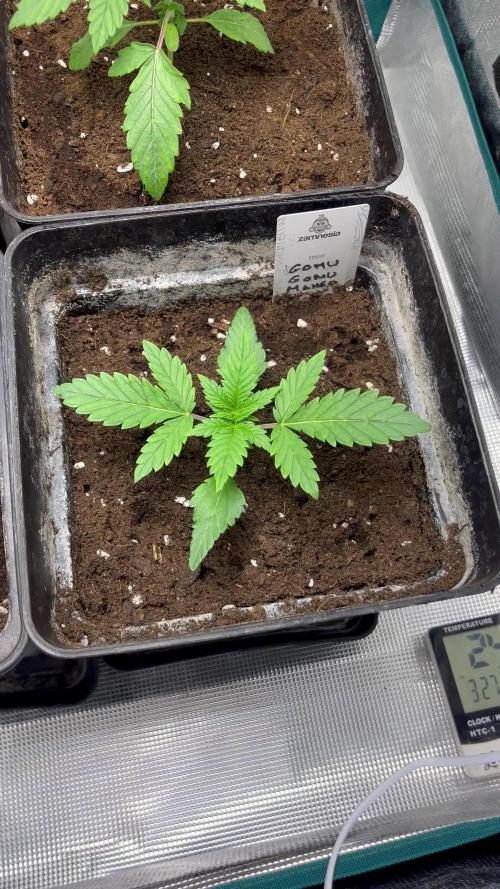
Que pasa familia, vamos con la tercera semana de vida de estas Gomu Gomu Mango feminizadas de HighBreed.
Vamos al lío ,se colocaron en macetas de 7 litros definitivamente.
El ph se controla en 6.0 , la temperatura la tenemos entre 24/20 grados y la humedad ronda el 50%.
El ciclo de crecimiento puse 16h de luz, el foco está al 50% de potencia.
De momento va creciendo tienen buen color y va progresando.
- os dejo por aquí un CÓDIGO: Eldruida
Descuento para la tienda de MARS HYDRO.
https://www.mars-hydro.com
Hasta aquí todo, Buenos humos 💨💨💨


Likes
3
Share



Likes
3
Share


@Sup3rNov4
Follow
She is looking fantastic the buds started putting on size yesterday last couple weeks me things can’t wait to try her

Likes
74
Share

@squalino
Follow
Journal de Culture : Givre 1 -
Babouch (Semaine 9)
Génétique : Frostbanger (F2 Perso) | Système : Autopot 20L (Géré en manuel pour le rinçage)
📣 Remerciements
Un immense merci à toutes les personnes qui suivent ce journal depuis le début ! Un grand merci en particulier à @MIA_BIOTABS et à Mrs_Larimar pour leurs précieux conseils toujours aussi utiles. Merci à tous pour votre soutien !
🛠️ Configuration Technique
Éclairage : Lumatek ATS 300W Pro (réglé à 100% pour le sprint final)
Distance lampe/canopée : 50 cm
Climat : Jour : 25°C / Nuit : 21°C
Humidité (HR) : 50% (gérée par le déshumidificateur)
Tente : 1m80 de hauteur
📅Évolution & Fin de Floraison :
Hier dernier repas PK et top départ pour un rinçage de 14 jours minimum !
État de la plante & Structure des bourgeons :
Hauteur actuelle : 84 cm (la taille reste inchangée, toute l'énergie va dans les fleurs).
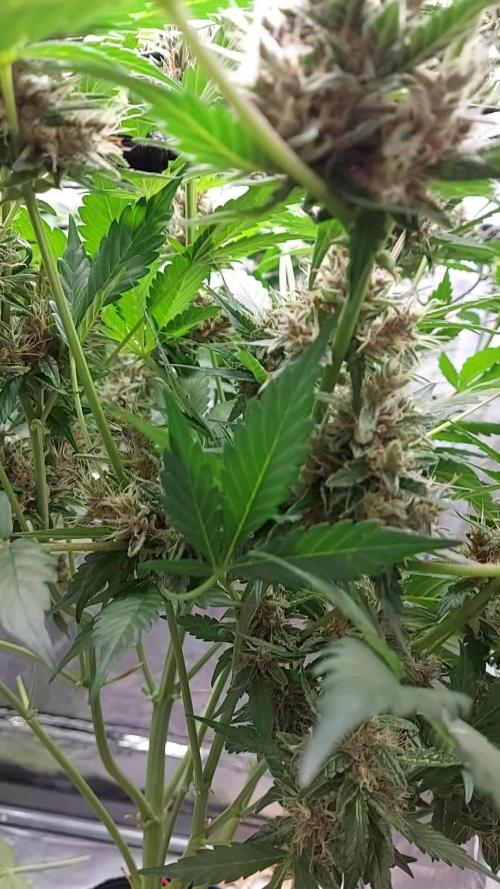
Morphologie des têtes : Les bourgeons continuent de gonfler d'une manière assez unique avec cette petite couleur rosée. J'ai l'impression qu'elle pousse "en épis de blé", une structure de floraison très intéressante, même si ce phénomène est un peu moins prononcé sur Babouch que sur sa sœur Dora.
Trichomes :
À l'observation, la plupart des trichomes sont désormais bien laiteux. C'est le signal parfait que j'attendais pour lancer la dernière ligne droite.
Nutrition et stratégie (Le grand nettoyage en mode manuel) :
Dernier apport :
J'ai donné hier ce qui sera normalement son tout dernier apport en PK 5-8 Biotabs.
Gestion du système :
Pour cette phase cruciale, j'ai bien coupé le système Autopot et je bascule en mode arrosage manuel. Cela va me permettre de contrôler précisément la quantité d'eau claire apportée et de bien laisser le substrat respirer entre deux arrosages.
Objectif Rinçage :
À partir de maintenant, Babouch passe uniquement à l'eau claire pour une période de 14 jours minimum. Le but est de couper complètement les vies pour la forcer à puiser au maximum dans ses propres réserves stockées dans les grandes feuilles, et ainsi déclencher une vraie et belle sénescence d'ici la coupe.
Résumé visuel :
Avec la lampe poussée à 100%, la production de résine s'intensifie et les têtes scintillantes sous les LED. Les calices continuent de s'empiler magnifiquement, et malgré sa structure de feuilles encore bien vertes et vigoureuses, le démarrage du rinçage va doucement commencer à faire pâlir la demoiselle.
L'odeur dans la tente est toujours aussi redoutable.
À bientôt pour suivre l'évolution ❤️❤️
Likes
41
Share


@Bread_n_Buds
Follow
This strain is currently satisfying us greatly, in fact the mainlined one is the best for now without a doubt, its name is King Louis Automatic.
Remember that we are growing a plant worked with the indicated techniques and another left to grow without pruning to preserve its speed; in the previous/next diary you will find the other plant of the same variety.
This plant has started flowering after a Main Lining that was a success in a Masterful way thanks to a good grower and a fantastic plant with a wide internodal distance: topping at the second internode, creation of the Mainfold, the brunches have stretched naturally and parallel to the ground with just a little pressure, no sign of breakage, fraying of the hemp, nothing. Everything very graceful, aligned and in rhythm. Truly everything is in its place, fingers crossed we will be able to see a mega result.
Comparison is the salt of experience, so the plant in the other diary will be treated very differently, go and see it to make a comparison.
We started the Plagron fertilization program, we are in 100% organic configuration, the soil is composed of recycled Promix + 1/3 fresh soil + 10% Perlite + RQS Mycorrhizae Mix (4 g in the mix, 1 g under the small fiber pot).
In the middle of the week the pre-flowering began so I decided to start the program for this phase: 1 ml/l of Power Roots - 1 ml/l of Pure Zym - 1 ml/l of Sugar Royal - 1 ml/l of Power Buds - 2 ml/l of Alga Bloom
Remember the Green Sensation from the 3rd/4th week of flowering depending on the flowering speed or how you see the calyxes composing, when the calyx is in the swelling phase it is used.
We sprayed 5ml/l of Vita Race foliar fertilizer once a week.
-------------------------------------------------
https://plagron.com/it
We always have the excellent RQS mycorrhizae running through the soil.
https://www.zamnesia.io/it/5778-mix-micorrhiza-easy-roots.html
Love this strain perfect for main lining! ---- https://www.zamnesia.io/it/11238-zamnesia-seeds-king-louis-automatic.html
Brief description of Zamnesia // Say hello to true royalty with King Louis Auto, an autoflowering version of the original King Louis. Bred from OG Kush, LA Confidential and a premium ruderalis cutting, King Louis Auto delivers premium bud fit for a king just a few weeks after germination. As if that wasn't enough, her small size and vigor make her great for almost any grow environment. Incredibly efficient
King Louis Auto has inherited the best traits of her photoperiod cousin, all wrapped up in a fast and easy-to-grow seed. With good soil and adequate watering, King Louis Auto seeds will quickly grow into robust and vigorous plants. Once fully mature, these plants will not exceed 80cm indoors, meaning they can easily fit into even the smallest of grow spaces. Likewise, outdoor plants will only reach 100cm, making this strain ideal for guerrilla grows or other environments where discretion is key. And if that wasn't enough, King Louis Auto only takes 9–10 weeks from germination to harvest, after which she'll reward you with yields of up to 300g/m² indoors and 150g/plant outdoors. With its pungent terpenes and high THC levels, King Louis Auto offers a fragrant and relaxing experience. When you open your jars of buds, you'll immediately notice intense scents of pine, damp earth and fragrant wood. After inhaling her equally complex smoke or vapor, you'll be hit with a deep, relaxing body stone that's perfect for those moments of well-earned rest and relaxation. With 24% THC, King Louis Auto hits hard and takes ef
The whole world of growing and much more is on Zamnesia: just take a look at the site and you will find "all the best that nature has to offer" in various shapes and colors.
---------------
www.zamnesia.com


Likes
65
Share


@bypado_farm
Follow
Day 44:
Watered the plants 0.5L with nuts
733 ppm, 1468 us/cm, PH 6.4
I am doing lst every other day
Did some defoliation
Day 46:
Watered the plants 0.5L with nuts
684 ppm, 1444 us/cm, PH 6.4
Did some defoliation
Used neem oil to prevent pests
Likes
21
Share


@MrWolfe
Follow
This was round 3 so I had some notes going in for finish time and schedule and have some more after this one for the next. Stay tuned.

Processing
Likes
8
Share


@DaLawry
Follow
Cherry Punch just got her last feed this past week. The next 2 weeks will be full flushing for them. Garlic cookies, watermelon Skittlez, Mint cookies, cookies and cream, and wedding cake are going to be fed up to weeks 7-8. All the plants are finishing nicely! smells are getting a little more dank forsure!😎


Likes
16
Share


@Vincent11
Follow
Hi everyone this last few weeks have been crazy as you all can see this Gelato turned out to be a Photoperiodic plant.
Week 17 in to flower for 2 weeks now.
All was going well but I did not have much time to look after it.
And got some light burn in the early stages did some training techniques and She looks is recovering now.
Some nice pictures how big one of those can get when I wasn't expecting this plant to be a Photoperiodic.
But let's see she turned out a female so that's great will be a nice surprise probably.
Happy Growing and have a lovely week.


Likes
13
Share


@DeepSouthDank
Follow
Another fantastic week!
The girls grew nicely during the stretching phase filling out most of the space, but have now started to calm down. It has been 14 days since switching to a 12/12 light cycle.
We lowered the light and are running it at 100% power.
The girls are being fed five times a day through a drip feed system @1500EC.
No problems so far. Happy daze 😁
