Likes
Comments
Share
This Diary contains one of Katsu Bluebird's Most Exciting breeding Projects; Grape Ape Cake ! Lineage; Hotcakes (Katsu Bubba X Burnt Toast from Raw Genetics) X Grape Ape Welcome to Week Seven, our last Veg Entry These Girls loved the topping last week.. & didn't really miss a beat as far as growth is concerned, a minor delay but still cracked an inch worth of height gained this week. As most seam to have a very tight growth pattern I honestly think they're going to be monsterous tower's in the coming weeks. with that in mind I gave everyone a good leg shave to increase those chances. Also The Frist trellis is up ! after talking with Katsu about how much he thinks this particular strain may stretch.. i've decided to hang 2 lines of support across these girls. this first being right as we move into FLOWER ! teh second line will go up one the stretch stops..(week3-4 maybe we will see) With that being said, after a slight flush @6.6ph Water, & 24 Hours of darkness happening as I type this entry.. They will receive their first Flower Feeding in the Morning! & the next entry will be our first week of flower ! It is always a blast working from a pack of Reg Seed, let alone an Exciting project like these Katsu beans ! and as we move into flower next week I've taken cuts that I'm hopeful will ensure I have the BEST of the Best Flowers from this run to keep for another run at least.. and maybe even outdoor 2021. Thanks for Reading This far 🙌 If you have a question or a comment leave it down below otherwise, I Hope You Check in Next Week, Stay Safe out there & Happy Gardening Cariboo
Likes
4
Share
@twenty20mendocino A-Team R&D Update ~ Let’s Go day 24 of flower 🌸 an we are looking amazing! Ladies are starting to stack an oh my we getting a lot of frost going on! starting to get some gassy stanky notes of em too😍 ! We are only into week 4 ladies an gents we still got a few weeks to go of stacking! Keep your eyes peeled for next week’s update yall , peace love a positive to all y’all , an have an amazing productive day ! Cheers an blaze on !!
Likes
61
Share
Hello and welcome to week 10. We join Queen Citronella after a week of high drama at the palace. She was poisoned! Dun dun duhhhhh. The royal food taster has already been executed, but her majesty is displeased still and on the warpath. She has recovered, much scabbed on her skin, but her new growth is coming in healthy. Lets see how week 10 goes for her royal highness. She and I will see you tomorrow. Day 64: Fertigated 5l. Day 65: Fertigated 5l. Her majesty have grown 2cm to 50cm. Day 67: Height 52cm. Not much of a stretch here now. Unsure what the prognosis is. For the first time today she smells like super lemon haze. Day 68: Fertigated 5l. Day 69: Nothing to report Day 70: Her majesty has recovered well from the serious nutrient toxcitiy I subjected her to for 2 days. However I do think I have given the plant a fairly big setback. I wonder if her stretch is already over. That would honestly suit me perfectly well for this grow. Her tent is too small for her.
Likes
5
Share
Likes
4
Share
Likes
44
Share
Che dire... Wow! La mia piccola sembra non aver accusato minimamente il mio errore ed ha proseguito magnificamente! La fioritura è cominciata e si sente già quell'odore pungente quasi dolce di formaggio 💚 è ancora presto per trarre conclusioni ma lo stress non sembra esserci stato, semmai il contrario! Sembra crescere come una sativa..
Likes
22
Share
Vamos que os explico un poco critical es una variedad indica con una floración rápida, sus flores son compactas , y bastante resinosas, tiene aromas fuertes. El ambiente en el secado estuvo en 23 grados de media y 40% de humedad se pasaron rápido al bote de cristal, 7 días en concreto. Hasta aquí todo familia, espero que os agrade un saludo y buenos humos💨💨💨
Likes
105
Share
@Coopmc
Follow
7 week first 5 were 12 on 6 off seamed stuck in week 2 flower for 4 weeks Gave her week 4 feed modeled after fox farm feed rate
Likes
36
Share
@nonick123
Follow
Día 73 (12/08) Riego 500 ml H2O pH 6,55 Todas las plantas muestras las preflores hembras! (excepto LemonPaya) Día 74 (13/08) Riego 250 ml H2O pH 6,55 . Están muy bien hidratadas Pequeños ajustes de LST Día 75 (14/08) Hoy día de lluvias torrenciales Riego 250 ml H2O pH 6,55 Día 76 (15/08) Detecto mosca blanca en varias plantas. Aplico Spruzit a 10 ml/l ahora que aún no estamos en floración Riego 500 ml H2O pH 6,55 Día 77 (16/08) Riego 500 ml H2O pH 6,55 La mosca blanca ha desaparecido completamente Día 78 (17/08) No riego. Mañana a primera hora aplico Top Dress y riego profundo Va a empezar la floración! Día 79 (18/08) Alimentemos el suelo con Top Dress! 💥 Aplicamos 4 g/L sustrato de Tasty Flowers TD by Lurpe Solutions. Total = 84 gramos / maceta Riego con 1 Litro H2O pH 6,5 con 25 ml/L de Humus de Lombriz Liquido Aplicación foliar Kelp hidrolizado de Lurpe Solutions a 0,25 ml/l 💦Nutrients by Lurpe Solutions - www.lurpenaturalsolutions.com 🌱Substrate PRO-MIX HP BACILLUS + MYCORRHIZAE - www.pthorticulture.com/en/products/pro-mix-hp-biostimulant-plus-mycorrhizae
Likes
60
Share
So da sind wir wieder .. aber auch ein paar Tage zu früh … Sonntag ist es erst soweit aber da ich bissle busy bin ziehe ich das Update ein paar Tage vor … Und mal wieder als kleinen Obolus … habe ich mal wieder ein Video gemacht :) Es geht zu Ende im Kanickelbau .. man könnte sagen .. (was ein grower normal nie sagt..) es stinkt bestialisch … die Terp Mischung in der Runde ist der Absolute Wahnsinn … alle 3 Cookies bilden komplette unterschiedliche Pheno … während Lulatsch Nr3 mit tangie Orangen terps um sich schmeißt … geht Pheno nr2 eher Richtung Lemon Sweety … und Pheno 1 Richtung leicht waldig Sweet …. Sehr sehr interessant… und freue mich die 3 gegrowt zu haben … Pheno 3 is jetzt nicht so meins .. solche Sativa Lanzen … ich mag lieber runde Nuggets … aber heulen auf höchsten Niveau :) Ich werde diese Woche noch ein wenig was an big bud verabreichen .. und dann werden sie ausgehungert … aktuell sind die Temperaturen auch sehr Grenzwertig um das Endprodukt vernünftig zu trocknen .. für die V-Cure hat sich noch kein Sponsor gefunden 😅 … mit den lebenden Pflanzen besser zu Händeln als Schock zu trocknen .. Ich hoffe ich konnte euch ein paar schöne Einblicke zeigen :)
Likes
32
Share
Day 21 Flowering (#1,2,3. day 14 flowering #4): Hi all and yet again a great week for the exotic girls. They just get more beautiful each week now. Buds are forming well on all of the older girls and it is easy to spot the difference between phenos close up. I am going to do a defol later today to open the right up for the air they need to get around now. They have some really good sized fan leaves that have help power their stretch well but now are blocking so much light to the inner growth too. #1 is medium sized in height with chunky golf ball buds forming .node spacing is not too long but I don't think they will join up with the ones above .#2 is a very big girl and the tallest of the 4 growing .Around 1m now and a good amount of mains to form her chunky single bud clusters . Her node lengths are fairly spaced apart and a good defol will allow them to all see light. #3 is in a 20L pot so i expected her to be slightly smaller than her sisters. She has kept up very well with them for bud production and overall flower amounts. #4 is at day 14 and doing a great job of keeping up oddly. while her buds are not as big yet , her look is more mature so it seems she is trying to compete . All are feeding well but #3 shows signs if mg defects. I will correct it with a feed with calmag but also keep vigilant. They are starting to kick out a nice fruity hit now too. keep it green Growmies
Likes
13
Share
@a1Andrew
Follow
MK Ultra How long this strain will need up to the harvest? 55 - 65 Days How many side branches will be build? 8/10; a great many How strong these side branches will be? 8/10; strong and vigorous How long these side branches will be? 5/10; into an average length The stature can be described at the best one as follows: bushy, strong, strudy, slowly How high is the yield? 7/10; high, but i dont opened it full potential How is the relationship from buds to leaves? 7/10; above average How compact are the Buds? 8/10; hard and compact How "strong" is the Weed? Does it have a lasting effect? Or will it be soft and effectless? 8/10; is strong and long lasting How fast there is tolerance build if you smoke (only) this Weed? 8/10; very slow tolerance education How do you would describe the effect/high? 90 body/10 head General Impression: 8/10; extraordinary and quite recommendable In this grow I dont defoliate MK's and LA SAGE so they all were more bushy and had more stems than Og18's. The main problem of the grow was temperature, cuz it was up to 38-40 degreese and the plants had hard times, also there were some issues in watering. 600w HID + HLG 135v2 kit in 4x4 gave me 272g of extra dry buds of MK ultra and 200+ of LA S.A.G,E. (dryed 7 days in 30% humidity and 26-30 celsius) ... Love the strain, one of classics :)
Likes
Comments
Share
Se empezó con lavado de raíces a 4 de las plantas, esto con florakleen de GH y agua pura. Dos de las plantas siguen con nutriente, aún siguen engordando. Las plantas tienen muy buen aroma y están pegajosas. La planta con manchas en la hojas y que además se quemó con el pk1314, sorpresivamente ha duplicado de tamaño las flores. Se volvió a cambiar la lámpara y se puso una de la mitad de potencia. - Luz: Bestva Pro 1000W / 18 h/d -FloraNova Bloom G.Hydroponics: 0.7ml/l - Bio Bud G. Hydroponics 2.5ml/l - Armour SI G. Hydroponics 0.4ml/l - C4 Mills 1ml/l - Everest: 0.5 ml/l - Florakleen G. Hydroponics
Likes
9
Share
@MaxMo8
Follow
Hello friends, this week is interesting, busy and even enthusiastic. I put compost tea for all of them, wish you happy days🤗
Likes
2
Share
@Jaschkoo0
Follow
I dryed them slow. I deleted the original report si i had to make a new one without all the data about watering and so.
Likes
21
Share
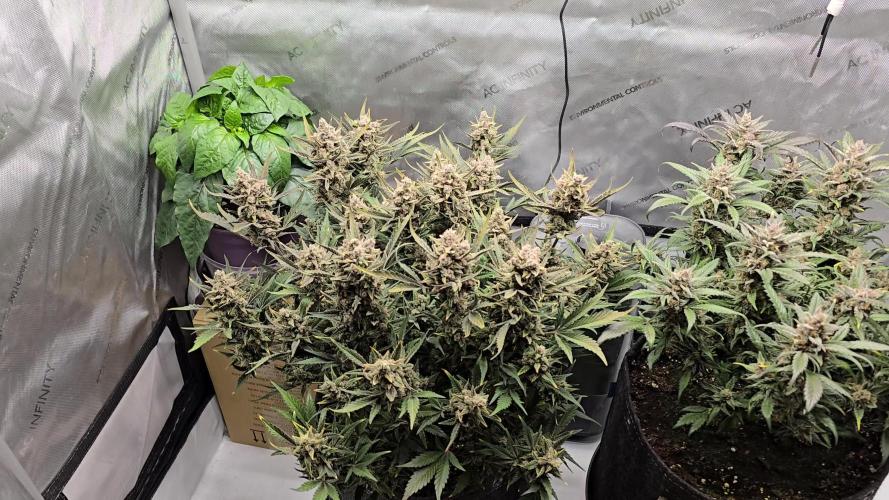
She’s looking good, still growing her buds more frosty and dense. She smells citrusy and piney so far. She’s continuing to fatten and frost.
Likes
3
Share
Caught up... things are going well, Bruce stretched like crazy and has evened up its canopy to the others idk if it's that big bud in it or what. Lilac has looked a solid week and half ahead of the others since flower, she looks wicked though, trichromes are starting to build. I've done my last training, I usually go hard on thinning but I'm trying to be conservative and only uncover buds under leaves. Still same feeding routine.. looking forward to the finish line but know this is an important time with terms and trichromes beginning to resonate... I sick at this guy's but I want to get better at chronicling my grows.. so hourly I will improve in the process of Journaling.
Likes
16
Share
@RakonGrow
Follow
Tag 85: + Generative Phase III der Canna Dünger Tabelle + Lichtdauer von 16 auf 15 Stunden reduziert. Ein Video und ein paar Bilder für den Größenvergleich . Ich hab versucht so nah wie möglich an die Buds zu kommen ohne das ich die Trichome platt drücke . Ausserdem hatte ich gestern noch etwas Entlaubung betrieben . Tag 86: + 2,25L Flaschenwasser (16:00 Uhr) ++ Dünger Blüte +++ Generative Phase III des Canna Düngeschema Leicht + final PH 6.10 Die Dame war heute Morgen noch fitt und noch Wasser vorhanden , 7 Stunden später war schon ein sichtbarer Wassermangel aufgetreten (Die kleinen Fanblätter hingen schon leicht). Tja so schnell kann es manschmal gehen . Tag 88: + 2,0L Flaschenwasser (16:00 Uhr) ++ Dünger Blüte +++ Generative Phase III des Canna Düngeschema Leicht + final PH 6.00 Tag 89: Tageslicht von 15 auf 14 Stunden reduziert. Tag 90: + 2,0L Flaschenwasser (13:00 Uhr) ++ Dünger Blüte +++ Generative Phase III des Canna Düngeschema Leicht + final PH 6.00 Tageslicht von 14 auf 13 Stunden reduziert. Photos mit Dose zum Größenvergleich !!! Und ein Video !!
Likes
2
Share
Pistils spotted on 4/7 plants will veg 2 more weeks
Likes
52
Share
Once again she passes my expectations, late to the show with trichome production. I'm surprised there is purple on the bud, maybe Purpinator does work. I thought I could see hints under the grow lights and thought my eyes were deceiving me, I was just being hopeful. But nah 2 of the 3(under the UV) have developed a beautiful tone of purple. I was never going to bother with a deep freeze but maybe the whole bud will change given conditions, that would be something, fingers crossed. 🤔 was a little skeptical that reducing temps humidity would change density, but it does, buds are solid something I've not been able to achieve before. Rule of thumb is never to surpass 60% RH in the flowering phase and try to progressively reduce it down to 40% in the last 2–3 weeks before harvest. The plant will react as it seeks to protect its flowers, responding by producing denser buds and a higher concentration of resin. Cannabis plants are sensitive to sudden temperature changes, especially in the flowering stage. Extreme heat or cold can impact bud density and overall yields. In nature as a defense mechanism from cold, the plant sensing sudden dips in temperature will attempt to remove the pockets of air within the bud, it achieves this by compacting itself in doing so to better protect itself from cold snaps which are normally indicators in nature that worse weather is on the way. Terpene levels are the highest just before the sun comes out. Ideally, you want as many terpenes present in your plants as possible when you harvest. Cannabis plants soak up the sun during the day and produce resin and other goodies at night. The plant is at its emptiest from "harvest undesirables" so to speak right before the lights on. Boiling cannabis roots during harvesting slows down the drying process. When you boil cannabis roots, it shocks the plant, closing the stomata on the leaves. This prevents massive moisture loss through the leaves, leaving only the floral clusters actively losing moisture at a reduced pace. I've always run a strict 60/60 and it took almost twice as long to dry to a snap than previous grows where I didn't boil for what it's worth. Chlorophyll is good for the plant but not for you. When you harvest the buds, even after you flush them, if you flush them, they’re still filled with chlorophyll. Freshly cut buds are greener than dried buds because they still contain loads of chlorophyll. However, when rushed through the drying process, the buds dry but retain some chlorophyll, and when you smoke it, you will taste it. Chlorophyll-filled buds are smokable, but they aren’t clean. Slow drying gives the buds enough time and favorable conditions to lose the chlorophyll and sugars, giving you a smoother smoke. How the plant disposes of the chlorophyll and sugars by a process of chemically breaking them down and attaching the decomposed matter once small enough to water molecules which then evaporate back into the ether. Time must be given to the process to break down the chlorophyll and sugars. Think of it like optimizing the environment for decay. All the nutrients it could ever need are in abundance, it eats nutrients based on its demand for growth, which is dictated primarily by available light. Plant growth and geographic distribution (where the plant can grow) are greatly affected by the environment. If any environmental factor is less than ideal, it limits a plant's growth and/or distribution. For example, only plants adapted to limited amounts of water can live in deserts. Either directly or indirectly, most plant problems are caused by environmental stress. In some cases, poor environmental conditions (e.g., too little water) damage a plant directly. In other cases, environmental stress weakens a plant and makes it more susceptible to disease or insect attack. Environmental factors that affect plant growth include light, temperature, water, humidity, and nutrition. It's important to understand how these factors affect plant growth and development. With a basic understanding of these factors, you may be able to manipulate plants to meet your needs, whether for increased leaf, flower, or fruit production. By recognizing the roles of these factors, you'll also be better able to diagnose plant problems caused by environmental stress. Water and humidity *Most growing plants contain about 90 percent water. Water plays many roles in plants. It is:* A primary component in photosynthesis and respiration Responsible for turgor pressure in cells (Like the air in an inflated balloon, water is responsible for the fullness and firmness of plant tissue. Turgor is needed to maintain cell shape and ensure cell growth.) A solvent for minerals and carbohydrates moving through the plant Responsible for cooling leaves as it evaporates from leaf tissue during transpiration A regulator of stomatal opening and closing, thus controlling transpiration and, to some degree, photosynthesis The source of pressure to move roots through the soil The medium in which most biochemical reactions take place Relative humidity is the ratio of water vapor in the air to the amount of water the air could hold at the current temperature and pressure. Warm air can hold more water vapor than cold air. Relative humidity (RH) is expressed by the following equation: RH = water in air ÷ water air could hold (at constant temperature and pressure) The relative humidity is given as a percent. For example, if a pound of air at 75°F could hold 4 grams of water vapor, and there are only 3 grams of water in the air, then the relative humidity (RH) is: 3 ÷ 4 = 0.75 = 75% Water vapor moves from an area of high relative humidity to one of low relative humidity. The greater the difference in humidity, the faster water moves. This factor is important because the rate of water movement directly affects a plant's transpiration rate. The relative humidity in the air spaces between leaf cells approaches 100 percent. When a stoma opens, water vapor inside the leaf rushes out into the surrounding air (Figure 2), and a bubble of high humidity forms around the stoma. By saturating this small area of air, the bubble reduces the difference in relative humidity between the air spaces within the leaf and the air adjacent to the leaf. As a result, transpiration slows down. If the wind blows the humidity bubble away, however, transpiration increases. Thus, transpiration usually is at its peak on hot, dry, windy days. On the other hand, transpiration generally is quite slow when temperatures are cool, humidity is high, and there is no wind. Hot, dry conditions generally occur during the summer, which partially explains why plants wilt quickly in the summer. If a constant supply of water is not available to be absorbed by the roots and moved to the leaves, turgor pressure is lost and leaves go limp. Plant Nutrition Plant nutrition often is confused with fertilization. Plant nutrition refers to a plant's need for and use of basic chemical elements. Fertilization is the term used when these materials are added to the environment around a plant. A lot must happen before a chemical element in a fertilizer can be used by a plant. Plants need 17 elements for normal growth. Three of them--carbon, hydrogen, and oxygen--are found in air and water. The rest are found in the soil. Six soil elements are called macronutrients because they are used in relatively large amounts by plants. They are nitrogen, potassium, magnesium, calcium, phosphorus, and sulfur. Eight other soil elements are used in much smaller amounts and are called micronutrients or trace elements. They are iron, zinc, molybdenum, manganese, boron, copper, cobalt, and chlorine. They make up less than 1% of total but are none the less vital. Most of the nutrients a plant needs are dissolved in water and then absorbed by its roots. In fact, 98 percent are absorbed from the soil-water solution, and only about 2 percent are actually extracted from soil particles. Fertilizers Fertilizers are materials containing plant nutrients that are added to the environment around a plant. Generally, they are added to the water or soil, but some can be sprayed on leaves. This method is called foliar fertilization. It should be done carefully with a dilute solution because a high fertilizer concentration can injure leaf cells. The nutrient, however, does need to pass through the thin layer of wax (cutin) on the leaf surface. It is to be noted applying a immobile nutrient via foliar application it will remain immobile within the leaf it was absorbed through. Fertilizers are not plant food! Plants produce their own food from water, carbon dioxide, and solar energy through photosynthesis. This food (sugars and carbohydrates) is combined with plant nutrients to produce proteins, enzymes, vitamins, and other elements essential to growth. Nutrient absorption Anything that reduces or stops sugar production in leaves can lower nutrient absorption. Thus, if a plant is under stress because of low light or extreme temperatures, nutrient deficiency may develop. A plant's developmental stage or rate of growth also may affect the amount of nutrients absorbed. Many plants have a rest (dormant) period during part of the year. During this time, few nutrients are absorbed. Plants also may absorb different nutrients as flower buds begin to develop than they do during periods of rapid vegetative growth. 432 Hz is said to be mathematically consistent with the patterns of the universe. Studies reveal that 432 Hz tuning vibrates with the universe’s golden mean PHI and unifies the properties of light, time, space, matter, gravity and magnetism with biology, the DNA code and consciousness. When our atoms and DNA start to resonate in harmony with the spiraling pattern of nature, our sense of connection to nature is said to be magnified. Another interesting factor to consider is that the A=432 Hz tuning correlates with the color spectrum while the A=440 Hz is off. Audiophiles have also stated that A = 432 Hz music seems to be non-local and can fill an entire room, whereas A=440 Hz can be perceived as directional or linear in sound propagation. Once you adopt the idea that sound (or vibration in general) can have an equalizing and harmonizing effect (as well as a disturbing effect), the science of harmony can be applied to bring greater harmony into ones life or a tune to specific energies. There is a form of absolute and of relative harmony. Absolute harmony can for example be determined by the tuning of an instrument. The ancients tuned their instruments at an A of 432 Hz instead of 440 Hz - and for a good reason. There are plenty of music examples on the internet that you can listen to in order to establish the difference for yourself. Attuning the instrument to 432 Hz results in a more relaxing sound, while 440 Hz slightly tenses up to body. This is because 440 Hz is out of tune with both macro and micro cosmos. On the contrary, 432 Hz is in tune. To give an example of how this is manifested micro cosmically: our breath (0,3 Hz) and our pulse (1,2 Hz) relate to the frequency of the lower octave of an A of 432 Hz (108 Hz) as 1:360 and 1:90. It is interesting to note that 432 Hz was the standard pitch of many old instruments, and that it was only recently (19th and 20th century) the standard pitch was increased. This was done in order to be able to play for bigger audiences. Bigger audiences (more bodies) absorb more of the lower frequencies, so the higher pitch was more likely to “cut through”. One of the oldest instruments of the world is the bell ensemble of Yi Zeng (dated 423 BC), tuned to a standard F4 of 345 Hz which gives an A= 432 Hz. The frequency of 345 Hz is that of the platonic year! Similarly many old organs are tuned in an A=432 as well; for example: St. Peter’s Capella Gregoriana, St. Peter’s Capella Giulia, S. Maria Maggiore in Rome. Maria Renold’s book “Intervals Scales Tones and the Concert Pitch C=128 Hz” claims conclusive evidence that 440 Hz and raising concert pitch above scientific “C” Prime=128 Hz (Concert A=432 Hz) disassociates the connection of consciousness to the body and creates anti-social conditions in humanity. The difference between concert pitch A=440 Hz and Concert A=432 Hz is only 8 cycles per second, but it is a perceptible difference of awareness in the human consciousness experience of the dream we share called existence.