Likes
Comments
Share
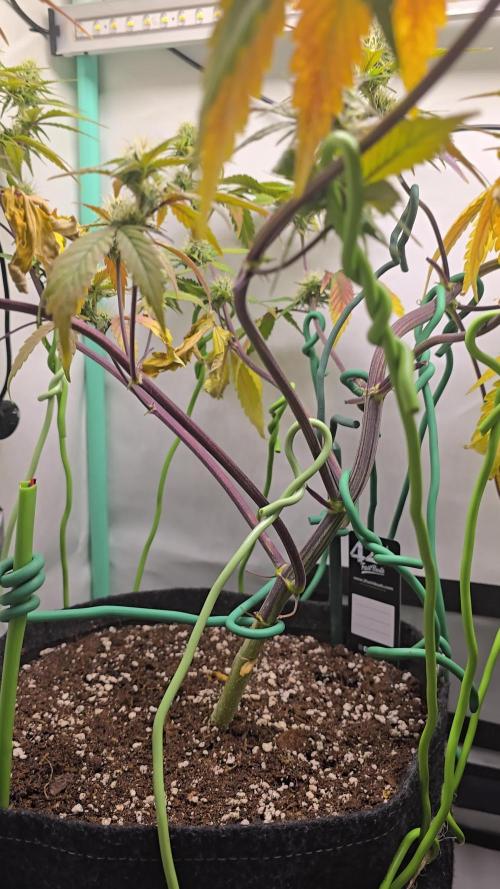
A happy home and these girls are doing what nature intended! 🚀🚀🚀 ______________________________________________________________ The time has gotten away from me! I was over here using a dropper on these ladies when i realized the needed a full-blown drain to waste FEED!!!! I consulted the feed chart and stuck them on a week 2 regimen. I learned the 3gal pots hold 2 containers in veg and 3 in flower. good to know for measurements. There was a little yelllowing of the leaf on 2 plants but i think its from the neglect! Lets see what a delicious meal brings about!!! ______________________________________________________________ They aren't 100% happy, but I'm hoping they grow out of it! Not sure why one plant has all they yellow spots when 3 others don't They also arent drying out fast, i think it was a bit to early for a drain to waste. Struggling to decide when to water again
Likes
19
Share
All being flushed now,.. 2 have come down today, 1 blackberry and the purple lemonade,... rest will come down Saturday except the strawberry banana
Likes
15
Share
@Messypies
Follow
brilliant week of growth from the peanut butter cookies. Been a little bit of a struggle for space but will HST once all autoflowers are out. Both the auto cinderella jack and auto critical cheese are developing buds nicely
Processing
Likes
20
Share
Buenas noches familia, finalizamos el primer mes de esta farm cheese, esta variedad está colocada básicamente por gusto de mi paladar, me encanta el sabor de la cheese y a sido un capricho. Volviendo a esta genética, vemos cómo la cheese a tirado unas preflores majas y unos brazos curiosos, es de las variedades que más huele de lo que e cultivado así que ojito gente que recuerdos tengo bastantes en cuanto a el tema olor-cheese. Ph controlado en 6.0 humedad por debajo de 50% temperatura siempre por debajo de los 27 grados. Poco más os dejo unas fotos y vídeos para que podáis comprobar que la farm cheese esta más que viva 💨💨💨 buenos humos.
Likes
16
Share
We are in flower ! Trainwreck is doing great, the defoliation delivered the shape I wanted like always, simple training but can change the plant shape a lot. The flower stretch went super well, I think she will stretch a bit more but should be almost done. I cleaned the lower branches completely to avoid any problems down below, better airflow and less risk for Pm etc. Still not using any nutrients, all living soil from Sonnenerde.
Processing
Likes
3
Share
The plants grow well in the first week I had 100% germination in the seeds, for a first-time sailor I'm happy. I added the humidifier to keep the humidity at 65%. Now in the second week I increased the quantity of fertilizers but always following the supplier's table and the plants seem to be enjoying their food.
Likes
55
Share
2nd net is up. Early bud formations are promising. holding up to the extremes pretty well, some leaves taking minor damage, but overall, she is holding up, gave her 1 night at 50F see how she would react, stressful. Not advised as it messes with her metabolism, but I want to see if it triggers any anthocyanin response. Love to see her purp up but no signs yet. Remember, For every molecule of glucose produced during photosynthesis, a plant needs to split six molecules of water. This process provides the hydrogen needed for synthesizing glucose and other organic compounds, while oxygen is released as a byproduct. Homework. If Rubisco activity is impaired and it cannot properly function or regenerate its substrate, the plant's leaves are likely to turn a pale green or lime green, a condition known as chlorosis. Essentially, Rubisco activity is highly regulated and susceptible to various environmental and metabolic factors that can cause it to become inhibited, leading to an apparent failure in RuBP regeneration due to a lack of consumption. Rubisco regeneration is intrinsically linked to nitrogen supply because Rubisco is a major sink for nitrogen in plants, typically accounting for 15% to over 25% of total leaf nitrogen. The regeneration phase itself consumes nitrogen through the synthesis of the Rubisco enzyme and associated proteins (like Rubisco activase), and overall nitrogen status heavily influences the efficiency of RuBP regeneration. RuBisCO is a very large enzyme that constitutes a significant proportion (up to 50%) of leaf soluble protein and requires large investments in nitrogen. Insufficient nitrogen supply limits the plant's ability to produce adequate amounts of RuBisCO, thereby limiting the overall capacity for photosynthesis and carbon fixation. Maintaining the optimal, slightly alkaline pH is crucial for the proper function and regeneration of Rubisco. Deviations in either direction (too high or too low) disrupt the enzyme's structure, activation state, and interaction with its substrates, leading to decreased activity and impaired RuBP regeneration. (Lime/yellowing) Structural Component: Nitrogen is an essential building block for all proteins, and the sheer abundance of the Rubisco protein makes it the single largest storage of nitrogen in the leaf. Synthesis and Activity: Adequate nitrogen supply is crucial for the synthesis and maintenance of sufficient Rubisco enzyme and Rubisco activase (Rca), the regulatory protein responsible for maintaining Rubisco's active state. Nitrogen deficiency leads to a decrease in the content and activity of both Rubisco and Rca, which in turn limits the maximum carboxylation rate, Vmax, and the rate of RuBP regeneration Jmax, thus reducing overall photosynthetic capacity. Nitrogen Storage and Remobilization: Rubisco can act as a temporary nitrogen storage protein, which is degraded to remobilize nitrogen to other growing parts of the plant, especially under conditions of nitrogen deficiency or senescence. Nitrogen Use Efficiency (NUE): The allocation of nitrogen to Rubisco is a key determinant of a plant's photosynthetic nitrogen use efficiency (PNUE). In high-nitrogen conditions, plants may accumulate a surplus of Rubisco, which may not be fully activated, leading to a lower PNUE. Optimizing the amount and activity of Rubisco relative to nitrogen availability is a target for improving crop NUE. Photorespiration and Nitrogen Metabolism: Nitrogen metabolism is also linked to the photorespiration pathway (which competes with carboxylation at the Rubisco active site), particularly in the reassimilation of ammonia released during the process. To increase RuBisCO regeneration, which refers to the process of forming the CO2 acceptor molecule Ribulose-1,5-bisphosphate (RuBP) during photosynthesis, the primary methods involve optimizing the levels and activity of Rubisco activase (Rca) and enhancing the performance of other Calvin-Benson-Bassham (CBB) cycle enzymes. Biochemical and Environmental Approaches: Optimize Rubisco Activase (Rca) activity: Rca is a crucial chaperone protein that removes inhibitory sugar phosphates, such as CA1P (2-carboxy-D-arabinitol 1-phosphate), from the Rubisco active site, thus maintaining its catalytic competence. •Ensure optimal light conditions: Rca is light-activated via the chloroplast's redox status. Adequate light intensity ensures Rca can effectively maintain Rubisco in its active, carbamylated state. •Maintain optimal temperature: Rca is highly temperature-sensitive and can become unstable at moderately high temperatures (e.g., above 35°C/95F° in many C3 plants), which decreases its ability to activate Rubisco. Maintaining temperatures within the optimal range for a specific plant species is important. •Optimize Mg2+ concentration: Mg2+ is a key cofactor for both Rubisco carbamylation and Rca activity. In the light, Mg2+ concentration in the chloroplast stroma increases, promoting activation. •Manage ATP/ADP ratio: Rca activity depends on ATP hydrolysis and is inhibited by ADP. Conditions that maintain a high ATP/ADP ratio in the chloroplast stroma favor Rca activity. Enhance Calvin-Benson-Bassham (CBB) cycle enzyme activity: The overall rate of RuBP regeneration can be limited by other enzymes in the cycle. •Increase SBPase activity: Sedoheptulose-1,7-bisphosphatase (SBPase) is a key regulatory enzyme in the regeneration pathway, and increasing its activity can enhance RuBP regeneration and overall photosynthesis. •Optimize other enzymes: Overexpression of other CBB cycle enzymes such as fructose-1,6-bisphosphate aldolase (FBA) and triose phosphate isomerase (TPI) can also help to balance the metabolic flux and improve RuBP regeneration capacity. Magnesium ions, Mg2+, are specifically required for Rubisco activation because the cation plays a critical structural and chemical role in forming the active site: A specific lysine residue in the active site must be carbamylated by a CO2 molecule to activate the enzyme. The resulting negatively charged carbamyl group then facilitates the binding of the positively charged Mg2+ion. While other divalent metal ions like Mn2+ can bind to Rubisco, they alter the enzyme's substrate specificity and lead to dramatically lower activity or a higher rate of the non-productive oxygenation reaction compared to Mg2+, making them biologically unfavorable in the context of efficient carbon fixation. The concentration of Mg2+ in the chloroplast stroma naturally increases in the light due to ion potential balancing during ATP synthesis, providing a physiological mechanism to ensure the enzyme is activated when photosynthesis is possible. At the center of the porphyrin ring, nestled within its nitrogen atoms, is a Magnesium ion (Mg2+). This magnesium ion is crucial for the function of chlorophyll, and without it, the pigment cannot effectively capture and transfer light energy. Mg acts as a cofactor: Mg2+ binds to Rubisco after an activator CO2 molecule, forming a catalytically competent complex (Enzyme-CO2-Mg2+). High light + CO2) increases demand: Under high light (60 DLI is a very high intensity, potentially saturating) and high CO2, the plant's capacity for photosynthesis is high, and thus the demand for activated Rubisco and the necessary Mg2+ cofactor increases. Mg deficiency becomes limiting: If Mg2+ is deficient under these conditions, the higher levels of Rubisco and Rubisco activase produced cannot be fully activated, leading to lower photosynthetic rates and potential photo-oxidative damage. Optimal range: Studies show that adequate Mg2+ application can enhance Rubisco activation and stabilize net photosynthetic rates under stress conditions, but the required concentration is specific to the experimental setup. Monitoring is key: The most effective approach in a controlled environment is to monitor the plant's physiological responses e.g., leaf Mg2+ concentration, photosynthetic rate, Rubisco activation state, and adjust the nutrient solution/fertilizer to maintain adequate levels, rather than supplementing a fixed "extra" amount. In practice, this means ensuring that Mg2+ is not a limiting factor in the plant's standard nutrient solution when pushing the limits with high light and CO2. Applying Mg2+ through foliar spray is beneficial to Rubisco regeneration, particularly in alleviating the negative effects of magnesium (Mg) deficiency and high-temperature stress (HTS). While Mg can be leached from soil, within the plant it is considered a mobile nutrient, particularly in the phloem. Foliar-applied Mg is quickly absorbed by the leaves and can be translocate to other plant parts, including new growth and sink organs. Foliar application of: NATURES VERY OWN MgSO4 @ 15.0g L-1 in a spray bottle. For those high-intensity workouts when 1 meal a day is just not enough! Foliar sprays are often recommended as a rapid rescue measure for existing deficiencies or as a supplement during critical growth stages, when demand for Mg is high. Application in the early morning or late evening can improve absorption and prevent leaf burn. The plant was getting a little limey yellow in the centre. Shortly thereafter, she was back in business, green mostly regenerated. The starting point [of creativity] is curiosity: pondering why the default exists in the first place. We’re driven to question defaults when we experience vuja de, the opposite of déjà vu. Déjà vu occurs when we encounter something new, but it feels as if we’ve seen it before. Vuja de is the reverse—we face something familiar, but we see it with a fresh perspective that enables us to gain new insights into old problems. Confidence is evidence... nothing more. You are confident because you have driven 10,000 times, you are confident because you have spoken 10,000 times. People think confidence is a feeling, but it's not. If you want more confidence, then you need to create evidence, take more shots, collect more data, build more experiences, take more risks; fail, confidence doesn't come first; it is the reward you get for doing the work. no one else wants to do.
Likes
13
Share
16/04/2021 (day 68): la plus grande plante a atteint le filet cette semaine mais j’ai été obligée de le retirer. Les tiges sont si épaisses et si rigides que j’arrive à peine à les plier pour les maintenir sous le filet. C’est seulement ma deuxième session et je n’ai pas assez d’expérience pour les plier sans les endommager. J’ai surélevé les plus petites pour avoir une canopée à peu près régulière et j’ai augmenté la puissance d’éclairage à 60%. Les plantes sont beaucoup plus vigoureuses que lors de ma première session et les fleurs sont beaucoup plus belles. Peut-être qu’elles apprécient plus les engrais Biobizz que les BioNova... ou peut-être que je commence à comprendre un peu mieux ce dont elles ont besoin 😀
Likes
10
Share
All in all i ended up with almost 2.5ozs of some super nice rock hard buds and another oz of some larfy smaller buds i made into cannaoil with coconut oil!! I will grow her again for sure but next time i will start it in my big tent and let her stretch her arms and legs out and see if i can get a monster!!!
Likes
29
Share
---------------------------------- ~SEEDSMAN PEYOTE FORUM~ ---------------------------------- Characteristics BREEDER/BRAND: Seedsman GENETICS: GSC Forum Cut x Peyote Purple VARIETY: Indica / Sativa FLOWERING TYPE: Photoperiod SEX: Feminized THC CONTENT: 20%+ GROWS: Indoors, Outdoors FLOWERING TIME: 65 days MEDICAL CONDITIONS: Glaucoma, Headaches, Migraines, Stress MEDICINAL PROPERTIES: Yes EFFECT: Powerful __________________________________________________________________________________________________________________________________________________________________________________________________________________________________________________________________________________________________________________________________________________________________________________________________________________________________________________ ~🤩This run is part of a Seedsman Seeds sponsored PEYOTE FAMILY COOPERATIVE GROW, I'm also cultivating a Peyote Gorilla and Peyote Zkittles that each have their own diaries.💚~ 'Peyote Forum is an Indica-sativa hybrid cross between the legendary taste sensation Forum Cookies, a pheno-type of GSC (Girl Scout Cookies), and the highly potent Peyote Purple cannabis strains. This is a must-have strain for your collection which produces very high THC content.. Forum Cookies is a 75% sativa strain which retains the qualities of the original Girl Scout Cookies while adding extra cerebral sativa effects. Despite the dominance of sativa the buds it produces are very dense and rich in resin-exuding trichomes which glisten against the forest green bud-leaves and orange pistils. Some plants may display purple colors in the buds and smaller leaves at maturity. While yields aren't enormous they are certainly decent and the sheer quality more than makes up for this fact. Flowering takes 65 days give or take. Flavors are pungent and similar to the original GSC showing a pungent Skunk character with notes of nuts and sweet spices and suggestions of earth and pine. THC production will vary between 19 - 28% depending on conditions, lighting intensity and the skill of the grower. The effect is physically relaxing while offering a cerebral twist which is uplifting, relieving stress while also helping with the symptoms of glaucoma, migraines and headaches. Peyote Purple, however, is an Indica-dominant strain with 90% Indica genetics. Its ancestry can be traced from a single purple phenotype which was back-crossed for several generations in order to stabilize its qualities. This plant takes 8 - 9 weeks of flowering before it is ready to harvest producing average yields of way-above-average weed. The THC content is very high with plants reaching between 18 - 28%. Its name is attributed to its headiness as this Indica offers some pronounced cerebral effects with a relaxing yet uplifting high which can leave smokers sleepy and somewhat unfocused with heavier use. Therapeutically it is recommended for the treatment of chronic pain, cramps, Insomnia, muscle spasms and stress. Brought together in Peyote Forum growers can expect some very potent, tasty dank buds with high levels of THC and an uplifting high.' *description credit to Seedsman Seeds __________________________________________________________________________________________________________________________________________________________________________________________________________________________________________________________________________________________________________________________________________________________________________________________________________________________________________________ THE SETUP: ~Planted into Jiffy Peat Pellets that were hydrated with de-chlorinated water with SuperThrive added then ph'd to 6.0 @ 80℉ ~Grown 100% organic in 10g fabric pots with Mother Earth 70/30 Coco/Perlite medium amended with 2tbs/g of Down To Earth 4-4-4 / 2 cups/g of Earthworm Castings / 1tbs/g of Dr. Earth Flower Girl 3-9-4, 1tbs/g of Dr. Earth Bat Guano, 3/4 cup of Down To Earth Azomite and 1 tsp/g Down To Earth Fish Bone Meal. ~24hr light cycle during Germination / 19/5 light cycle for Vegetation and 12/12 for Flower ~Straight water ph'd @ 6.2-6.8 when needed and weekly Compost Tea's. __________________________________________________________________________________________________________________________________________________________________________________________________________________________________________________________________________________________________________________________________________________________________________________________________________________________________________________ WEEKLY UPDATES: 9/27- Week Seven of flower here we go! She's looking good to go with her flowers stacking and her trichome production continuing to coat her flowers! Today she was given 1.5g of de-chlorinated water which was ph'd to 6.2 @ 72℉ which I gave her half through her drip pan (bottom chuggin), the remainder trough the medium. I also gave her pot a 1/4 turn. 9/29- Yesterday I didn't water her, only turned her pot and checked her over... Wow! She's really ramping up the trichomes making her flowers look like their sugar coated! 🤩 I watered her today with 1.5g of de-chlorinated water with 1 tsp/g of unsulfured molasses added which was then ph'd to 6.4 @ 72℉. The molasses will give the microbial colony some additional food as well as supplying micro-nutrients to the plant. I finished out the daily maintenance giving her a check over and turning her pot 1/4 turn to ensure she gets light to every inch of her. 10/1- Yesterday was a 'no water' day as her pot was still fairly heavy to lift. Today she was watered with her usual of 1.5g of de-chlorinated water which was ph'd to 6.2 @ 72℉. Her flowering continues to impress me with her trichome production covering her flowers with 'frost' she's a sight for sore eye's! 😍 The end of next week will be the beginning of her wrapping up with the 'Finish Line' approaching by Week 9, but it will all depend on when she tells me that she's ready to go! 10/3- With Week Seven coming to a close we're going into the last 2-3 weeks for this lady and she's right on track, looking like a Rock Star! 🤩 I watered heavy yesterday and added 1 tsp/g of Unsulfured Molasses to the 1.5g of de-chlorinated water which was then ph'd to 6.6 @ 72℉. Her pot had some weight to it when I checked today so I'll skip watering her until tomorrow. I finished up today by checking her over and giving her pot a turn. ~Thanks for stopping in! This epic run will be wrapping up in the coming weeks...Stay lifted and be Blessed! 😎🙏~
Likes
17
Share
Welcome back at week 2 of White Label White Skunk Automatic. This week was not much going on. The plant is getting new leafs and so far, I can’t see any mutation according to newer leafs. But it’s still very tiny and grow speed is slow for an automatic strain. Maybe it’s still an issue with my setup ? Growing progress is slow but steady. First leafs have a yellowish Color but the plant seem to be healthy. Keep in touch ! Cheers, HighZenBerg
Likes
12
Share
@FreakShow
Follow
She's growing super fast and smells great 😍😍 Starting building little buds allready 😍😍
Likes
18
Share
my dry and cure style is this: 4 days of hanging upside down to get water activity lower to around 0.6 in 50% humidity and 26 C temp (i know its a little high but we are in a hot summer right now and i cant get it lower even with air conditioner) and then after 4 days of drying i remove leaves and stalks, trim buds and move them to jar for the rest of their life :D . and in the first 4 days of curing i open the jar door and let hem get some fresh air in the jar for about 5 minutes and close the jar door again, after 4 days of curing like that buds are smokable but they will get better as they getting cured about 1 month. buds are one of the hardest as fucking rocks type of buds! very dense , compact , sticky , smelly , amazing at every aspect growing stage was 56 days and flowering stage was 75 days total (harvested tops at day 64th) the total weight of dry buds was : (plant #1 & #3 top buds 56 G + lower buds 22 G ) 78 G + (plant #2 top buds 47 G + lower buds 18 G ) 55 G + (plant #4 top buds 120 G + lower buds 67 G ) 187 G = 367 G
Likes
19
Share
@Bncgrower
Follow
This time it was this girl's turn with a great smell. A very good strain, easy to grow, fast, and without many demands. Besides the controlled environment, it has a sweet citrus scent that makes you want to eat it instead of smoke it, lol. The buds were a good size, very resinous, and sticky. I really liked the result and intend to grow it again ✌️💪🌿🍁
Likes
12
Share
Week 5 begins for LSD and Green Crack! The LSD ladies had the most yellowing over the last week, yet they have the most frost on the buds. The Green Crack ladies had a little bit of yellowing and has bigger buds, but no frost at this time. They all seem very happy in their new 4x8 home. Thanks for stopping by growfessors, tune in next week for another episode of growfessor theatre. 👽🌳💚
Likes
2
Share
Likes
46
Share
Alright, I moved her into Homebox Q60+ now and provided some professional light Q3W from Sanlight with 120W full spectrum range. This setup is much better for the plant compared to my setup in 1st week. Now it is also much easier for me to keep stable humidity and temperature. Day 9 - Looks like she recovers from stress I gave her in 1st week. Stem looks quite thin to me - but since I have no experience I can't be sure if it is abnormal for this age or not.
Likes
5
Share
Everything look excellent wishing I had a time machine. Just about run out from first grow can't get enough . hands down best smoke I had all year but I still think there is room for improvement .