


Likes
Comments
Share


@Cannerd
Follow
Week 5 Flowering - She's starting to put a little focus towards Trichrome production now. while still majorly on bulking up. The fade is slowly coming in as well. little video for perspective!

Likes
45
Share


@AsNoriu
Follow
Day 8 since seed touched soil. Great strain, started early and strong. Have big hopes from first look ;)
Girls got tent and air movement. 240w dimmed to 30%, distance approximately
40 cm .
HappyGrowing !!!

Likes
2
Share


@Earthsower
Follow
She has received a bit of heat stress from last week but she seems stable. She has not been fead anything this week all she has had is just pure natural sunlight. The pot is not light enough to feed her so I will wait until tbefore I feed her and continue to keep her in the natural sunlight

Likes
25
Share


@Merrymoosefamilyfarms
Follow
Hey hey! What’s goin on growmies? I hope everyone is doing well and everyone’s gardens are doing fantastic as always! Today marks the beginning of week 4! That’s right, one whole month today!
This week the girls look like they are feeling MUCH better! Everyone seems as though they have completely bounced back from what we’ll call our “taproot incident….” Dare I say ready for transplant!
Due to that recent trauma though, I am really going to try not to push it too much this grow- I’m going to play it safe and feel like that will benefit me most- but that being said, GENERALLY speaking, I train, top and transplant autos and photos alike- I just think certain things need to be considered… this is me considering those things.
This being said, I decided to transplant them into their final pots, usually I try and transplant at least one more time but I don’t have any mycorrhizal product anyways so I won’t beat myself up too bad for not transplanting the autos more, it definitely can be considered playing with fire and I think in this scenario specifically due to the fact that I already slow down their growth- I just have to know when to pause, regroup, and head in a slightly different direction.
I ended up going with 5 gallon fabric pots, I have no issues with and have been using 3 gallons up until now for autos however I noticed how the roots were looking after I had harvested my last plants and I wondered if there would be any noticeable difference between the three and the five. I have heard with autos you really don’t need to go above a three so I’m not saying that I’m changing up my game completely I’m just experimenting…
We decided to fill those 5 gallon fabric pots with a blend of Coco and perlite, I go with a rough 70 to 30 ratio on that mixture. I actually had to split the transplanting process into two separate days because I ran out of the coco mixture I had made- I bought a bag of Coco Loco from fox farms And mixed in my own perlite the first day but then today I finished transplanting everything and went with Fox Farms cultivation nation which saved me a step, for those of you who are in familiar with that product it is just there 70/30 cocoa perlite blend and I have used it numerous times, both of those with great success.
When I put them back into my tent I rearranged things a little bit- I set that scrog up in a debatably weird spot of my tent, however I am glad that I did! I was looking for just a bit of room and it looks like I found it! In a perfect world they would all be raised on the same cement blocks that I have for the others, however Christmas is coming up and I really have to spend wisely so those will just have to wait!
They really exploded growth wise this week so I am excited for next week to see how they are lookin- I think they are ready to roll so it’s off to the races for these little ladies! Growmies, once again thank you so much for following along, we have some amazing things in the works- I think we are about to really see what these girls can do and I couldn’t be happier that you are here to follow along and experience this with me! I hope all of you have an outstanding week with vigorous growth in all of your gardens! Growers love everybody!!! 💚🤙🌱

Likes
5
Share

@BudBrewerz
Follow
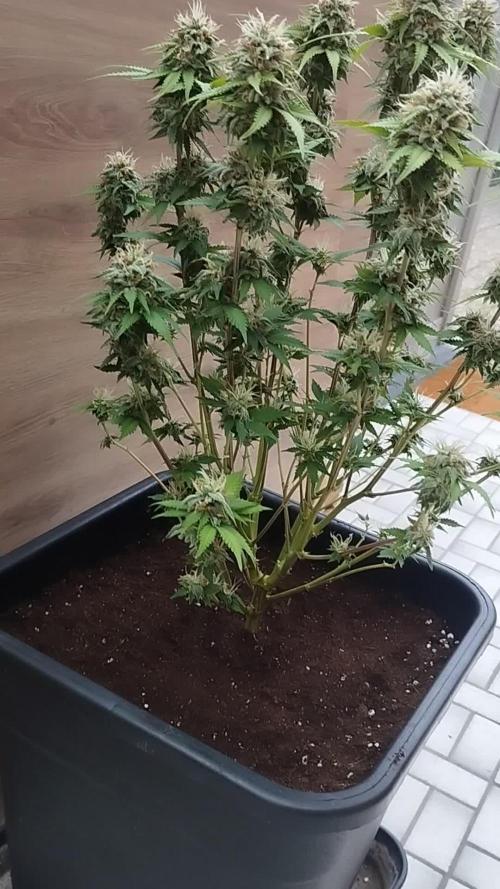
This lady seems to be doing really great, she's growing on some thick nuggs that start to smell super fruity, im really curious about how she will turn out.
Stopped with nutrients yesterday
Think she will be ready in a week or two
Likes
95
Share


@Only4passion
Follow
🤩 WoW those girls are definitely enjoying their life with this new light ⭐️⭐️⭐️⭐️⭐️
Flowering time now just ad 2ml/l of calmag.
Northernlight she’s really fast all ready forming buds !!🤩
Tente ⛺️ : marshydro 120/120/2m
Light 💡 : marshydro ts 3000
Genetics :
- 5 girls scoot cookies auto, Seedstocker
- 3 runtz auto, Zamnesia
- 2 northernlight auto, Seeds Mafia
Soil : coco mix 50%
Cannaterra light mix 50%
Promo code zamnesia 10%off:
🔥🔥⭐️✨ GROWITGD✨⭐️🔥🔥
Marshydro discount code :
⭐️⭐️🔥Only4passion 🔥⭐️⭐️
Thanks all for the likes n comments happy to share with you all growers 🙌🍀💪💪🍀👊


Likes
9
Share


@Ziocannabis
Follow
Ne sono rimaste 2..la più indietro come crescita non ho idea di cosa uscirà
Doveva essere un automatica... invece no!
Perciò non so cosa dirvi
L'altra matura, invece,tra una settimana sarà da togliere...Cime compatte, classica cima/pepita,tipo roccia😅
Ho iniziato oggi con acqua e melassa agricola,7/8 giorni per dare tutta la dolcezza del caso😋🤤


Likes
23
Share


@DeepRootsGrowTrees
Follow
MATARO BLUE by KANNABIA
Week #13 Overall
Week #12 Veg
This week she's doing good no issues to report great genetics being outside she had dealt with the heat and elements. Stay Growing!!
Kannabia.com MATARO BLUE

Likes
14
Share


@BudXs
Follow
CRAZY NIGHT (continued)
I get a cab back to the boys, we take the company car to the casino where we can park it relatively safely under cctv camera. It has a non functioning and non closing window at this point, so thats the best place we could think of. We hit the sino, win a few bucks and kill a few hours. I lose one of the boys to a high class and expensive looking late night date (???) and he assures us he will see us at breakfast in 40 minutes (hahah). We walk out with our winnings to find our car is gone. Not only is the window non functioning, it is non existent. Well there goes fucking breakfast! We called to report the incident, and one of us had to stay to chat with the cop and the casino. I didnt have the time, so my remaining buddy gave the notes. No texts from NX, so I called him. at around 4:40am. Went right to voicemail, followed by a text: "Im stucK" ...(continued)
DIARY STUFF
These Fastbud fast finishers are incredible plants. Not even finished 6 weeks of flower and they are packing on some serious cola weight. So much bud to leaf ratio, and sticky as all hell. Added Beastie blooms to the flowering feed and they seem to be loving it. Heat has been a battle this week as it is the middle of july and humid. Running lights at half power and ac full
HEATHER !!!
SELL ME FFT5 and FFT7


Likes
7
Share


@RivenWaters
Follow
It’s week 9 and you can definitely see the flowers now. The seeds were all 60-70 day to flower and they all started at week 8-9! Awesome

Likes
12
Share


@The_Good_Twin
Follow
7/16/22
Today marks the 1st day of week 14, and the start of the 2nd week of the ripening stage.
Stella received a gallon of water mixed with the following nutrients:
FloraMicro - 5 ml
FloraBloom - 15 ml
Floralicious Plus - 1 ml
Dry KoolBloom - 0.5 tsp.
I seem to be having an issue with pH the last 2 feeding days. I think my gallon jugs have reached the end of their lifetimes, and THAT is what is causing my issue. It has happened to me once before, and getting new jugs cleared up the issue. I’m assuming that will be the solution to the problem.
However, we all know what “assume” stands for don’t we? If you don’t, leave a comment and I’ll explain.
The initial pH was 5.4. That is the lowest that I have ever had simply after adding nutrients. I added a total of 10 ml’s of pH UP, which in my opinion is way too much! But, I did it in 3 separate increments. Not that that makes it better.
The final pH after all that was 6.3. The runoff pH was 5.6.
She is still looking good, but you can tell she’s getting ready to start getting to her end stage. I wait with baited breath!
The tent was 81.7F, with a humidity of 56%.
We’re almost there! Happy growing everyone.
7/18/22
Today I’m going to keep this note brief… I promise.
Stella is continuing to fatten up getting ready for harvest in a few weeks. She is still doing well.
Today she received a gallon of water mixed with the ripen stage nutrients again. I changed all of my jugs, but after mixing everything up the initial pH was 5.5. I added 8 ml’s of pH UP which adjusted the pH going in to 6.2. Her runoff pH was 5.6.
The tent was 83.3F, with humidity at 58%.
See! A short note is possible!! Happy growing everyone.
7/21/22
Stella and all of her children were fed today. As usual, a day later than planned, but they got fed, and are all still doing wonderful.
We’re keeping with the ripen nutrients mixed into a full gallon of water.
FloraMicro - 5 ml
FloraBloom - 15 ml
Floralicious Plus - 1 ml
Liquid KoolBloom - 2 ml
Initial pH was 5.2. I added 12 ml’s of pH UP which adjusted it to 6.2. She had plenty of runoff with a pH of 5.8
The tent was 83.9F, and humidity was 52%.
Her buds are FAT!! Happy growing everyone!

Likes
15
Share


@OrganikTek
Follow
Sorry brothers to be so lait this week... had some problems with may Home Assistant raaspberry. Lost a day and half of photos.
Weather is Getting better
Black Cream Is in senescense. Buds are fattening and getting some color. Shes so Beautiful now.
The other are starting to a lot of pistilis out. Flowering in early stage. didnt train them so much let them grow more vertically.
Chears BrotherHood

Likes
12
Share


@Naturalist
Follow
AG#1+6 bolted to showing male sacs & were pulled from tent, guess I'm glad it happened before flipping to 12/12 (today), I'm pretty certain the other 4 are female. I wiped the tent down & water sprayed the rest of plants to be safe.
I did some more LST on AG#4+5
Plants seem to be recovering pretty well from the Cal-Mag deficiency, most burn is gone.


Likes
40
Share

@BudXs
Follow
All is good in the Scroggernaut and the plants are taking to their hempy buckets.
Ladies were topped this week and responding well. VPD is on point as can be seen by the way the leaves are praying to the skies.
The lighting is just killing it and Im not even cranked up yet. Trying to fiddle and keep the seedling plants on the other table close to the same size as the coco hempys, so Im using slowing techniques like early defo and light deprivation on the seeds.
Really looking forward to what this strain has to offer and hope to get some variance in the phenos.
Follow my son on his first Grow Diaries adventure - Budxless
I go live on insta Sunday nights from the garden at 9:30pm EST - Budxsmedical

Processing
Likes
70
Share


@CBD_Sweden
Follow
@MephistoGenetics,
Hi all the happy people here in GrowDiaries.
This is my second cultivation ever and it will be fun to try a bigger space than my closet grow.
First, I'm just going to say I'm done with the construction of my new growroom.
The room is 2.14 meters by 1.7 meters and has a ceiling height of 2 meters.
It provides a floor area of 3.6 square meters.
I use a 54 Watt Lightwawe T5 for germination and 2 Pcs 400 Watt HPS lamps.
I have a channel fan that replaces the room air about 40 times an hour to get a comfortable environment in the room, the air enters a fresh air intake from the outside.
The air is purified through a carbon filter to then leave the room to the rest of the basement.
Then I use that heat to heat the rest of the basement.
I will use 10 pcs 15 liter Autopots to grow with and a 100 liter water tank that supplies the pots of water and nutrition.
I will grow completely organically in soil and will watercure my buds to get the best possible medicine for me.
But there are no cultivation rooms to be displayed here, so I continue with what is most important.
I am very excited to see how the new growroom will work and how this Illuminauto 21 - Sour Crinkle will turn out.
Illuminauto 21 - Sour Crinkle (Grape Crinkle x Sour Crack)
Two of our fastest and frostiest varieties collide to make a sweet and sour delight!
Expect super frosty, compact nugs that won't be a toke for novices.
Destined to be a great strain for extraction work too!
Plant size - Small - Medium
Cycle time - 60-65 days from sprout
Indica/Sativa - 80/20
Frost level - Extra Ridiculous
https://www.mephistogenetics.com/product-page/illuminauto-21-sour-crinkle
--------------------------------------------------------------------------------------------------------
2017-09-25. Week 5 starts. Added a video of the girls. Gave the girl water and nutrients. This girl is 27 cm high and have grown 7 cm in 7 days.
I flushed the girl yesterday with 40 liters of tap water. Im lowering the humidity in the room with a dehumidifier and try to have 50% air humidity.
----------------------------------------------------------------------------------------------------------------------------------
2017-09-29. Installation of the New light rail in the grow room. Its Advanced star light V 5.0. Added a video of it.


Likes
26
Share


@GrowGuy97
Follow
First auto run! Fastbuds , Seedsman & Victory seeds!
Never done autos before so excited to see how this goes!
Day 5 and 2 of the NHL’s from Victory seeds still hasn’t popped😫😬


Likes
20
Share


@Luv2Grow
Follow
Day 78 - Was just about to go ahead and chop today but decided against it and will give her till the weekend. She’s at about 25% amber so just about where I’d like her to be so just letting her completely dry out before chopping.
Day 79 - Just letting her go until the weekend when she’ll get chopped. Hopefully her being dried out gets her fattening up a bit before beforehand. She’s about 30% amber so thinking she’ll be right about 40-50% but chop day.
Likes
32
Share

@AsNoriu
Follow
Day 77. Forced one, noticed nanners and bud rot. So had to take fast actions !!!
Easiest trim jail ever ! ;)))
Two down, one left for extra week.
Day 82. Last one is down ! Very smelly and hairy ;)
Day 85. First two in jars !
Day 89. Last one went for curing. 347 g from 3 plants !
Happy Growing !!!