


Likes
Comments
Share


@KCChiefers
Follow
Day 65 Update: Watered both plants with almost a gallon until runoff. Plant #2's water was dosed with Terpinator at 25ml/gal. 11 days left of flushing on Plant #1. This will be Plant #2's last nutrient watering, as she will start the flushing process next watering. Also added two yoyo hangers and two stakes to Plant #2 as her branches are getting heavy (not complaining 🤷♂️)
Day 68 Update: Starting flush on Plant #2 today. Plant #1 has 8 days left of flushing. Watered both plants with almost a gallon of pH balanced water until runoff.


Likes
8
Share


@Piro420
Follow
Smelling strong got a lil crispy on some tops but looking real good overall a pretty maxed out 5x5.
It's gonna be a trim fest.
Likes
141
Share


@Anonymous_2022
Follow
Thanks for stopping by.. Please hit the like button if you like what you see and ill be sure to check you out too Growmies 🌱
Week 7 of flower .. things are stinky and sticky 😂
Added a PK booster and using Problem Solver by Bio Bav an organic feed for an extra boost due to the recent deficiency..
Trichomes are a mixture between cloudy and clear so i will be keeping an eye on the over the next week or so…
Temps 21 - 27 ✅
Humidity 45 - 60 ✅
Thanks for all the likes and support guys means a lot being fairly new on the scene 💚

Processing
Likes
15
Share


@eldruida_lamota
Follow
Que pasa familia, traemos la segunda semana de floración de nuestras crazy cookies y la verdad es que se ven sanas y vigorosas, ya comienzan a verse pelos y a formarse nuestras flores.
Ph controlado 6,5 . Maximas de 28 y mínimas de 19, hemos cambiado la bombilla esta semana por una nueva de 400w HPS de sylvania.
Veremos cómo avanzan la semana que viene.



Likes
164
Share


@Silky_smooth
Follow
At the start of week 8 she is still doing amazing and looking very healty and lush green the little nuggets are fatning up nicely and smelling very tasty cant put my finger on it what the smell is but its like a certain brand of bubblegum very sweet
Day 51 drinking 33cl a day that’s a lot for such a little thing but she takes it in 3 times feeding her at 6 in the morning 5 in the afternoon and 11 at night like a little baby that needs her bottle in time
Some of the outer leaves are colouring a little but hey she is half way her flowercycle so i expected her to start showing Some kind of signs that fall is starting to kick in
Day 53 split her stem on top of her flux knob to increasse thc and budproduction to the fullest potential and binded a soft bendie arround it so she does not split further then neccesary🙏🙏
To all contestants the end dates is moved to 31 december due to Some unexpected and unnormal wheather factors with Some of the contestants Some of them have to unfortunatly start over so to give every one a fair chance final date is 31 DECEMBER!!! Or 14weeks as maximum growcycle
Everybody gets that?!🙄🤣🤣
Not many people know about this trick, but I’m sharing it with you today. Have you ever heard of splitting the stem of your plant?
No? Well, did you know this will force your plants to create heavier and denser buds? And it also increases THC production up to 20%!
The purpose of stem splitting is to disturb the flow of nutrients and water right at the base of the stem.
This will cause the plant to start producing more trichomes which means heavier and denser buds with higher THC levels.
Make sure to read my article How to split the stem to increase THC levels after I tell you how to do this in 3 easy steps.
How to split the stem in 3 easy steps:
Step 1 Tie the stem with a rope or cable tie right at the base. Tie a second rope or cable tie a couple inches above that.
Step 2 Take a very sharp knife and cut from the top tie to the bottom tie. There should be one vertical cut that is a few inches in length.
Step 3 The knife should remain inside until you have a pencil or chopsticks to replace it with. This is to keep both sides of the marijuana plant from touching each other.
Splitting the stem causes stress on the plant and forces it to create more trichomes.
Trichomes serve as protectors of the marijuana plants. Specifically against pests, diseases, low temperatures and wind.
Because of this protective feature, more trichomes are produced during times of stress. Take advantage of this special feature and read this article about splitting the stem and many more secret tricks to grow huge buds and increase your yield

Processing
Likes
45
Share


@Kelseyheart
Follow
Starting up week 2. So far so good! Looking like strong and healthy little seedlings ! Gonna start with ancient earth nutrients.. .1 per L very mild. Have a feeling these plants are about to have a growth spurt!
Happy growing fam!

Likes
38
Share


@MadeInGermany
Follow
Flowering day 30
since time change
to 12 / 12 h
Hey guys :-)
Every day when I look into the tent, the sight and the smell are a dream 💚.
They are all developing very well.
There is no tip of the leaf that looks funny at the bottom or at the top 😃.
They were watered every 2 days with 1.3 l each (nutrients see table above).
They were all checked and checked for their health.
Stay healthy 💚🙏🏻
👇🏼👇🏼👇🏼👇🏼👇🏼👇🏼👇🏼👇🏼👇🏼👇🏼👇🏼👇🏼
You can buy this Nutrients at :
https://greenbuzzliquids.com/en/shop/
With the discount code: Made_in_Germany you get a discount of 15% on all products from an order value of 100 euros.
👇🏼👇🏼👇🏼👇🏼👇🏼👇🏼👇🏼👇🏼👇🏼👇🏼👇🏼👇🏼
You can buy this strain at :
https://www.exoticseed.eu/de/hanfsamen/hippie-therapy-cbd
Water 💧 💧💧
Osmosis water mixed with normal water (24 hours stale that the chlorine evaporates) to 0.2 EC. Add Cal / Mag to 0.4 Ec Ph with Organic Ph - to 5.8 - 6.5
MadeInGermany

Likes
10
Share


@gdogfunk
Follow
Day 63: This should be the last week in veg. It might be a partial week...I'll make the call in a few days. I'm excited to see these babes flower!!!
Day 64: Last night I saw what appeared to be signs of overwatering, so I turned off the humidifier and the temp increased immediately and today, they look just fine. I also raised the 150W LED on that side of the tent just a bit to reduce the intensity. This will be the last week for veg. I flipped the other tent, but these babes need just a little longer before flipping.
Day 65: They looked pretty thirsty today, so I fed 1 gal of late veg nutes per plant. The soil was very dry according to my meter, so if I overwatered last time, they had plenty of dryness today.
Day 67: I came home to near wilting plants! It had been 52 hours since last feeding and I've never seen them this thirsty during this grow. I watered 1 gal/plant again and GZ is showing the same signs of over watering again. The leaf color is fine with zero nutrient issues, so I suspect there may be a root problem. I don't know what else it could be?
Day 68: The moisture meter showed bone dry again, so I watered a half gallon of water/cal-mag.
Day 69: She was dry again today, so I watered a half gallon of late veg nutes.
Day 70: Last day of VEG!

Likes
8
Share

@MadeInGermany
Follow
Hey guys :-)
It's finally time for the space in the blossom tent to be free :-) .
In the coming days I will put them in the flowering tent.
Watering would be done twice this week with 1 l each (nutrients see table above)
Otherwise it was checked and everything was cleaned.
Have fun and stay healthy 💚🙏🏻
👇🏼👇🏼👇🏼👇🏼👇🏼👇🏼👇🏼👇🏼👇🏼👇🏼👇🏼👇🏼
You can buy this Nutrients at :
https://greenbuzzliquids.com/en/shop/
With the discount code: Made_in_Germany you get a discount of 15% on all products from an order value of 100 euros.
👇🏼👇🏼👇🏼👇🏼👇🏼👇🏼👇🏼👇🏼👇🏼👇🏼👇🏼👇🏼
You can buy this strain at :
Greenhouse seeds Company
Water 💧 💧💧
Osmosis water mixed with normal water (24 hours stale that the chlorine evaporates) to 0.2 EC. Add Cal / Mag to 0.4 Ec Ph with Organic Ph - to 5.8 - 6.4
MadeInGermany

Likes
7
Share


@Mr_nugs_lover_David
Follow
This 5 plants are absolutely gorgeous, they're supper similar to each to each other beautiful leafs and structure, looks like this lady is gonna provide us with beautiful citrussy buds!! Stay tuned everybody! Great autoflowering strain by SPLIFF SEEDS!

Likes
4
Share


@Krusty13
Follow
All photos are from the last day of week 3.
This week we had some problems with the temperatures, not to mention the broken fan.
We solved the problem by removing the power supply from the Lumatek ats 300w pro lamp and taking it outside the tent.
Everything seems to be fine even if there are some yellowish leaves.


Likes
25
Share


@Dingle_Dangle
Follow
02/06/2022 - Day 14 - First day of the 3rd week.
Small for the age.
Had sustain problems, the rocks were not enough, had to to tie her to a little stick.
Wish me good luck and let's hope in sunny mild days 🤞☀️
- DD
Likes
23
Share


@DeepRootsGrowTrees
Follow
MATARO BLUE by KANNABIA
Week #8 Overall
Week #7 Veg
This week she's doing good no issues it got hot but she didn't falter stayed growing. She not that bushy but she's a sturdy looking plant. Stay Growing!!
Kannabia.com. MATARO BLUE

Likes
6
Share

@MadeInGermany
Follow
Harvest day 64
since time switch
to 12 / 12 h
Hey guys :-)
Finally it's time 💚
The lady is done the large leaves have been removed and hung upside down to dry in the dark drying room.
You can now stay there for 13-15 days at a temperature of 16-18 degrees and 55-59% humidity.
After 13-15 days it is neatly trimmed by hand and placed in jars with boveda packs 62.
After 4 weeks Boveda 58% come in and are ready for testing ;-).
After everything has been cut cleanly, the last update comes with the smoke report and the finished pictures.
Let's get to the plant 💚.
Unfortunately, the rating system at Growdiaries is a bit strange because I have to give the stars before the Smoke Report and in the end it might have led to more stars in terms of taste.
. The smell is great I'm curious about the taste 💚
Have fun and stay healthy 💚🙏🏻
👇🏼👇🏼👇🏼👇🏼👇🏼👇🏼👇🏼👇🏼👇🏼👇🏼👇🏼👇🏼
‘Powered by GreenHouse Feeding’
Copy the link for 10% off all Nutrients 👇🏼
http://shop.greenhousefeeding.com/
affiliate/madelngermany_passiongrower/
👇🏼👇🏼👇🏼👇🏼👇🏼👇🏼👇🏼👇🏼👇🏼👇🏼👇🏼👇🏼
Water 💧 💧💧
Osmosis water mixed with Cal/Mag (24 hours stale that the chlorine evaporates) to 290 ppm and Ph with Ph- to 5.8 - 6.4
MadeInGermany


Likes
6
Share


@Willy_Balls
Follow
I don’t why is that. It is supposed to be 8-9 week strain. But it is very slow. At week 7 of flower it is barely in the bulking stage. All 3 also did not grew much vertically. Maybe they didn’t like the high plant count I ve had this run or high humidity in the beginning but the other strains seems to be ok. I have all 3 cloned and maybe will give the best of them another shot.
Likes
20
Share

@cangrowz
Follow
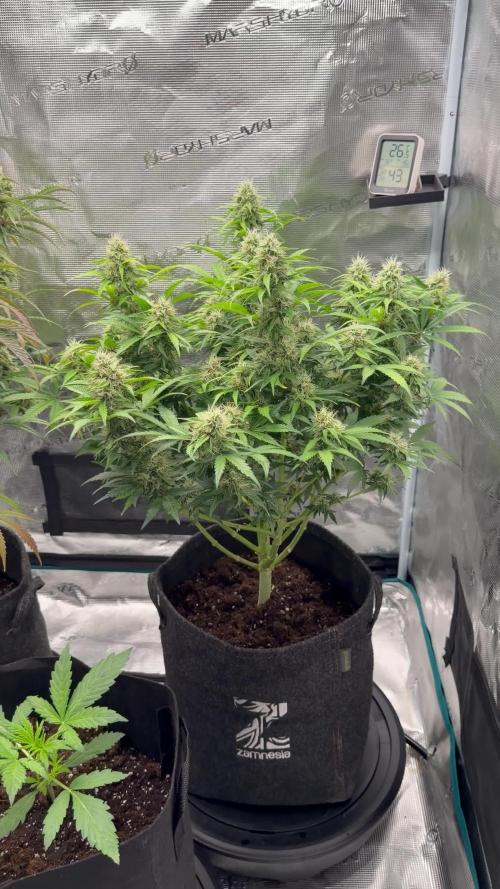
Grow Diary Update – Lemon Haze 🍋
So langsam geht es Richtung Ende. Am Samstag oder Sonntag werde ich die linke von den beiden Pflanzen ernten. Die kleinere lasse ich noch etwas länger stehen, da sie bei der Bud-Entwicklung noch gut nachlegt und sicherlich noch etwas Potenzial hat.
Generell bin ich wirklich überrascht, wie stark die Buds in den letzten Wochen noch aufgebaut haben. Gerade gegen Ende haben die beiden Lemon Haze nochmal ordentlich Masse zugelegt.
Außerdem habe ich gestern schon die **Seeds für den nächsten Run bestellt: Mimosa x Orange Punch Auto von Barney’s Farm.
Davon werde ich zwei Pflanzen starten, allerdings erst, wenn die beiden Lemon komplett fertig sind und das Zelt wieder frei ist.
Die Runtz Auto lasse ich einfach nebenher weiter wachsen und schaue mal, was daraus wird.
Der Geruch der Lemon Buds ist inzwischen richtig stark geworden – sehr citrus-lastig, genau so wie man es von einer Lemon erwartet. 🍋
Happy Growing Growmies 🌱