Likes
Comments
Share
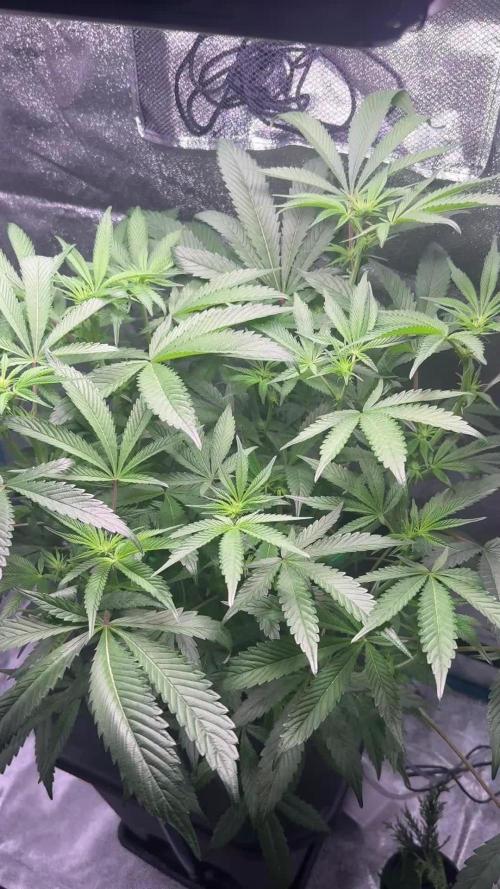
Holy shit we boomin'. I actually had to super crop (i think that's what i did) bc one red poison was getting so tall. I had to pull her to 90 degrees... she's already back reaching for the light - I'm not sure what impact this has on my grow, but I think it will be a positive one. She was going to be insanely tall if I hadn't done this.
Likes
2
Share
We become aware at such times of man's wonderful ability to bring seemingly unrelated elements into harmonic balance, and receive a glimpse into a world where everything exists in conscious sympathetic attunement to everything else. When we listen to a piece of music that seems to strike a beautiful chord somewhere inside us, or view a painting that simply glows with harmonic awareness well executed, we probably do not spare much time to contemplate the wonderfully intricate combination of vibrations that our sensors make it possible for us to perceive. We tend to appreciate the relationship between the parts of something by an awareness of the harmony or dissonance of the whole. This ability enables us to say "what a beautiful house!" instead of "analysis has proven that this collection of building materials exhibits certain elements of harmonic proportion." While this ability to instinctively appreciate the beauty of true harmony has an important role to play in evolution, a more analytical understanding of the laws involved can be most useful. This is especially so if we wish to create works of art where each part exists in true harmony, not only with the other part of that particular whole, but with the universe within which the creator and the created exist. Everything vibrates. From the most dense matter to the most subtle cosmic rays, everything which our senses allow our thoughts to become aware of, can be specified in terms of wavelength or frequency of vibration. These two terms define the same thing, but from different points of view. The following are the approximate wavelengths of various energy carriers: Cosmic rays 0.000,000,001 mm Gamma rays 0.000,000,1 mm X rays 0.000,500 mm Ultraviolet rays 0.003 mm Visible light 0.006 mm Infrared 0.01 mm Sound waves 1 meter Radio waves 300 meters Violet light 400 nm to 450 nm Blue light 450 nm to 500 nm Green light 500 nm to 570 nm Yellow light 570 nm to 590 nm Orange light 590 nm to 610 nm Red light 610 to 700 nm 1 nanometer (nm) = 0.000,000,1 cm = 1/10,000,000 cm If a guitar string is plucked and we hear a sound, it is not too difficult for the human mind to associate this sound with the vibration of the guitar string. With color it is quite different. It is difficult for us to conceive that the color of a substance is not an inherent property of the substance itself, but an indication picked up by our senses of that substance's ability to absorb or reflect the light which happens to be shining on it at that moment. Neither the matter nor the light is colored. What happens is that the brain learns to differentiate between the frequencies reflected or transmitted by the substance the eyes are focused on. The same thing happens with sound. When we say "Oh! Listen, they're playing my favorite song," what we really mean is: "My brain has stored within it a particular pattern of frequencies. I have compared the new information being received with this stored pattern and have deduced the answer that the two patterns are similar within certain specified tolerances." The 'pleasure' involved could have something to do with our running the pre-recorded pattern at the same time, in 'sympathy' with the new pattern as it is received. The word sympathy describes very well our ability to appreciate color and sound. It also describes the reason behind certain elements of harmony. For instance, if a substance vibrating at 100 cycles per second (tone 1) is in the proximity of another substance vibrating at 200 cycles per second (tone 2), we could perceive, if we had the right equipment, a certain sympathetic relationship between the two. We will see from this that there is a uniform doubling of the first tone seen in the second. At various points along the waves, the two are the same in amplitude. At other points, they are at opposite poles to each other. This doubled frequency has more points of similarity to the original than any other frequency except the original itself. If the equipment we had available for measuring these two frequencies was a soundboard amplifier and a pair of ears, then we would hear what would sound to us like one tone. If we had the opportunity to hear one at a time, we would hear that although they sound the same, one is higher in pitch than the other. This characteristic of 'the same but different in pitch', musicians have called the octave. Any two tones produced where one has exactly doubled the frequency of the other is called an octave. Speaking in ratios, an octave would appear then as the ratio 2:1 or 1:2, depending on whether we are talking of an octave up or down. A single note produced by almost any instrument will contain more than one wavelength or frequency. It will have a dominant frequency, the wavelength of which we would call the note's 'fundamental' or 1st harmonic. It will also have a varying number of upper harmonics, gradually fading in intensity into infinity or silence. Natural harmonics always have the same pattern of intervals between them. The interval between the 1st and 2nd harmonic is a perfect octave; between the 2nd and 3rd a perfect fifth; between the 3rd and 4th a perfect 4th; and so on, the intervals becoming smaller and smaller until they lose any relationship with the western 12 tone scale as it exists at the moment. Just as an octave has certain elements of sympathy with its fundamental, so some intervals have been noted to be more perfectly in sympathy with the fundamental than others. The ratio of the 'perfect 5th' or interval of 7 semitones, as it occurs in the harmonic series, is 3:2 or 2:3, while that of the 'perfect fourth" is 4:3 or 3:4. All the tones in the western 12 tone scale can be expressed in terms of the ratio between the upper tone and its fundamental. This would seem to be an ideal way of generating a scale from any given fundamental and several attempts have been made to do this, the Pythagorean system being probably the most well known. Although when working with a single tone instrument playing on its own, the Pythagorean formula works wonderfully well, if we had several instruments tuned this way together and asked them to play almost any western music, we would find that at times they sounded quite out of tune to each other. The lack of flexibility of the various scale systems based on the harmonic series has led to what is known as the 'tempered' scale. This uses as its primary unit of interval the ratio of the octave or 2:1. It then proceeds to divide the interval between any fundamental and its upper octave into 12 smaller intervals by applying the ratio: two to the one-twelfth power, to one (21/12:1). This equals 1.059463094, so by multiplying any frequency by this number, we will obtain the tempered semitone next up from our fundamental. We will also find that any tone twelve semitones up from any other tone, in a scale generated in this way, will have exactly double the frequency. If we took the note middle C on a piano and halved the wavelength, we would have the note C one octave above. If we halved this, we would have the C above, and so on. However, within about 6 octaves, we would find that although a 'sound' was being produced, no human ear could perceive it. If we kept on going, halving and producing upper octaves of our fundamental C, we would proceed through the infrared band, into the visible light spectrum. If we happened to be outside during the day, we would, for one octave only, see the note C with our eyes. The next octave above would already be in the ultraviolet band, and outside the eye's sensitivity range. If we can think of color as being an indication of a substance's vibratory rate or wavelength, we may begin to see a relationship that could exist between the color and sound spectrums. The logical extension of what has so far been said is that there exists a scale in the color spectrum that corresponds exactly to the scale in the sound spectrum, each color tone being an octave of the equivalent note in the sound range. This is not the end of the story but only the beginning. If we can for the moment accept that any wavelength in one band has upper and lower octave stretching out to infinity, then the next question is 'fine, but what shall we use as our fundamental? A particular color? A particular sound frequency?' The musicians among us will probably say 'A 440'. This means that the note A should vibrate at 440 Hertz, or 440 times per second. They would tell us that this is standard pitch has been adopted by most orchestras around the world; pianos are tuned to it, instruments are constructed to formulas based on it, and so to them it would probably seem the most appropriate place to begin. Some of these musicians may know of the battle that is still raging with regards to this being the standard, but few would know why A = 440 Hz was chosen except that it worked when it was set to be a suitable compromise between the many different pitches in use at the time. 432 Hz is said to be mathematically consistent with the patterns of the universe. Studies reveal that 432 Hz tuning vibrates with the universe’s golden mean PHI and unifies the properties of light, time, space, matter, gravity, and magnetism with biology, the DNA code, and consciousness. When our atoms and DNA start to resonate in harmony with the spiraling pattern of nature, our sense of connection to nature is said to be magnified. Another interesting factor to consider is that the A=432 Hz tuning correlates with the color spectrum, while the A=440 Hz is off. Audiophiles have also stated that A = 432 Hz music seems to be non-local and can fill an entire room, whereas A=440 Hz can be perceived as directional or linear in sound propagation. Once you adopt the idea that sound (or vibration in general) can have an equalizing and harmonizing effect (as well as a disturbing effect), the science of harmony can be applied to bring greater harmony into one's life or tune to specific energies. There is a form of absolute and relative harmony. Absolute harmony can, for example, be determined by the tuning of an instrument. The ancients tuned their instruments at an A of 432 Hz instead of 440 Hz - and for a good reason. There are plenty of music examples on the internet that you can listen to in order to establish the difference for yourself. Attuning the instrument to 432 Hz results in a more relaxing sound, while 440 Hz slightly tenses up the body. This is because 440 Hz is out of tune with both macro and micro cosmos. On the contrary, 432 Hz is in tune. To give an example of how this is manifested microcosmically: our breath (0,3 Hz) and our pulse (1,2 Hz) relate to the frequency of the lower octave of an A of 432 Hz (108 Hz) as 1:360 and 1:90. It is interesting to note that 432 Hz was the standard pitch of many old instruments and that it was only recently (19th and 20th century) the standard pitch was increased. This was done in order to be able to play for bigger audiences. Bigger audiences (more bodies) absorb more of the lower frequencies, so the higher pitch was more likely to “cut through”. One of the oldest instruments of the world is the bell ensemble of Yi Zeng (dated 423 BC), tuned to a standard F4 of 345 Hz, which gives an A= 432 Hz. The frequency of 345 Hz is that of the platonic year! Similarly, many old organs are tuned in A=432 as well; for example, St. Peter’s Capella Gregoriana, St. Peter’s Capella Giulia, S. Maria Maggiore in Rome. Maria Renold’s book “Intervals Scales Tones and the Concert Pitch C=128 Hz” claims conclusive evidence that 440 Hz and raising concert pitch above scientific “C” Prime=128 Hz (Concert A=432 Hz) disassociates the connection of consciousness to the body and creates anti-social conditions in humanity. The difference between concert pitch A=440 Hz and Concert A=432 Hz is only 8 cycles per second, but it is a perceptible difference of awareness in the human consciousness experience of the dream we share called existence.
Likes
1
Share
@Bdog7878
Follow
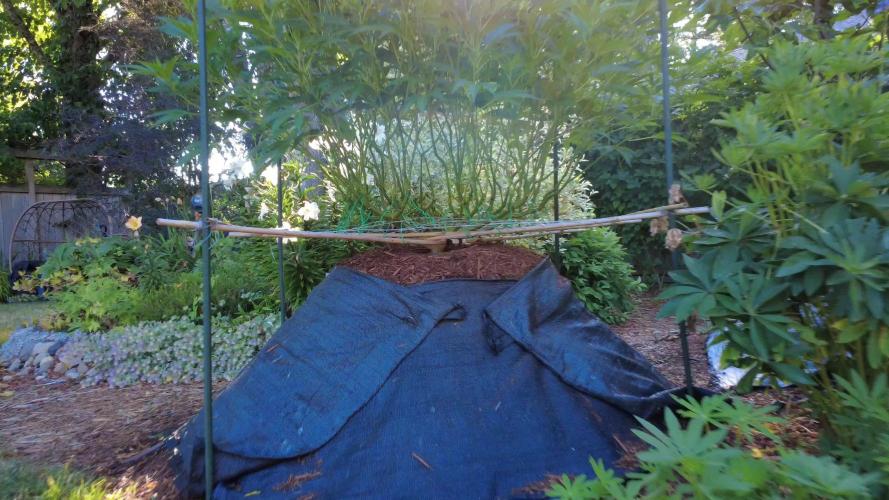
The stretch is on they are growing super fast right now and feeding heavy. Been feeding every 5 days giving recharge once a week and they drinking two gallons a day now in this hot heat. I did a small amount of trimming im a little late with it i usually do it earlier but been super busy. I had a few split branches from a storm other day but I bandaged it up and didn't loose anything never skipped a beat. Im working on getting some support going on if they breaking now they dont have heavy buds yet.
Likes
25
Share
The purple Lemonade despite a very beautiful structure is a little worrying us because the flowers are swelling very slowly. We are afraid that they will remain small but it seems they are getting bigger so we wait a little longer to express ourselves even if the painta seems in excellent health. Bloom is slow.
Likes
3
Share
So nothing has been done to these plants except a few toppings on all the branches so right now there should be like eight main colas and that's good enough for me I found one male out of the eight regular seeds from devil dog genetics. It was juicehead78 pheno number 1. So down to 11 plants. They're definitely in need of transplanting but I've been so busy with work and I also need to get more pro mix so hopefully this weekend I will be transplanting into 3 gallon pots. Amended with a 50/50 ratio of Gaia Green's All Purpose and power bloom. After transplanting I'm going to give them a week or more to chill and grow a bit more, then flip them. If they will still be needing another feeding in flower...I'm just going to top dress with a 80/20 ratio of power Bloom and all purpose. Thanks for checking in y'all!! I'll be seeing you all next week!! Peace, love and growth!!
Likes
17
Share
Growing great. been adding calmag to the mix and she bounced back. Still a little yellow but the buds are growing nicely. Great trichome production To the touch it smells SO much like blueberries Im blown away and theres still more maturing to do! Excited to see how much more she fills out.
Likes
55
Share
@w33dhawk
Follow
09.03.21 die Ladys machen sich gut und erholen sich schnell von dem ganzen entlauben. Mal schauen was diese Woche noch so mit sich bringt bald geht es in die blüte (so ca 2 Wochen noch). Bin Echt froh das ich bis jetzt noch keine gravierenden Fehler gemacht habe zumindest habe ich noch keine bemerkt bis auf den bei der keimung war nix besonderes los bin echt zufrieden mit der Genetik von Growers choice danke schon mal an euch
Likes
16
Share
I was expecting a slower plant, but the yellow pisils proving I was wrong. I added Canna Flush to the mix and from this point I will monitoring daily the trichomes.
Processing
Likes
6
Share
10/6: She's doubling in size every day now, so.. me thinks she'll be a real specimen. 10/7: She continues to impress! I installed my new AC Infinity 6" fan in the attic and hooked up a 16" carbon filter today. I used some sound deadening foam on the rafter that I mounted it to and removed 100% of the vibration. I haven't programmed the thermo/hygro stuff yet, but tested it on high and I can't hear a thing anywhere in the structure.👍 I'm also purchasing a dual 120mm fan system from AC Infinity in the door, behind the grille I already installed to serve as fresh air intake. It also has a thermostat feature that will allow me to set it to only come on when the temps are too high, so I'm optimistic that it will allow me to manage the temperatures in this closet with about 1000w running for 18-20 hours a day.🙏 I moved the 200w 3500k+660nm to the top section today and lowered my QB frame to 32" above the plants. I have two pairs of them running now(480w), and received the replacement HLG 240-48A driver today for the third pair. I'll hook it up later..dont need it now.. 10/8: I fed her today for the first time...about 16 oz of solution containing grow big, big bloom, kelp me kelp you, boomerang, and armor si. I hooked up the 3rd pair of qb's today....wow that's bright....she's gonna love it!😎 10/9: She experienced her first night time today...4 hours, from midnight to 4am..at approx 72f and 50% RH. 10/10: I sprayed her with Axiom today and gave her a few ounces of spring water. 10/11: I sprayed her with Boom Boom spray right before dark and also started brewing some compost tea today. 10/12: I just gave her a little spring water today because she's getting douched with compost tea tomorrow. I wish I had some additional blue light to dose her with to get her branching better, but she's doing okay I guess. Since I've overplanted the space, I'm not gonna have much elbow room for her anyway.
Likes
3
Share
@zenderman
Follow
27/3/26.day 50 from germ.beginning week 8. watered with 2l water with 4ml calmag xtra. 28/3 2ml Bud Candy. this strain is fantastic and unbelievably fast . 1/4/26.lollipop"
Likes
10
Share
@Shefman93
Follow
Defoliated and lollipop the bottom of the plant at the end of week 2. Plant seems healthy, did an early top dress of 80% bloom 20% veg and I have began using the tribus bloom microbes inoculant at every watering. I will also be making banana peel tea to feed a boost this week.
Likes
24
Share
@AsNoriu
Follow
Day 29. Girl is going , a bit slower than Ice, i was hoping Chocolopez will be same big runner, still very nice plant is forming. Mars TS1000 - Light is solid and does job. For last week output is on max . Still rotate a lot, but am happy with development. I miss more good wind inside, but i live in shared house ;)))))))))))) even really silent air system is still loud on desired speeds ... Hope next week ill send her to flower. Will top up with Worm Castings and Mycorrhizae during training in few days, when girls will be watered next time. Rhythm is good, every 3 days pots are light. 1.5 liters to each went straight in after photo shoot. Day 31. Applied BioBizz Leaf Coat when lights went off. Loads of training was made today too. Day 32. Now girls are trained daily. Top shoot twisting, leaf tucking, rotation around axis , changing positions inside of tent and so on. Always wash hands before any training, it is a must. Still havent made mind, scrog or lst ... Think tomorrow will be watering day and i have to decide which way to go , i am fliping them at next watering 100%, otherwise again rush to harvest before late spring holidays ... Happy Growing !!!
Likes
6
Share
@TyRun
Follow
Two weeks have passed since the flip. Plants haven’t started flowering yet, but they’ve already shown their sex. The height distribution turned out quite interesting, almost like it was planned. Weekly growth: #4 – 55 cm – getting pretty close to the light already #3 – 24 cm – perfect size for my box, exactly what I wanted #6 – 7 cm – solid progress compared to last week Overall everything is stable. I’m doing light defoliation, removing 2–3 leaves per day where they block light from growth tips. I’m not going for heavy defoliation — after reading and watching a lot, I’d rather keep the leaves. There’s also an opinion that around week 3 you shouldn’t remove too much anyway, and in general aggressive leaf stripping isn’t a great idea, partly because of mold risks. Why mold? Because external humidity isn’t as important as internal humidity inside the buds. The plant constantly releases moisture through transpiration all the way until harvest. If you remove most of the leaves, where does that moisture go? Exactly — into what’s left: buds and small inner leaves. That can create near 100% humidity inside dense flowers. You can drop RH in the room all you want, but inside the buds conditions for mold can still be ideal. Add a strong day/night temperature swing reaching the dew point, and it becomes a perfect environment for mold. So I’ll keep most of the leaves, just thinning enough to improve light penetration both from the top and bottom, without going overboard. Gradual defoliation also causes less stress compared to doing a heavy lollipop in one go. This isn’t a commercial farm with 1000 plants — we can afford to be precise and take off a few leaves every couple of days. Nothing more to report for now. Plants are still stretching — expecting the first “buttons” any day now.
Likes
8
Share
@Artyparty
Follow
This week I added CO2 to the garden. My pH in the DWC dipped to 4.6 which was scary. I knew something was wrong bc usually I'm adding water every 36 hours and it was still alot left. I adjusted it to 6.1 and hopefully she recovers...I must say the dwc is so sensitive compared to soil..good grief. During week 4 they only got hit with nutes once then water throughout the rest of week. Update: I decided to drain the dwc and just put in 1gal of water at 5.8 pH. I'm being extra cautious since it's up in the air if the issue is light burn or nutrient deficiencies. Update: Two days before the end of week 5. The purple punch is doing great so far..glad I took cuts. Ice cream cake is absorbing nutrients but the pH is still dipping to the 4s almost every 6 to 8 hrs. I'm just going to keep adjusting the pH and keep her rolling.
Likes
9
Share
Que pasa familia, estamos actualizando la primera semana de floración de estas Kritical de GrowBarato. Cómo podéis apreciar en las imágenes el color que tienen es espectacular y con esa vegetación y vigorosidad pintan de miedo. Además siendo tan rápidas , de 57/63 días, las tendremos listas como quien dice en un abrir y cerrar de ojos. Agrobeta: https://www.agrobeta.com/agrobetatiendaonline/36-abonos-canamo Mars hydro: Code discount: EL420 https://www.mars-hydro.com/ Las maximas de temperatura no superan los 26 grados y las mínimas no bajan 19, así que no me puedo quejar. Los niveles de humedad también son los correctos van entre 50%/60%de humedad relativa. Por supuesto el Ph lo estamos dejando alrededor de 6. Hasta aquí es todo poco más la verdad, solo deciros que buenos humos 💨💨💨y nos vemos el finde en SPANNABIS.
Likes
1
Share
@undermink
Follow
Her buds are all purple by now. Just lovely. Can't wait to try her... Hope she tastes just as she smells... awesome. I love all the diffenrent colors.
Likes
24
Share
Estoy super satisfecho con los resultados,se la recomiendo al 200% esta maravillosa variedad de Kannabiaseeds 🙏😍