Likes
8
Share
@mikearon
Follow
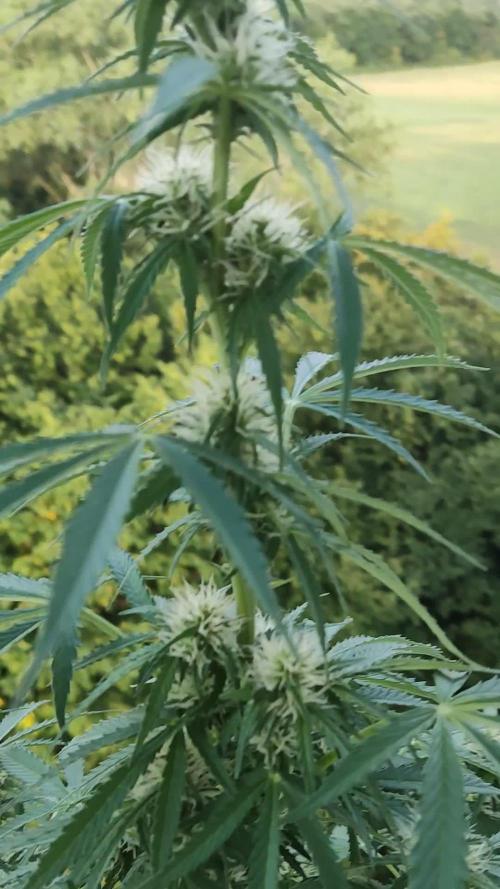
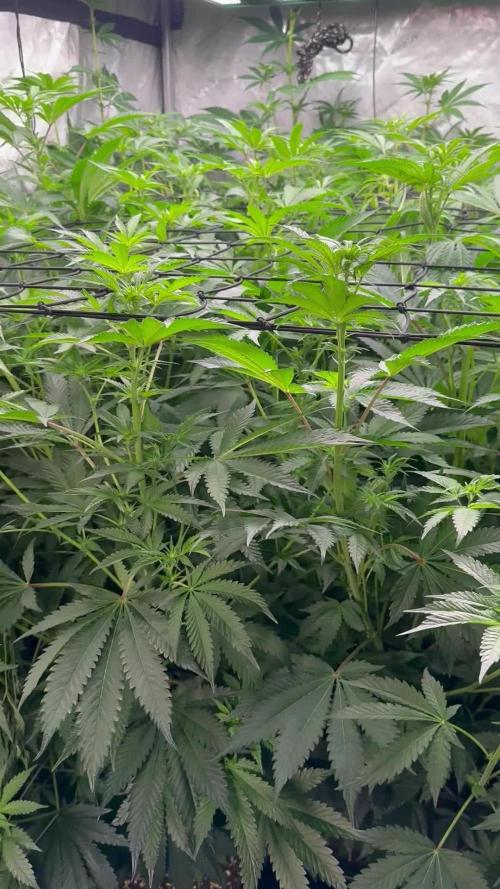
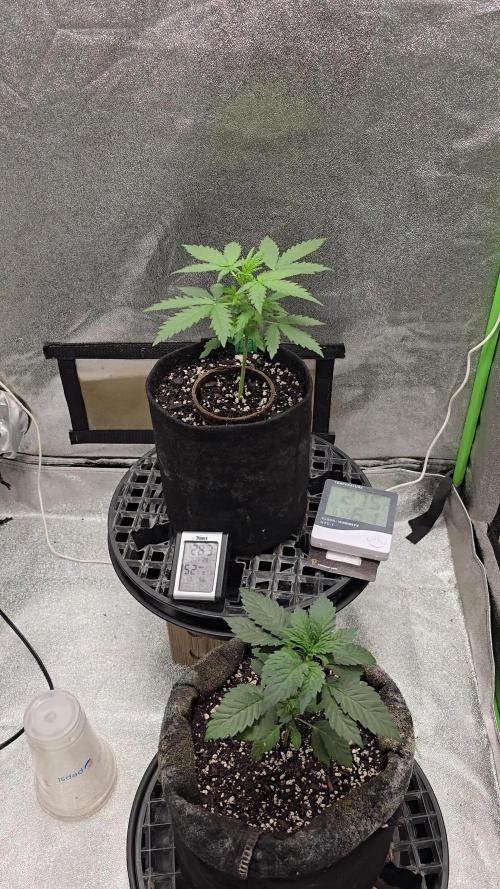
June 14th - Day 118 : Heavy defoliation today as I can’t lower my humidity and tried everything from cleaning to lowering the humid in the lung room... But I mean...!!! Looooooks at theses beautiesssss
Likes
27
Share
Performed the "back building" technique this week to help bulk up the top cola. Watering the soil when dry, and defoliating the dry-dying fan leaves.
Likes
72
Share
Quite a week!! I did a light defoliation on day 30... I just did a heavy defoliation again on day 36.... I hope they handle this well!! I watered them on day 31 & 33... I I fed them a half dose of all 3 nutrients on day 35... They are starting to stink!! The Cloudline T6 works great!! I also LST'ed them on day 30... they seem to be opening up pretty good... even though I was really late applying the LST.... still learning!! Alana is 16" tall and Anna is 20" tall... Alana grew 6" this week!!! Incredible! I've been battling some humidity lately... it's been in the low 60's for the most part... that's part of the reason I so heavily defoliated today! Otherwise, this grow is going really well!! You'll notice I moved them into the flowering 4X4 tent... I needed to make room in the veg tent.... I germinated 2 Seedsman Strawberry Cheesecake Auto seeds and I'll start their diary tomorrow! Cheers!!
Likes
24
Share
Then it was time to top them. It was interesting to observe how differently all four girls reacted to the loss of the main cola. Yes and then I gradually started to bring her down. But again, completely different reactions. Every time before I stressed them, they fed Boom Boom Spray beforehand. Super addition.
Likes
3
Share
Girls are coming along well transplanted set 1&2... seem to be loving it....we getting there
Likes
Comments
Share
Likes
20
Share
STRAWBERRY PIE AUTOFLOWER (FASTBUDS) SOLO CUP GROW WEEK 10 She is nearing the end. Trichomes are mostly cloudy with some amber here and there. Likely give her another day or two before the chop.
Likes
2
Share
Topped them and let them and grow for 1-2 weeks before switch to 12/12. I just want to test the Taste. And if i like it, i make some bigger GG4.
Likes
2
Share
Hey huerteros pues asi va esta sativa dream que hoy hace su dia 46... y nos veas como esta desarollando! Seguimos aplicando LST ... para ir abriendo la planta y haciendo una buena estructura para cuando llegue la fase de floración!! De momento solo regamos con agua y cada 10-15 dias añadimos microbes! El sustrato es All mix de biobizz y ya viene prefertilizado asi que por nutrientes no sera y la planta asi lo demuestro con ese verde tan vivo! Esperemos que todo siga igual... iremos subiendo contenido asiduamente todas las semanas! Saludos desde el sur 🇪🇸
Likes
Comments
Share
Likes
3
Share
@Cysolja
Follow
Buds are fattening like crazy this week, begun lowering nitrogen to allow concentration on the buds to get as fat as possible
Likes
45
Share
My homework. Rubisco regeneration is intrinsically linked to nitrogen supply because Rubisco is a major sink for nitrogen in plants, typically accounting for 15% to over 25% of total leaf nitrogen. The regeneration phase itself consumes nitrogen through the synthesis of the Rubisco enzyme and associated proteins (like Rubisco activase), and overall nitrogen status heavily influences the efficiency of RuBP regeneration.Structural Component: Nitrogen is an essential building block for all proteins, and the sheer abundance of the Rubisco protein makes it the single largest storage of nitrogen in the leaf. Synthesis and Activity: Adequate nitrogen supply is crucial for the synthesis and maintenance of sufficient Rubisco enzyme and Rubisco activase (Rca), the regulatory protein responsible for maintaining Rubisco's active state. Nitrogen deficiency leads to a decrease in the content and activity of both Rubisco and Rca, which in turn limits the maximum carboxylation rate, Vmax, and the rate of RuBP regeneration Jmax, thus reducing overall photosynthetic capacity. Nitrogen Storage and Remobilization: Rubisco can act as a temporary nitrogen storage protein, which is degraded to remobilize nitrogen to other growing parts of the plant, especially under conditions of nitrogen deficiency or senescence. Nitrogen Use Efficiency (NUE): The allocation of nitrogen to Rubisco is a key determinant of a plant's photosynthetic nitrogen use efficiency (PNUE). In high-nitrogen conditions, plants may accumulate a surplus of Rubisco, which may not be fully activated, leading to a lower PNUE. Optimizing the amount and activity of Rubisco relative to nitrogen availability is a target for improving crop NUE. Photorespiration and Nitrogen Metabolism: Nitrogen metabolism is also linked to the photorespiration pathway (which competes with carboxylation at the Rubisco active site), particularly in the reassimilation of ammonia released during the process. To increase RuBisCO regeneration, which refers to the process of forming the CO2 acceptor molecule Ribulose-1,5-bisphosphate (RuBP) during photosynthesis, the primary methods involve optimizing the levels and activity of Rubisco activase (Rca) and enhancing the performance of other Calvin-Benson-Bassham (CBB) cycle enzymes. Biochemical and Environmental Approaches: Optimize Rubisco Activase (Rca) activity: Rca is a crucial chaperone protein that removes inhibitory sugar phosphates, such as CA1P (2-carboxy-D-arabinitol 1-phosphate), from the Rubisco active site, thus maintaining its catalytic competence. •Ensure optimal light conditions: Rca is light-activated via the chloroplast's redox status. Adequate light intensity ensures Rca can effectively maintain Rubisco in its active, carbamylated state. •Maintain optimal temperature: Rca is highly temperature-sensitive and can become unstable at moderately high temperatures (e.g., above 35°C/95F° in many C3 plants), which decreases its ability to activate Rubisco. Maintaining temperatures within the optimal range for a specific plant species is important. •Optimize Mg2+ concentration: Mg2+ is a key cofactor for both Rubisco carbamylation and Rca activity. In the light, Mg2+ concentration in the chloroplast stroma increases, promoting activation. •Manage ATP/ADP ratio: Rca activity depends on ATP hydrolysis and is inhibited by ADP. Conditions that maintain a high ATP/ADP ratio in the chloroplast stroma favor Rca activity. Enhance Calvin-Benson-Bassham (CBB) cycle enzyme activity: The overall rate of RuBP regeneration can be limited by other enzymes in the cycle. •Increase SBPase activity: Sedoheptulose-1,7-bisphosphatase (SBPase) is a key regulatory enzyme in the regeneration pathway, and increasing its activity can enhance RuBP regeneration and overall photosynthesis. •Optimize other enzymes: Overexpression of other CBB cycle enzymes such as fructose-1,6-bisphosphate aldolase (FBA) and triose phosphate isomerase (TPI) can also help to balance the metabolic flux and improve RuBP regeneration capacity. Magnesium ions, Mg2+, are specifically required for Rubisco activation because the cation plays a critical structural and chemical role in forming the active site: A specific lysine residue in the active site must be carbamylated by a CO2 molecule to activate the enzyme. The resulting negatively charged carbamyl group then facilitates the binding of the positively charged Mg2+ion. While other divalent metal ions like Mn2+ can bind to Rubisco, they alter the enzyme's substrate specificity and lead to dramatically lower activity or a higher rate of the non-productive oxygenation reaction compared to Mg2+, making them biologically unfavorable in the context of efficient carbon fixation. The concentration of Mg2+ in the chloroplast stroma naturally increases in the light due to ion potential balancing during ATP synthesis, providing a physiological mechanism to ensure the enzyme is activated when photosynthesis is possible. At the center of the porphyrin ring, nestled within its nitrogen atoms, is a Magnesium ion (Mg2+). This magnesium ion is crucial for the function of chlorophyll, and without it, the pigment cannot effectively capture and transfer light energy. Mg acts as a cofactor: Mg2+ binds to Rubisco after an activator CO2 molecule, forming a catalytically competent complex (Enzyme-CO2-Mg2+). High light + CO2) increases demand: Under high light (60 DLI is a very high intensity, potentially saturating) and high CO2, the plant's capacity for photosynthesis is high, and thus the demand for activated Rubisco and the necessary Mg2+ cofactor increases. Mg deficiency becomes limiting: If Mg2+ is deficient under these conditions, the higher levels of Rubisco and Rubisco activase produced cannot be fully activated, leading to lower photosynthetic rates and potential photo-oxidative damage. Optimal range: Studies show that adequate Mg2+ application can enhance Rubisco activation and stabilize net photosynthetic rates under stress conditions, but the required concentration is specific to the experimental setup. Monitoring is key: The most effective approach in a controlled environment is to monitor the plant's physiological responses e.g., leaf Mg2+ concentration, photosynthetic rate, Rubisco activation state, and adjust the nutrient solution/fertilizer to maintain adequate levels, rather than supplementing a fixed "extra" amount. In practice, this means ensuring that Mg2+ is not a limiting factor in the plant's standard nutrient solution when pushing the limits with high light and CO2. Applying Mg2+ through foliar spray is beneficial to Rubisco regeneration, particularly in alleviating the negative effects of magnesium (Mg) deficiency and high-temperature stress (HTS). While Mg can be leached from soil, within the plant it is considered a mobile nutrient, particularly in the phloem. Foliar-applied Mg is quickly absorbed by the leaves and can be translocate to other plant parts, including new growth and sink organs. Foliar application of: NATURES VERY OWN MgSO4 @ 15.0g L-1 in a spray bottle. Foliar sprays are often recommended as a rapid rescue measure for existing deficiencies or as a supplement during critical growth stages, when demand for Mg is high. Application in the early morning or late evening can improve absorption and prevent leaf burn. The starting point [of creativity] is curiosity: pondering why the default exists in the first place. We’re driven to question defaults when we experience vuja de, the opposite of déjà vu. Déjà vu occurs when we encounter something new, but it feels as if we’ve seen it before. Vuja de is the reverse—we face something familiar, but we see it with a fresh perspective that enables us to gain new insights into old problems.
Likes
13
Share
Finally at the end of another grow, unfortunately it's the worst grow I've done!!! My heart just wasn't in this grow! It started out well until the flowering stage. Which was right around Christmas, super busy with other things, not maintaining them every day. Leaving them days at a time 4 to5 days before checking ph & ec! So they were constantly rising to high levels, went away a few days & had a watering line come loose flooding the tent & draining the reservoir so they had no water or nutrients for days. Pure laziness!
Likes
14
Share
@Wenz004
Follow
NL topped will be a monster...did not defoliate yet...lost one of the 4 main colas (broken) but seems to get extremely bushy anyway...nutrients mainly from TA as shown above NL untopped (coco with aptus) seems to be extremely healthy and develops monster leaves...yesterday removed appr 10 leaves for more ventilation. For untopped didnt change the nutriens yet...still this Aptus all in one 1 ml/l Aptus regulartor 3 drops/l Aptus start booster 4 drops/l Aptus callmag booster 1 ml/l I have to water with the nutrients everyday, 2 litre...each plant...keeping the ec low at 1,2 - 1,3...means the basic water should not have more than 0,3 better 0,2...means I have to use destilled water partially Next week will be some in nutrients...blooming is coming especially the topped NL...untopped maybe later...
Likes
36
Share
@GYOweed
Follow
One pheno smells like straight up slurricane i grew from clones so im sure not a mixed up seed lol One pheno has not much scent and probably leans bubba kush. I have no idea where this sweet candy berry pheno is coming from...probably wedding cake. I hope to get some damn cheese from the 3rd one that i saved but didnt make the flower room cut. Size and trichomes for week 3 is satisfactory given i did a heavy defoliaton at flip, and these are only 10L/3 gallon grow bags sharing a 200w light. Tried to stop stretch with cytokinins and kelp but i may have to raise the lights?
Likes
5
Share
Week 6 / flowering Everything is looking good so far. The plants are stacking weight nicely and there are no major nutrient lockout issues at the moment. The next couple of weeks will be all about keeping things balanced and not pushing them too hard before flush week.There was a minor heat-stress burn during a temperature spike, but it’s under control now. The purple colors from the genetics are starting to come through on some phenos, which is great to see. Repotting : 23/04/2026 12/12 swtich:15/05/2026 Middle: Strawberry Lemonade 16-20l x2 Background : Amnesia Lemon :11l x2 Front : Cherry Mc Muffin 7l / Oreoz : 11l Topping : 01/05/2026 Light : 50-60cm / 100% dimmer 24-26 degrees / 30-40 % hygro 22-24 degrees Watering is light at this stage — around 1l5;2,5l;3l depend pot size ( 1. watering humic ; 2. if plants show excess signs(1) if not, 3. watering with fertilizers flower )700-1000 ppm calmag 1/2 watering