


Likes
Comments
Share


@BB_US
Follow
These ladies are solid and filled with tons of orange hairs. The smell is like no other of citrus and fresh cut wood. One week then I am going to flush her.

Likes
14
Share


@Patillac31
Follow
Made it 67 days before the chop.
•••03/21/2020 After a 6 day hang I've trimmed and started to jar cure. Had a total flower weight of 85 grams. Over all I'm pleased. Will update with a smoke report in about 3 weeks.

Likes
2
Share

@Oldwied
Follow
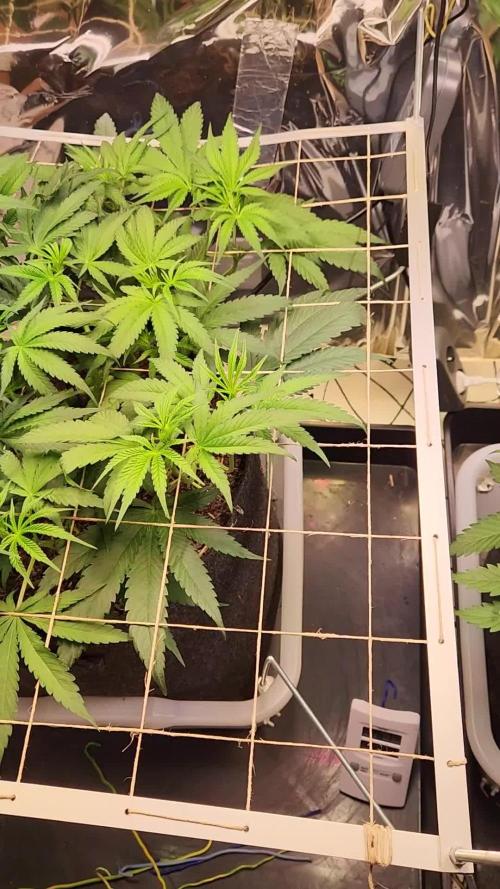
First week of flowering.
The big stretch has started.
The SCrOG screen is in place.
Every two days, the shoots are pushed under the net.
I added 60mL LAB (lacto acid bacteria, diy with rice water and milk) üer liter of irrigation water
Light Power: 70%
Day 56
Flower day 6
Photoshooting
Likes
38
Share


@Crownlaura
Follow
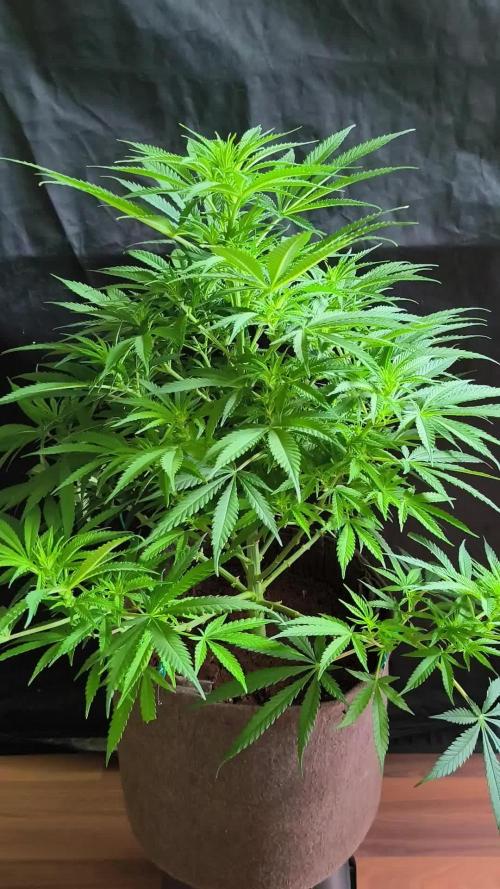
11 weeks / 77 days old today.
They’ve definitely fattened up more this week. We got to a point where we were 50% amber pistils but then both plants sprouted a load of new ones so hoping for another week of bulking up! We have a few more milky looking trichomes too. I’m hoping they’ll be partially done in the next couple of weeks.
Inspected all the buds and I’m pretty sure I’m gonna have to harvest in 2 or 3 steps and give the lower buds a bit more time to ripen up.
I don’t know what I’ve done to piss her off so much but purple skunk is now covered in brown spots on quite a lot of leaves. I dosed her up with some calmag and since then I’ve switched to water only. I’ve noticed she’s slowed down drinking isn’t taking as much as sticky orange now.
Chopped more yellowing leaves from around the bottom. Hoping this is another sign they’re coming towards the end.
My patience got the better of me this week and I chopped a little bud off sticky orange to try. I haven’t smoked for months and even though they’re not there yet it almost sent me straight to sleep. So very excited to try the finished product!
See you in week 12!



Likes
9
Share


@GERGrowDesigns
Follow
Welcome to Flower Week 3-4 of Divine Seeds Auto Fractal
I'm excited to share my grow journey with you all as part of the Divine Seeds Autoflowering Competition 2025. It's going to be an incredible ride, full of learning, growing, and connecting with fellow growers from all around the world!
For this competition, I’ve chosen the Feminized Automatic strain: Auto Fractal
Here’s what I’m working with:
• 🌱 Tent: 120x60x80
• 🧑🌾 Breeder Company: Divine Seeds
• 💧 Humidity Range: 50
• ⏳ Flowering Time: 60 Days
• Strain Info: 23%THC
• 🌡️ Temperature: 26
• 🍵 Pot Size: 0.5l
• Nutrient Brand: Narcos
• ⚡ Lights : 200W x 2
A huge thank you to Divine Seeds for allowing me to be a part of this amazing competition and Sponsoring the Strains. Big thanks for supporting the grower community worldwide! Your genetics and passion speak for themselves!
I would truly appreciate every bit of feedback, help, questions, or discussions – and of course, your likes and interactions mean the world to me as I try to stand out in this exciting competition!
Let’s grow together – and don’t forget to stop by again to see the latest updates!
Happy growing!
Stay lifted and stay curious!
Peace & Buds!


Likes
37
Share


@Ruediger
Follow
Tag 89 - heute wahrscheinlich das letzte Mal 1,2l gegossen.
Die Trichome schauen langsam schön milchig aus.
Jetzt heißt es regelmäßig nachschauen und Kontrollieren.
Leider ist die Luftfeuchtigkeit immernoch um die 65%

Likes
3
Share

@Greybeardbud
Follow
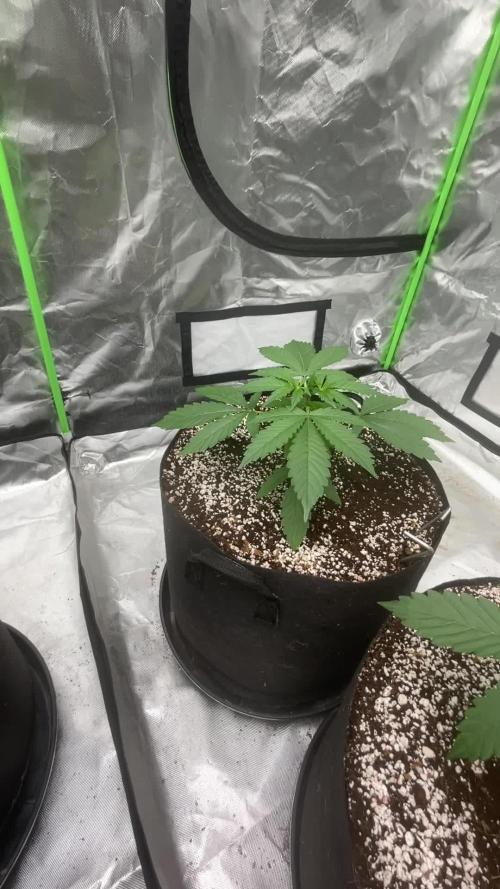
The girls are just running on autopilot the past week. Have done nothing but give them a feed every 2 days, now increased to 5L ~1.81 ec 10-20% runoff, lights 24/0 50% veg channel only. lights fixed 1.5m from top of pot so still plenty of room to grow. They all look really healthy. 2 typical phenos here, 2 @ 16cm, 1 @ 14cm, then the other 3 are 20, 21, 22cm. Expecting to see 3 tall stretchy plants and 3 compact at the end will be introducing 15% bloom channel today to start the full spectrum and preparing them for bloom when it happens. I am not expecting to see pistils for another 1-2 weeks because of the pot size it will take a bit longer for the roots to hit the edges
Week 3 day 2 update: well I was wrong. Noticed tonite we have pre flowers forming, I guess in a few days we will have pistils. Have kept veg at 55% and increased bloom to 25%. Once pistils have started to emerge will transition canna bloom into the mix

Likes
45
Share


@Bud_Spencer
Follow
Hi Grower!
Day 101 Complete
Flower 57
Wow shit the time goes fast now!! Yesterday was the last day with nutrients!!! She looks bombastic and im sure this is a top smoke!! I think she have the last 7-10 days
follow me on Instagram for the best Shoots of all my Strains: bud_spencer_of_herbs
Grown under Spiderfarmer SF-2000
When you want to grow with the same professional Equipment then Checkout this Link
https://www.spider-farmer.com/?ref=budspencer
Discount Code: Budspencer420

Likes
52
Share


@Ultraviolet
Follow
Once again she passes my expectations, late to the show with trichome production. I'm surprised there is purple on the bud, maybe Purpinator does work. I thought I could see hints under the grow lights and thought my eyes were deceiving me, I was just being hopeful. But nah 2 of the 3(under the UV) have developed a beautiful tone of purple. I was never going to bother with a deep freeze but maybe the whole bud will change given conditions, that would be something, fingers crossed. 🤔 was a little skeptical that reducing temps humidity would change density, but it does, buds are solid something I've not been able to achieve before.
Rule of thumb is never to surpass 60% RH in the flowering phase and try to progressively reduce it down to 40% in the last 2–3 weeks before harvest. The plant will react as it seeks to protect its flowers, responding by producing denser buds and a higher concentration of resin. Cannabis plants are sensitive to sudden temperature changes, especially in the flowering stage. Extreme heat or cold can impact bud density and overall yields. In nature as a defense mechanism from cold, the plant sensing sudden dips in temperature will attempt to remove the pockets of air within the bud, it achieves this by compacting itself in doing so to better protect itself from cold snaps which are normally indicators in nature that worse weather is on the way.
Terpene levels are the highest just before the sun comes out. Ideally, you want as many terpenes present in your plants as possible when you harvest. Cannabis plants soak up the sun during the day and produce resin and other goodies at night. The plant is at its emptiest from "harvest undesirables" so to speak right before the lights on. Boiling cannabis roots during harvesting slows down the drying process. When you boil cannabis roots, it shocks the plant, closing the stomata on the leaves. This prevents massive moisture loss through the leaves, leaving only the floral clusters actively losing moisture at a reduced pace. I've always run a strict 60/60 and it took almost twice as long to dry to a snap than previous grows where I didn't boil for what it's worth.
Chlorophyll is good for the plant but not for you. When you harvest the buds, even after you flush them, if you flush them, they’re still filled with chlorophyll. Freshly cut buds are greener than dried buds because they still contain loads of chlorophyll. However, when rushed through the drying process, the buds dry but retain some chlorophyll, and when you smoke it, you will taste it. Chlorophyll-filled buds are smokable, but they aren’t clean. Slow drying gives the buds enough time and favorable conditions to lose the chlorophyll and sugars, giving you a smoother smoke. How the plant disposes of the chlorophyll and sugars by a process of chemically breaking them down and attaching the decomposed matter once small enough to water molecules which then evaporate back into the ether. Time must be given to the process to break down the chlorophyll and sugars. Think of it like optimizing the environment for decay.
All the nutrients it could ever need are in abundance, it eats nutrients based on its demand for growth, which is dictated primarily by available light.
Plant growth and geographic distribution (where the plant can grow) are greatly affected by the environment. If any environmental factor is less than ideal, it limits a plant's growth and/or distribution. For example, only plants adapted to limited amounts of water can live in deserts. Either directly or indirectly, most plant problems are caused by environmental stress. In some cases, poor environmental conditions (e.g., too little water) damage a plant directly. In other cases, environmental stress weakens a plant and makes it more susceptible to disease or insect attack. Environmental factors that affect plant growth include light, temperature, water, humidity, and nutrition. It's important to understand how these factors affect plant growth and development. With a basic understanding of these factors, you may be able to manipulate plants to meet your needs, whether for increased leaf, flower, or fruit production. By recognizing the roles of these factors, you'll also be better able to diagnose plant problems caused by environmental stress.
Water and humidity
*Most growing plants contain about 90 percent water. Water plays many roles in plants. It is:*
A primary component in photosynthesis and respiration
Responsible for turgor pressure in cells (Like the air in an inflated balloon, water is responsible for the fullness and firmness of plant tissue. Turgor is needed to maintain cell shape and ensure cell growth.)
A solvent for minerals and carbohydrates moving through the plant
Responsible for cooling leaves as it evaporates from leaf tissue during transpiration
A regulator of stomatal opening and closing, thus controlling transpiration and, to some degree, photosynthesis
The source of pressure to move roots through the soil
The medium in which most biochemical reactions take place
Relative humidity is the ratio of water vapor in the air to the amount of water the air could hold at the current temperature and pressure. Warm air can hold more water vapor than cold air. Relative humidity (RH) is expressed by the following equation:
RH = water in air ÷ water air could hold (at constant temperature and pressure)
The relative humidity is given as a percent. For example, if a pound of air at 75°F could hold 4 grams of water vapor, and there are only 3 grams of water in the air, then the relative humidity (RH) is:
3 ÷ 4 = 0.75 = 75%
Water vapor moves from an area of high relative humidity to one of low relative humidity. The greater the difference in humidity, the faster water moves. This factor is important because the rate of water movement directly affects a plant's transpiration rate.
The relative humidity in the air spaces between leaf cells approaches 100 percent. When a stoma opens, water vapor inside the leaf rushes out into the surrounding air (Figure 2), and a bubble of high humidity forms around the stoma. By saturating this small area of air, the bubble reduces the difference in relative humidity between the air spaces within the leaf and the air adjacent to the leaf. As a result, transpiration slows down.
If the wind blows the humidity bubble away, however, transpiration increases. Thus, transpiration usually is at its peak on hot, dry, windy days. On the other hand, transpiration generally is quite slow when temperatures are cool, humidity is high, and there is no wind.
Hot, dry conditions generally occur during the summer, which partially explains why plants wilt quickly in the summer. If a constant supply of water is not available to be absorbed by the roots and moved to the leaves, turgor pressure is lost and leaves go limp.
Plant Nutrition
Plant nutrition often is confused with fertilization. Plant nutrition refers to a plant's need for and use of basic chemical elements. Fertilization is the term used when these materials are added to the environment around a plant. A lot must happen before a chemical element in a fertilizer can be used by a plant.
Plants need 17 elements for normal growth. Three of them--carbon, hydrogen, and oxygen--are found in air and water. The rest are found in the soil.
Six soil elements are called macronutrients because they are used in relatively large amounts by plants. They are nitrogen, potassium, magnesium, calcium, phosphorus, and sulfur.
Eight other soil elements are used in much smaller amounts and are called micronutrients or trace elements. They are iron, zinc, molybdenum, manganese, boron, copper, cobalt, and chlorine. They make up less than 1% of total but are none the less vital.
Most of the nutrients a plant needs are dissolved in water and then absorbed by its roots. In fact, 98 percent are absorbed from the soil-water solution, and only about 2 percent are actually extracted from soil particles.
Fertilizers
Fertilizers are materials containing plant nutrients that are added to the environment around a plant. Generally, they are added to the water or soil, but some can be sprayed on leaves. This method is called foliar fertilization. It should be done carefully with a dilute solution because a high fertilizer concentration can injure leaf cells. The nutrient, however, does need to pass through the thin layer of wax (cutin) on the leaf surface.
It is to be noted applying a immobile nutrient via foliar application it will remain immobile within the leaf it was absorbed through.
Fertilizers are not plant food! Plants produce their own food from water, carbon dioxide, and solar energy through photosynthesis. This food (sugars and carbohydrates) is combined with plant nutrients to produce proteins, enzymes, vitamins, and other elements essential to growth.
Nutrient absorption
Anything that reduces or stops sugar production in leaves can lower nutrient absorption. Thus, if a plant is under stress because of low light or extreme temperatures, nutrient deficiency may develop.
A plant's developmental stage or rate of growth also may affect the amount of nutrients absorbed. Many plants have a rest (dormant) period during part of the year. During this time, few nutrients are absorbed. Plants also may absorb different nutrients as flower buds begin to develop than they do during periods of rapid vegetative growth.
432 Hz is said to be mathematically consistent with the patterns of the universe. Studies reveal that 432 Hz tuning vibrates with the universe’s golden mean PHI and unifies the properties of light, time, space, matter, gravity and magnetism with biology, the DNA code and consciousness. When our atoms and DNA start to resonate in harmony with the spiraling pattern of nature, our sense of connection to nature is said to be magnified.
Another interesting factor to consider is that the A=432 Hz tuning correlates with the color spectrum while the A=440 Hz is off.
Audiophiles have also stated that A = 432 Hz music seems to be non-local and can fill an entire room, whereas A=440 Hz can be perceived as directional or linear in sound propagation.
Once you adopt the idea that sound (or vibration in general) can have an equalizing and harmonizing effect (as well as a disturbing effect), the science of harmony can be applied to bring greater harmony into ones life or a tune to specific energies. There is a form of absolute and of relative harmony. Absolute harmony can for example be determined by the tuning of an instrument. The ancients tuned their instruments at an A of 432 Hz instead of 440 Hz - and for a good reason. There are plenty of music examples on the internet that you can listen to in order to establish the difference for yourself. Attuning the instrument to 432 Hz results in a more relaxing sound, while 440 Hz slightly tenses up to body. This is because 440 Hz is out of tune with both macro and micro cosmos. On the contrary, 432 Hz is in tune. To give an example of how this is manifested micro cosmically: our breath (0,3 Hz) and our pulse (1,2 Hz) relate to the frequency of the lower octave of an A of 432 Hz (108 Hz) as 1:360 and 1:90.
It is interesting to note that 432 Hz was the standard pitch of many old instruments, and that it was only recently (19th and 20th century) the standard pitch was increased. This was done in order to be able to play for bigger audiences. Bigger audiences (more bodies) absorb more of the lower frequencies, so the higher pitch was more likely to “cut through”. One of the oldest instruments of the world is the bell ensemble of Yi Zeng (dated 423 BC), tuned to a standard F4 of 345 Hz which gives an A= 432 Hz. The frequency of 345 Hz is that of the platonic year! Similarly many old organs are tuned in an A=432 as well; for example: St. Peter’s Capella Gregoriana, St. Peter’s Capella Giulia, S. Maria Maggiore in Rome.
Maria Renold’s book “Intervals Scales Tones and the Concert Pitch C=128 Hz” claims conclusive evidence that 440 Hz and raising concert pitch above scientific “C” Prime=128 Hz (Concert A=432 Hz) disassociates the connection of consciousness to the body and creates anti-social conditions in humanity.
The difference between concert pitch A=440 Hz and Concert A=432 Hz is only 8 cycles per second, but it is a perceptible difference of awareness in the human consciousness experience of the dream we share called existence.

Likes
Comments
Share


Likes
29
Share

@El-Ecko
Follow
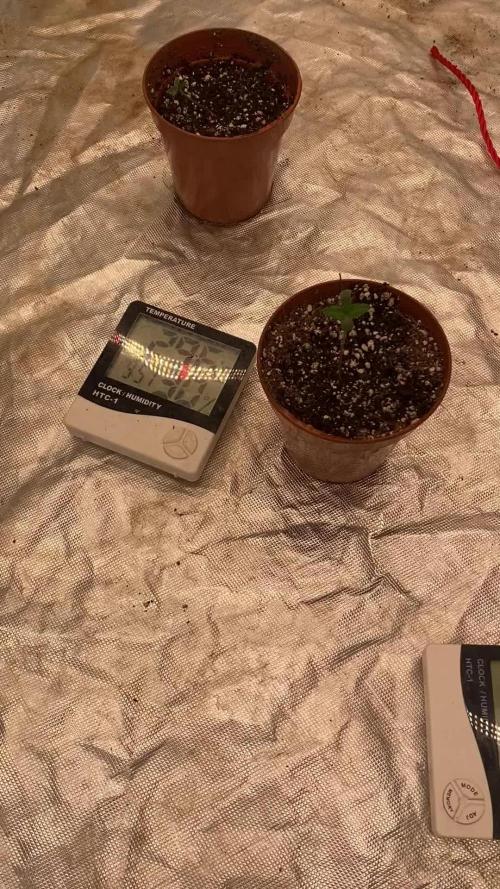
Week 11 Flowering
My vacation substitute did a great job, and when I got back from vacation today, I was surprised at how big the buds had gotten in just 5 days.♂️
The head bud seems to be getting too heavy and is already leaning a bit to the side. I’ll probably have to prop it up a bit over the next few days.😊 Most of the trichomes are still very clear.
Note: The plant is only brought into the flat for the photos. Thank you for your understanding 😉
Likes
9
Share


@Grow_N_Smoke
Follow
Super easy week, just watering the ladies when they need it. Still concerned about the humidity so I’m going to start using my dehumidifier outside of the tent. I’ll monitor the humidity each day and set my humidifier on a schedule based upon the data collected.
Soon I’ll be adding in another layer of netting to help support the branches and space them out more for better airflow and a more “sea of green” look. I usually vegetate for longer but I wanted to see if I could shorten my grow times and produce about the same results. Time will tell!

Likes
4
Share

@Canda
Follow
Tak začínáme prikrmovat opatrně skrz guano 2ml bloom a uvidime bambulatiii se to zatím pěkně, holky vypadaji zdravě ,substrat udržuje vlhky porad skrz hlistice ale zatim to vypadá na dobre cestě.. nechci to zakriknout ale 2den po nasazení hlistic .. a s novými lepovkama smutnic ubylo..at to roste a cukruje peace....
Likes
56
Share


@Ledbelieve
Follow
This week was pretty mellow. Not much done. Watered twice this week, with second watering made some compost tea I brewed up on Thursday. Plants seem very happy. Smell is getting a little stronger. Not sure I have smelled anything some grapey. Very strange doesn't even seem real...lol. Loving this grow!!!

Likes
16
Share


@Joseman656
Follow
Hello everyone nothing really to report we are getting some extreme growth and I am loving it. The girls are super happy with their environment. They look droopy because i just fully watered their pots. I gave them some molasses, calmag and kelp. Nothing mas, I think next week I will start to go 25% on the Remo lineup. That foxfarm happy frog/ocean forest mix is excellent for the lazy grower lol just water all the way until it's time to flower basically. Also big shout out to Optic, their lights have my weed growing like weeds ! I had to turn off the GMAX150 for the pics since it does emit a orange hue(due to lack of blue LEDs) but the Phatslim XL is perfect for pics.
Let me know if you have any questions or comments :)
Processing
Likes
39
Share


@DjDaveAtHome
Follow
Humboldt OGKZ Fast Flower and DinaMed CBD Plus Week 2 Veg Jan 18
The Dinamed has been transplanted into DWC from soil and is doing very well. Was going to partner it up with an HSO Amherst Sour Diesel or perhaps a Blueberry Headband. Have new genetics on the way so, I think I'll pop in an HSO OGZKZ Fast Flower!
Dinamed Plus from Dinafem Seeds (1) and OGKZ FF (1)from Humboldt Seeds.
https://www.dinafem.org/en/dinamed-cbd-plus/
https://www.humboldtseeds.net/en/fast-flowering-ogkz/
Lighting
https://www.horticulturelightinggroup.ca/products/260w-qb-v2-led-kit
DWC Nutients
https://generalhydroponics.com/floraseries
FloraGro
FloraBloom
FloraMicro
Diamond Nectar
https://generalhydroponics.com/diamond-nectar
Cal Mag
https://generalhydroponics.com/calimagic
SuperThrive
https://superthrive.com/
Epsom salts


Likes
114
Share


@Natrona
Follow
This week, my Titans are sleeping in a cooler dark room until harvest.
So for your viewing pleasure, I've loaded some videos made of the Titans during there time with me.
I'm wondering what to serve at my Queens Tea Party... I made some butterscotch pistachio bars and modified the recipe for less sugar. 😋 We experimented with topping the bars with black cherry spread, orange marmalade and a mango jelly. All are very tasty as the bit of sour/tart enhances the butterscotch sweet.
A few solar eclipse pics.

