


Likes
Comments
Share


@Holy_Guacamole
Follow
3rd week - let's goooo🤙🏽🤙🏽 decided to use HPS only and it shows the result. So now devotchka is slow in grow for 1 week. but i believe that HPS will compensate this time.
Started to add nutrients. Will use Biobizz by the end of harvest.
In total I love genetics, girl is stable, loves her new lamp. Hope all growing will not face troubles any more. Have a nice week, guy! 😊


Processing
Likes
20
Share


One of the dark devils is extremely stunted.... it's almost comical how small it is.... but she went through a lot .......it's a wonder she still alive .....some other people might have just thrown her away and started with some other seeds...... but it's kind of an experiment .....to see the extreme they're able to go through

Likes
40
Share


@Ketamine
Follow
3-25-22 Things are going great as I can tell , differences in VEG vs Flower lower humidity ,higher light intensity , less feeding volume but more frequent , and drier medium overall , and lower room temps . Feeding 1500 PPM's and like 200ml per plant every 2 hours till media gets to around 60% saturation . Thanks for stopping by :)
3-29-22 Holy Moly!! Stretching ! Hope it is slowing down , will be putting another trellis this weekend. Plants are in full on flower generation now. My Co2 controller is JUNK , it only lasted 1 year.
Likes
52
Share


@Ultraviolet
Follow
Its time to prepare for war. *Blows bagpipe*
FISH SH!T THE ORGANIC SOIL CONDITIONER (used twice before and always noticed instantly)
Fish Shit is a living product! It provides a complex Microbial profile that includes thousands of different species of bacteria, fungi, and protozoa. This profile is closer to a natural ecosystem than anything you will find on the market. Fish Shit helps release essential oils and terpenes which contribute to the building of a myriad of flavonoids. Flavanoids play a key role in the development of the most potent aromas and tasteful flavors of a plant and its fruit. Fish Shit contains beneficial microorganisms that help plants maximize nutrient uptake. It does this by transforming nutrients into more usable forms and keeping these nutrients in the soil longer. During photosynthesis plants naturally produce exudates (chemicals that are secreted through their roots). Through these exudates, plants can attract the types of good bacteria that are beneficial to them at different points in their growing cycle. These good bacteria cover the roots and act as a barrier to the invasion of disease-causing organisms that may harm the plant.
What Are Enzymes?
Before we dive headfirst into how, exactly, enzymes can benefit cannabis plants, it helps to understand a little about what these microscopic proteins do. Essentially, enzymes facilitate chemical reactions. They do so by binding with a substrate and forming or breaking molecular bonds. In this context, the substrate is the molecule upon which an enzyme acts to boost the efficiency of a reaction.
•substrate /sŭb′strāt″/
•noun
•The material or substance on which an enzyme acts. A surface on which an organism grows or is attached. An underlying layer; a substratum.
Enzymes are proteins with complex 3D shapes that feature regions called active sites. When the substrate binds to these active sites, it forms an enzyme-substrate complex that causes a chemical reaction to take place, temporarily changing the structure of the enzyme and ultimately causing molecules to either come together or break apart. As a result, molecular products are released, and the enzyme returns to its original shape.
Specific enzymes are capable of binding with certain substrates, as the substrate fits into the active site more or less via a lock-and-key principle. Although, new research suggests a more accurate theory of "induced fit", in which enzymes and substrates undergo structural changes to facilitate the reaction.
If you take the human body as an example, we have an abundance of enzymes in our saliva and digestive system. These molecules bind with substrates in these regions (food particles), working to break down the food we eat into usable parts before converting them to energy.
Enzymes in cannabis work in a similar way to the example highlighted above. Typically, enzymes occur in soil naturally, but if your soil mix is lacking organic material, or you're growing hydroponically, then adding enzymes directly to the substrate is crucial.
By using them in cannabis growing, enzymes not only help break down essential nutrients into smaller, more readily available pieces, but they also support the digestion of dead root cells, clearing a direct path for nutrients.
Overall, enzymes make it easier for your cannabis plants to absorb all the elements they need to reach their full potential. For growers, a plant that reaches its full potential means a bucketload of juicy buds come harvest. This is essential if you want to reuse a pot with old systems left over like mine.
Common plant enzymes include:
•Cellulase
•Xylanase
•Beta-glucosidase
•Hemicellulase
•Amidase
Amino acids are a crucial, yet basic unit of protein, and they contain an amino group and a carboxylic group. They play an extensive role in the gene expression process, which includes an adjustment of protein functions that facilitate messenger RNA
Nitrogen, phosphorus, and potassium are the three main pillars of nutrient solutions and fertilizers, but there are countless other nutrients that your cannabis plants need to produce the best possible harvest. Amino acids are one of them.
You may have noticed that amino acids get a lot of attention from bodybuilders and other athletes. That’s because they play a key role in the synthesis of protein, which, as you probably know, is super important for sports recovery and muscle growth. Amino acids are the building blocks of protein and the foundation of both plant and animal life.
But what do amino acids do for cannabis?
WHY IS PROTEIN IMPORTANT FOR CANNABIS?
Just like proteins are important for the human body, they are equally important for the growth and development of plants.
For example, proteins help plants:
•Facilitate the growth of intracellular plant structures
•Promote energy generation
•Stimulate metabolic processes
•Facilitate the absorption and transportation of nutrients
So, where do plants get these vital proteins from? Well, unlike humans, plants can’t source proteins or amino acids from other organisms. Instead, they need to create their own amino acids, and then use these to build protein. That's why gardeners, much like athletes, go wild for amino acid supplements.
Amino acids help plants by…
• Increasing their production of chlorophyll, which ultimately improves their ability to photosynthesize
• Serving as an easily absorbable form of nitrogen
• Stimulating the synthesis of key vitamins
• Improving their resistance to pests and diseases
• Boosting the strength of their cells
Amino acids also serve as the precursors to auxins, a group of plant hormones produced in the meristems—the apex of the stems where new leaves and stems are born.
Auxins play a key role in the plant, activating genes for plant growth and development by triggering a multitude of vital plant functions. In other words, they determine what its size and architecture will look like. Auxins influence the development of branches, flowers, and roots, and even help to regulate the photoperiod response of the plant.
Some amino acids, like cysteine, also work together with antioxidants like glutathione to help cannabis plants deal with oxidative stress, which can be caused by high-intensity lighting, some nutrient solutions, and high levels of CO₂.
Unlike humans, plants can synthesize all the amino acids they need to survive and develop properly. Unfortunately, however, amino acid synthesis is a really high-energy process, and plants may struggle to produce enough amino acids when exposed to stress.
WHAT FACTORS AFFECT A PLANT’S ABILITY TO SYNTHESISE AMINO ACIDS?
Any kind of stress can affect a plant’s ability to produce enough amino acids.
This includes:
• Drought
• Temperature extremes
• Poor soil health
• Pests
• Diseases
• Poor lighting
• Lack of space
• Poor root health
WHAT DOES ALL OF THIS MEAN FOR WEED PLANTS?
If you want to push your plants to their extreme in terms of floral growth and resin production, you should look into amino acid fertilizers. By making amino acids readily available to your plants, they’ll be able to use crucial energy to grow and bloom, rather than focusing on synthesizing amino acids themselves. Game of Inches, this is another Plants can absorb amino acids via their roots and leaves. They can also benefit from amino acids during both their vegetative and flowering phases. The fastest way for plants to absorb amino acids is via their leaves. The foliar application of amino acids is believed to improve the transportation of nutrients, increase transpiration, and boost photosynthesis. Hence, I recommend feeding your plants with foliar amino acid fertilizers. When doing so, however, carefully measure the amount of fertilizer you use, as—like with any nutrient—overfeeding can damage your plants.
FOLIAR FEED AND SOIL SOAK
• 1 crushed queen anne carrot
• Add 2 tbsp of NPK Raw powdered water-soluble cane molasses
• 20ml h2o2
• 1 crushed radish
• 0.25 tsp NPK Enzymes
• 0.25 tsp NPK Amino Acids
• 50ml coconut water ( nature's own amniotic fluid packed with amino, enzymes )
+ The sound of songbirds.
Onto the predators
1250 -Green Lacewings
Lacewings are extremely voracious predatory insects that feed on several pests. In adulthood, it feeds on pollen and nectar. In the larval stage, it feeds on aphids, thrips, and mealybugs at all stages of growth. It can also attack spider mites in moderate quantities. It is initially an aphid predator, but very effectively controls thrips and mealybugs infestations. It is so voracious that in the absence of prey, it will feed on its congeners. Lacewings are cannibalistic if there is no food available for them. It is therefore important to introduce them into an infestation situation, and not just preventively.
•congener /kŏn′jə-nər/
•noun
•A member of the same kind, class, or group.
•An organism belonging to the same taxonomic genus as another organism.
•A thing of the same kind as. or nearly allied to, another; specifically, in botany and zoology, a plant or an animal belonging to the same genus as another or to one nearly allied.
Ideal temperature 20°C – 26°C
Ideal humidity 60% – 70%
Predatory stage life cycle 21 days
Introduction rate 4 weeks
Storage Refrigerator
Use Immediately
Are there any specific instructions on how to use this predator?
Lacewings are available on small paper cards that you can hang to plant stems. On the cards are dozens of eggs ready to hatch. There are also sterile eggs they can feed on once they have hatched before they are ready to disperse in the foliage. It is important to use them quickly upon receipt to avoid cannibalism. If you don't use them right away, you can store the cards in the refrigerator for 24 to 48 hours to prevent the eggs from hatching too quickly. Avoid storing them for longer than this or you risk losing eggs. 1250 eggs are divided into 7.5 cards, 2500 eggs on 15 cards, and 5000 on 30 cards. The application rate is one card per square meter of growing surface.
Is this predator best used for preventive or curative treatments?
Lacewings are used as a curative solution.
Anything else I should know?
Lacewing eggs hatch approximately 24-72 hours after the cards are exposed to room temperature. When they emerge, the lacewings are just 1.5-2 mm long. They are very small so they are difficult to see. Once hatched, they will stay on the cards for a few hours and then disperse in the foliage. You quickly lose sight of them if you have not witnessed the hatching.
They then live in the foliage for about 3 weeks. Often, you will see them towards the end of their larval cycle. After feeding for 3 weeks, they will triple and even quadruple in size. At that point, they are easier to see. But they remain very discreet insects, it is not abnormal not to see them.
Egg carcasses left behind on the cards do not disappear after the hatching has happened. It's normal to see eggs still on the cards. Visually it is very similar before and after hatching.
Also, on the boxes, there are sterile ephestia eggs which are used to feed the lacewings once hatched. Not all lacewing eggs are viable either. Only a certain percentage of lacewing eggs will hatch. Once hatched, the eggs are white. You can observe this using a magnifying glass.
With,
5000 Stratiolaelaps Scimitus
It is used to prevent or control thrips pupae, fungus gnats larvae, and root mealybugs in the soil. It can also be used for red mites in bird farms or hen houses. The adult is about 1 mm long and is medium brown with a beige triangle on its back. Another fun fact about them is they can survive without prey. They can eat algae and plant debris. This is why they can reproduce and stay in plants for long periods.
Ideal temperature 15°C – 23°C
Predatory stage life cycle 18 days
Introduction rate 2 weeks
Storage Room temperature
Use Within one week
Are there any specific instructions on how to use this predator?
Sprinkle directly on the growing media. They can live in all types of substrates like potting soil, coconut fiber, rock wool, cedar mulch, etc. Stratiolaelaps establish easily so they are permanently fighting pests. One introduction is generally enough unless you have an infestation. In this case, introduce them at least twice at a 2-week interval for best results. If you grow your plants in a 100% mineral substrate, it will have to be released more often since there is less organic matter than in traditional soil.
Do I need to take any specific precautions?
Stratiolaelaps breed in the top layer of the soil. So it is important not to disturb them in the first days following their introduction. They don't like temperatures below 8 ° C. So be sure not to introduce them in a water-saturated or cold environment. Release them 24-48 hours after your last watering. They are very sensitive to chemical acaricides and diatomaceous earth. These methods are incompatible with their use.

Likes
19
Share


@UKLEEDSGROWER
Follow
Just harvested last night so will come back on in next couple of week to review!! No estimates on yield as yet. But the smell is definitely pungent lemon and sweet smell. Can’t wait to try the end product!!

Processing
Likes
5
Share


@Kikiwindsurf
Follow
New kikiwindsurf Grow dude !
Diary will be updated every week dont miss !!
If i can grow you can grow too ! Fuck the dealers and low quality weed now its our time!

Likes
26
Share


@All_our_small_plants
Follow
Bewässerung: 2500 ml jeden 3 Tag in der vierzehnten Woche
pH-Wert: 6.3
EC-Wert: 1,6 mS/cm
Temperatur: 28ºC
Luftfeuchtigkeit: 50%
Schädlingsbekämpfung: Wir haben seit ein paar Tagen die Nematoden in der Erde und es sind schon deutlich weniger Trauermücken unterwegs.
PPFD: 600 µmol/m²/s
DLI: 38 mol/m²/Tag
Düngemittel: Sie bekommt ab jetzt nur noch Wasser.
Besonderheiten: Müssen jeden Tag Gießen durch die hohen Temperaturen.
-Tag 92 Heute wieder Wasser bekommen, Dünger bekommts ja keinen mehr
-Tag 93 Heute haben wir ihre Trichome Kontrolliert sie sehen schon sehr Milchig aus.
-Tag 97 Heute wieder Wasser gegeben, sie hat so ca. 75 bis 80% der Trichome Milchig, sie wird nächste Woche geerntet.

Likes
Comments
Share


@grower0007
Follow
Great strain! I was to get such plan with tree leaves instead of two.

Likes
Comments
Share

@MrIssa3x3
Follow
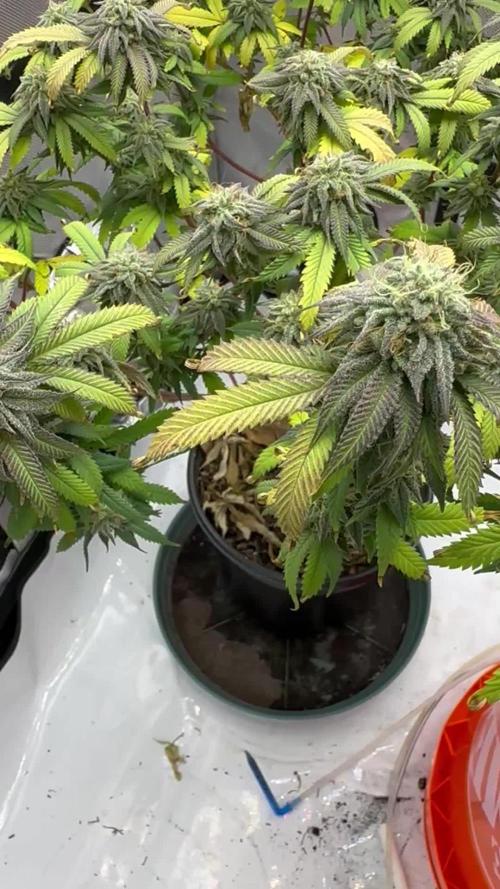
She’s spread out and should be ready to swell. Very very very sticky. Already starting to yellow but I know everything’s in the medium so I think it’s just the pheno.
Processing
Likes
28
Share


@StunFlower
Follow
D49
The Purps is rocking. I hope she's near done with the stretch as she's now approaching 40" tall. She's got a ton of bud sites and they're all plumping up and getting frosty.
She's been pretty hungry and thirsty, demanding 3 litres of water almost every day. Her PPMs have been running in the low 900s with stable PH. She's due for a rez change and will get one tomorrow after 2-weeks of top-ups.
Super happy with the way she is growing and she may actually finish within her 6-7 week advertised harvest time. 🤞
Thanks for tuning in ✌️

Likes
15
Share


@Muntjac
Follow
So I suspect the strain isn't all that stable but I'm having a fun time with the variation. They smell wonderful, very fruity, with cream and pepper, though Weirdo has stronger sweet spice scents over fruit. She might be around a lot longer than the other two to finish her run. My lil' Eldritch monstrosity :)


Likes
91
Share


@Salokin
Follow
Gu Guys,
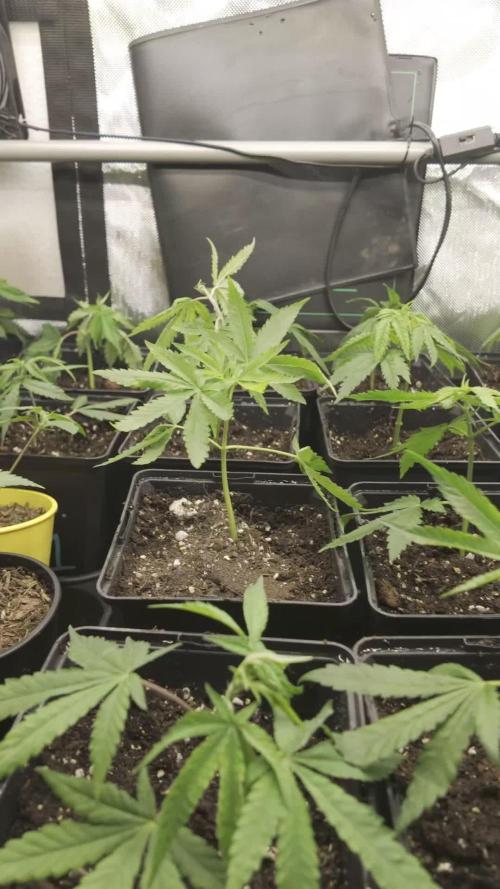
she is continuing to develop as she should, however doesn't seem to be stretching all to much even with lower light intensities. I have therefore decided to push the ppfd to roughly 600 and let her finish her pre flower, no matter if she will fill the entire scrog or not. the roots are bit stained, however, this seems to be nutrient related, no slime or smelly roots thus far and it seems like she is constantly shooting out new ones from the net pot. She is going to be a nice little bonsai bush :)



Likes
9
Share


@Siriuz
Follow
Guys Shes looking very good but I am noticing that she is kinda short and I believe she got stressed out after all the techniques we applied on her, I think I will only go with LST/HST and defoliation for next time with the auto flowers, I think they don't have enough time to recover and I think we get to see it here because otherwise she would have grown like the cream Mandarine, she is an XL but not looking like that tho.
Everything else is good, either that or too many nutes and she got locked out with nutes which I don't think so since she is giving nice smells and flowers and the main trunk got many compact buds forming sites, I just think I need to let them be since auto genetics are too delicates to fuck with, specially this strain not all the strains responds equally, in my experience amnesia, grapefruit and even cream Mandarine XL are warriors, they will resist and recover fats but this lady os very delicate and need to be trates carefully, we did a lot of experiments on this one and I bet the high is wicked bomb just the fact that will produce ultra high quality bud but not as much as you would expect im guessing 15g dry bud top and probably 40 wet but I will let you know at the end, I think I am going to harvest this girl in about 4-5 weeks from now what do you think?
Feel free to leave your comments below and please enlighten me with your experience brothers
Happy growing :)
@cannagrowersiriuz #Instagram
Likes
2
Share


@inversi0n
Follow
Hello, growers!
This was usual growing week with defoliation and stretching

