Check the winners The Grow Awards 2026 🏆
Processing
Likes
Comments
Share
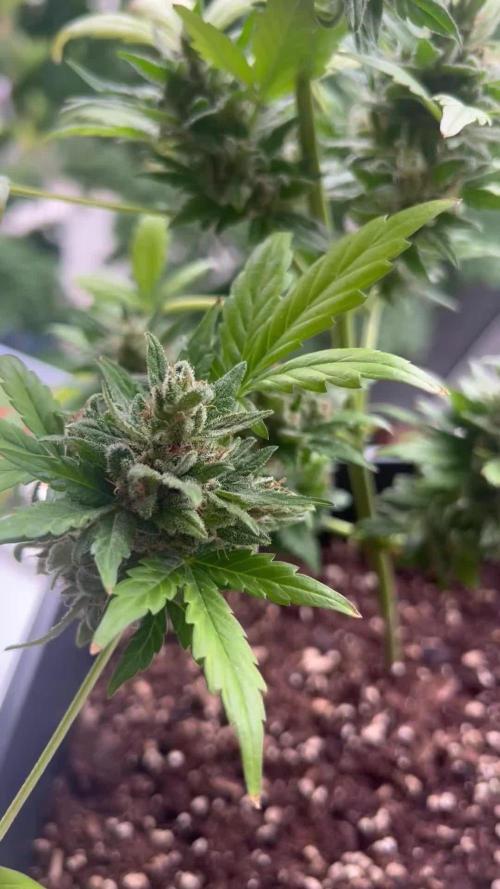
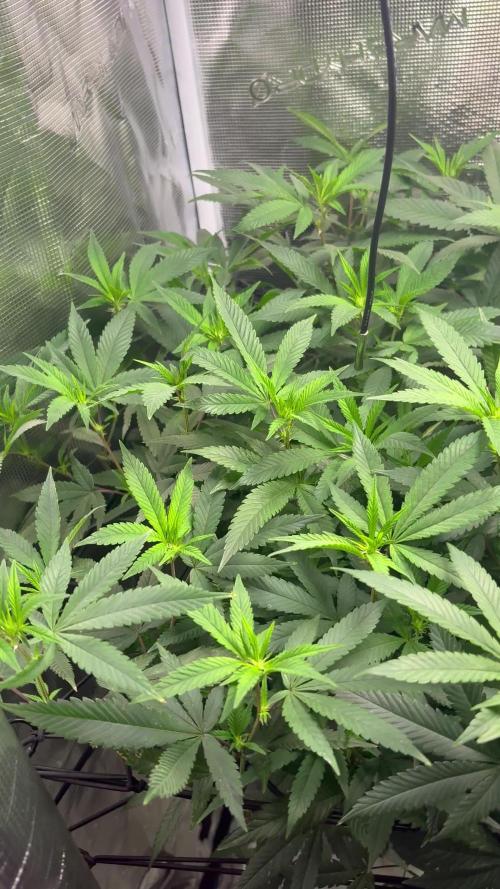
Starting the scrog net, gonna let her stay in veg state till the day 120th. 😎
Likes
34
Share
We chopped down the plants. Now they hang out to dry in the tent. The Trichs looked very good. Some milky, some amber, hardly any clear. Just the way I want it. The popcorn buds were rather milky. So we have more of a couchlock effect on the head buds and the maximum THC on the popcorns. I'm really looking forward to the taste💚
Likes
15
Share
@foxbberg
Follow
Day 15:Gave water & nutrients (2 L each). For the looks they do very well - dark green. Fanleaves build little sunroofs over a good amount of new shoots from the nodes😊. Planns for this week: will keep the soil moist and spongy and wait for the first roots to come out the bags. Till there i'll keep my alternating rhythm of clear water/nutrient solution. As soon as the pots are fully rootet through, i'll start feeding with a little drain, so i can observe wether my soil gets too salty or not. Further i'll keep bending the tops, in order to give more light to the younger shoots. As soon as the stems start making diameter, i'll prepare my scrog-net. Day 16: everything fine so far - nothing to do.....let them ladies do they thang...... Day 17: 1.5 liters of water each (pH 6.2) 1st root made it throug the bottom-edge of the potđŸ’Ș!!! strong white and meaty😁. stems get stronger now, plants show dark green colour. 1(!) tipp shows a tiny little tipp-burn. i will keep watering 'till the ladies loose a little of that dark green..... just to avoid overfeeding. Day 18: 1.25 liters of water each (pH 6.2) Everything fine so far

.. still dark green an vital. Soil is soaked (i had first little drops coming out the bottom after watering this morning) Thoughts: More LST? Less LST? These fanleaves are really huge and make real sunroofs right above the new shoots. I don't see any way to get the shoots into the 'sun' but bending those fanleaves away.....but honestly..... nope! Since the lights are running at 60% (~600 ppfd) already, i rather give the littleones a soft start. They'll make it through the roof one day. My real 'concern' is the height. Yet the stem doesn't really push upwards..... if these ladies stay short, it'll take plenty of time to create a scrog 😕. Wonder wether it could help, if i let them grow straight up for a while and bend them again later. Any suggestions? Day 19: plant 3 really pops out some roots...😁; elsewise everything fine...... Day 20: Poured out some 1.5 l of water to each an had a decent amount of drain

 pH 6.1 EC 2.4 - 3.4 (average 2.9)đŸ€ĄđŸ˜”â€đŸ’«! Since the ladies don‘t show any tipp-burn, i will keep watering with drain (daily from now on) instead of flushing them - no panic here 😎. i guess it was just some accumulations from feeding without drain. Stems get stronger

 slow but steadily

. They still don‘t make much hight, though they produce mass. No worries yet:-) What's next? Will keep watering with drain and have an eye on EC. As soon as it gets below 1.4/1.5 i'll start feedin nutrients again. In case the ladies start getting brighter, i'll start feeding just underneath the EC, measured at last. Day 21: Drain EC still rising!!! (top 3.7/avg. 3.0)..... still not panicking - i observed very few leafs, rolling up their teeth...... but there are some. No tipp-burn at all. 1 liter poured out, would produce about 0.4 liters of drain - i guess there is still a lot of root-growth happening. Main colas and shoots are developing fine. Still dark green. Lifted the lights a bit - since the ladies took a little hight😁. Thoughts: According to the producer, my soil has an EC of about 1.2. Factoring the amount and concentration of nutrient-solution fed, i can only etsimate, there are some accumuations, residue or whatever, washing out from top to bottom. Though i'll have to check for signs of overfeeding...... and do a little flush ........only if REALLY necessaryđŸ˜€! In an ideal world, the ladies would demad more nutrients with any bit of growth, so i would just have to feed them water, another 2 or 3 days and everything was just perfect😁😁😁 UPCOMING: Week 4 đŸ˜
Processing
Likes
8
Share
Esa familia, de vuelta vamos a actualizar esta tercera semana de floraciĂłn de estas candy caramelo de Zambezaseeds. Son fast flowering, asĂ­ que veremos que tal se rĂĄpidas son en su floraciĂłn, hasta ahora se estĂĄn comportando muy bien, tienen 0 bloqueos alimenticios, esta vez no se nos va de la mano con el producto 😂. En resumen color verde, vigorosas, bastante estables hasta ahora, sigo regulando ph , humedad y temperatura. Gracias al led ts-600 que me a facilitado marshydro es posible cultivar en interior 365 dĂ­as al año . Www.mars-hydro.com web: http://bit.ly/2uJAjgy ts600: http://bit.ly/3cnv0Ev code: an420 Macetas de 7L en sustrato all mix de plagron, hasta ahora esto es todo un saludo y buenos humos gente 💹💹💹
Likes
19
Share
Week 1 Day 1 - 8/12/2023 1st Water change Day! Such a special time it is when you remove the little bit of Nutes that you gave them as an appetizer and you give them their first real meal. Added 39 Gallons of Water to my system SILICA= .5mil/Gal = 19.5 = 20mil Root Drip = 1mil/Gal = 39mil Cal Mag= .25mil/Gal = 9.75 = 10mil FLoraMicro= 3.0mil/Gal = 114mil FloraGro = 2.0mil/Gal = 78mil FloraBloom = 2.0mil/Gal =78mil ORCA= .5mil/Gal = 19.5 = 20mil Week 1 Day 2 - 8/13/2023 Everything is looking good the roots are making thier way to the water and the new grow is looking nice and green. Week 1 Day 3- 8/14/2023 Everything is right on track, they are looking beautiful and in the praying postition all leaves happily lifting towards the light. Week 1 Day 4- 8/15/2023 Looking beautiful today and looked like she could use her first haircut.. gave her a TOP off. Roots are laying in the water everything is looking right on track.. Week 1 Day 5- 8/16/2023 walked in and the humidity was under 60.... ohh noooooo.. So I added 2 humidifiers to the tent and attached them to my InkBird controller which is set to 62. She had roots nicely in the water.. this grow is on!!! Week 1 Day 6- 8/17/2023 Humidity was a little low this morning, so I refilled the humidifiers. Other than that, the temp looks great, the PH looks great, the PPM looks good the plant is in the praying position and all damage from the little drowning seems to have been fixed. Happy Happy. Week 1 Day 7- 8/18/2023 Yay.. week 1 in the books, roots in the water growth has started first hair cut given and both side nodes are growing. Everything is looking good and on track.. A lot better than week one of the last grow when I had them drowning week 1. Really excited on how this grow is going to come out.
Likes
16
Share
@osmrducks
Follow
Day 36: Girls looking pretty happy. Still some discoloration going on. Doesn't look to be spreading though. Day 37: Ok, the girls obviously were not happy this morning. I watered with quite a good amount of runoff and measure the PPM at 3200!!!!!!!!!!!!!!!!!!!!! I'm surprised they are still alive! Had to make a quick run to get some water for a flush as I only have 5 gallons worth. Ran 2 gallons through each of them at a ph of 6.4 around 9:30 this morning. It's now 5pm and they have pulled through great. These OG Kush are extremely resilient. Day 38: The girls look way better today after flushing yesterday. Two of the pots were almost completely dry already. Went ahead and fed at 500ppm with runoff. Day 39: I think it's dialed in now. They are looking amazing and still stretching pretty good. Went ahead and pulled off a handful of leaves between the 5 of em. Day 40: Did a little more defoliation and opened them up a bit. I am super worried about getting any type of mold or any issues in particular for this first round. One of the girls needs a touch more but ran out of time. Girls are looking super healthy! đŸ’Ș Day 41: They are looking super awesome. Got the runoff dialed in. 750 going in and roughly 800 coming out. May up it in a week or so. Day 42: Nothing new to update. Girls still looking amazing. I think the stretch may be slowing just a tad.
Likes
2
Share
@MT_Farmer
Follow
Still only watering ph'd water. The plants are actually quite different, the one in the front seems to expand out towards the sides much more the the one in the back. Also the colors of teh leaves are different
Likes
22
Share
In 1995, scientists placed human DNA inside a sealed, air tight tube with photons. Without the DNA, the photons arranged themselves in a random scattered pattern, but when the DNA was inserted, the photons formed an alignment. Are there metaphysical, multidimensional aspects to our DNA? Have we just begun to understand what DNA is and what it represents? Vladimir Poponin is a well known Russian scientist who in 1995, with his colleagues, including biophysicist Peter Gariaev, conducted a very interesting experiment during their time at the Russian Academy of Sciences. In their paper (P.P. Gariaev and V.P. Poponin. Vacuum DNA phantom effect in vitro and its possible rational explanation. Nanobiology 1995 (in press)), Poponin states, in the introduction of the report, that, “We believe this discovery has tremendous significance for the explanation and deeper understanding of the mechanisms underlying subtle energy phenomena including many of the observed alternative healing phenomena.” Why did he feel this way? We will get to that. Poponin and Gariaev tested the behaviour of DNA on photons, little tiny bits of matter, in the “quantum” that our world is made up of. They put photons into a tube specially designed to simulate a vacuum, just like the vacuum of space. With no air inside, they inserted the photons as they wanted to see what they did and how they behaved. The photons were distributed in a way that was completely unordered and random, scattered all over the container. This of course was what the team of researchers expected. Next, samples of human DNA were placed inside the tube with the photons, and what happened next is what’s truly mysterious. The photons reacted to the DNA, and changed their pattern and formed a specific alignment. In the presence of living material, the human DNA, the photons organized! This signified that the DNA was clearly having a direct influence over the photons. It’s one of many examples hypothesizing that something within us has a direct affect on the physical material matter outside of us. This experiment was repeated and confirmed, and it was further observed that human DNA has a direct affect on the quantum ‘stuff’ that our world is made up of. Fascinating to say the least. The Next Big Surprise The next big surprise was observed when the researchers removed the DNA from the container. The scientists assumed that the photons would simply return to their original scattered state, but this didn’t happen. Instead, the photons remained ordered as if the DNA were still in the tube. Poponin described the light as behaving “surprisingly and counter-intuitively.” The researchers hypothesized and were “forced to accept the working hypothesis that some new field structure is being excited.” Is there something being left behind? Something in non-physical form? This experiment tells us that DNA is communicating with the ‘stuff’ our world is made of, and that there is some sort of invisible field that exists. Perhaps DNA represents a place of storage and communications to the past? To the future? To others in the universe who have left their mark, so to speak. Who knows. Quantum Physics and Consciousness Nobel laureate of the twentieth century Richard Feynman once said, with regards to quantum mechanics, “we choose to examine a phenomenon which is impossible, absolutely impossible, to explain in any classical way, and which has in it the heart of quantum mechanics. In reality, it contains the only mystery.” Another great quote that comes to mind anytime the world of science dives deep into the mysterious world of quantum physics: There seems to be a deep concern that the whole field will be tarnished by studying a phenomenon that is tainted by its association with superstition, spiritualism and magic. Protecting against this possibility sometimes seems more important than encouraging scientific exploration or protecting academic freedom. But this may be changing.” – Cassandra Vieten, PhD and President/CEO at the Institute of Noetic Sciences. The reason why the association with superstition, spiritualism and magic mentioned in the quote above exists when it comes to examining certain phenomenon is simply because the observed phenomenon is unexplainable. But it’s important to remember, just because something is unexplainable does not mean that it’s not real, it simply means we don’t fully understand it yet. Academia has a long history of rejecting phenomenon, that’s clearly real, yet simply unexplainable. Quantum physics clearly has a strong connection to consciousness and metaphysical phenomenon. Max Planck, a physicist who originated quantum theory, regarded consciousness as “fundamental,” and matter as “derivative from consciousness.” He said that “we cannot get behind consciousness. Everything that we talk about, everything that we regard as existing, postulates consciousness.” This has been demonstrated quite clearly by multiple experiments, like the quantum double slit experiment. A paper published in the peer-reviewed journal Physics Essays by Dean Radin, PhD, explains how this experiment has been used multiple times to explore the role of consciousness in shaping the nature of physical reality. In this experiment, a double-slit optical system was used to test the possible role of consciousness in the collapse of the quantum wave-function. Photons were shot through two slits, in multiple different ways. The study found that factors associated with consciousness “significantly” correlated in predicted ways with perturbations in the double slit interference pattern. In this experiment, tiny bits of matter (photons, electrons, or any atomic-sized object) are shot towards a screen that has two slits in it. On the other side of the screen, a high-tech video camera records where each photon lands. When scientists close one slit, the camera will show us an expected pattern, as seen in the video below. But when both slits are opened, an “interference pattern” emerges — they begin to act like waves. You can refer to the actual study to find out more about that if you want to see a visual demonstration of the quantum double slit experiment. The point is, consciousness changes the behaviour of the particles. “Observation not only disturbs what has to be measured, they produce it. We compel the electron to assume a definite position. We ourselves produce the results of the measurement.” The study cited above points out that “factors associated with consciousness, such as meditation experience, electrocortical markers of focused attention, and psychological factors including openness and absorption, significantly correlated in predicted ways with perturbations in the double-slit interference pattern. The results appear to be consistent with a consciousness-related interpretation of the quantum measurement problem.” The Takeaway DNA is fascinating, and it’s probably the least understood part of our biology. There are definitely interesting metaphysical non-material aspects to our DNA, and changes to our DNA can come as a result of our thoughts, feelings, and emotions alone. HeartMath researchers have shown that physical aspects of DNA strands could be influenced by human intention. The article, Modulation of DNA Conformation by Heart-Focused Intention – McCraty, Atkinson, Tomasino, 2003 – describes experiments that achieved such results.
Likes
17
Share
Travasare tutte le piccole alcune hanno già preso altre meno ma con calma sono sicuro che andranno alla grande e niente prima esperienza in sog con una genetica non ancora stabilizzata per tutto. Questi sono semi di prova di orangina ma non ancora in commercio e sto facendo una orova per conto di un mio amico grower in Spagna spero vi piaccia la crescita🙏 Ha sto provando a darli acqua da sotto 10 litri alla volta
Likes
17
Share
Today I have diced it is time to switch to 12/12 scheme. Net is almost covered and I am expecting some stretch during pre-flower phase. Watering volume is increasing day by day, thanks to my dehumidifier I can keep the VPD around 1.2. Temperature is a thing... probably need to cool down some in a few weeks. Thankfully I am already adding CO2 so that should do it. As you can see I have raised EC a bit. That was easier than bringing the PH down with PH-minus. Some little burned tips on the leaves but I do like the overall colour. So let's see how it goes. 15/06: Sorry... something more important came up than updating my report.... On Monday, I start working for a boss... it's been over 20 years, so it will take some getting used to... I also suddenly had to buy a car because I hate cycling. I usually dislike driving too, but as long as the car has enough power, I can live with it and stay dry. Regarding the ladies... the problem with the persistent lighting does indeed seem to be an internet issue, as it hasn't occurred again. Furthermore, the amens is just brutally large compared to the others and will soon overgrow the whole net. I don't mind... I always prefer the strongest. In the photo from 3 days ago, this is still fairly visible, but in the photos below, it's getting harder to see... Harvesting will also be fun... Keeping the stuff separate by type will be a challenge. Water values are currently nice and stable, though I did increase the CO2 slightly to an average of 1350ppm. I've also already hung my blooming lamps (not visible in the photo). These are again Chinese quantum boards, but 400W each. They will run 4 hours a day for the last 3 weeks. This way, the dehumidifier doesn't have to work as hard, and I keep the stuff around 30˚C. Actually quite satisfied.... the first signs of flowering seem visible, but not convincing enough to take pictures yet...
Likes
15
Share
@U_Moeder
Follow
Repotted at day 20. Started LST at day 21.
Processing
Likes
2
Share
@Valedor
Follow
Bien en la semana, germinaron bien las pequeñas y se estån adaptando al sistema
Likes
13
Share
Just added Mephisto 3 sour crinkles and 2 double grapes to the equation. It was meant to be 4 sour crinkles but one seed still ent popped so I’m hoping it will! On to the grow where I haven’t trained any plants it’s a fight for space but I’m happy with most of the plants few fast buds wedding still ent properly flowered yet week 7 on but am happy with a couple glues and the 3 runtz the runtz is frosty! The grape Walkers are starting to swell and fill out big time I am happy so far with it all had a couple burns and defincys through the 7 weeks so far but got over them! The grape walkers are the big budded plants then the frosty ones at the back are runtz then the rest are glues! Started defoliating plants
Likes
5
Share
GG4 Clone day 151 10-30-24 - Gave 4 cups of regular water GG4 Clone day 155 11-3-24 - Gave 4 cups of regular water GG4 Clone day 156 11-4-24 - Gave 4 cups of regular water GG4 Clone day 158 11-6-24 - Gave 4 cups of feed water
Likes
32
Share
@Hawkbo
Follow
Daytime smoke, nighttime smoke. Depends when you go to bed. Photos shot with Nikon D5600 with various lighting and stop settings Videos shot on Samsung Galaxy S8 and cut with inShot00
Likes
18
Share
Green light is radiation with wavelengths between 520 and 560 nm and it affects photosynthesis, plant height, and flowering. Plants reflect green light and this is why they appear green to our eyes. As a result, some growers think that plants don’t use green wavelengths, but they actually do! In fact, only around 5 – 10% of green light is reflected from leaves and the rest (90 – 95 %) is absorbed or transmitted to lower leaves [1]. Green wavelengths get used in photosynthesis. Chlorophyll pigments absorb small amounts of green wavelengths. Light that doesn’t get absorbed is transmitted to leaves that are shaded out from direct light. This means that leaves at the bottom of the canopy get more green light than leaves at the top. A high proportion of green wavelengths compared to other colors tells lower leaves that they are being shaded out, so they are able to react accordingly. Lower leaves may react by opening or closing their stomata or growing longer stems that help the leaves reach brighter light [1, 2, 3]. When it comes to growing cannabis, many cultivators are interested in the quality of light used for the flowering stage. In many plants, flowering is regulated by two main photoreceptors: cryptochrome and phytochrome. Both photoreceptors primarily respond to blue light but can also respond to green, although to a lesser extent. Green can accelerate the start of flowering in several species (although cannabis has yet to be tested) [1, 4, 5]. However, once flowering has begun, it’s important to provide plants with a “full spectrum” light that has high amounts of blue and red light, and moderate amounts of green, in order for photosynthesis to be optimized. Green light mediates seed germination in some species. Seeds use green wavelengths to decide whether the environment is good for germination. Shade environments are enriched in green relative to red and blue light, so a plant can tell if it is shady or sunny. A seed that senses a shaded environment may stay dormant to avoid poor growing conditions [1]. Some examples of plant species where researchers have documented this response are: ryegrass (a grass that grows in tufts) and Chondrilla (a plant related to dandelion) [1, 6]. Although green wavelengths generally tell plants NOT to germinate, there are some exceptions! Surprisingly, green wavelengths can stimulate seed germination in some species like Aeschynomene, Tephrosia, Solidago, Cyrtopodium, and Atriplex [1, 6, 7]. Of course, light is not the only factor affecting seed germination – it’s a combination of many factors, such as soil moisture, soil type, temperature, photoperiod, and light quality. When combined with red and blue light, green can really enhance plant growth [1, 8]. However, too much green light (more than 50% of the total light) can actually reduce plant growth [8]. Based on the most current research, the ideal ratio of green, red, and blue light is thought to be around 1:2:1 for green:blue:red [9]. When choosing a horticultural light, choose one that has high amounts of blue and red light and moderate amounts of green and other colors of light. Not many studies can be found about the effect of green light on cannabis growth or metabolism. However, if one reads carefully, there are clues and data available even from the very early papers. Mahlberg and Hemphill (1983) used colored filters in their study to alter the sunlight spectrum and study green light among others. They concluded that the green filter, which makes the environment green by cutting other wavelengths out, reduced the THC concentration significantly compared to the daylight control treatment. It has been demonstrated that green color can reduce secondary metabolite activity with other species as well. For example, the addition of green to a light spectrum decreases anthocyanin concentration in lettuce (Zhang and Folta 2012). If green light only reverses the biosynthesis of some secondary metabolites, then why put green light into a growth spectrum at all? Well, there are a couple of good reasons. One is that green penetrates leaf layers effectively. Conversely red and blue light is almost completely absorbed by the first leaf layer. Green travels through the first, second, and even third layers effectively (Figure 2). Lower leaf layers can utilize green light in photosynthesis and therefore produce yields as well. Even though a green light-specific photoreceptor has not yet been found, it is known that green light has effects independent from the cryptochrome but then again, also cryptochrome-dependent ones, just like blue light. It is known that green light in low light intensity conditions can enhance far red stimulating secondary metabolite production in microgreens and then again, counteracts the production of these compounds in high-intensity light conditions (Kim et al. 2004). In many cases, green light promoted physiological changes in plants that are opposite to the actions of blue light. In the study by Kim et al. blue light-induced anthocyanin accumulation was inhibited by green light. In another study it has been found that blue light promotes stomatal opening whereas green light promotes stomatal closure (Frechilla et al. 2000). Blue light inhibits the early stem elongation in the seedling stage whereas green light promotes it (Folta 2004). Also, blue light results in flowering induction, and green light inhibits it (Banerjee et al., 2007). As you can see, green light works very closely with blue light, and therefore not only the amount of these two wavelengths separately is important but also the ratio (Blue: Green) between these two in the designed spectrum. Furthermore, green light has been found to affect the elongation of petioles and upward leaf reorientation with the model plant Arabidopsis thaliana both of which are a sign of shade avoidance symptoms (Zhang et al. 2011) and also gene expression in the same plant (Dhingra et al. 2006). As mentioned before, green light produces shade avoidance symptoms which are quite intuitive if you consider the natural conditions where the plants grow. Not all the green light is reflected from the highest canopy leaves in nature but a lot of it (50-90%) has been estimated to penetrate the upper leaves at the plant level ((Terashima et al., 2009; Nishio, 2000). For the plant growing in the understory of the forest green light is a signal for the plant of being in the shade of a bigger plant. Then again, the plants growing under unobstructed sunlight can take advantage of the green photons that can more easily penetrate the upper leaves than the red and blue photons. From the photosynthetic pigments in higher plants, chlorophyll is crucial for plant growth. Dissolved chlorophyll and absorb maximally in the red (λ600–700 nm) and blue (λ400–500 nm) regions of the spectrum and not as easily in the green (λ500–600 nm) regions. Up to 80% of all green light is thought to be transmitted through the chloroplast (Terashima et al., 2009) and this allows more green photons to pass deeper into the leaf mesophyll layer than red and blue photons. When the green light is scattered in the vertical leaf profile its journey is lengthened and therefore photons have a higher chance of hitting and being absorbed by chloroplasts on their passage through the leaf to the lower leaves of the plant. Photons of PPFD (photosynthetic photon flux density) are captured by chlorophyll causing an excitation of an electron to enter a higher energy state in which the energy is immediately passed on to the neighboring chlorophyll molecule by resonance transfer or released to the electron transport chain (PSII and PSI). Despite the low extinction coefficient of chlorophyll in the green 500–600 nm region it needs to be noted that the absorbance can be significant if the pigment (chlorophyll) concentration in the leaf is high enough. The research available clearly shows that plants use green wavelengths to promote higher biomass and yield (photosynthetic activity), and that it is a crucial signal for long-term developmental and short-term dynamic acclimation (Blue:Green ratio) to the environment. It should not be dismissed but studied more because it brings more opportunities to control plant gene expression and physiology in plant production. REFERENCES Banerjee R., Schleicher E., Meier S. Viana R. M., Pokorny R., Ahmad M., Bittl R., Batschauer. 2007. The signaling state of Arabidopsis cryptochrome 2 contains flavin semiquinone. The Journal of Biological Chemistry 282, 14916–14922. Dhingra, A., Bies, D. H., Lehner, K. R., and Folta, K. M. 2006. Green light adjusts the plastic transcriptome during early photomorphogenic development. Plant Physiol. 142, 1256-1266. Folta, K. M. 2004. Green light stimulates early stem elongation, antagonizing light-mediated growth inhibition. Plant Physiol. 135, 1407-1416. Frechilla, S., Talbott, L. D., Bogomolmi, R. A., and Zeiger, E. 2000. Reversal of blue light -stimulated stomatal opening by green light. Plant Cell Physiol. 41, 171-176. Kim, H.H., Goins, G. D., Wheeler, R. M., and Sager, J. C. 2004.Green-light supplementation for enhanced lettuce growth under red- and blue-light emitting diodes. HortScience 39, 1617-1622. Nishio, J.N. 2000. Why are higher plants green? Evolution of the higher plant photosynthetic pigment complement. Plant Cell and Environment 23, 539–548. Terashima I., Fujita T., Inoue T., Chow W.S., Oguchi R. 2009. Green light drives leaf photosynthesis more efficiently than red light in strong white light: revisiting the enigmatic question of why leaves are green. Plant & Cell Physiology 50, 684–697. Zhang, T., Maruhnich, S. A., and Folta, K. M. 2011. Green light induces shade avoidance symptoms. Plant Physiol. 157, 1528-156. Wang, Y. & Folta, K. M. Contributions of green light to plant growth and development. Am. J. Bot. 100, 70–78 (2013). Zhang, T. & Folta, K. M. Green light signaling and adaptive response. Plant Signal. Behav. 7, 75–78 (2012). Johkan, M. et al. Blue light-emitting diode light irradiation of seedlings improves seedling quality and growth after transplanting in red leaf lettuce. HortScience 45, 1809–1814 (2010). Kasajima, S., et al. Effect of Light Quality on Developmental Rate of Wheat under Continuous Light at a Constant Temperature. Plant Prod. Sci. 10, 286–291 (2007). Banerjee, R. et al. The signaling state of Arabidopsis cryptochrome 2 contains flavin semiquinone. J. Biol. Chem. 282, 14916–14922 (2007). Goggin, D. E. & Steadman, K. J. Blue and green are frequently seen: responses of seeds to short- and mid-wavelength light. Seed Sci. Res. 22, 27–35 (2012). MandĂĄk, B. & PyĆĄek, P. The effects of light quality, nitrate concentration and presence of bracteoles on germination of different fruit types in the heterocarpous Atriplex sagittata. J. Ecol. 89, 149–158 (2001). Darko, E. et al. Photosynthesis under artificial light: the shift in primary and secondary metabolism. Philos. Trans. R. Soc. B Biol. Sci. 369 (2014). Lu, N. et al. Effects of Supplemental Lighting with Light-Emitting Diodes (LEDs) on Tomato Yield and Quality of Single-Truss Tomato Plants Grown at High Planting Density. Environ. Control Biol. 50, 63–74 (2012).
Likes
54
Share
@Kirsten
Follow
Black Opium this week! It's looking very nice, a good deal of progress with the flower production and bud development. Here's what I did this week. 27.8.25: I watered with 3.25L of dechlorinated water PH'd to 6.5 with; 💜 1ml Trace PH: 6.5 PPM: 321 29.8.25: I watered with 2L of dechlorinated water PH'd to 6.5 with; 💜 1ml Trace PH: 6.5 PPM: 391
Likes
34
Share
@Birale91
Follow
Harvested on day 113 after ending week 9 of bloom. after washing week ago with adding flora kleen and then after 3 days turn light to 48 hours darkness before harvest. First trim in harvest defoliated big fan leaves with all the leaves without sugar and the tip of the small leaves. When the buds will be dry ill do second trim untill the bud will be like dense diamond. So, really love this strain and i give her a score of 9/10. First, for the buds beauty,dense. purple,red,yellow,pink and blue are showing on buds and its realy amazing.10/10. Smell are very sweet and strong of grapes.9/10. Taste is very fruity sweet grapes and i like it.9/10. Very strong effect on mind but feel very good.9/10. So, for final, 9/10. Something like week drying and ill update more pics and videos. *Added video of drying buds at day 4. *Added video and pics of well dried buds. ill add more stunning pics soon.
Likes
4
Share
Getting bigger and looking healthy, only around 150 PPFD They seem to be sensitive to strong light, still too little Day 21 - topped the bigger girl, hopefully she catches up since she was already moving faster