



shorts_status_processing


@snowybudz
Volgen
There is definitely some deficiencies present. I had planned on doing a flip to flower however this will put me off for another week or two while I correct any nutritional problem. Other than that they look good, very bushy. What do you guys think? Am I going to have a good 1212?







@blasterw32
Volgen
I didn't have any problems at all with this strain. Really enjoyed growing and and will def do it again

shorts_status_processing


@BudXs
Volgen
Room is almost there
Flood table coating was completed this week. Took forever to cure in the colder weather, but it is looking great now. Normally I wouldnt use this stuff because it is $200 per gallon, but since Im in the industry, these expired sample cans didnt cost me a cent and provides a much more durable, reflective, cleanable and puncture resistant alternative to plastic. Im very happy with the table overall, it cost me very little to build
I installed the fan and carbon filter, moves about 750 cf per minute. Its a bit loud, but its huge, so what are ya gonna do?
My dutch bucket pails are slowly being collected from my local coffee shop. I need 4 - 8 more. Ive got all the hardware to set up the watering system, so I will work on that in the coming week


@Gingercannacat
Volgen
Beginning of week 4 so far so good. The girls are reacting well to there training. Vita race from plagron is a game changer. They are super green and healthy everytime I feed them you see the difference.Did some defoliation. Nothing major just removed any leaf overlapping or blocking light to lower parts of the plant.


@Hashy
Volgen
Grow diary 11 stage 7
Day 61-70
This is the size of plant I was expecting from all 4 strains and the way I had trained them. She has come on quite a bit over last 9 days, she is the 3rd furthest along.





@hinterhofgrower
Volgen
🌱: Loopking yellowish, no burnt tips, so switch tp 2ml/l Supermix
💧 : 8l
💡 : Dli: 45 mol/m²/d
🤔:



@Cannabinatek
Volgen
Week 3 of Flowering 🌸
Good overall progress, with vigorous growth and plenty of pistils already showing. The girls still seem to be in the stretch phase, continuing their structural development.
Watering & Feeding Log:
* Water: 2 litres
* Terra Aquatica TriPart: Micro, Grow & Bloom
* Urtimax
* Great White — Plant Success Organics
Final pH: 5.67
A positive week overall, with good growth, abundant pistil development and flowering progressing nicely. 🌱💚💚💚


@Cannabucket
Volgen
Hello!
Welcome to the fourth week on our Royal Gorilla Automatic.
This week dates the start of flowering!
We started adding Bloom Booster Tablets to her feed (we add 1 gram from a tablet to 1.4 liters of water).
Please take a moment to compare the development between the first and last picture of this week, simply amazing.
She is a joy to look at and after every feed she just looks great!
Stay safe, see you next week.


@PEAKYPLANTERS
Volgen
hi friends farm, did you have a good Easter? we made a decent harvest that left me quite satisfied even if I had to collect a little earlier because of my absence at home but this did not ruin the work 🤪🤪🤪🤪😎😎


@Witteviking48
Volgen
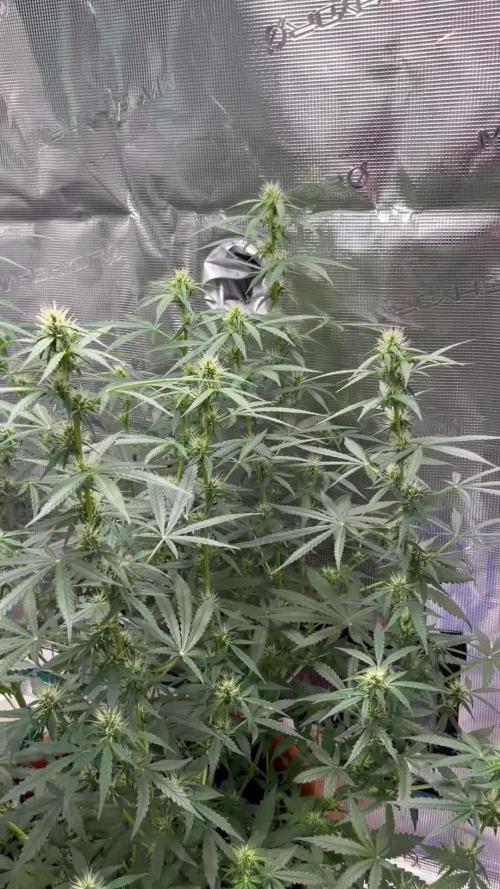
Kept tucking leaves and tried to fill up the canopy.
Guess it's working out. We'll see.
Any tips?
I see a lot of buds developing, deep in the canopy. They seem to catch a fairly amount of light.
In hindsight, could I have trimmed them more a couple weeks ago?
Early on in the grow the two light hung closer together, therefore the right half of the tent got to much lighting before I replaced the light, further apart. I'm thinking this being the cause of the right half of the tent being lower then the left side. I'm hoping it will catch up.



@Splint
Volgen
I’m still removing some leaves everyday, I prefer only removing a few leaves but instead of taking just the lowest ones I pick some from every part of the plant. I’ve had good results so
far with giving the lower buds a bit more light through this “method”.
I’ve seen a lot of online tutorials recommend exclusively removing leaves from the lowest 2-5 sections and a lot in one setting but rarely instead.
What’s your experience with defoliation? Do you prefer one or another method?
I’m currently watering once per week, giving her 5-7 liters with fertilisers over a few hours. She’s only getting watered again when the substrate is dry in the first few inches. I’m thinking about getting a cloth-pot for the next grow for better oxygen supply.
Also, it’s way too early to take a look under the microscope but I think I’ll take one anyways.
see ya



@Luv2Grow
Volgen
Really enjoyed growing this girl. She was compact with nice and tight buds. Wish she would of been a bit bigger but probably something I did early on might of stunted her.

@OB-GYN-Kenobi
Volgen
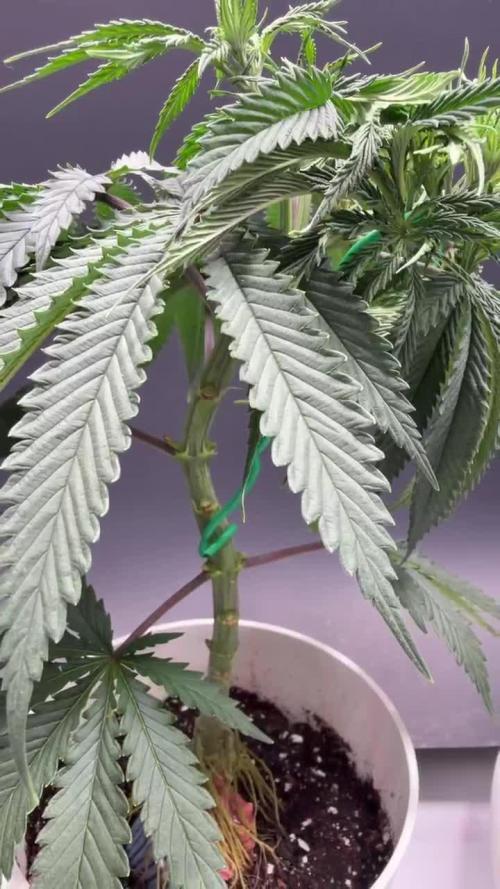
Very pleased with the state of the Chemdawg bonsai, the ceramic cupcake reveal is working nicely. Still need to clean up those roots once they firm up a bit. She's also starting to show pre-flowers now.
Meanwhile, the main Chemdawg is looking great, the octo-colas are shaping exactly like I hoped, and she's mostly outgrown the overwatered thing. That said, she's a very fast grower and I'm running out of horizontal room. I'll probably need to top her again just to slow her down compared to her tent-mate (Lemon Tart Pucker, growing in a much more indica fashion).
Tent is still holding at 600 PPFD, 82 F (28 C) daytime temps, target VPD of 1.0. Did another Rootwise soak across the tent this week, plants seemed to enjoy it.


shorts_status_processing


@GanjaFarmerGrow
Volgen
So far so good...
flowering really nice...
starting to smell really good...
feeding her modestly and going to keep it that way...
Fingers crossed 🙏




@Ultraviolet
Volgen
What's in the soil? What's not in the soil would be an easier question to answer. 16-18 DLI @ the minute. +++ as she grows.
Probably not recommended, but to get to where it needs to be, I need to start now.
Vegetative @1400ppm 0.8–1.2 kPa 80–86°F (26.7–30°C) 65–75%, LST Day 10, Fim'd Day 11
CEC (Cation Exchange Capacity):
This is a measure of a soil's ability to hold and exchange positively charged nutrients, like calcium, magnesium, and potassium. Soils with high CEC (more clay and organic matter) have more negative charges that attract and hold these essential nutrients, preventing them from leaching away.
Biochar is highly efficient at increasing cation exchange capacity (CEC) compared to many other amendments. Biochar's high CEC potential stems from its negatively charged functional groups, and studies show it can increase CEC by over 90%. Amendments like compost also increase CEC but are often more prone to rapid biodegradation, which can make biochar's effect more long-lasting. biochar acts as a long-lasting Cation Exchange Capacity (CEC) enhancer because its porous, carbon-rich structure provides sites for nutrients to bind to, effectively improving nutrient retention in soil without relying on the short-term benefits of fresh organic matter like compost or manure. Biochar's stability means these benefits last much longer than those from traditional organic amendments, making it a sustainable way to improve soil fertility, water retention, and structure over time. Needs to be charged first, similar to Coco, or it will immobilize cations, but at a much higher ratio.
a high cation exchange capacity (CEC) results in a high buffer protection, meaning the soil can better resist changes in pH and nutrient availability. This is because a high CEC soil has more negatively charged sites to hold onto essential positively charged nutrients, like calcium and magnesium, and to buffer against acid ions, such as hydrogen.
EC (Electrical Conductivity):
This measures the amount of soluble salts in the soil. High EC levels indicate a high concentration of dissolved salts and can be a sign of potential salinity issues that can harm plants.
The stored cations associated with a medium's cation exchange capacity (CEC) do not directly contribute to a real-time electrical conductivity (EC) reading. A real-time EC measurement reflects only the concentration of free, dissolved salt ions in the water solution within the medium.
98% of a plants nutrients comes directly from the water solution.
2% come directly from soil particles.
CEC is a mediums storage capacity for cations. These stored cations do not contribute to a mediums EC directly.
Electrical Conductivity (EC) does not measure salt ions adsorbed (stored) onto a Cation Exchange Capacity (CEC) site, as EC measures the conductivity of ions in solution within a soil or water sample, not those held on soil particles.
A medium releases stored cations to water by ion exchange, where a new, more desirable ion from the water solution temporarily displaces the stored cation from the medium's surface, a process also seen in plants absorbing nutrients via mass flow. For example, in water softeners, sodium ions are released from resin beads to bond with the medium's surface, displacing calcium and magnesium ions which then enter the water. This same principle applies when plants take up nutrients from the soil solution: the cations are released from the soil particles into the water in response to a concentration equilibrium, and then moved to the root surface via mass flow.
An example of ion exchange within the context of Cation Exchange Capacity (CEC) is a soil particle with a negative charge attracting and holding positively charged nutrient ions, like potassium (K+) or calcium (Ca2+), and then exchanging them for other positive ions present in the soil solution. For instance, a negatively charged clay particle in soil can hold a K+ ion and later release it to a plant's roots when a different cation, such as calcium (Ca2+), is abundant and replaces the potassium. This process of holding and swapping positively charged ions is fundamental to soil fertility, as it provides plants with essential nutrients.
Negative charges on soil particles: Soil particles, particularly clay and organic matter, have negatively charged surfaces due to their chemical structure.
Attraction of cations: These negative charges attract and hold positively charged ions, or cations, such as:
Potassium (K+)
Calcium (Ca2+)
Magnesium (Mg2+)
Sodium (Na+)
Ammonium (NH4+)
Plant roots excrete hydrogen ions (H+) through the action of proton pumps embedded in the root cell membranes, which use ATP (energy) to actively transport H+ ions from inside the root cell into the surrounding soil. This process lowers the pH of the soil, which helps to make certain mineral nutrients, such as iron, more available for uptake by the plant.
Mechanism of H+ Excretion
Proton Pumps: Root cells contain specialized proteins called proton pumps (H+-ATPases) in their cell membranes.
Active Transport: These proton pumps use energy from ATP to actively move H+ ions from the cytoplasm of the root cell into the soil, against their concentration gradient.
Role in pH Regulation: This active excretion of H+ is a major way plants regulate their internal cytoplasmic pH.
Nutrient Availability: The resulting decrease in soil pH makes certain essential mineral nutrients, like iron, more soluble and available for the root cells to absorb.
Ion Exchange: The H+ ions also displace positively charged mineral cations from the soil particles, making them available for uptake.
Iron Uptake: In response to iron deficiency stress, plants enhance H+ excretion and reductant release to lower the pH and convert Fe3+ to the more available form Fe2+. The altered pH can influence the activity and composition of beneficial microbes in the soil. The H+ gradient created by the proton pumps can also be used for other vital cell functions, such as ATP synthesis and the transport of other solutes. The hydrogen ions (H+) excreted during photosynthesis come from the splitting of water molecules. This splitting, called photolysis, occurs in Photosystem II to replace the electrons used in the light-dependent reactions. The released hydrogen ions are then pumped into the thylakoid lumen, creating a proton gradient that drives ATP synthesis.
Plants release hydrogen ions (H+) from their roots into the soil, a process that occurs in conjunction with nutrient uptake and photosynthesis. These H+ ions compete with mineral cations for the negatively charged sites on soil particles, a phenomenon known as cation exchange. By displacing beneficial mineral cations, the excreted H+ ions make these nutrients available for the plant to absorb, which can also lower the soil pH and indirectly affect its Cation Exchange Capacity (CEC) by altering the pool of exchangeable cations in the soil solution.
Plants use proton (H+) exudation, driven by the H+-ATPase enzyme, to release H+ ions into the soil, creating a more acidic rhizosphere, which enhances nutrient availability and influences nutrient cycling processes. This acidification mobilizes insoluble nutrients like iron (Fe) by breaking them down, while also facilitating the activity of beneficial microbes involved in the nutrient cycle. Therefore, H+ exudation is a critical plant strategy for nutrient acquisition and management, allowing plants to improve their access to essential elements from the soil.
A lack of water splitting during photosynthesis can affect iron uptake because the resulting energy imbalance disrupts the plant's ability to produce ATP and NADPH, which are crucial for overall photosynthetic energy conversion and can trigger a deficiency in iron homeostasis pathways. While photosynthesis uses hydrogen ions produced from water splitting for the Calvin cycle, not to create a hydrogen gas deficiency, the overall process is sensitive to nutrient availability, and iron is essential for chloroplast function.
In photosynthesis, water is split to provide electrons to replace those lost in Photosystem II, which is triggered by light absorption. These electrons then travel along a transport chain to generate ATP (energy currency) and NADPH (reducing power). Carbon Fixation: The generated ATP and NADPH are then used to convert carbon dioxide into carbohydrates in the Calvin cycle. Impaired water splitting (via water in or out) breaks the chain reaction of photosynthesis. This leads to an imbalance in ATP and NADPH levels, which disrupts the Calvin cycle and overall energy production in the plant. Plants require a sufficient supply of essential mineral elements like iron for photosynthesis. Iron is vital for chlorophyll formation and plays a crucial role in electron transport within the chloroplasts. The complex relationship between nutrient status and photosynthesis is evident when iron deficiency can be reverted by depleting other micronutrients like manganese. This highlights how nutrient homeostasis influences photosynthetic function. A lack of adequate energy and reducing power from photosynthesis, which is directly linked to water splitting, can trigger complex adaptive responses in the plant's iron uptake and distribution systems.
Plants possess receptors called transceptors that can directly detect specific nutrient concentrations in the soil or within the plant's tissues. These receptors trigger signaling pathways, sometimes involving calcium influx or changes in protein complex activity, that then influence nutrient uptake by the roots. Plants use this information to make long-term adjustments, such as Increasing root biomass to explore more soil for nutrients. Modifying metabolic pathways to make better use of available resources. Adjusting the rate of nutrient transport into the roots. That's why I keep a high EC. Abundance resonates Abundance.


@Sugahmama
Volgen
Hello, its week 12 and we are still in this lol
I think 3-4 more weeks and I can finally harvest wohoo.
I had a little Problem with gnats. Had to remove 20~25% of the plants.
Has anybody more good advice besides sticky traps and not water to often? Thanks
See you next week lol


@I_Identify_As_A_Dan
Volgen
Week 1 of Black Lebanon by SSSC
Didn't create a diary at the start of these plants lives but they vegged for 7/8 weeks before i flipped into flower.
I've got 4 of the Black Lebanon in this tent😎
The new indoor light is in im now running 600W LED (igrox taurus TRS600) so no more yellow looking pictures 😂


@Stonyways
Volgen
trimmed and netted the plants last night, 12/30, and the energy pushed the plants to stretch another 1/2 inch+
this will be the last week of vegetation as I prep this light leaking tent for flower, not a fan of mars hydro at all right now. their poles are the weakest I've encountered yet, too many light leaks and this is the first grow with it. My high cfm fan , which is only a 4", is pulling the fabric too much and causing the leaks to grow a bit. This is not new, its been happening with indoor tents for a while now but I thought a grow company such as MH would have a decent, respectable tent. My solution is Blackout Curtains draped over the sides. However, I am hesitant to do this with the MH tent as the poles for the tent are too weak as it is, tsk tsk tsk mars hydro.
will continue to increase the watts the next 6 days
HAPPY NEW YEAR
a combination of light and fresh soil has made the plants stretch so I will finish tightening up the MH tent today and ill start flower tomorrow, day 62.
while adjusting the height I must have nudged the dial for the dimmer and sent it to 184w. this would have been a big jump but manageable but I lowered the light 7" and the plants took a bit of a hit. I adjusted the light back down to 160w and I'll let the plants recover before anymore adjustments.