Processing
Likes
Comments
Share
8/16/2020 Not too many changes, starting to lower the amount of nutrients and just adding bloom, just watching the birds fattening up getting ready to do a flush in about 2 1/2 weeks, hopefully end up with some good quality flavorful bud
Likes
6
Share
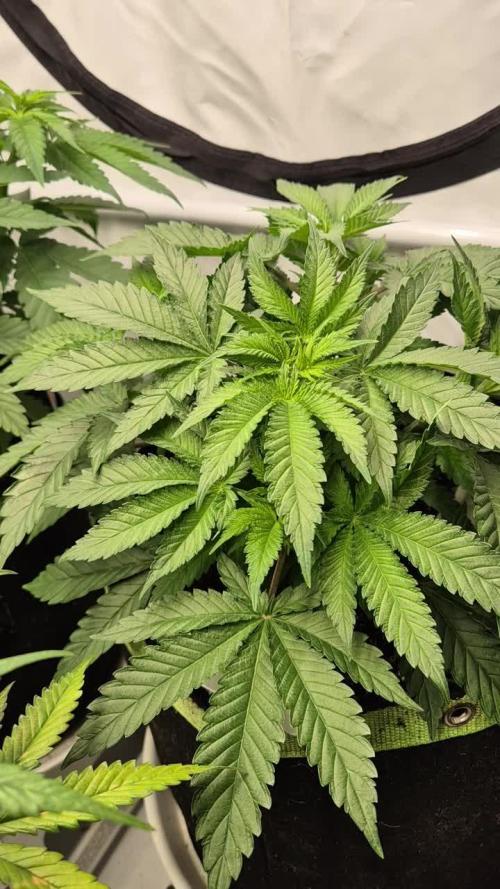
2nd topped on day 20 and she is reacted well to HST, she is too busy with growing, there is no time to get stunted. I give her 1/3 of the feed schedule’s recommendation. Soon I will switch to bottom feed. DLI has been set to 30. Day 26 - today I installed the Megapot system. She has been transplanted from a 5 gal bag to a 6 gal one, it was quite a torture I must say. More stress for the plant. I had to do this for the better drainage. Was it a stupid move? We shall see.
Likes
40
Share
@valiotoro
Follow
easy trim✂️ The buds are Absolutely perfect,exactly what i was looking for🤩 Green pheno : cookie,diesel & gelato🍪⛽️🍦 Purple pheno : flower,sweet & honey🌸🍯 After 7 days on the dry rack she was ready for the jar to start the curing process.😋
Processing
Likes
28
Share
I wish I would of taken pics of them before I trimmed them up because they were a massive bush!!! At this point im satisfied with the number of potential cola's and size of the branches. I can already see preflowers coming from some of the nodes which is crazy because i've never seen any of plants in history doing this. Its also the first time i've taken veg past 3-4 weeks but mainlining does extend the veg time some. Today i've switched to 12/12 so next week will be the first update of flowering!!! quite excited to finally get to this stage.
Likes
2
Share
Likes
17
Share
She’s taking her sweet time now! I found a nanner and pulled it off, but I have to keep an eye out. You can see from the trichome shots that she is not ready yet... thinking maybe 1-2 more weeks—-hoping for sooner. Going to start a flush because of the leaf yellowing. Otherwise, she’s moving along! ✌️🏻💚🌿💨
Likes
3
Share
@PoshGrow
Follow
Welcome to GhostGrow Chapter One by PoshGrow! 🌳 Week #7 4th week of flowering. Somehow didnt documented alot of this week and last one in vids or pics... Need to smoke less i guess 🤦‍♂️😆 Scrog works perfect, plants are looking amazing and healthy, tought, fast growing. If you wonder about my home made scrog net, its made from 18mm hot water pvc tube, some screws and rope 😅 Watering when needed, every other watering I used Fox Farm Big Bloom, Grow Big & Tiger Bloom
Likes
15
Share
The girls are fully in flower this week which of course is a GREAT sight to see when opening the tent. The smell in the tent is so sweet and fruity it's already making your mouth water!! So this week I feed the girls with a little of the living soil veg so they are still getting a helping hand. They were also given the living soil bloom and some barley which I will admit is the first time using it but so far me plus the girls are very much enjoying!! I have done the necessary light de-foliating on all 4 girls over the past 2 weeks and more LST. Happy toking guys and girls!! Will keep you all posted with more videos through the week so please keep checking back 🙂
Likes
2
Share
We become aware at such times of man's wonderful ability to bring seemingly unrelated elements into harmonic balance, and receive a glimpse into a world where everything exists in conscious sympathetic attunement to everything else. When we listen to a piece of music that seems to strike a beautiful chord somewhere inside us, or view a painting that simply glows with harmonic awareness well executed, we probably do not spare much time to contemplate the wonderfully intricate combination of vibrations that our sensors make it possible for us to perceive. We tend to appreciate the relationship between the parts of something by an awareness of the harmony or dissonance of the whole. This ability enables us to say "what a beautiful house!" instead of "analysis has proven that this collection of building materials exhibits certain elements of harmonic proportion." While this ability to instinctively appreciate the beauty of true harmony has an important role to play in evolution, a more analytical understanding of the laws involved can be most useful. This is especially so if we wish to create works of art where each part exists in true harmony, not only with the other part of that particular whole, but with the universe within which the creator and the created exist. Everything vibrates. From the most dense matter to the most subtle cosmic rays, everything which our senses allow our thoughts to become aware of, can be specified in terms of wavelength or frequency of vibration. These two terms define the same thing, but from different points of view. The following are the approximate wavelengths of various energy carriers: Cosmic rays 0.000,000,001 mm Gamma rays 0.000,000,1 mm X rays 0.000,500 mm Ultraviolet rays 0.003 mm Visible light 0.006 mm Infrared 0.01 mm Sound waves 1 meter Radio waves 300 meters Violet light 400 nm to 450 nm Blue light 450 nm to 500 nm Green light 500 nm to 570 nm Yellow light 570 nm to 590 nm Orange light 590 nm to 610 nm Red light 610 to 700 nm 1 nanometer (nm) = 0.000,000,1 cm = 1/10,000,000 cm If a guitar string is plucked and we hear a sound, it is not too difficult for the human mind to associate this sound with the vibration of the guitar string. With color it is quite different. It is difficult for us to conceive that the color of a substance is not an inherent property of the substance itself, but an indication picked up by our senses of that substance's ability to absorb or reflect the light which happens to be shining on it at that moment. Neither the matter nor the light is colored. What happens is that the brain learns to differentiate between the frequencies reflected or transmitted by the substance the eyes are focused on. The same thing happens with sound. When we say "Oh! Listen, they're playing my favorite song," what we really mean is: "My brain has stored within it a particular pattern of frequencies. I have compared the new information being received with this stored pattern and have deduced the answer that the two patterns are similar within certain specified tolerances." The 'pleasure' involved could have something to do with our running the pre-recorded pattern at the same time, in 'sympathy' with the new pattern as it is received. The word sympathy describes very well our ability to appreciate color and sound. It also describes the reason behind certain elements of harmony. For instance, if a substance vibrating at 100 cycles per second (tone 1) is in the proximity of another substance vibrating at 200 cycles per second (tone 2), we could perceive, if we had the right equipment, a certain sympathetic relationship between the two. We will see from this that there is a uniform doubling of the first tone seen in the second. At various points along the waves, the two are the same in amplitude. At other points, they are at opposite poles to each other. This doubled frequency has more points of similarity to the original than any other frequency except the original itself. If the equipment we had available for measuring these two frequencies was a soundboard amplifier and a pair of ears, then we would hear what would sound to us like one tone. If we had the opportunity to hear one at a time, we would hear that although they sound the same, one is higher in pitch than the other. This characteristic of 'the same but different in pitch', musicians have called the octave. Any two tones produced where one has exactly doubled the frequency of the other is called an octave. Speaking in ratios, an octave would appear then as the ratio 2:1 or 1:2, depending on whether we are talking of an octave up or down. A single note produced by almost any instrument will contain more than one wavelength or frequency. It will have a dominant frequency, the wavelength of which we would call the note's 'fundamental' or 1st harmonic. It will also have a varying number of upper harmonics, gradually fading in intensity into infinity or silence. Natural harmonics always have the same pattern of intervals between them. The interval between the 1st and 2nd harmonic is a perfect octave; between the 2nd and 3rd a perfect fifth; between the 3rd and 4th a perfect 4th; and so on, the intervals becoming smaller and smaller until they lose any relationship with the western 12 tone scale as it exists at the moment. Just as an octave has certain elements of sympathy with its fundamental, so some intervals have been noted to be more perfectly in sympathy with the fundamental than others. The ratio of the 'perfect 5th' or interval of 7 semitones, as it occurs in the harmonic series, is 3:2 or 2:3, while that of the 'perfect fourth" is 4:3 or 3:4. All the tones in the western 12 tone scale can be expressed in terms of the ratio between the upper tone and its fundamental. This would seem to be an ideal way of generating a scale from any given fundamental and several attempts have been made to do this, the Pythagorean system being probably the most well known. Although when working with a single tone instrument playing on its own, the Pythagorean formula works wonderfully well, if we had several instruments tuned this way together and asked them to play almost any western music, we would find that at times they sounded quite out of tune to each other. The lack of flexibility of the various scale systems based on the harmonic series has led to what is known as the 'tempered' scale. This uses as its primary unit of interval the ratio of the octave or 2:1. It then proceeds to divide the interval between any fundamental and its upper octave into 12 smaller intervals by applying the ratio: two to the one-twelfth power, to one (21/12:1). This equals 1.059463094, so by multiplying any frequency by this number, we will obtain the tempered semitone next up from our fundamental. We will also find that any tone twelve semitones up from any other tone, in a scale generated in this way, will have exactly double the frequency. If we took the note middle C on a piano and halved the wavelength, we would have the note C one octave above. If we halved this, we would have the C above, and so on. However, within about 6 octaves, we would find that although a 'sound' was being produced, no human ear could perceive it. If we kept on going, halving and producing upper octaves of our fundamental C, we would proceed through the infrared band, into the visible light spectrum. If we happened to be outside during the day, we would, for one octave only, see the note C with our eyes. The next octave above would already be in the ultraviolet band, and outside the eye's sensitivity range. If we can think of color as being an indication of a substance's vibratory rate or wavelength, we may begin to see a relationship that could exist between the color and sound spectrums. The logical extension of what has so far been said is that there exists a scale in the color spectrum that corresponds exactly to the scale in the sound spectrum, each color tone being an octave of the equivalent note in the sound range. This is not the end of the story but only the beginning. If we can for the moment accept that any wavelength in one band has upper and lower octave stretching out to infinity, then the next question is 'fine, but what shall we use as our fundamental? A particular color? A particular sound frequency?' The musicians among us will probably say 'A 440'. This means that the note A should vibrate at 440 Hertz, or 440 times per second. They would tell us that this is standard pitch has been adopted by most orchestras around the world; pianos are tuned to it, instruments are constructed to formulas based on it, and so to them it would probably seem the most appropriate place to begin. Some of these musicians may know of the battle that is still raging with regards to this being the standard, but few would know why A = 440 Hz was chosen except that it worked when it was set to be a suitable compromise between the many different pitches in use at the time. 432 Hz is said to be mathematically consistent with the patterns of the universe. Studies reveal that 432 Hz tuning vibrates with the universe’s golden mean PHI and unifies the properties of light, time, space, matter, gravity, and magnetism with biology, the DNA code, and consciousness. When our atoms and DNA start to resonate in harmony with the spiraling pattern of nature, our sense of connection to nature is said to be magnified. Another interesting factor to consider is that the A=432 Hz tuning correlates with the color spectrum, while the A=440 Hz is off. Audiophiles have also stated that A = 432 Hz music seems to be non-local and can fill an entire room, whereas A=440 Hz can be perceived as directional or linear in sound propagation. Once you adopt the idea that sound (or vibration in general) can have an equalizing and harmonizing effect (as well as a disturbing effect), the science of harmony can be applied to bring greater harmony into one's life or tune to specific energies. There is a form of absolute and relative harmony. Absolute harmony can, for example, be determined by the tuning of an instrument. The ancients tuned their instruments at an A of 432 Hz instead of 440 Hz - and for a good reason. There are plenty of music examples on the internet that you can listen to in order to establish the difference for yourself. Attuning the instrument to 432 Hz results in a more relaxing sound, while 440 Hz slightly tenses up the body. This is because 440 Hz is out of tune with both macro and micro cosmos. On the contrary, 432 Hz is in tune. To give an example of how this is manifested microcosmically: our breath (0,3 Hz) and our pulse (1,2 Hz) relate to the frequency of the lower octave of an A of 432 Hz (108 Hz) as 1:360 and 1:90. It is interesting to note that 432 Hz was the standard pitch of many old instruments and that it was only recently (19th and 20th century) the standard pitch was increased. This was done in order to be able to play for bigger audiences. Bigger audiences (more bodies) absorb more of the lower frequencies, so the higher pitch was more likely to “cut through”. One of the oldest instruments of the world is the bell ensemble of Yi Zeng (dated 423 BC), tuned to a standard F4 of 345 Hz, which gives an A= 432 Hz. The frequency of 345 Hz is that of the platonic year! Similarly, many old organs are tuned in A=432 as well; for example, St. Peter’s Capella Gregoriana, St. Peter’s Capella Giulia, S. Maria Maggiore in Rome. Maria Renold’s book “Intervals Scales Tones and the Concert Pitch C=128 Hz” claims conclusive evidence that 440 Hz and raising concert pitch above scientific “C” Prime=128 Hz (Concert A=432 Hz) disassociates the connection of consciousness to the body and creates anti-social conditions in humanity. The difference between concert pitch A=440 Hz and Concert A=432 Hz is only 8 cycles per second, but it is a perceptible difference of awareness in the human consciousness experience of the dream we share called existence.
Likes
22
Share
@Gram_Solo
Follow
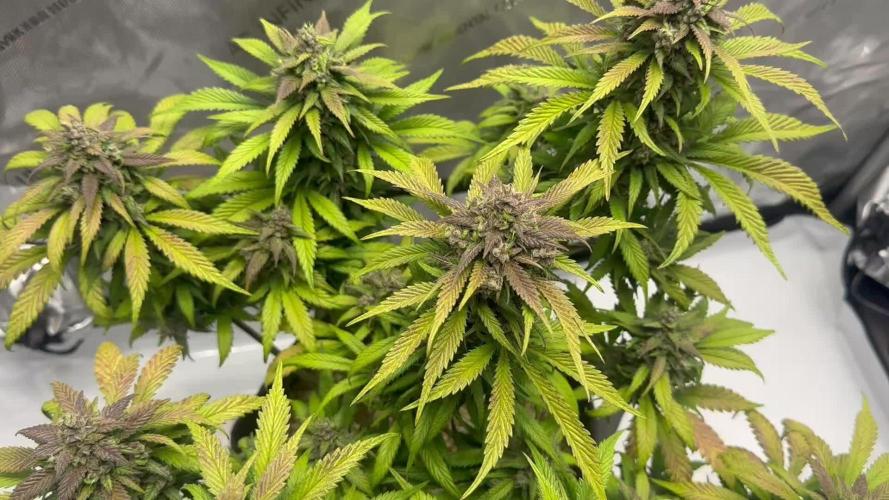
WEEK 8 These banana purple are looking 🔥🔥 2 plants now starting to show that amazing purple colour 1 more is also coming along with some hints. I will be buzzing if they all go purple lol. Had some issues with PH last week so they have had fresh nutes and adjusted PH to 6.5 now. It was on 7.5 because of uncalibrated pen. Sticking to the advanced nutrient feeding chart for autoflowers atm I may do a week flush yet just to get rid of any excess buildup and start again on bloom and boosters. A couple of these are behind by a couple of weeks I think. I took off a few more leaves that were barely getting and light and a few nodes at the bottom. Just to keep that airflow going between stems and the top. The Rest are powering through it! So no more defoilation on the late ones💪 Buzzing with results so far! Update next week 👊
Processing
Likes
1
Share
Hi, everybody. With you back in touch with the Russian gardener. Today I decided to show you my friend's tent. The size of 100 cm by 100 cm has 5 plants of auto AK 47. 5 plants-63 days. 9 weeks. He did not do LST training, but pulled them with a lamp, raising it every week by 10 cm. This is one of the most common cannabis strains on the Russian market. Thanks to strong undemanding genetics, grows almost anywhere in the most adverse conditions, great for the harsh Russian climate and for novice gardeners who with minimal skills want to get the most. As you can see, yesterday we planted 21 sprouted young plants that are preparing for guerrilla cultivation in the open air Later, when we grow them outdoors, I will create a separate diary with a detailed description. Despite the little experience of growth, my friend is a good student and a reliable person, we have grown grass together and harvested. That's why I trust him. Except him, more no one knows about my Hobbies. In this case it is necessary to observe secrecy.
Likes
4
Share
All fastbuds autos are in pots. The weather is really good, humudity is around 55. Their area is sunny from 08.00 til 19.00
Likes
60
Share
@Natrona
Follow
Sour Jealousy Auto FastBuds 2025 Outside Grow Week 6 May 11-17 Veg Sour Jealousy remains in veg at 6 weeks with no hairs or buds in sight. She is a sativa hybrid, and they say sativas take longer to go into flower. She is 12 inches tall now. This week’s weather has been rainy and will continue thru the weekend. May started out in the 90s but has steadily fallen over the past two weeks. Maintaining temperatures in the upper 60s and low 70’s These temperatures are below our average upper 70s-to 80s. I noticed some spots on a leaf but the other outside girls don’t show any spots. Side note: outside growing isn't easy. I found cabbage worms on my Brussels sprouts. Hope my outside girls get stinky to protect my vegetables. Your likes and comments are appreciated. Thanks for stopping by. Growers love 💚🌿 💫Natrona💫
Likes
4
Share
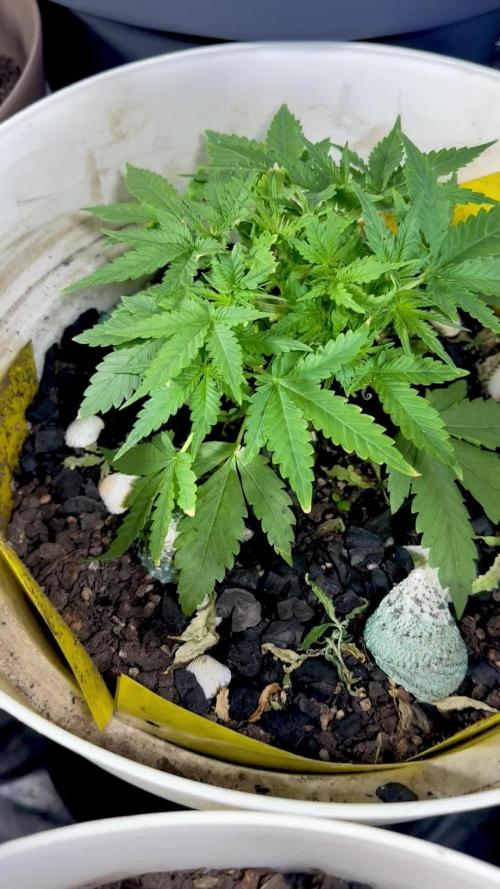
June 8: planted out first seedling into 7 gallon bag. Using peat pots as intermediate container because it is too cold here to start seeds outdoors and I don’t have room for final containers inside. After about one week roots are coming out the bottom. It was pretty cool in May with some frost nights so I’m glad I waited until June to start these.
Likes
20
Share
@HisHope
Follow
11/10 Week 7 Coloring is deepening, hairs stand straight no ambering, leaves are beginning to fade so meh couple of weeks maybe? 11/14 Feeding day 1 gal at 6.5PH with 5ml Cal Mag , 5ml Bio-Bloom, 5ml Fish Sh!t
Likes
90
Share
@AsNoriu
Follow
Day 43. Girls still on water, but they are getting bigger, need more water, so installed trays, gave them a lift from ground and hopefully this weekend heavy LST and defoliation session with light BioBizz FishMix feed . All girls are nice, two a bit smaller, but they should catch up. Made small shuffle , sometimes it looks to me, that one light is overperforming others in veg. Day 45. Heavy training, loads of lst and defoliation, pure phed water. Think to give them 2 more weeks before flip, will clear up in a week all small shoots and bottoms. Happy Growing !
Likes
142
Share
Hi everyone :-) This week a lot of nice things happened in the flower tent :-) Everyone looks super nice, and is growing stronger and more beautiful week by week 😍👌. The blue cheese smells like a dream ;-) As usual from this variety 👍. The kosher tangie is also very, very tasty 👏🏻. Both got Pk 13/14 this week for the last time :-) Everyone else is developing very well 👍, That will be the last diary with several strains together :-) In future everyone will come individually 👌. I wish you a lot of fun with the videos, have a nice weekend, stay healthy 🙏🏻 and let it grow 😎👌
Likes
41
Share
12/24/18 Decided to make bubble hash with the trim and small buds from all 4 plants. The bubble hash is now drying. This plant has been a dream to grow. No problems from her at all. I even found a couple keeper phenos as well. The black magic soil and fertilizer, along with the aerated nutrient teas that these ladies were feed worked to perfection. All organic living soil is the way to go! Im not finished yet. I will update this diary soon with dry weight and a smoke report once the ladies are done drying.00000
Processing
Likes
1
Share
Steady week, all the girls seem to just keep getting bigger and bigger! Defoliated which I forgot to take pictures of however, they literally replaced the foliage in days! I Have a slight worry about one of the GG as she seems to be carrying on vegging with no real signs of flowering, just stretching more each day!? This seems strange as the Stardawgs look like they could be ready for flush in the coming weeks.. I am only a newbie so maybe i'm just been a little paranoid!? Either way She's absolutely massive!! Got the Dawgs out for a little photoshoot!