Likes
30
Share
@Roberts
Follow
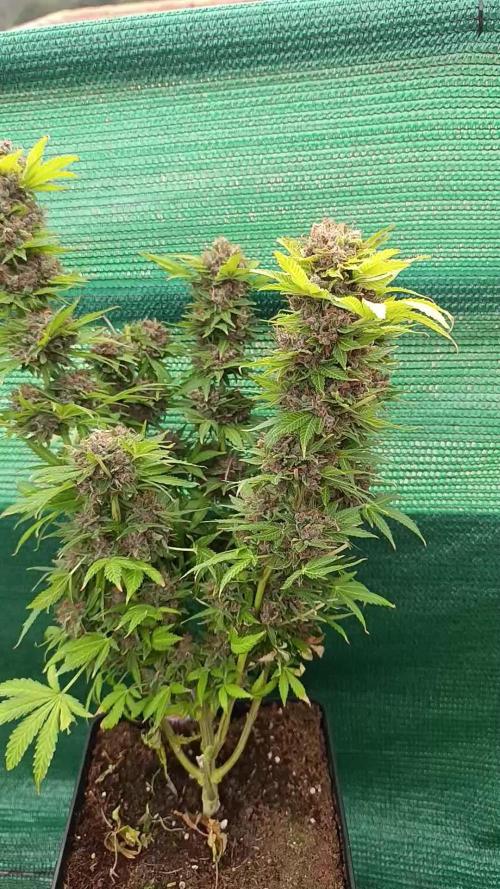
Watermelon auto is hurting this week. The neem oil spray is always so harsh on my plants. I am trying a different a way of spraying them, spray, wait a half hour, and rinse off. But leave on the under side of leaves. Since they like to hide there. Hopefully it will help. I have not seen new ones on this plant. They were on another. It has been a horrible year for issues in my grows. Thank you RQS, Gen1:1, and Medic grow.. 🤜🏻🤛🏻🌱🌱🌱 Thank you grow diaries community for the 👇likes👇, follows, comments, and subscriptions on my YouTube channel👇. ❄️🌱🍻 Happy Growing 🌱🌱🌱 https://youtube.com/channel/UCAhN7yRzWLpcaRHhMIQ7X4g Thank you grow diaries community for the 👇likes👇, follows, comments, and subscriptions on my YouTube channel👇. ❄️🌱🍻 Happy Growing 🌱🌱🌱 https://youtube.com/channel/UCAhN7yRzWLpcaRHhMIQ7X4g
Likes
6
Share
The Afghani x Mac1 auto solo grow yielded 9.7g of potent, stank nugs. Smelling a bit like fruit and paint thinner in the jar, and transforming into sweet tarts candy once ground up. Excellent flavor and blissful effects.
Likes
24
Share
@Momentum
Follow
Bei der Hash Burger ist mir klar geworden, dass der Leafly Strain of the Year Titel sich nur auf das Endprodukt bezieht. Vom Growing her performt sie eher klein und graziös, wird sicher aromatisch und ist ne schöne Pflanze, aber der Wuchs ist nicht die erwartete Bombe bis jetzt.
Likes
8
Share
Likes
12
Share
Performed some HST this week. Pics and video were taken 2 days after the bending. I bent the main stalk a little lower than 1/2 way down. She was getting a little closer to the HPS light than I liked (but no signs of light burn). I expect her to stand straight up again in a few days but with a new knuckle at the bend point. Then I'll probably bend her over again 👍
Likes
1
Share
Gave a nutrient boost and set to 12 hr. Still doing LST but I will probably unleash once it actually starts flowering. Been a bit lazy with defoliation but that can wait until flowering as well. I think it will be due for cal mag and some flower nutes in the near future.
Likes
46
Share
Hello growers and tokers! 👋 👩‍🌾 🧑‍🌾.🔥💨 It's my first harvest on this community and I'm loving it. Everyone always ready to help each other and have great feedback. Tracking my grow on here has made it way easier. There were times that I misplaced notes or forgot what I did or when with a certain strain and all I had to do was come on here and check it. Also motivated me take more pictures and do more logs. All out great site. Don't know how I haven't found it earlier. HIGHLY recommend for all growers. The grow cycle went pretty smooth. She's easy to grow and flowers early so you can't do much training. That being said it's great for beginners. 👌 Had no problems with pests on these, while on the other plants (none cannabis) in the balcony I had issues with spider mites. They grew better than expected given the few hours of direct sunlight they received. Results were good, I was expecting 10-15 grams per plant and ended up with a tad bit more. Drying went a bit fast because there were few buds. I probably could have took it down a few degrees as well.. my fault on that part. They dried in 4 days, they've been curing for 10 days. I normally test them after 15 days but they smelled so good I had to try them. Smell: Lovely earthy, woody, slightly like diesel. Quite pungent for being autos. Taste: Just as it smells.. leaving a nice after taste of diesel. Touch: Very sticky, dense buds. They break down finely in the grinder. Cleaned the grinder before testing and after 4 joints ( 2 grams or so) I already have a good amount of kief collected in the bottom. (Check photo) Might grow this one again just to make some bubble hash. The high is awesome nice uplifting, long lasting energetic but without a heavy euphoric rush. Reminds me of a smooth haze high, although if you smoke a lot even being an experienced smoker, she'll get to you. Only down side is dry mouth, very dry mouth! Have some water on hand because your mouth will transform into a desert. 😂 Great strain to kick start the day. Beginner smokers take it easy with this one. She hits hard! 👊
Likes
141
Share
💩Holy Crap Growmies We Are Back💩 Well growmies we are at 42 days in and everything is going as good as it can👌 Afraid she's had some major issues but that's just how it goes folks 😉 👉 Shes a short chunky little plant 👈 We got some very pretty colors😍 👌 She's got some odd colors kinda like tiger leafing,😉 Lights being readjusted and chart updated .........👍rain water to be used entire growth👈 👉I used NutriNPK for nutrients for my grows and welcome anyone to give them a try .👈 👉 www.nutrinpk.com 👈 NutriNPK Cal MAG 14-0-14 NutriNPK Grow 28-14-14 NutriNPK Bloom 8-20-30 NutriNPK Bloom Booster 0-52-34 I GOT MULTIPLE DIARIES ON THE GO 😱 please check them out 😎 👉THANKS FOR TAKING THE TIME TO GO OVER MY DIARIES 👈
Likes
2
Share
Α,α (alpha) and Ω,ω(omega) Here we grow again. LAST GROW. 344g+280g+445g+255g=1324g dry bud. Yielding 1,324 grams of dry cannabis using a 600W light in a 4x4 tent is exceptionally efficient. This breaks down to roughly 2.21 grams per watt, far exceeding the standard indoor benchmark of 1.0 g/W and outperforming elite professional targets (1.5–2.0 g/W). For carbon and energy efficiency, this output drastically lowers the carbon cost per gram compared to typical indoor grows. Achieving 1,324 grams (47.2 ounces) of dry cannabis from a 600W light in a 4x4 tent is exceptional, yielding roughly 2.21 grams per watt. This is an elite-tier result that reflects world-class photosynthetic conversion, highly optimized canopy light distribution, dialled-in CO2 supplementation, and precise environmental control. Growing 1.3kg of dry in a 2x2 with 1 plant is just being silly and not understanding how carbon and energy conversion works towards mass. Took 6 years and 10,000+ Hours to break the 2 grams-per-watt barrier not exactly 600W, in honesty, though—even with modern, high-efficiency LEDs—is an incredible feat that requires hitting the absolute genetic ceiling of the cultivar and maintaining flawless environmental parameters for the space. Photosynthesis is the literal conversion of light energy (photons) into chemical energy (carbohydrates). Leaf temperature, driven by radiation from fixtures and mitigated by latent heat of vaporization (transpiration), dictates metabolic rates. If your room's thermal dynamics are off, enzyme activity inside the plant stalls, grinding growth to a halt. Anyone else pretending to have done so with nothing but Plagron nutrients at 75F is telling porkie pies *cough*, otherwise known as a liar, liar with a bum that's on fire, but it seems that's the new norm these days on GD. *cough cough*. Using copper and zinc plates in the plant medium to form a natural earth battery to assist with Electrochemical Reactance. The moist soil acts as an electrolyte, while zinc serves as the anode and copper as the cathode. Zinc is a highly reactive metal and oxidizes, losing electrons into the soil. These electrons travel through an external wire to the copper plate. The moisture and dissolved salts in your plant medium allow charged ions to move freely between the plates, completing the circuit and generating a small direct current (usually between 0.8 and 1.1 volts). This micro-current subtly alters/the Electrical Conductivity (EC), allowing more effective breaking apart of chemical bonds in the soil (electrolysis), making soil nutrients like phosphorus, calcium, and potassium more accessible to roots. Buried the zinc plates around the sides of the plant pot's root zone and the copper plate in the middle. Ran an insulated copper wire above ground to connect the zinc plate to the copper plate, creating a closed loop. Making sure the soil remains perfectly moist and contains everything it needs; entirely distilled water or bone-dry medium will prevent ion exchange and block the current. Leave that up to the rhizosphere. Currently testing new parameters for a couple of weeks. Seeing what she can do with a new and upgraded ducting closed loop and double the water capacity. Also added 6kg of inoculated biochar along with a slew of small improvements. Keeping an eye on. Zinc toxicity vs. consumption, given how sacrificial zinc is. Want to make sure the biochar stabilizes first. A Synganic closed-loop bioengineering-logic grow room merges synthetic inputs (precision minerals/chelated nutrients) with an organic living soil matrix (microbial life/bio-stimulants), managed via automated, data-driven automation. Master Operating Procedure (MOP): The system balances a sterile environment with a thriving, dynamic rhizosphere, merging the biological resilience of living organic soil with the high-precision chemical control of modern Controlled Environment Agriculture (CEA). Synganic blends a biologically active living soil or microbe-rich substrate with targeted, low-dose mineral or synthetic fertigation to optimize both metabolic yield and secondary metabolite expression (terpenes/flavonoids). What else is alive! Eisenia fetida (Red Wigglers) will continuously process organic matter into plant-available nutrients and aerate the media. Stratiolaelaps scimitus (Hypoaspis mites) provides excellent biological control against fungus gnats and pupating thrips. Armadillidium vulgare (Pillbugs) excel at breaking down tough, woody organic matter and toxic heavy metals. New "Closed-Loop Sealing" Isolates the internal microclimate from external weather, vectors, and pests. Air is scrubbed 264nm UV-C, recirculated, and enriched rather than openly exhausted. Operational Parameters (MOP Framework). Microbes act as biological buffers for the mineral inputs, preventing salt toxicity and ensuring continuous nutrient availability. Precise management of Vapour Pressure Deficit (VPD) day and night to force optimal stomatal conductance without stressing the biological media. Strict clean-room protocols prevent pathogen intrusion while maintaining non-sterile, highly active beneficial bacteria and fungi populations in the root zone. Looking at a grow room as a closed-loop system changes everything. You aren't "growing a plant"; you are managing a mass and energy balance equation where the plant is a biological transducer. Every watt of light introduces sensible heat. Every drop of water turns into latent heat via transpiration. When a deficiency appears, a grower flushes or adds a bottle of "magic" additive. A master looks at the HVAC duty cycle, realizes the dew point spiked, the stomata closed, and calcium transport stalled due to lack of transpiration, not lack of nutrients. Protocol-driven logic can be automated, replicated, and optimized. Legacy growing and anecdotal habits fail the moment the room moisture volume changes. ADD CALMAG! Comprehensive Substrate Composition: Because why not. 1. Substrate Base & Aeration Media Expanded Clay Aggregates (Hydroton Pebbles) Coir Chunks & Horticultural Coco Coir Sphagnum Peat Moss Horticultural Perlite Horticultural Vermiculite Horticultural Pumice Volcanic Basalt Rock 2. Mineral Amendments & Soil Conditioners Agricultural Gypsum (Calcium Sulfate) Wollastonite (Calcium Silicate) Dolomitic Limestone (Calcium Magnesium Carbonate) Basalt Rock Dust (Trace Mineralizer) Azomite (Micronutrient-Rich Volcanic Ash) Glauconite (Greensand) Crushed Seashells (Calcium Carbonate Source) Pyrolyzed Carbon Feedstocks (Biochar & Horticultural Charcoal) Shungite (Carbonaceous Mineraloid) 3. Organic Nutrient Amendments Steamed Bone Meal (High Phosphorus) Dehydrated Blood Meal (High Nitrogen) Fish Bone Meal (Phosphorus & Trace Calcium) Cold-Processed Kelp Meal (Ascophyllum nodosum) Dehydrated Moringa Oleifera Powder (Botanical Nutrient) Spirulina Powder (Arthrospira platensis / Cyanobacteria Nutrient) Marine Crustacean Biomass (Shrimp & Crab Chitin) 4. Biological Inoculants & Organic Acids Mycorrhizal Fungi Inoculant (Endomycorrhizae / Ectomycorrhizae) Vermicompost (Premium Worm Castings) Humic & Fulvic Acids (Concentrated Humates) Soil-Plant-Atmosphere Continuum (SPAC): An ecological concept referring to the pathway of water moving from the soil, through the plant, and into the atmosphere. Humidity of the air dictates the moisture in the medium, which dictates the rate of pull from the terracotta stakes 15 in total. Terracotta (unglazed, low-fired clay) is highly porous, acting as a breathable, permeable membrane that transports water based on the moisture gradient between the potting medium (soil) and the surrounding air. White terracotta and brown terracotta often have different pore sizes and overall porosity, primarily driven by differences in clay composition, impurities, and firing temperatures. While both are considered porous, brown terracotta often has higher iron content and impurities that behave as fluxes, affecting how the pores form during firing, while white terracotta is generally derived from more refined clays, with smaller pores making it more suited to pure water. This mechanism is driven by capillary action and evaporation. When the surrounding soil is dry, the terracotta acts as a wick, pulling water out of the pot and into the soil. If the soil is very saturated, the terracotta absorbs water from the soil and allows it to evaporate from its outer surface, increasing the drying rate of the soil. Terracotta tends to keep the potting mix at an optimal saturation point, wicking up more water when the outside surface evaporates water into the air. The greater the difference in moisture between the soil and the outside air, the faster the water transfers through the ceramic. In low humidity and hot weather, the evaporation rate from the terracotta surface is high, creating a rapid drying effect. Newer terracotta pots often have a denser, lighter-toned structure that is less porous than traditional, red-orange terracotta, slowing down the moisture transfer rate. Over time, dissolved salts from fertilizer or tap water build up and block the pores, reducing the permeability of the clay. Water is all that is used or needed, thanks to the biochar and the massive storage bank of nutrients. Just waiting until something creeps up. Clay pot irrigation (Ollas), an ancient farming practice, utilizes this property by burying unglazed jars in the soil, allowing water to slowly seep into the surrounding soil only when the soil dries out. Remember to clean terracotta stakes in mild acid after each grow. Submerge the stakes in a solution of 1 part distilled white vinegar to 3 or 4 parts water. Let the stakes soak for 20 to 30 minutes. You will hear a fizzing sound as the acid reacts with and dissolves the mineral salts. Use a stiff-bristled brush or an old toothbrush to scrub away the loosened residue. Rinse the stake thoroughly in clean water to wash away any leftover vinegar. BOOM good for next grow! Indigenous Amazonians created, or at least significantly enhanced, the fertile, dark soil known as Terra Preta de Índio (Portuguese for "Indian Black Earth") by incorporating biochar and other organic materials into the soil. This anthropogenic (human-made) soil technique, which dates back roughly 2,500 to 8,000 years, allowed ancient civilizations to flourish in regions with naturally poor, acidic, and nutrient-poor tropical soils. Electrical Conductivity refers to how easily a material or solution allows electrons or ions to flow continuously when an electrical potential is applied. Electrochemical Reactance is the opposition to alternating current (AC) caused specifically by the temporary storage of energy in electric or magnetic fields, rather than energy being lost as heat. Reactance does not directly alter a material's intrinsic electrical conductivity. Instead, it dictates how the system stores and releases energy over time, which creates a temporary barrier to current flow in AC circuits. Together with resistance, reactance makes up total impedance. Electrical impedance (the combination of resistance and reactance) in the rhizosphere dictates how easily ions and water move into plant roots, directly impacting the Electron Transport Rate (ETR). High impedance restricts ion mobility, leading to nutrient deficiencies that decrease ETR and stunt overall plant growth. Electrolysis in the rhizosphere can reduce the direct ATP energy cost for a plant by electrochemically altering soil chemistry, changing pH gradients, and splitting or reducing compounds so that nutrients become easier to absorb or break down. Electrolysis uses an external electrical voltage to drive chemical reactions (like splitting water or reducing ions). This external electricity performs thermodynamic work on the soil solution. Rather than directly fueling plant enzymatic machinery or lowering biological ATP synthesis costs inside root cells, electrochemical reactions alter surrounding nutrient forms (e.g., changing pH, altering redox states, or breaking tight mineral bonds). By electrochemically making mineral ions more mobile or bioavailable, the plant may spend less root exudate carbon or membrane-transport ATP trying to scavenge locked nutrients, though the plant's baseline respiration and ATP costs for active uptake still apply. Laws of math are conceptual, laws of math are universal, the laws of math are invariant, and the laws of math are exceptionless. The laws of mathematics are the foundational rules that govern structure, quantity, space, and change. Unlike the laws of physics, which describe how our specific universe behaves, mathematical laws are absolute truths independent of physical reality. Think of electricity like highway traffic to easily understand the difference between the movement, the road, and the speed. •Electron Flow is the traffic (the cars moving). •Electrical Conductivity is the highway (how wide and smooth the road is). •Electron Transport Rate (ETR) is the speedometer (how many cars pass by per second). ETR stands for Electron Transport Rate. It measures the speed at which electrons are moved through the thylakoid membranes in a plant's chloroplasts during the light-dependent reactions of photosynthesis. Mass is effectively "congealed" energy. Energy is just numbers. Energy isn't a physical "substance" you can hold or touch. It is essentially an abstract, calculated number that we assign to a system to predict how it will change, interact, or move. A numerical label we attach to matter to track how it behaves. ATP (adenosine triphosphate) is the primary energy carrier in cells, including plant cells. It powers various cellular activities like nutrient uptake, protein synthesis, and cell division. Without ATP, the plant's metabolic machinery would grind to a halt, regardless of the presence of nutrients, oxygen, or carbon. Nutrients, like nitrogen, phosphorus, and potassium, are essential for building plant tissues and various molecules. They are incorporated into proteins, nucleic acids, and other vital compounds. While crucial, their uptake and utilization rely on ATP-driven processes. Oxygen is vital for cellular respiration, a process that generates ATP. While plants can produce ATP through photosynthesis, oxygen is essential for maximizing ATP production in mitochondria through oxidative phosphorylation. Carbon is the backbone of all organic molecules, including carbohydrates synthesized during photosynthesis. It's the fundamental building block of plant structures and fuels. However, its incorporation into organic molecules is also ATP-dependent. We don't grow we facilitate energy conversion. Everything is energy. Energy is represented by numbers. Numbers are frozen music. Music is moving sacred geometry of the Uni-verse.
Processing
Likes
56
Share
Week 3 of flower and plants are settling in nicely. Gave the plants a top feeding of some of my super soil....and will water in a little bit.... half a Dixie cup every other week seems to do the trick... The plant are showing there different pheno traits. The back right plant seems like it's gonna be the burgandy phenom.. love this grow so far can't wait!!!
Processing
Likes
13
Share
White Widow is looking amazing!!! I continue to be impressed by Seedsman strains. Huge bushy leaves, nice green color and she grew a ton this week. Overloading with Recharge is giving me AMAZING results. I'm going to continue giving 1 tbs/gallon, the plants love it (and so do I) 👍
Likes
20
Share
Amazing, incredible smell. Purple Red Sativa 😎🔥 is drying quickly due to cold temperatures and low humidity. Conserving that flavour 💯❤️🌈🔥
Likes
3
Share
@S3phwaa
Follow
Going well. Think I may flip in the next week. Don't want the plants to become too unmanageable for my first crop. Really enjoying the learning process. Thinking a t-break starting soon would make it easier to enjoy the harvest. Looking at getting some bubble hash processing equipment and a rosin press, my prefered consumption method from right at home. At this size what would an experienced grower expect in terms of yield? The strains seem hearty. Thinking- Flip: September 7 Harvest Window: November 2 – November 15 Drying: November 2 – November 16 Cure Starts: November 16 First Smoke: Early December Peak Quality: Late December – January
Processing
Likes
34
Share
@ertaverd
Follow
Another week! We are closer to the harvest but not much. It rained almost the full week and the majority of pistils turned brown. I could not water with my biobizz and bloombastic. Lucky hat I put coco on them.
Likes
36
Share
@Ferinky
Follow
En esta actualización se incluyen 2 semanas ya que por trabajo me fue imposible añadir la semana anterior. El día 15 de Agosto recibió la segunda pulverización de Bacillus Thuringiensis para prevenir el ataque de las orugas. Sigo alternando riego de agua un día con riego de Ascophillum Nodosum al día siguiente. He dejado de regar con Cannazym.
Likes
15
Share
@Seabass
Follow
21.07. Harvested 1 small plant + majority of middle plant. And tried sample of last weeks dry out trial. What a great smoke, very mellow smoke, intense high.
Likes
8
Share
@Salokin
Follow
Base nutrients were reduced and PK 13/14 increased. So far she seems to take the change well. The buds keep swelling and are already rock-hard.
Likes
32
Share