


Likes
Comments
Share


@AUTOBUDDHA
Follow
Very strong bud growth this week! I have 1 out of the five that its quite a bit ahead of the others, I will post a photo of her main cola.
Otherwise, they are looking fantastic. Smelling amazing also.
Today is day 77. So the end of week 11.
Looking forward to going to space on these mango beauty's!
Introduced them to black strap molasses tonight in their feeding.
Ph water to 6.2 with 5ml of mollases per gallon.
This will be my first go with mollases, hoping it helps build bud density!

Likes
18
Share


@NMGDOC
Follow
July, 1: flushing to lower EC.
Today i fed them with 1/2 of the snoop's premium nutrients bloom and the other half with snoop's premium nutrients grow, following the recommendations of the product. Also i incorporate Genesis from Agrobeta (last pictures).
Again, don't pay attention to the plants in the small pots, i will do another diare for them because they are one week younger (this is why i will keep the fotoperiod of 18 hours one more week)
It was too late for use the nem oil, and for the moment it's not necessary. So, i dont used it in the 4 week like i said.
July 3: Today i trimed the lower leafs. Maybe it was too late, but i just cut the leafs that were really low and looking not that good.
July 5: This is my first time growing anything, I'm super excited and i think they are doing it great jaja because i don't have any experience, so i can't compare it. Anyway, i think they look fine 😊
I can't find snoop's premium nutrients bloom in GrowDiares, but you can see composition in the last pictures 😊


Likes
18
Share


@Bread_n_Buds
Follow
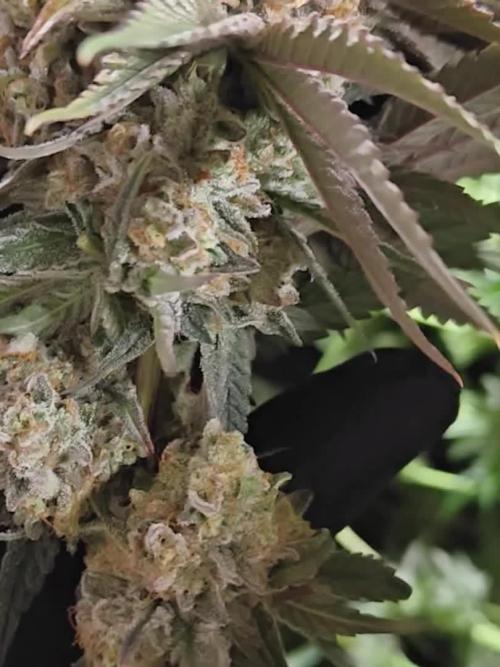
The photoperiodic Blue Dream gave us this magnificent main cola which is the most exciting visual part but guys, you should smell what this beauty has. A real marvel I am very happy with her. Also here excellent resin and resistance to the first heat.
** Remember that we have two plants per strain one left to grow straight and one worked with the techniques.
Description // This plant was simply left to grow straight, free and beautiful and the result was really excellent. The scent is its hidden strength, great fragrance in the room and soon in the jars. It did not give us particular problems and was very fast to flower.
Trichomes and maturation // We did a thorough microscopic analysis 10x (and 10x x 1.6) and noticed a good percentage of milky/lumpy trichomes; The percentage of amber trichomes was also excellent and still a bit transparent, but that's fine for us as we're not crazy about THC oxidation and hyper indica effects around here.
Fertilizers and soil // We used the Plagron organic fertilizer range, all the recommended additives and Pro Mix soil, both unfertilized and organic. Calculate the dosage according to your needs on the website
------ https://plagron.com/
The nutrients are available in convenient packs on the Zamnesia website
--------- https://www.zamnesia.io/en/11457-plagron-easy-pack-natural.html
Try this strain, it's more than promising ---- // https://www.zamnesia.io/en/3271-zamnesia-seeds-blue-dream-feminized.html
Zamnesia Short Description // Exceptionally tasty and potent, Blue Dream by Zamnesia Seeds is a distinctive and sophisticated hybrid. A blend of Haze and Blueberry strains, it manages to bring out the best of both worlds. Its short flowering time of just 9 weeks far surpasses that of other Haze strains!
From the moment you take your first toke of Blue Dream your taste buds will be intoxicated by a delicious blend of berry, citrus and sweet flavours. As for the experience, Blue Dream induces an incredible uplifting and euphoric high. But be careful, if you consume large quantities you will quickly be swept away to dreamland. This overwhelming potency not only makes Blue Dream particularly attractive to recreational users, but also to medical marijuana users. Those suffering from anxiety, stress, insomnia, depression, pain and lack of appetite will find this plant particularly effective in reducing symptoms.
The whole world of growing and more is at Zamnesia, just take a look at the site and you'll find "the best that nature has to offer" in various shapes and colors.
The new strains are fantastic and the old ones are no exception...
-- // www.zamnesia.com

Likes
51
Share


Likes
295
Share


@Ju_Bps
Follow
Hello growmies 👩🌾👨🌾🌲🌲,
👋 This week growing well, Preflowering started.
💡 I up a bit the supply of lamp each days.
💪 I've started the training.
💧 Give water each 2/3 day
And vaporise plant with water + Plagron Roots (1ml/l)
0.5 l Water + Roots + Easy plus
0.6 l Water + Roots + Grow
0.7 l Water + Roots + Grow
PH @6
RQS - Easy Grow Booster Tabs
1 tabs/5 l
RQS - Easy Micronutrients Plus
1 tabs/5l (1 watering each 10 days.)
💡Mars Hydro - FC 3000
27% 60 cm.
Mars Hydro Fan kit
Setting 5
Have a good week and see you next week 👋
Thanks community for follow, likes, comments, always a pleasure 👩🌾👨🌾❤️🌲
Mars Hydro - Smart FC3000 300W Samsung LM301B LED Grow Light💡💡
https://www.mars-hydro.com/fc-3000-samsung-lm301b-led-grow-light
Mars Hydro - 6 Inch Inline Fan And Carbon Filter Combo With Thermostat Controller 💨💨
https://www.mars-hydro.com/6-inch-inline-duct-fan-and-carbon-filter-combo-with-thermostat-controller
RQS - Titan F1🌲🌲
https://www.royalqueenseeds.com/f1-hybrid-cannabis-seeds/624-titan-f1.html


Likes
1
Share


@Pestitel
Follow
Amazing experience with the Mix Pack, I will try it again next summer for sure. Love the variety.

Likes
9
Share


@CampaCavallo
Follow
sempre più bella la nostra amica misteriosa🎄🤪
Qualcuno di voi sa dirmi che specie è?
Likes
34
Share


@MisterSix
Follow
Week 5 for my plant so far it might be 4 more week to go, i have cut down a little bit of nitrogen
The bud get nicer and got more trichomes but it seem not harden up by now.
I have 5 large branches as in the video and 5 other small branches, how many gram dry will i get anyone have a guess i'm excited
the last picture is the bud i cut down because the downside of it has greymold, i dry it for 5 day and cure for 6 day seem pretty nice, enter your thought :)
If there anything i would do in this stay to maximize the crop, need suggestion
Likes
30
Share


@DunDerma
Follow
* Setup *
Veg: 125W CFL
Bloom: Outdoor 12/12
Soil: Canna Coco
Pot: 3gal, 12L, Fabric pot.
Methods used: LST, Topping, Fimming, Defoliation, Neem oil misting
Wet weight: Not weighed/harvested entire plant yet, but harvested part, trimmed was 270g, and around 30g of sugar leaves, thats is in the freezer.
Wet bud on stick Weight: ca 480g
Fine trimmed Dry bud weight: 119g
The sugar leaves/popcorn nugs not weighed.
I also have 1/3 of the plant left to harvest, probably tomorrow.
After that I can give you the full wet weight, and hopefully in 2 weeks the full dry weight! (If I dont smoke to much if it before 😆)
Thank you all for following this diary.
And thank you @Sweet_Seeds for your fantastic seeds!
"Sweet seeds are made of this
Who am I to disagree?
I smoked in the world
And in the seven seas
Everybody's looking for something
Some of them want to smoke you
Some of them want to get smoked by you"
I got this plant as a present from my local club, supposdely its Cream Caramel from Sweet Seeds. It was around 2 weeks old when I got it.
I have no former experience of any type of growing cultivation, I recently Moved to a country where cannabis cultivation for personal use is legal.
I started this Journey by having the plant under 25W of homemade lamp solution and 6hrs of sun, until I could buy proper setup for vegetation.
Growdiaries really helped me learn alot fast and achieve results way above me and my girlfriends expectations.
I topped the plant Once, I accidently stepped on it, Vegged it under 125W Of CFL from week 3 onwards and then transitioned to Outdoor.
The weather around here has been the hottest in 60 years, averaging around 32 lately. Humidity has been stable around 50-70% with a average of around 60%
I really learned alot and this strain(which ever it now is, ill ask the club again!) is fantastic and most definently not Indica like.
"Its kinda like smoking candy" - Dunderma Grow

Likes
19
Share


@Naujas
Follow
everything turned out very well :) and it's only with 50w and with 40x40cm space :) It was an interesting journey with her, a slightly different cultivation and old mistakes were discovered :) the flowers are not dense, but they are really very, very sticky :) I'm happy:)
Likes
9
Share


@Bakeryguy420
Follow
Crusing through week 3 no problems. :) frost already showing really pleased with this one so happy I got 9 more seeds of this left :) ready get a tent filled with gelato only. But I lovd my mixed runs :) rest of the plants are doing great new phone :) as well super pleased with the camera quality
Likes
47
Share


@Ultraviolet
Follow
What's in the soil? What's not in the soil would be an easier question to answer. 16-18 DLI @ the minute. +++ as she grows.
Probably not recommended, but to get to where it needs to be, I need to start now.
Vegetative @1400ppm 0.8–1.2 kPa 80–86°F (26.7–30°C) 65–75%, LST Day 10, Fim'd Day 11
CEC (Cation Exchange Capacity):
This is a measure of a soil's ability to hold and exchange positively charged nutrients, like calcium, magnesium, and potassium. Soils with high CEC (more clay and organic matter) have more negative charges that attract and hold these essential nutrients, preventing them from leaching away.
Biochar is highly efficient at increasing cation exchange capacity (CEC) compared to many other amendments. Biochar's high CEC potential stems from its negatively charged functional groups, and studies show it can increase CEC by over 90%. Amendments like compost also increase CEC but are often more prone to rapid biodegradation, which can make biochar's effect more long-lasting. biochar acts as a long-lasting Cation Exchange Capacity (CEC) enhancer because its porous, carbon-rich structure provides sites for nutrients to bind to, effectively improving nutrient retention in soil without relying on the short-term benefits of fresh organic matter like compost or manure. Biochar's stability means these benefits last much longer than those from traditional organic amendments, making it a sustainable way to improve soil fertility, water retention, and structure over time. Needs to be charged first, similar to Coco, or it will immobilize cations, but at a much higher ratio.
a high cation exchange capacity (CEC) results in a high buffer protection, meaning the soil can better resist changes in pH and nutrient availability. This is because a high CEC soil has more negatively charged sites to hold onto essential positively charged nutrients, like calcium and magnesium, and to buffer against acid ions, such as hydrogen.
EC (Electrical Conductivity):
This measures the amount of soluble salts in the soil. High EC levels indicate a high concentration of dissolved salts and can be a sign of potential salinity issues that can harm plants.
The stored cations associated with a medium's cation exchange capacity (CEC) do not directly contribute to a real-time electrical conductivity (EC) reading. A real-time EC measurement reflects only the concentration of free, dissolved salt ions in the water solution within the medium.
98% of a plants nutrients comes directly from the water solution.
2% come directly from soil particles.
CEC is a mediums storage capacity for cations. These stored cations do not contribute to a mediums EC directly.
Electrical Conductivity (EC) does not measure salt ions adsorbed (stored) onto a Cation Exchange Capacity (CEC) site, as EC measures the conductivity of ions in solution within a soil or water sample, not those held on soil particles.
A medium releases stored cations to water by ion exchange, where a new, more desirable ion from the water solution temporarily displaces the stored cation from the medium's surface, a process also seen in plants absorbing nutrients via mass flow. For example, in water softeners, sodium ions are released from resin beads to bond with the medium's surface, displacing calcium and magnesium ions which then enter the water. This same principle applies when plants take up nutrients from the soil solution: the cations are released from the soil particles into the water in response to a concentration equilibrium, and then moved to the root surface via mass flow.
An example of ion exchange within the context of Cation Exchange Capacity (CEC) is a soil particle with a negative charge attracting and holding positively charged nutrient ions, like potassium (K+) or calcium (Ca2+), and then exchanging them for other positive ions present in the soil solution. For instance, a negatively charged clay particle in soil can hold a K+ ion and later release it to a plant's roots when a different cation, such as calcium (Ca2+), is abundant and replaces the potassium. This process of holding and swapping positively charged ions is fundamental to soil fertility, as it provides plants with essential nutrients.
Negative charges on soil particles: Soil particles, particularly clay and organic matter, have negatively charged surfaces due to their chemical structure.
Attraction of cations: These negative charges attract and hold positively charged ions, or cations, such as:
Potassium (K+)
Calcium (Ca2+)
Magnesium (Mg2+)
Sodium (Na+)
Ammonium (NH4+)
Plant roots excrete hydrogen ions (H+) through the action of proton pumps embedded in the root cell membranes, which use ATP (energy) to actively transport H+ ions from inside the root cell into the surrounding soil. This process lowers the pH of the soil, which helps to make certain mineral nutrients, such as iron, more available for uptake by the plant.
Mechanism of H+ Excretion
Proton Pumps: Root cells contain specialized proteins called proton pumps (H+-ATPases) in their cell membranes.
Active Transport: These proton pumps use energy from ATP to actively move H+ ions from the cytoplasm of the root cell into the soil, against their concentration gradient.
Role in pH Regulation: This active excretion of H+ is a major way plants regulate their internal cytoplasmic pH.
Nutrient Availability: The resulting decrease in soil pH makes certain essential mineral nutrients, like iron, more soluble and available for the root cells to absorb.
Ion Exchange: The H+ ions also displace positively charged mineral cations from the soil particles, making them available for uptake.
Iron Uptake: In response to iron deficiency stress, plants enhance H+ excretion and reductant release to lower the pH and convert Fe3+ to the more available form Fe2+. The altered pH can influence the activity and composition of beneficial microbes in the soil. The H+ gradient created by the proton pumps can also be used for other vital cell functions, such as ATP synthesis and the transport of other solutes. The hydrogen ions (H+) excreted during photosynthesis come from the splitting of water molecules. This splitting, called photolysis, occurs in Photosystem II to replace the electrons used in the light-dependent reactions. The released hydrogen ions are then pumped into the thylakoid lumen, creating a proton gradient that drives ATP synthesis.
Plants release hydrogen ions (H+) from their roots into the soil, a process that occurs in conjunction with nutrient uptake and photosynthesis. These H+ ions compete with mineral cations for the negatively charged sites on soil particles, a phenomenon known as cation exchange. By displacing beneficial mineral cations, the excreted H+ ions make these nutrients available for the plant to absorb, which can also lower the soil pH and indirectly affect its Cation Exchange Capacity (CEC) by altering the pool of exchangeable cations in the soil solution.
Plants use proton (H+) exudation, driven by the H+-ATPase enzyme, to release H+ ions into the soil, creating a more acidic rhizosphere, which enhances nutrient availability and influences nutrient cycling processes. This acidification mobilizes insoluble nutrients like iron (Fe) by breaking them down, while also facilitating the activity of beneficial microbes involved in the nutrient cycle. Therefore, H+ exudation is a critical plant strategy for nutrient acquisition and management, allowing plants to improve their access to essential elements from the soil.
A lack of water splitting during photosynthesis can affect iron uptake because the resulting energy imbalance disrupts the plant's ability to produce ATP and NADPH, which are crucial for overall photosynthetic energy conversion and can trigger a deficiency in iron homeostasis pathways. While photosynthesis uses hydrogen ions produced from water splitting for the Calvin cycle, not to create a hydrogen gas deficiency, the overall process is sensitive to nutrient availability, and iron is essential for chloroplast function.
In photosynthesis, water is split to provide electrons to replace those lost in Photosystem II, which is triggered by light absorption. These electrons then travel along a transport chain to generate ATP (energy currency) and NADPH (reducing power). Carbon Fixation: The generated ATP and NADPH are then used to convert carbon dioxide into carbohydrates in the Calvin cycle. Impaired water splitting (via water in or out) breaks the chain reaction of photosynthesis. This leads to an imbalance in ATP and NADPH levels, which disrupts the Calvin cycle and overall energy production in the plant. Plants require a sufficient supply of essential mineral elements like iron for photosynthesis. Iron is vital for chlorophyll formation and plays a crucial role in electron transport within the chloroplasts. The complex relationship between nutrient status and photosynthesis is evident when iron deficiency can be reverted by depleting other micronutrients like manganese. This highlights how nutrient homeostasis influences photosynthetic function. A lack of adequate energy and reducing power from photosynthesis, which is directly linked to water splitting, can trigger complex adaptive responses in the plant's iron uptake and distribution systems.
Plants possess receptors called transceptors that can directly detect specific nutrient concentrations in the soil or within the plant's tissues. These receptors trigger signaling pathways, sometimes involving calcium influx or changes in protein complex activity, that then influence nutrient uptake by the roots. Plants use this information to make long-term adjustments, such as Increasing root biomass to explore more soil for nutrients. Modifying metabolic pathways to make better use of available resources. Adjusting the rate of nutrient transport into the roots. That's why I keep a high EC. Abundance resonates Abundance.
Likes
13
Share

@Huntablunt
Follow
High!
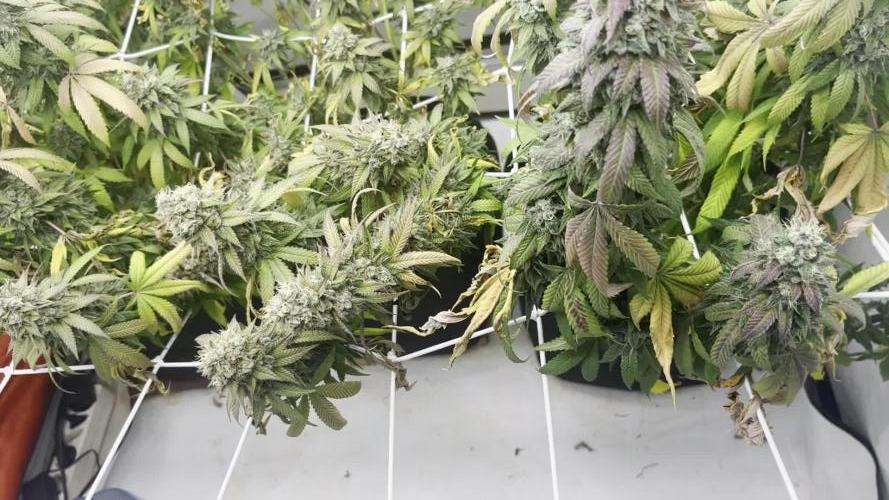
The final courtain fell today.............I am amazed and will report again after curing......smell, looks is just amazing. After ripping of the leaves of these resinous buds I had 1,5g of hash in my hand.....

Likes
8
Share

@HowtoBubatz
Follow
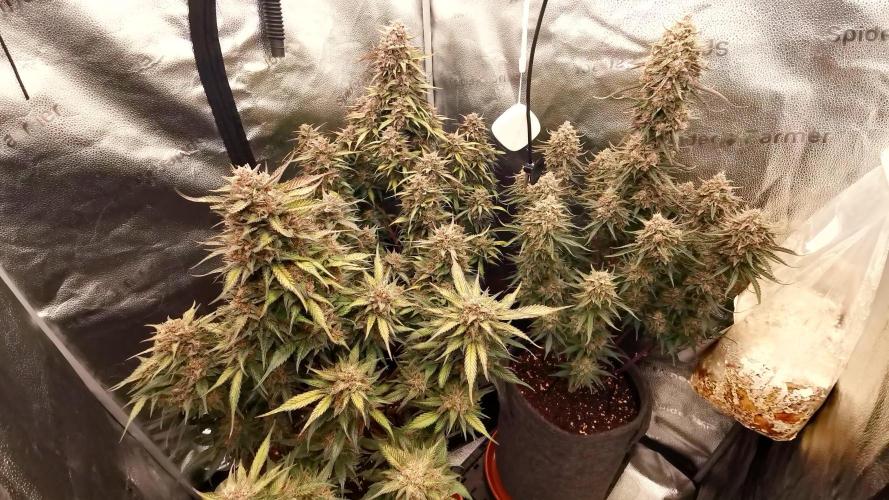
We’re deep in bloom now, and the buds are fattening up nicely on all three ladies!
The scent is getting stronger by the day and interestingly, while they all share a base note of red pepper, each plant has developed its own unique aroma twist.
Really curious to see how that translates after the cure. Overall, everything’s going smoothly, no issues to report. They’re happy, healthy, and stacking up beautifully. Let’s keep it rolling! 💪🌿


Likes
73
Share


@MisterZ
Follow
Bonjour les amis,
Pas de changement morphologique cette semaine mais la résine est apparue en même temps qu'une légère odeur.😻
M.

Likes
29
Share


@BusyBeeFarmer
Follow
Week 7: Preparing for Flowering
At the beginning of the week, we installed the net, marking the final stretch before flipping to flower. The plant is growing beautifully, and I’m genuinely impressed by its vitality. All the training seems to have had no negative impact—she’s handling everything like a champ! 💪🌿
By the end of the week, it’s finally time to switch to flower—wish me luck! 🍀
Challenges this week:
Temperature: ~26°C
Humidity: ~35%
VPD: A whopping 2.4!
Not exactly ideal, but thanks to the large fabric pot, she had enough water to keep going strong while I was on vacation. 🌱💦
We’re still seeing light-colored tips, and she’s putting on a final growth spurt before I flip the switch! 🌸🚀
Likes
41
Share


@Skinnytalls420
Follow
Day 29-19/11/21 I’ve gave them nice bit of water today with bio grow and bloom. They are starting to bud!!!! Day 30-20/11/21 nothing new today just letting them grow!!!! Day 32- 22/11/21 I gave them water yesterday but forgot to take a pic a post it but everything is looking good!!!! Day 33-23/11/21 nothing new today but made a nice video for u all!!!! Day 35-25/11/21 I watered yesterday and I think I got a bit of burn I don’t know why but yeah tips are yellow!!
Likes
44
Share


@rudiak
Follow
Hey everyone!
It’s been another fabulous week of the girls fattening up getting ready for the ever looming harvest time! The colas are huge and glistening like a glitter ball!
The back right girl has been on flush since day 51, 2 more went on flush on day 53, and the final girl front right went on flush today, day 56!
Over the week I gave 3 girls a really heavy defoliation taking the majority of fan leaves off to allow good airflow and try fattening up those lower buds. It’s still impossible to tell if I prefer defoliation or not but we are getting close to harvest so should have a definitive answer to that soon! The back right girl has had absolutely no defoliation or trimming through her life cycle.
I still regularly think back to when we broke one of the girls and transplanted, the cannabis gods were on our side warning us 4 girls will be huge, we were very lucky or would be seriously short of space as of now.
As the girls are going to be harvested at slightly different times to ensure each are at their optimum, I have had to construct a dry box.
How I built my smell free DIY dry box:
Take a large cardboard box, cut an extraction hole in the top at one end and mount some ducting and seal the gap around the edge. Cut a flap in the opposite end at the bottom which will be the passive intake and promoting a draft through the hanging buds. Poke some holes in each end of the box using a screwdriver and thread some thin rope or string through the box tying the ends together once finished to give you sturdy locations to hang some pegs from. Finally I attached an extra bit of card on one of the flaps at the top; this overlaps the slight gap in the top between the flaps that could allow light to enter. Once completed I put the ducting into one of the lower intakes of the tent; the negative pressure in the tent then uses the air in the dry box as a passive intake creating a smell free area to dry your cannabis outside of your grow tent. This also keeps a slight breeze flowing through the box to ensure even drying.
Happy toking guys and hope you enjoy the pics and vids, thought it was getting hard to tell how big these girls were in pics anymore so the vids help a lot, and I was lazy this week! :P
Likes
28
Share


@GanjaGecko
Follow
Die Woche 2 der Blüte haben alle 3 Ladys ordentlich an Höhe zugelegt. Alle haben sehr schöne Blütenansätze die auch schon einen lieblichen Duft verströmen💚
Mit dem Wetter hatte ich relativ Glück. Das Unwetter zog hier vorbei, nur 2 Tage ohne Sonne und wenig regen. Was aber auch weniger gießen mit sich brachte. Jetzt stehen die Ladys wieder seit 3 Tagen in der Sonne und entwickeln sich prächtig.
Es gab 1× an Tag31/10F 1g/L BioEnhancer von GreenHouseFeeding. Je Ladys gab es ca 500ml mit einem ph-Wert von 6.7.
Ansonsten hab ich die Töpfe angehoben und nach Bedarf etwas nachgegossen.
GorillaZkittlez: 66cm
GorillaAuto: 81cm
StrawberryB: 86cm
Immer gemessen ab Subtratoberfläche.
Vielen Dank fürs reinschauen🤙🏻💚