


Likes
Comments
Share


@CanadianFillmore
Follow
Welcome growfessors to my latest run of my all time favorite strain Super Lemon Haze. This was the last clone I took from a SLH mother plant I had started from seed. This clone has been very slow to develop and grow over the last 14 weeks, I've decided I'm going to flip her over to flowering in a couple weeks, instead of using her as a new mother plant.


Likes
10
Share


@Big0zGrower420
Follow
Hey everyone,
I may have stressed her out too much in the beginning:/ she’s been staying small but growing still, looks healthy but we will see what happens I guess. Will run her till she’s done but not sure what the outcome will be.
Have a great week

Likes
8
Share


@Roberts
Follow
Fast version B is doing good. She is vegging good. Everything is looking great. Thank you Dutch Passion, SSSC, Athena, and Medic Grow. 🤜🏻🤛🏻🌱🌱🌱
Thank you grow diaries community for the 👇likes👇, follows, comments, and subscriptions on my YouTube channel👇.
❄️🌱🍻 Happy Growing 🌱🌱🌱
https://youtube.com/channel/UCAhN7yRzWLpcaRHhMIQ7X4g.
Likes
13
Share


@Bryankush
Follow
Settimana di lavaggio probabilmente la sua ultima. Le cime al tatto sono appiccicose ma più che altro farinose , emanano un aroma tropicale favoloso😋
Giorno 3 viene annaffiata con 1L di acqua a 0 ppm
Giorno 7 oggi pomeriggio verrà tagliata
Le cime sono veramente compatte e piene di resina come vedete nel video. Nel vassoio sottostante ci sono a sinistra la cima centrale e a destra l'altra apicale simmetrica.

Likes
Comments
Share


@Laylowandgrow
Follow
Had to defoliate again in week 5 day 32 so far we defoliated 3 times , day 19, day 26, and day 32.
Start of week 6, this next 2 weeks the plants should triple in size and start crowning,and all defoliation are done.

Likes
25
Share


@JonnyKush
Follow
day 73
I was not ready for all this! 🤣🤣 they literally exploded, even though the buds of El Patron are much thinner than the purple queen I have in my tent, I had to tie them up so that the weight of the flowers didn't break the branches. I have to say that 6 photoperiods are too many for my 1m x 1m x 2m tent. in addition to this I have noticed that they are very hungry. like me and give me some advice. thanks for stopping by, have a nice day and happy cultivation 💚🌳💚🌳
Likes
27
Share


@Ganjagrandaddy
Follow
Hi Growmies
I hope your week had been as productive and fun as mine and that your flowering is progressing.
It has been a very easy week to manage their needs. Nicely set and with lots of light per plant , we have a lot of clusters of pistils throughout their whole structure. Keeping the humidity lower now is helping to reduce the risk of bud rot with so much vegetation and fresh pistils to feed it. It will also help raise the oils needd within the girls to keep them supple amd attractive to those buzzy friends they hope to attract. The smell of sweet pineapple is so strong in the room now and their stickiness from resin is really starting to show itself now. It is evident that the plagron products have had a substantial effector the progress now with so.mamy sets of flowers lower in the canopy too. Seeing other grows of the Biscotti not using the products , there is a difference in node lengths between flowers without doubt. The flowering plants are nice and stocky compared to most of my previous grows sonit has been easier to keep them well within the lights sweet spot
With just 2 weeks left that will hopefully be the adding weight and second flowering sets kicking into play too , a good yield could be on the cards.
I do seem to have 2 phenotypes off the Biscotti running so it will be interesting to see how they differ at the end for yield etc..
I have added a small greenhouse heater to bring the temp up a little and help with the humidity control too as we are experiencing a very cold snap again in good old Blighty.
All in all a great week with a more to follow hopefully. 😀
Be lucky and stay safe among the chaos unfolding.......

Likes
24
Share


@Doubleb84
Follow
Great harvest! Ended up a little shy of 12 ounces from the two plants, all super dense sticky top buds!! It’s smooth, flavorful and strong! Love it!

Likes
6
Share

@Nedizzle
Follow
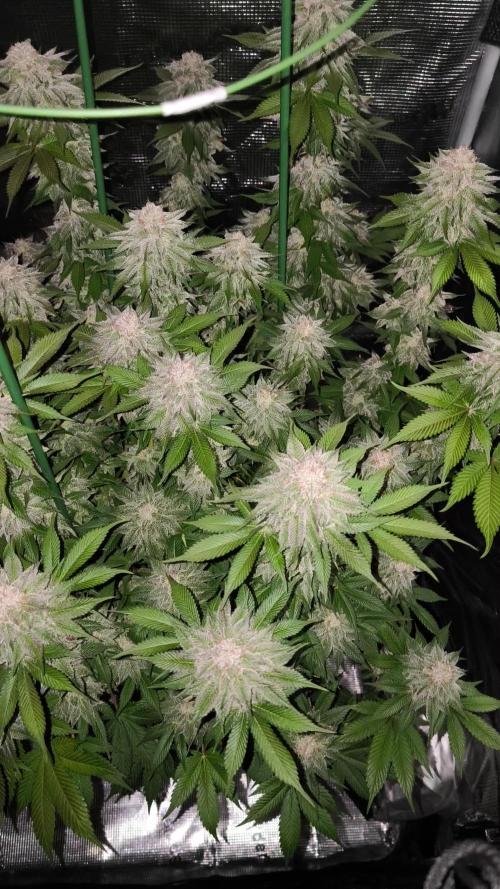
One more week. Everything is changing colors. It smells and looks beautiful.

Likes
6
Share


@Xpie77
Follow
This was a 1 plant going from outside to in. Didn't know what to do but she ended like Crazy 😧 😧 😧 😧

Processing
Likes
105
Share


@Green_Friends_Inc
Follow
Commencing week 4: Day 22 on November 14th
Day 22-ph'd back to 5.8x range from 5.5 to 6.1
It
Day 23- added 5ml Clonex to each buck and ph'd. Ppm around 600-650
Day 24- added a little fertilizer salts for N mostly and then ph'd again. Ppm 750-850. Also turned on a few more lights as well as turned timer off to increase temps in lieu of pending storm. Also adding passive humidifier to at least help with the coming dip in humidity from snow outside.
Day 25- pass few days are going well. Aside from a heavy dip in the temp and humidity last night (we have a bit of snow come already). Plants seem to be picking up the pace a little finally. Not much but A little bit which is great because it feels like I've been watching paint dry lol
Day 26- plants are doing great. Seem to be happy 😄 despite or maybe because of the changes over pass two days. And..,.we have roots in water!!!!!! So far gorilla zkittlez2 and gorilla zkittlez3 both have a few roots in the nutrient solution. Now I expect growth rate and work to pick up soon. Hopefully the rest get their feet wet soon 💧
Day 28 last day of week 4 Nov 19
Some plants went from seedlings to "hardened off" this week nearly tripling and doubling in size as well as starting with the secondary growth. Some still a little behind. I've noticed all the Gorilla Zkittlez are simply growing much faster then the rest so far. And that out of the three GZ s one seems to be leaving more hybrid or possibly sativa (see pics) .
Also one or two of the plants seems to have some funny traits like the Boss Hogg1 very purple and covered in baby hairs.
Overall I am amped to see the growth in the coming two weeks and expect big changes 👍👍
Thank you all! who view, like, comment, follow, and support me. I swear it will be much more exciting grow soon!😎


Likes
29
Share


@MadeInGermany
Follow
Info:
Unfortunately, I had to find out that my account is used for fake pages in social media.
I am only active here on growdiaries.
I am not on facebook instagram twitter etc All accounts except this one are fake.
Hey everyone :-)
Another nice week goes by and it is slowly becoming a bush from training 😊.
This week it was poured 2 times with 1 l each time (For nutrients, see the nutrient table above).
She was trained once again with topping.
You still have some time until it blooms until space is free :-).
Otherwise everything was checked and cleaned like every day.
Have fun with the update and stay healthy 🙏🏻
You can buy this Nutrients at :
https://greenbuzzliquids.com/en/shop/
With the discount code: Made_in_Germany you get a discount of 15% on all products from an order value of 100 euros.
You can buy this Strain at :
https://www.amsterdamgenetics.com/product/kosher-tangie-kush/
Type:
Kosher Tangie Kush
☝️🏼
Genetics:
Kosher Kush
X
Tangie
👍
Vega lamp:
2 x Todogrow Led
Quantum Board 100 W
💡
Bloom Lamp :
2 x Todogrow Led
Cxb 3590 COB 3500 K 205W
💡💡☝️🏼
Soil :
Canna Coco Professional +
Nutrients :
Green Buzz Liquids :
Organic Grow Liquid
Organic Bloom Liquid
Organic more PK
More Roots
Fast Buds
Humic Acid Plus
Growzyme Big Fruits
Clean Fruits
Cal / Mag
Organic Ph - Pulver
☝️🏼🌱
Water: Osmosis water mixed with normal water (24 hours stale that the chlorine evaporates) to 0.2 EC. Add Cal / Mag to 0.4 Ec Ph with Organic Ph - to 5.8


Likes
3
Share


@Twolargedabs
Follow
Loved growing. Definitely one of the best buds i have smoked. Trimming was enjoyable.

Likes
2
Share


@TowersD
Follow
In the beggining of week 4 of flower the phenos are showing differences.
Nanaz x BBC are way toller that the Headbands.
Also, Nanaz x BBC #2 has no pistils but it is a female plant. I have that happened before when I grew the Banana Butter Cups S1

Likes
13
Share


@Swamp81
Follow
Week 5 looking good!
Easy going so far. No problems at all and still growing strong. Put on another few inches of height and signs of flowering have burst through.
Starting to get a lovely sweet smell now
Likes
2
Share


@Aleks555
Follow
Our beauty is now 9 weeks old and is in full bloom, delighting us with her appearance and aroma. Her buds are getting covered in a thick layer of fragrant trichomes, and the air is filled with a pleasant fruity scent—promising a wonderful finish.
The climate in the tent remains stable: daytime temperature is 28°C, nighttime drops to 21°C, and humidity is kept at 65%. The light schedule is still 12/12, and we continue using CO2 to support the flowering process. We’re also consistently feeding her with Xpert Nutrients, which provide everything she needs during this critical stage.
A huge thank you to Xpert Nutrients for their top-quality fertilizers that drive such vigorous flowering, and to Seeds Mafia for the amazing genetics that gave us this strong and aromatic beauty. We’re eagerly looking forward to the moment she fully ripens and rewards us with a great harvest!
Likes
16
Share


@simps
Follow
The bud development on this strain has been great rock hard buds I mean rock hard really nice quality bud heavy the resin production is super high it’s been cold at night for a week 48 as the low it has this girl oozing with resin very pungent smells of Fuel so dank smells like pine fuel citrus and a touch of skunk I’m very happy with the quality of this strain
Likes
4
Share


@TheGreenGroomer
Follow
🌱 Week 5, Day 1 – Veg Update 🌱
Hey everyone! We’re officially on Week 5, Day 1 of the veg cycle, and everything is looking fantastic so far! The plants are healthy, vibrant, and showing some solid growth, which has me excited to flip them into flower soon—maybe at the start of Week 6, but I’m taking it day by day.
That said, I have noticed a bit of nutrient burn creeping in, which is a little strange considering the PPMS are sitting at just 450 ppm. The PPFD output is also where it should be, so I’m thinking it could be a minor fluctuation in nutrient uptake or possibly slight environmental factors playing a role.
To be cautious, I’ve dialed back the feeding a bit to see if that helps. I'll give it a couple of days and keep a close eye on them. The goal is to give them a solid week of recovery before we hit the next big step.
Once we hit that one-week mark, it’s time for a deep, heavy lollipop and some defoliation to really clear out the lower growth, ensuring all energy is focused on the top colas. After that, we’ll flip them into flower and get that SCROG net in place. Things are about to get real! Stay tuned for more updates as we get closer to flowering! 🌸