


Likes
Comments
Share


Likes
3
Share


@Luke_Lee
Follow
—————————————————————
WEEK 1 / DAY 01-07
Mars Hydro FC-E3000
Floragard Professional GrowMix
11L Plant bag made of fleece
Light: 50 cm / 25%-75watt;
Schedule: 24/0;
20° C - 55 RH
150ml water per Plant
PH 6,5-7
0ml BioGrow; 0ml TopMax ; 0ml BioBloom
#1 Royal Critical Automatic
#2 Royal Critical Automatic
Fan, extractor and pump ON 24/0.
—————————————————————-
These are the two at the bottom left (green brackets)
-24.01.2025
Both seeds have sprouted successfully after 3-4 Days
-26.01.2025
Today is the last day of the first week. The little ones are doing well, the first few “real leaves” have appeared and the vegetation phase can begin
19.5° C - 78RH
Total Time: 193,39h
Total Energy: 25,04kWh

Likes
18
Share


@Cockneycultivar
Follow
Week 8
Apart from having some issues with a high run off I think she’s growing ok. Although she doesn’t look very healthy at the moment. I am not sure if it’s because I left my soil tester inside the soil. In which case I’ve taken it out now to see if there’s any difference.
She has yellowing leaves Burt tips and and brown spotting. I presume something isn’t right but being so close to harvest I don’t wanna set her back 2 weeks. Tomorrow morning will be day 59 going into week 9.
Shall I keep feeding or just ph water it? I don’t want it to affect my yield.
From one stoner to another your advice is appreciated always x peace out. Live, laugh be healthy and eat weed. Big love to all you growers. Happy new year !! 2021 let’s hope it’s the year they legalise this wonderful plant in uk. Wishful thinking but you never know aye.
Cockneycultivar


Likes
19
Share


@ThatoneAKguy
Follow
So here it is. The story of the six shooter. I left these ladies to their own device with very minimal LST and not topping for the single cola effect. I really like topping my autos personally just before flower but that’s just me. This strain has thre very consistent characteristics. Rock hard flowers, super floral smelling and as many sugary leaves as Any other I’ve seen. They did great with the nutrients I gave them and are a fan favorite for sure. In the photos are a moon rock I made for fun and all aspects of the final plant harvested.

Likes
72
Share


@BodyByVio
Follow
This week I had to Lollipop again (I know is very late and I hope I didn’t stressed the plant to much).
My canopy is so tick and so many overlapping leaves and buds in the center of the plant that don’t receive enough light or any at all , n combination with the RH swings that I got going on (45 and 63 RH), I’m very afraid of mold. I should have did a better job at Lollipoping from day 21. I’m inexperienced grower and I didn’t knew better.
I decided is better to risk to shock the plant a little bit risking a reduction in yield then get mold or pests and lose it all.
My 30 pin dehumidifier works great with the AC but sometimes when the AC( compressor) stops my RH jump at 62% -63%, witch I don’t like . I’m trying to keep the humidity around 50% but in such a small room between the AC and Dehumidifier I got big swings in temp ( 75-82) and RH ( 45%-63%) witch is not ideal but is nothing that I can do. I played with the AC and Dehumidifier setting a lot trying to keep humidity around 50% and temp around 80 degrees and that’s the best I can. My AC is set at 82 degrees and my Dehumidifier is set at 45% RH.
Also during the lights off (day time) is very hard to keep the temperature In control when outside is 110-115 degrees with my portable AC (1400BTU) in the 4x 6 closet. Is crazy but I do my best to keep temp under control.
This is another rocky mistake I made is trying growing weed DWC in the middle of summer where temps are 105-115 degrees constant in a closet without centralized AC port and at second level in the building. LOL
Also I think I underfed her (630 PPM TDS, PH 5.8-5.9) ) and I got a Ca deficiency witch I think is the reason my flowers developed slower then I anticipated.
Hopefully I’m wrong and everything will be good.
P.S. I got a little bit of calcium deficiency caused by salt buildup (to much PK boost) despite my earlier belief that is underfed.
I increased the PPM from week 4 (630-640TDS) to 680 TDS) on week 5 while I kept the PK booster at 3+ml l per gallon. Slightly my PPM’s was rising in my reservoir for few days until I decided that my plant can’t take that much nutrients (PK). 2-3 days after I increased the TDS I’ve noticed more spots on the lower leaves with tip burns on top ( first signs of PK toxicity). One day later found spots and yellowing of the leaves on top of the plant that indicates Ca deficiency caused by salt buildup ( PK toxicity) and reversed osmosis (hope I’m not wrong). Going into week 6 I lowered the PK boost at 1.5ml / gallon and total TDS to 640 PPM. Seems like leaves damage to stop and my PPM to stay stabile at 630-640. Trying to keep PH at 5.8 max 5.9.
I will post pictures of my Ca deficiency/ PK toxicity.
If you guys have any suggestions please leave me a comment.

Likes
136
Share


@Kitties_and_Colas
Follow
~_~_~_~_~_~_~_~_~_~_~_~_~_~_~_~_~_~_~_~_~_~_~_~_~_~_~_~_~_~_~_~_~_~_~_~_~_~_~_~_~_~_~_~_~_~_~_~_~_~_~_~_~_~_~_~_~_~_~_~_~_~_~_~_~_~_~_~_~_~_~_~_~_~_~_~_~_~_~_~_~_~_~_
💡🌱🤘🐱 Week 10 of flower! Amber trichomes are starting to form, we're cloudy in most sections but there's still a bunch of clear a little deeper in. This is probably their last full week..we cut all nutrients nearly a month ago and have been watering heavy (as we typically do during flush) but they have only lightened slightly, we use a soilless media which should be completely flushed out by now but most the leaflets are still super dark, after seeing several other grows of this strain we assume it must be characteristic of B.B..we have 4 grow areas in our grow room and the Bangers can be smelled over everything else.. It smells like Fruit Loops with notes of gasoline 🍓⛽...The SP-3000 by MarsHydro is an absolute beast in a 4x2, this is our 2nd grow under The SP-3000 and we completely filled the 4x2 on both occasions. Each run resulted in massive, compact Buds just covered in resin..its without a doubt the best LED of its size we have in house or have ever been privileged to use honestly...
Full disclosure: we got a little impatient starring at these girls, so we (well I did lol) pulled down a bud 2 days ago (approx. 10grams) and immediately threw it in the oven for decarb..we made a 5oz batch of tincture and this is easily the "speediest" Seedsman strain I've tried to date, its a surprisingly clear headed high, definitely a daytime smoke..however, may have a different opinion after a proper dry and cure..we'll update our smoke report after drying...thanks as always for dropping by and happy harvests everyone!! ❤️💡🌱
⚡Mars Hydro/SP-3000⚡ Specifications ⚙️:
Diodes: Samsung LM301B / Osram 660nm (960 total!)
Driver: Meanwell 300watt 🔌 (300W±5% @AC120V-277V)
PPF: 824umol/S ☢️
PPE: 2.8 µmol/j 〰️〰️
Lifespan: 50k+ hrs ⌛
Weight: 10.1 lbs (4.6kg)
Veg Coverage: 3 x 5 ft 🌱
Flowering Coverage: 2 x 4 ft 🌼
-The SP-3000 uses an aluminum heatsink (no fan) and the driver can be placed outside the tent 🌡️⬇️
-IP65 waterproof ratings, tolerant to high humidity grow environments 💦 ..
-Up to 15 can be daisy-chained together and all controlled from a single light! 💡~💡~💡~💡~💡
~_~_~_~_~_~_~_~_~_~_~_~_~_~_~_~_~_~_~_~_~_~_~_~_~_~_~_~_~_~_~_~_~_~_~_~_~_~_~_~_~_~_~_~_~_~_~_~_~_~_~_~_~_~_~_~_~_~_~_~_~_~_~_~_~_~_~_~_~_~_~_~_~_~_~_~_~_~_~_~_~_~_~_

Likes
4
Share

@frigo_camelo
Follow
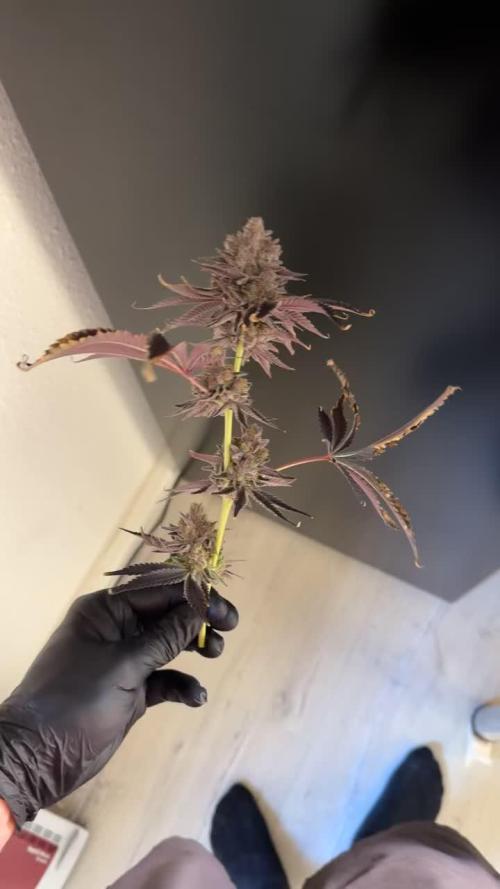
Harvest after 8.5 weeks 🤘🏻 fruity smell , insane cut , will se how its washing in winter , its in the freezer now
the cut was from hanfgarten.de
Likes
90
Share


@AsNoriu
Follow
Day 50. Had big plans, but postponed them to monday/tuesday. Will strip and heavy bend/lst girls, give them 5 days and i think they will be ready for flower.
Increased light power output from 50% to 70%. Girls got water with 0.5 ml/l Fish Mix.
Overtimes and all weekend at work stops me a bit, but work is work ...
Day 54. Girls got heavy training, started it even too late, leaves were too droopy. All went good, while last one was done, first were somewhere "happy" ;)))
Pure water.
Think to send them to flower this weekend.
Day 55. And like nothing happend ;))) All girls are happy and bushy, one or two days, darkness and FLOWER TIME ! ;)
Happy Growing !

Likes
200
Share


@Ferenc
Follow
Day 79, 28th of November 2020:
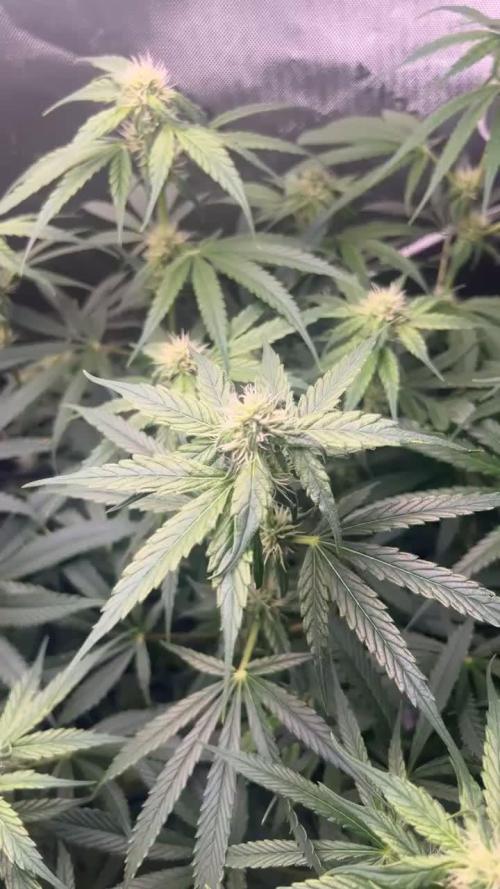
Hi there! Here we go let's say half way. Plants are pretty these Original Sensible Seeds genetics are fantastic! The 2 OG and the Runtz Gum is very strechy.
Black Ghost is pretty shorter bushier plant. Runtz Gum and Do-Si-Dos OG approx the same height Do-Si-Dos OG is taller a bit.
Wedding Gelato is really cool little, bushy anf nice buds forming not problem with her all she is quiet.
Do-Si-Dos OG has some deficiency and leaf gets dry but nothing very serious.....
Fertilization is still the same every second day with the rationand mixture above stated.
The lamp is on 11.15 min and off 12.45 min.
Last week was 15 min longer light cycle....
So every week 15 min shorter light cycle until the 5th week. So far -45 min. It switches on at 6 am and off at 17.15 pm.





Likes
2
Share


Likes
22
Share


@valiotoro
Follow
I’m in love with the straw gorilla 😍🤩🍓
All the top buds ready✂️
The colors & the smell pouaaah out of this world !!
One more week for the lower buds and finito bye bye


Likes
16
Share


@Prototype0181
Follow
End of week 8 it's almost time for the chop. Really gonna mis this Vieuw


Likes
68
Share


@I_and_I
Follow
Start of week 5, lady continues to put on weight and crystal
Looking and smelling great, I have high hopes for this plant 😂😂😂
The gorilla zkittlez seems to be the most developed of the plants, expecting a fairly shortish flower time, will see though
Likes
25
Share


@MrJoint
Follow
🛁 Beginning to clear nutrients.
✌️🎃 Thank you for checking my cultivation.
Likes
27
Share


@Smokepurple137
Follow
I'm happy with the progress they have made, all have responded well to defoliation and LST. I'll be adding a few more light nutrients at some point this week. The gorilla zkittles is shorter than the rest but looks very sturdy and has plenty of bud showing already, I think this is because it started flowering maybe 7days before the rest and in them 7days the rest shot up rapidly! I'll update daily and try get some nice videos with lights out.
Likes
4
Share


@Boscaglia
Follow
Finally time to chop off the second plant. Harvested just when about 5-10% of crystals have turned to ember color in an attempt to get the most upper effect out of this sativa.
Noticed yet again some bugs on the leafs, luckily enough they only showed up in noticing numbers towards the end but ffs I'm getting tired of soil, especially after trying hydro.
My main conclusion is that BioBizz soil is just not good to use as is, no matter what, it ends up not draining water well enough.