


Likes
Comments
Share


@JUNGLE_B4RNS
Follow
Hello folks ! Back from holidays, the plant keeper did not so bad ! Following recommendations from a piece of paper and readjusted after sending pictures. All the plants on the drain tables had recovered well from over feeding. Only 2 plants didn’t recovered, coming from another seeds bank and growing in pots with cups. White Label genetics are suitable for new growers and will forgive wrong moves like Nutrients excess as you can see 😉
Week 2 of flowering, some plants suffered from over feeding around week 6-7 of Veg. But everything should be fine now. Flowers start to show. I had to trim the legs and small shoots not reaching canopy to avoid any waste of energy for the plants.
Canopy is dense and thick, I feel like playing at Jumanji sometimes 😅😂
(I’m looking for a job in the Cannabis industry as Master Grower, Mineralogist, Quality Control)


Likes
18
Share


@Ageddd
Follow
She is starting to getting fat, at the begginning of this week, it was raining, but in the middle of the week, sunny days are appearing, and she is loving it, drastically increased eating levels, in 1-2 days, lower leaves started to yellow, but i noticed soon and gave a good dose with 4ml/l Top BLoom + some carbohydrates, Top Candy 2ml/l, and now she is lovin it.
That purple colours appearing...no words... Simply a blessing, even more beautiful :D
Last videos are about what i think are Chemtrails, like ie said before, the week started with rainy days, but when the sun came, this kind of biodegradable material appeared again like it is usual, it could be identified as spiderwebs if you dont look closer, but when you touch it is like soap and disappears... Guys and Ladies, let me know what you think if you want to stick a comment :)
Take Care GD !!!

Likes
34
Share


@PrairieFrostGrow
Follow
**** Week 3 Veg - December 26/20 to Jan 1/21 *****
That is two weeks in solo cups and this will be transplant to 1 gal pots week. The girls are doing fine and not always perked up but I think a new home will help change that. They have been happy and noticed that when they were given a stronger feed at the end of last week they responded very well the next day and looked very healthy. Add that I am starting to see some purpling on the stem and I think they are ready for full on veg cycle to kick in.
Not a lot of excitement her either Growmies😀 just to early with nothing go on other than making sure they are alive each day 😂😂 So for this week we will give the roots a new home, step up the ppm on veg feeding. Add in microbes to help the root development and keep the environment in the same 82 degrees and humidity in the mid 60's.......I am not supplementing with CO2 so keeping everything a little lower with feed, light, and humidity. They are growing veg well with the blue light and are very happy with the current 28" distance. Will maintain and let them grow into the light more until I see negative signs and then start raising the light with them as they grow.
That's what I have to add at the start of the week.......see how the days unfold😀
Little more detail........
Dec 26/20, Day 15 Veg
- Dry out day
- Let the microbes in the media do their thing and start pushing root growth harder than what has been happening.
Dec 27/20, Day 16 Veg
- Gave the girls a little splash of the left over nutes from 1 gal girls two days ago to add a little oxygen and they can take the extra microbes and bacteria right now😀
- 100ml with Microbial Mass and Piranha @ 2ml/L = 650ppm and 5.7pH
Dec 28/20, Day 17 Veg
- 100ml each girl with the full line for this week. No other additives, just the IPP line = 700ppm and 5.7pH
- This was also from the big girls.....I am thinking that they are ready for transplant so will give them a little high feed today.
Dec 29/20, Day 18 Veg
- It is transplant day.......we need to keep this party moving along. She may not have the root mass I am after but I am moving forward.
- Prepared 1 gal pots with Mycorrhiza added to the holes.
- Gave each girl 500ml watering with full strength IPP line for week 1 veg = 700ppm and 5.8pH
- Root mass on these girls was very poor......there were roots.......keep stepping up the microbes with all of the girls!!!!!!
Dec 30/20, Day 19 Veg
- they were just watered heavier yesterday........dry out day today
- think it is a CalMag only feeding tomorrow for all the ETS girls.
Dec 31/20, Day 20 Veg
- feed day today since it has been a couple of days.
- 500ml with CalMag @ 2ml, Gold Storm @ 7ml, Sea Storm @ 5ml, Blackstorm @ 2ml, Vitamin B @ 0.5ml = 525ppm and 5.7pH
- keeping the humic and fluvic acids going in, plus Kelp and CalMag👍
- the girls are happy and seeing forward movement everyday, looking for more aggressive though from the girls.
Jan 1/21, Day 21 Veg
- doing very well......like really well💪
- didn’t push them today and left them alone for watering, pots of course still had some weight and I didn’t expect them to need today.
- Optic Folier Overgrow given today. Folier spray to give them just an extra boost since everything is otherwise dialed in👍
Finishing off the week very strong!!!!!! They have been looking very healthy and perky everyday. The roots are a concern and will be taking it easy on the nutrients for another week yet and keep up the microbes and beneficials. Will get them in line......my hope is too keep their time in the 1 gals down to two weeks max......maybe 10 days??
Looking very nice ETS.......you find yourself just staring at them and realize you just waisted 5 minutes😂😂😂

Processing
Likes
10
Share


@CanadianFillmore
Follow
Start of week 4, the blueberries had major bud growth during week 3 and they filled in nicely. There are a few signs of deficiency in the larger fan leaves, but overall I'm very happy with how the blueberries are growing. The Super Lemon Haze is showing signs of deficiencies, she's also hungrier than the blueberries, she got an extra 2 liters of nutes at 1/4 mute strength, the last two weeks. She may require full strength nutes in the extra feeding, to help with the deficiencies. Still, bud site development is coming along nicely on the SLH.

Likes
79
Share


@Roberts
Follow
Alien OG Autoflower grew great, and finished beautifully. Strong smell, frosty, and sticky. She grew great under the Mars Hydro FC4800 light. It was my first time using the Gen 1:11 nutrients. I really like them, and will use again till I run out or get more. She will hang dry 24 hours then be put into the cannatrol for a 8 day cycle. I got a great grow to try it out the first time. 🤞. Thank you Aeque Genetics, Gen1:11, and Mars Hydro. 🤜🤛🌱🌱🌱
Thank you grow diaries community for the 👇likes👇, follows, comments, and subscriptions on my YouTube channel👇. ❄️🌱🍻
Happy Growing 🌱🌱🌱
https://youtube.com/channel/UCAhN7yRzWLpcaRHhMIQ7X4g

Likes
12
Share


@cookingwithninja
Follow
day22 video. now adding more pk booster than earlier weeks, should be done week 7-8 we will see
day23 I start adding more pk, still will 4x more pk now. Some nice pics today, videos of each, frost on fan leafs, no issues other than pros: bridal frost on fan leafs+sugar, cons 6ft tall. I think I should have pumped more pk earlier into flower/pre Its cool. Adding 2tbsp soluble pk into 5gal vs quarter tbsp in beginning 22 days ago. I am feeding soluble pk, +3 pk soil conditioners and carbs every day. There is no water day.
day 25 stacking up. been spraying old cs I made 3ish years ago to test, works on unrooted so I may potential cross. Bridal starting to smell like a mix between fresh watermelon, and lemon+lime or a citrus aroma.

Likes
16
Share


@DOOBS_N_BREWS
Follow
Started the week with a big mid flower feed with NFTG. Also shaved her legs up a bit and defoliated some leaves blocking some light. She is growing tall for a indica and her leaves are more similar to a sativa imo but regardless she is growing very well!
Day 57- NFTG mid flower feed/ Mammoth P/Recharge @ 6.5 Ph
Day58-59-No water
Day 60- Recharge/Cal-Mag/Mammoth P/ Bloom Khaos Feed @6.5ph
Day 61- No water
Likes
22
Share


@wheedtobeus420
Follow
Day 21 she just got low stress trained so the light can reach more areas. Super excited to have her growing and being beautiful. Some of my favorite smoke around. Very impressed.

Likes
5
Share



Likes
8
Share


@frankterpenes
Follow
The plant is suffering some calcium and phosphorus deficiency.
I add more of this in my feeding chart.
The plant is blooming now and It seems she will be nice. The smell has started and it seems to be quite delicious.
The buds are getting fatter.
Here are some pictures
Likes
20
Share


@Automaniac
Follow
Welcome to week 9 / week 6 of flowering!
She is getting close to harvest now! Some nice fall colors starting to show up in the fade. 🍁
I got some good trichome photos on day 60 which were mostly all cloudy with only a very few of them beginning to turn amber.
I’m aiming for an uplifting smoke on this one, so I’ll keep a close eye on the trichomes from this point and harvest as soon as I see a few that turned full amber.
✅Day 57: No water. Trimmed off several fan leaves at the bottom that were dead or dying to free up air flow and make space. She was getting very compact and tight in the lower center. Buds in that area had no space to grow. I shouldn’t have waited this long to defoliate that area.
✅Day 58: No water.
✅Day 59: No water.
✅Day 60: 128oz of water.
✅Day 61: No water.
✅Day 62: No water.
✅Day 63: 128oz of water.
Likes
27
Share


@Lordshiva83
Follow
Olá amigos, estamos na terceira semana de floração, 54 dias de vida, pois as meninas não param de me surpreender, estão a crescer cheias de vigor, com um bom desenvolvimento de floração e a esticar para todos os lados, tenho o armário com 0,89m2 cheio de flores 🤩💪💪, a shyscaberry tem um aspeto sativa cheia de ramos, a BlueBerry OG tem um estilo indica robusta, e a runtz muffin tem aspeto híbrido muito forte, ambas com muito boa saúde 🤩 esta semana adicionei 1ml delta9 para ajudar na floração... Até para a semana ✌️

Likes
5
Share


@Jardineiro_Br
Follow
Reduzi o fertilizante e aumentei o número de regas semanais, dia sim.dia nao também por causa do calor verão chegou com tudo por aqui .
Likes
28
Share


@GrowingisFunkO
Follow
-Grow is going great. Swelling up
-I've been dropping the temps and humidity down during lights off. The temps don't drop below 66 degrees and I try to bring the humidity level down to 30-35% several times throughout the dark period.
-Starting my flush. On my hydro plants, I will be using florakleen and hydroguard in water with a ph level of 6.0-6.2.
-Flushing the plants in coco with ph balanced water and blackstrap molasses for the remainder of the grow. A nice experiment to see what difference it makes.

Likes
4
Share

@MaltaHerbman
Follow
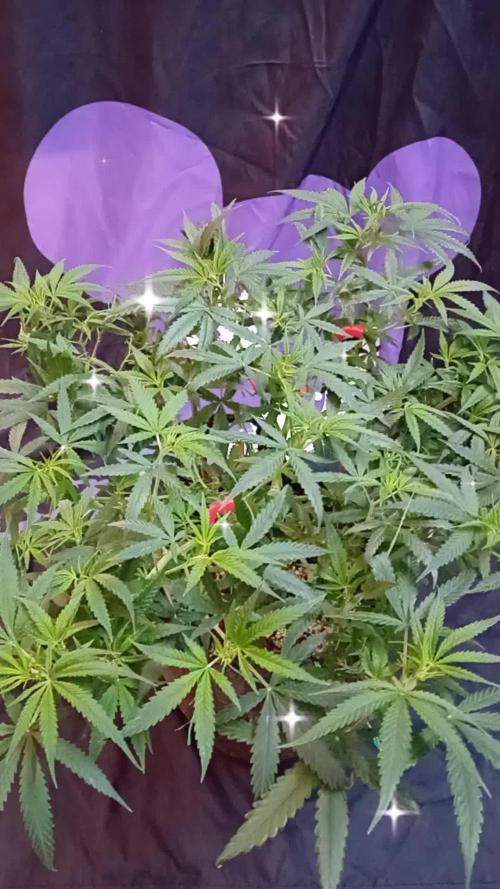
Last week in vegitation,in the last few weeks had a bit of work to do with the Dank Berry to give a shape to this plant as she is a very fast growing plant.
Nutrients Plagron
Light Marshydro ts 3000 450w

Processing
Likes
13
Share


@Cheesefarmer420
Follow
This plant has a solid stench of pure ripe lemons. So much aroma and color in every bud, purples, to dark green, to lime green, to solid frost. This one definitely a fun strain to watch grow and tend too for the last few months. She’s definitely a hungry girl, seemed to be the only strain out of the three that accepted and thrived with full feed nutrients. Would definitely recommend this Strain to someone For a nice uplifting day smoke, also seems to do me good for some pain and stress relief.
Likes
19
Share


@Kirsten
Follow
This week, the plant is feeding heavily and has grown well.
I super cropped the main stem to help with the plant becoming too tall, afterwards I made some scaffolding and a sling to hold the break and prevent it from snapping. It has taken very well.
Before the training I performed, I used 4 bamboo canes to stake the base. The plant had become very top heavy so this has really helped.
The plant was becoming very tall so I thought this would be something to try out.
Here's what I did this week.
18.7.25:
I watered with 2ltrs of dechlorinated water PH'd to 6.4, containing the following nutrients;
💜 2ml Ecothrive Trace
PH: 6.4
PPM: 365
22.7.25:
I watered with 3ltrs of dechlorinated water PH'd to 6.6 with;
💜 1 TSP Sea K
PH: 6.6
PPM: 485
25.7.25:
I watered with 2ltrs of dechlorinated water PH'd to 6.5, containing the following nutrients;
💜 2ml Ecothrive Trace
💜 1/4 TSP Ecothrive Biosys
PH: 6.5
PPM: 361
28.7.25:
I watered with 6.5ltrs of dechlorinated water PH'd to 6.0 with;
💜 7ml Trace
💜 1.5 TSP Ecothrive Biosys
PH: 6.0
PPM: 351
Thank you for checking in this week and hanging out in the comments 😁💚✌️🌱🙌

Likes
10
Share


@Drtomb
Follow
I'm 4 days into flower.
Topped all the plants nice and even. Then removed all bud sites below the top 4 on each branch. Leaving fan leaves intact. I allowed them to recover for 2 days. Then flipped the lights.
Inzane In The Membrane was growing much taller as expected. It's a sativa and it was really stretching. The plants currently are looking to be very thin. They occupy 2/3 of a net and do not look as filled as the blue gelato screen.
My guess is that these will continue to stretch for another week longer then the other plants and will eventually overwelm their screen.

Likes
29
Share


@Caertner
Follow
Toller Start in die Woche an Ostern...
Letztes mal Dünger... EC bei 2,5 jetzt muss sie nur bulken.


