





@SurSideCrew
Volgen
Phenotipos muy similares pero con problemas de Hermafroditismo, tuvimos que cortar los bajos para que no se polenize lo demas.. Producto final increíble! Terpenos a auténtico Gelato dulce y cremoso con toques Gassy que la hace casi perfecta en mi paladar! Planta pequeña con pocas ramas y cosecha poca-media de calidad top!





@UncleRemus
Volgen
Flicked them over to 12 a few days ago they are getting really big and starting to stretch. I have used bendz to train the canopy. No Scrog or netting hoping the buds will support themselves. Any small deficiencies have disappeared although the “dwarf claw“ plant has been stunted Since day one so she’s back in the greenhouse where she seems to prefer it.


@CanadianFillmore
Volgen
Week 8 begins for mandarin dreams and divine storm. All four ladies are frosty, sticky and the mandarin smell is incredibly strong.
I love how these girls look and are growing under the TSW2000, they look better than round 1, grown under my own custom Samsung strip's.
Thank you Mars-Hydro for the light!
Thanks for stopping by growfessors 👽🌳💚


@TheSurfBud
Volgen
Ganja Farmer Seeds
Amnesia Haze Auto
In @highpoweredorganics new ISLAND-BLEND.
Fed water soluble powders.
AQUA-MARINE Grow Formula 5.1.4 paired with OCEAN-POTION and RHIZO-MOJO in dechlorinated water.
Alternating ANTI-MATTER & DARK-MATTER feds weekly.
Foliar fed GREEN-SUPREME daily
Following High Powered Organics Island-Blend Feed Guide.
https://www.highpoweredorganics.com/
Happy growing friends 🇦🇺🇦🇺🇦🇺


@The_Bearded_Grower
Volgen
Day 53 11/20/20 well well she is looking great, she is getting big and fat just the way I like them all the info is in my vid. happy growing and keep your stick on the ice
Day 54 11/21/20 after research I have come the realize it's a cal/mag deficiency not nitrogen so seeing as cal/mag was removed and it got worse im putting it back with more cal/mag 10ml per gal I also increased the micro grow and bloom to full strength. I see her every day i can correct it if I need to flush her


@Esjey
Volgen
Hello, this week and the next ones will be peaceful. It's +-34 days of the girls' life. About 30 more days and we'll switch to flowering. The smell is delicious. I hope that the girls will also give me lush buds. Due to the use of new plant cultivation techniques, I have small concerns about growth, but I hope that my technique will work and I will base on it. (34 days of feminized seeds and the stem at the base has a circumference of 4.5 cm 😁. I should also start fertilization now, but it's already over. If I waited, I would have a problem with bending the stems.
Best regards for all
Smoke weed every day ✌️





@Ultraviolet_
Volgen
We become aware at such times of man's wonderful ability to bring seemingly unrelated elements into harmonic balance, and receive a glimpse into a world where everything exists in conscious sympathetic attunement to everything else. When we listen to a piece of music that seems to strike a beautiful chord somewhere inside us, or view a painting that simply glows with harmonic awareness well executed, we probably do not spare much time to contemplate the wonderfully intricate combination of vibrations that our sensors make it possible for us to perceive. We tend to appreciate the relationship between the parts of something by an awareness of the harmony or dissonance of the whole. This ability enables us to say "what a beautiful house!" instead of "analysis has proven that this collection of building materials exhibits certain elements of harmonic proportion." While this ability to instinctively appreciate the beauty of true harmony has an important role to play in evolution, a more analytical understanding of the laws involved can be most useful. This is especially so if we wish to create works of art where each part exists in true harmony, not only with the other part of that particular whole, but with the universe within which the creator and the created exist.
Everything vibrates. From the most dense matter to the most subtle cosmic rays, everything which our senses allow our thoughts to become aware of, can be specified in terms of wavelength or frequency of vibration. These two terms define the same thing, but from different points of view.
The following are the approximate wavelengths of various energy carriers:
Cosmic rays 0.000,000,001 mm
Gamma rays 0.000,000,1 mm
X rays 0.000,500 mm
Ultraviolet rays 0.003 mm
Visible light 0.006 mm
Infrared 0.01 mm
Sound waves 1 meter
Radio waves 300 meters
Violet light 400 nm to 450 nm
Blue light 450 nm to 500 nm
Green light 500 nm to 570 nm
Yellow light 570 nm to 590 nm
Orange light 590 nm to 610 nm
Red light 610 to 700 nm
1 nanometer (nm) = 0.000,000,1 cm = 1/10,000,000 cm
If a guitar string is plucked and we hear a sound, it is not too difficult for the human mind to associate this sound with the vibration of the guitar string. With color it is quite different. It is difficult for us to conceive that the color of a substance is not an inherent property of the substance itself, but an indication picked up by our senses of that substance's ability to absorb or reflect the light which happens to be shining on it at that moment. Neither the matter nor the light is colored. What happens is that the brain learns to differentiate between the frequencies reflected or transmitted by the substance the eyes are focused on. The same thing happens with sound. When we say "Oh! Listen, they're playing my favorite song," what we really mean is: "My brain has stored within it a particular pattern of frequencies. I have compared the new information being received with this stored pattern and have deduced the answer that the two patterns are similar within certain specified tolerances." The 'pleasure' involved could have something to do with our running the pre-recorded pattern at the same time, in 'sympathy' with the new pattern as it is received.
The word sympathy describes very well our ability to appreciate color and sound. It also describes the reason behind certain elements of harmony. For instance, if a substance vibrating at 100 cycles per second (tone 1) is in the proximity of another substance vibrating at 200 cycles per second (tone 2), we could perceive, if we had the right equipment, a certain sympathetic relationship between the two.
We will see from this that there is a uniform doubling of the first tone seen in the second. At various points along the waves, the two are the same in amplitude. At other points, they are at opposite poles to each other. This doubled frequency has more points of similarity to the original than any other frequency except the original itself. If the equipment we had available for measuring these two frequencies was a soundboard amplifier and a pair of ears, then we would hear what would sound to us like one tone. If we had the opportunity to hear one at a time, we would hear that although they sound the same, one is higher in pitch than the other. This characteristic of 'the same but different in pitch', musicians have called the octave. Any two tones produced where one has exactly doubled the frequency of the other is called an octave. Speaking in ratios, an octave would appear then as the ratio 2:1 or 1:2, depending on whether we are talking of an octave up or down.
A single note produced by almost any instrument will contain more than one wavelength or frequency. It will have a dominant frequency, the wavelength of which we would call the note's 'fundamental' or 1st harmonic. It will also have a varying number of upper harmonics, gradually fading in intensity into infinity or silence.
Natural harmonics always have the same pattern of intervals between them. The interval between the 1st and 2nd harmonic is a perfect octave; between the 2nd and 3rd a perfect fifth; between the 3rd and 4th a perfect 4th; and so on, the intervals becoming smaller and smaller until they lose any relationship with the western 12 tone scale as it exists at the moment. Just as an octave has certain elements of sympathy with its fundamental, so some intervals have been noted to be more perfectly in sympathy with the fundamental than others. The ratio of the 'perfect 5th' or interval of 7 semitones, as it occurs in the harmonic series, is 3:2 or 2:3, while that of the 'perfect fourth" is 4:3 or 3:4. All the tones in the western 12 tone scale can be expressed in terms of the ratio between the upper tone and its fundamental. This would seem to be an ideal way of generating a scale from any given fundamental and several attempts have been made to do this, the Pythagorean system being probably the most well known. Although when working with a single tone instrument playing on its own, the Pythagorean formula works wonderfully well, if we had several instruments tuned this way together and asked them to play almost any western music, we would find that at times they sounded quite out of tune to each other.
The lack of flexibility of the various scale systems based on the harmonic series has led to what is known as the 'tempered' scale. This uses as its primary unit of interval the ratio of the octave or 2:1. It then proceeds to divide the interval between any fundamental and its upper octave into 12 smaller intervals by applying the ratio: two to the one-twelfth power, to one (21/12:1). This equals 1.059463094, so by multiplying any frequency by this number, we will obtain the tempered semitone next up from our fundamental. We will also find that any tone twelve semitones up from any other tone, in a scale generated in this way, will have exactly double the frequency.
If we took the note middle C on a piano and halved the wavelength, we would have the note C one octave above. If we halved this, we would have the C above, and so on. However, within about 6 octaves, we would find that although a 'sound' was being produced, no human ear could perceive it. If we kept on going, halving and producing upper octaves of our fundamental C, we would proceed through the infrared band, into the visible light spectrum. If we happened to be outside during the day, we would, for one octave only, see the note C with our eyes. The next octave above would already be in the ultraviolet band, and outside the eye's sensitivity range. If we can think of color as being an indication of a substance's vibratory rate or wavelength, we may begin to see a relationship that could exist between the color and sound spectrums.
The logical extension of what has so far been said is that there exists a scale in the color spectrum that corresponds exactly to the scale in the sound spectrum, each color tone being an octave of the equivalent note in the sound range.
This is not the end of the story but only the beginning. If we can for the moment accept that any wavelength in one band has upper and lower octave stretching out to infinity, then the next question is 'fine, but what shall we use as our fundamental? A particular color? A particular sound frequency?' The musicians among us will probably say 'A 440'. This means that the note A should vibrate at 440 Hertz, or 440 times per second. They would tell us that this is standard pitch has been adopted by most orchestras around the world; pianos are tuned to it, instruments are constructed to formulas based on it, and so to them it would probably seem the most appropriate place to begin. Some of these musicians may know of the battle that is still raging with regards to this being the standard, but few would know why A = 440 Hz was chosen except that it worked when it was set to be a suitable compromise between the many different pitches in use at the time.
432 Hz is said to be mathematically consistent with the patterns of the universe. Studies reveal that 432 Hz tuning vibrates with the universe’s golden mean PHI and unifies the properties of light, time, space, matter, gravity, and magnetism with biology, the DNA code, and consciousness. When our atoms and DNA start to resonate in harmony with the spiraling pattern of nature, our sense of connection to nature is said to be magnified.
Another interesting factor to consider is that the A=432 Hz tuning correlates with the color spectrum, while the A=440 Hz is off. Audiophiles have also stated that A = 432 Hz music seems to be non-local and can fill an entire room, whereas A=440 Hz can be perceived as directional or linear in sound propagation.
Once you adopt the idea that sound (or vibration in general) can have an equalizing and harmonizing effect (as well as a disturbing effect), the science of harmony can be applied to bring greater harmony into one's life or tune to specific energies. There is a form of absolute and relative harmony. Absolute harmony can, for example, be determined by the tuning of an instrument. The ancients tuned their instruments at an A of 432 Hz instead of 440 Hz - and for a good reason. There are plenty of music examples on the internet that you can listen to in order to establish the difference for yourself.
Attuning the instrument to 432 Hz results in a more relaxing sound, while 440 Hz slightly tenses up the body. This is because 440 Hz is out of tune with both macro and micro cosmos. On the contrary, 432 Hz is in tune. To give an example of how this is manifested microcosmically: our breath (0,3 Hz) and our pulse (1,2 Hz) relate to the frequency of the lower octave of an A of 432 Hz (108 Hz) as 1:360 and 1:90.
It is interesting to note that 432 Hz was the standard pitch of many old instruments and that it was only recently (19th and 20th century) the standard pitch was increased. This was done in order to be able to play for bigger audiences. Bigger audiences (more bodies) absorb more of the lower frequencies, so the higher pitch was more likely to “cut through”. One of the oldest instruments of the world is the bell ensemble of Yi Zeng (dated 423 BC), tuned to a standard F4 of 345 Hz, which gives an A= 432 Hz. The frequency of 345 Hz is that of the platonic year! Similarly, many old organs are tuned in A=432 as well; for example, St. Peter’s Capella Gregoriana, St. Peter’s Capella Giulia, S. Maria Maggiore in Rome.
Maria Renold’s book “Intervals Scales Tones and the Concert Pitch C=128 Hz” claims conclusive evidence that 440 Hz and raising concert pitch above scientific “C” Prime=128 Hz (Concert A=432 Hz) disassociates the connection of consciousness to the body and creates anti-social conditions in humanity.
The difference between concert pitch A=440 Hz and Concert A=432 Hz is only 8 cycles per second, but it is a perceptible difference of awareness in the human consciousness experience of the dream we share called existence.







@3lementa1
Volgen
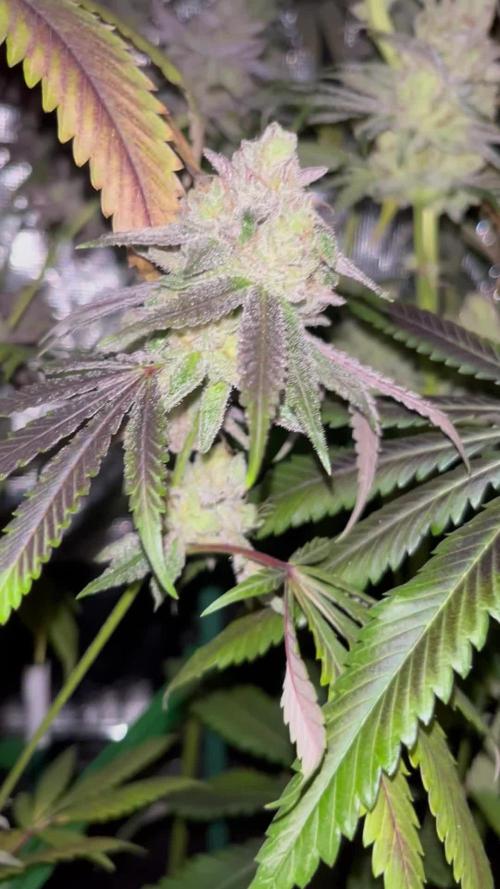
This is just a beautiful strain to grow. The leaves have a rich dark green appearance and the shape is a mix of fatter indica leaves and longer sativa leaves. It's tendency is a fairly manageable and predictable grow/stretch and it responds well to training and powerful lights. The leaves on one of them changed colour at the end of flush and went yellow with some purples and pinks but the buds themselves have almost a silver glow to them. The pistils come out in early flower in a very strong, spikey and symmetrical way that amplifies the cool glow given off by the trichomes. With the rich, dark, beautiful leaves, the whole appearance is really beautiful and otherworldly. One of the Wedding Cake plants self-pollenated and there are some seeds in the CBD Blue Shark, but they're few and far between. It's not a disaster like the Wedding Cake. Honestly I can't say enough good things about this strain. The plants were hardy, easy to work with and forgiving of mistakes and experiments. The flowers looked amazing through every stage of development, and the finished product smells great, tastes great, looks great, and makes you feel great. This is my favourite strain to grow so far.



@Wondrej
Volgen
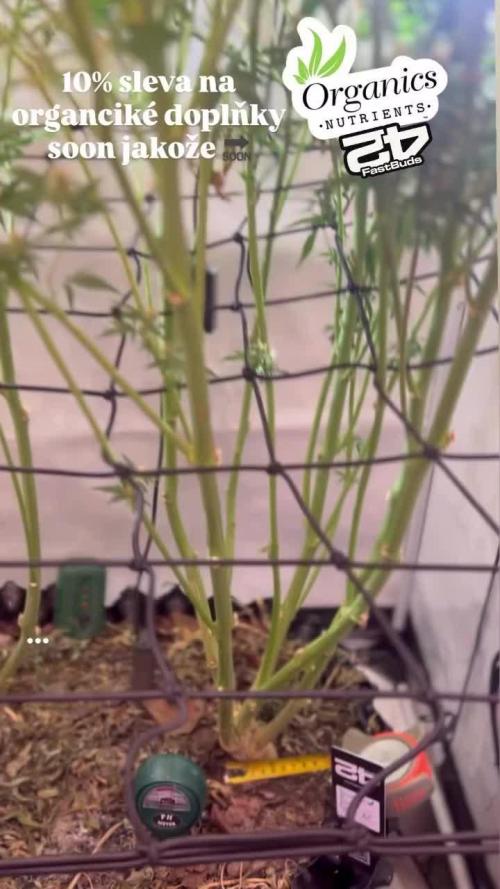
Week 14: Final Countdown (Flower Week 9) 🍌🥊
We’ve reached the final ripening! This Banana Purple Punch Auto by @FastBuds is finishing its 14th week from seed and its 9th week in full bloom. At this stage, it's no longer about volume; it’s all about ripening, resin density, and terpene complexity. 💎
Living Soil Performance:
Following the 9 Cardinal Parameters, my focus is currently on:
• VPD & Humidity: Keeping humidity low (around 40-45%) to drive transpiration and protect these dense, frosty buds from any late-stage issues. 🌬️
• Temperature: Dropping the night temps to 18–19°C to encourage those deep purple hues. The anthocyanins are really putting on a show! 💜
• Nutrients: No flush needed! In a true Living Soil setup, the plant naturally senesces as the soil microbiome slows down nitrogen availability while still providing essential minerals for trichome maturation. The "autumn fade" is looking beautiful. 🍂
Trichome Status: 🔬
Observation shows about 85% still not ready and 10–15% milky. I’m looking for that perfect "sweet spot" to capture the full sedative punch and overripe banana flavor. 🍌
It’s been an incredible journey with this organic ecosystem. The plant is incredibly sticky and the smell is overpowering. Harvesting very soon!
One love growmies 🧑🏻🌾


@YAKDADDYDWC
Volgen
started this week off by changing it to 12/12 lighting once i see her start to bud i will change bulbs... will keep updated




@Natrona
Volgen
Auto Purple Hulk Auto by MSNL Outside
👉Sponsored Grow👈
W4V4
7/6- 12
Auto Purple Hulk, stretched about 6 inches and is now 18 inches tall.
We have returned to heat in the 90s with heat index at or above 100f with not as much rain this week. So far she is doing well with the heat and humidity.
I am giving water only for this grow since I have Supersoil as part of the base and will add Green Sensation during flower.
As always, thank you all for stopping by, for the likes and most of all growers’ love and support.
Stay green, growers love 💚🌿
💫Natrona💫


@adam_pawloski87
Volgen
This week went very well! One will be getting cut an hung to dry while the rest finish up with one more week of flush ! These ladies are smelling so lovely I hope you all enjoy! Stay tuned for next week! Cheers 😤💨💨💨💨💨


@Professor_Daank
Volgen
8/30 - Day 65:
All is great. Plant 1 will be harvested very soon, I'm thinking September 6th or 13th... all depends on the trichome development.
I have come across a wicked calcium deficiency that I am solving with foiler spray and a little more supplemented in the nute mix, but I don't quite understand what's happening. I will post a question and update with information. I read it takes about a week to fix, so I'm not to worried about it ruining my harvest, it just sucks and I want to fix it.
8/3 - Day 69: Fuck... man... it's CRAZY how much they change overnight at this stage. We are flushing plant 1 (center plant in photos) Sunday, and we will harvest her September 13th, at the latest. I check her trichomes everyday and they are still not milky — so we wait! Colors are beautiful, bright orange and a wonderful violet purple. The sugar is just piling itself on. Smell is average, but if you bump them, or trim a leaf... it gets much, much more potent. The buds are sticky as literal superglue. I cannot wait to smoke.
We have been fighting a small CalMag deficiency the past 8 days, but I think we are out of it. Typically takes 6-8 days to see any sort of relief from this, and I haven't seen it spread to a few of the older colas, so that's good!
I'll get some more micro shots later this week.
Harvest scheduled for September 13th. Flush starts tomorrow - 9/6. Fuck. Yes.
