


Likes
Comments
Share


@GoosengrowerUK
Follow
Hey growmies hope everyone is good missed last week as I wasn't well but anywho update on them girls the video is from Tuesday 7th July and the pictures from today unfortunately had to chop the smallest fadiest plant of the Lemon Meringue Auto from Tastebuds Genetics as a lower top succome to botryitis 13 days early (I got rid of the affected top and chopped the rest down to small buds and thoroughly washed the rest with fresh water) 95%milky - 5% amber so this one is going to be melow not all is lost so happy growing peeps stay humble and as high as humanly possible! 👊💚

Likes
13
Share


@TheMightyHermit
Follow
Honey Cream is almost ready (Aiming for 15% amber trichomes), another week or two and the first tops will come out. The smell is very pleasant, a bubble gum, sweet and almost ripe berry smells, very intoxicant !
Power flower is stacking nicely, but still with no smell, very frosty too.
Special queen #1 is also doing amazingly, specially being in a pot, 2.25m and stacking EVERYWHERE ! The smell reminds me of an amnesia haze, very pungent on the nose !
Old Lemongrass is doing a little bit worse, her leaves yellowed a lot, but hopefully it will get fixed by next week. Trichome production is considerably slower than all the other strains, but she is stacking for sure.
Smells of a very pleasant sweet lemon.

Likes
5
Share


@Pechu420
Follow
End of cultivation of a landrace, probably Manga Rosa, due to the smell and flavor, in addition to other characteristics (sativa, long-flowering, style of flowers).
3.7 liters (1 gallon) = 58 grams / 2.04 oz (flowers without branches)
Using 120w lm301h-evo, together with another plant in the same environment.
Last week just water, two small flushes, to clean the soil a little, but nothing excessive. 7 days drying, dark, well-ventilated environment, without direct wind. And now cure for at least a month, trying a little each week.
I killed her when she was 93 days old, with 12 hours of light from the beginning, it seemed automatic. Because she is almost or completely sativa, perhaps another 2 weeks could be good for her, but I wanted a cultivation period of around 3 months, which was cool, but I believe that for a 90-day cultivation period, it is better to use some hybrid or indicates, as they develop faster. Sativas are aggressive in their expansionism and slow in flowering. Leaves and branches saved for later extraction, probably ice hash.


Likes
3
Share


@factoryofweed
Follow
Buenas!
Esta semana se encuentran ya terminadas de estirar y produciendo gran cantidad de pistilos, enseguida comenzaran a engordar y rellenar las paredes celulares.
Podemos observar los tonos purpuras que estan saliendo de nuestras variedades!!
Ahorraremos para un LED que pueda ayudarnos en este armario tan bonito ya que con sodio g/w es un poco escaso hoy en dia.


Likes
12
Share


@GeekSayWhat
Follow
Nice week of steady growth, nothing to report really. Let's just hope for a decent harvest. I'm not expecting to much but I'm guessing 40g/50g

Likes
4
Share

@Chubbs
Follow
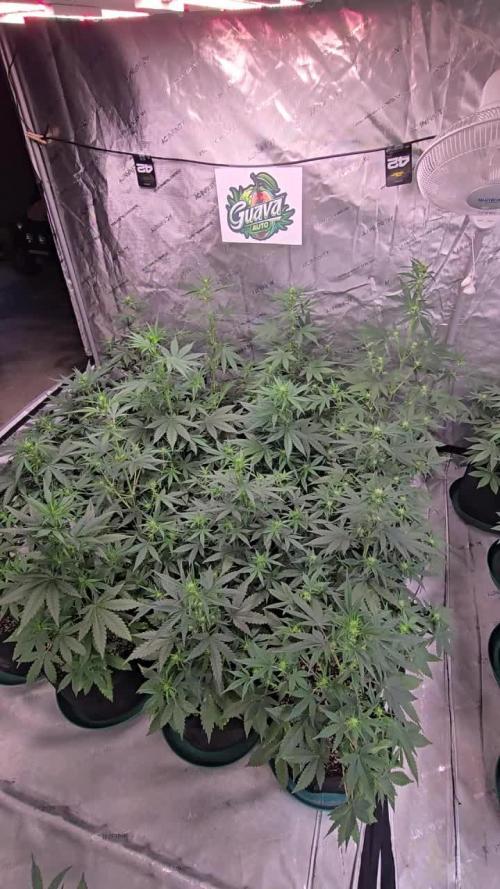
What up Fam. These girls are growing amazing. Now that I can controll the temps a little better they've taken off with growth. Starting the flower period which we all no know what that means. The countdown is on. Over all Happy Growing.

Processing
Likes
82
Share


@ClubRiot
Follow
Start week 5 , Bio Grow 2 ml/L + Sensi Cal-Mag Xtra 2 ml/L + Alg-A-Mic 2 ml/L + CarboLoad 2 ml/L + Bio-Heaven 2 ml/L + Bio-Bloom 1 ml/L ( Ph 6.5).


Likes
10
Share

@DogDoctorOfficial
Follow
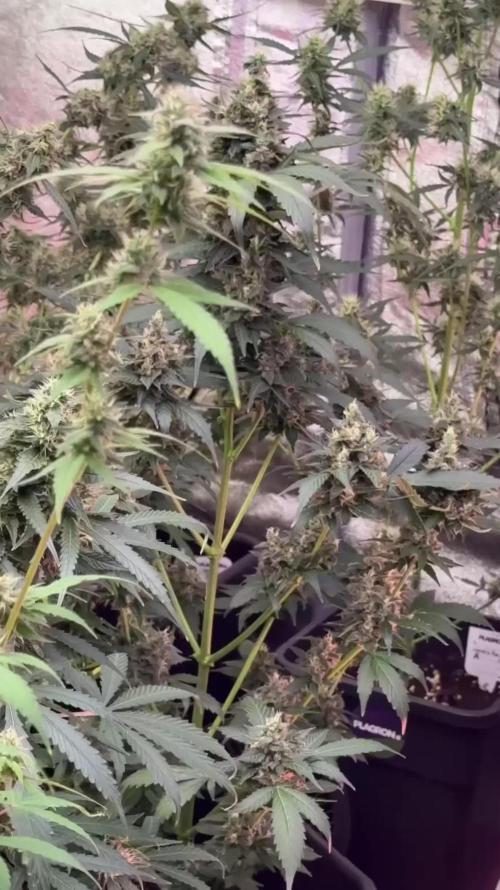
🌸 Pink Rosay Auto by Zamnesia | Pheno A | Week 10
💗 Small Frame. Massive Flower Power. Still Absolutely Beautiful.
Welcome back to another chapter of the 8×8 Adventure! 🌱💚
And this girl...
She's still shining.
Actually, I think I'm becoming a little bit obsessed with her. 😂💗
Because every time I look at Pink Rosay Pheno A, I have the same thought:
"I wish they were all this easy."
Not because the other girls aren't beautiful.
They are.
I love every single one of them for different reasons.
But this girl?
She's just...
easy.
Easy to manage.
Easy to move.
Easy to photograph.
Easy to inspect.
Easy to care for.
She doesn't take up much space.
She doesn't demand much attention.
She doesn't try to take over the room.
And yet somehow...
she's carrying an absolutely ridiculous amount of flower for the space she occupies.
Small frame.
Big personality.
Lots of buds.
Lots of density.
Lots of beauty.
And at Week 10?
She's still doing exactly what she's been doing from the beginning.
Shining. 💗✨
🌱 The 8×8 Adventure — Same Room, Different Stories
For anyone finding this diary for the first time, welcome to the 8×8 Adventure.
The concept is simple:
Give twelve different plants essentially the same opportunity...
and let them show us what they're capable of.
Same room.
Same general environmental strategy.
Same 12/12 lighting schedule.
Same irrigation philosophy.
Same nutritional program.
Same lighting ecosystem.
Same grower.
But different genetics.
Different phenotypes.
Different architectures.
Different personalities.
And Pink Rosay Pheno A has definitely developed one of my favourite personalities in the room.
She's compact.
She's dense.
She's productive.
She's beautiful.
And she doesn't seem interested in making my life difficult.
😂💗
Honestly...
I'll take that.
💗 I Really Love This Plant
I think it's time to admit it.
I really love this plant.
There.
I said it. 😂
There's something incredibly satisfying about a plant like this.
You don't have to constantly work around her.
You don't have to fight for access.
You don't have to figure out how to move a giant structure without bumping into everything around it.
You can simply pick her up, move her where you need her, inspect her, photograph her and put her back.
And then you look at what she's carrying...
and suddenly you realize:
This little girl is not playing around.
She's compact, yes.
But she's carrying a lot.
A lot of flowers.
A lot of density.
A lot of developing weight.
And a lot of personality.
That's a combination I absolutely appreciate.
🌸 Small Plant. Huge Flower Presence.
The height hasn't changed dramatically.
She's still around 111 cm.
And honestly?
That's perfect.
I don't need her to become taller.
I don't need another metre of plant.
I don't need her reaching for the ceiling.
Because she's already using her available space incredibly well.
Look at the flowering structure.
Look at how much of her frame is dedicated to flowers.
Look at the density.
This is what makes her so interesting.
She's not producing a huge amount of empty architecture around the flowers.
She's compact.
She's efficient with her space.
And she's filling that space with beautiful developing flowers.
It's almost like someone took a much larger plant and compressed it.
😂
And I absolutely love it.
🌿 Peculiar Is Beautiful
One word keeps coming back to me with this girl:
peculiar.
And I mean that as a compliment.
She's not generic.
She doesn't look like every other plant in the room.
She has her own proportions.
Her own flower distribution.
Her own architecture.
Her own way of occupying space.
And that's exactly the sort of thing I enjoy finding during an experiment like this.
I like unique.
I like unusual.
I like plants that make me stop and look twice.
Pink Rosay does that.
And the more I watch her develop, the more I appreciate just how special her expression is.
❄️ The Density Keeps Building
At Week 10, the flowers are becoming increasingly substantial.
The developing buds have that wonderful compact appearance that has become one of her defining characteristics.
The calyxes are stacking.
The flowers are gaining density.
The pistils are continuing their progression.
And the resin is becoming increasingly apparent across the flowering structures.
There is something particularly satisfying about seeing these flowers photographed at this stage.
From a distance, you see a compact flowering plant.
Get closer...
and the story changes completely.
Suddenly you're looking at layers of calyxes.
Pistils.
Sugar leaves.
Resin.
Textures.
Tiny details everywhere.
And because this plant is so compact, I can actually get around her easily enough to photograph all of those different angles.
That's another little advantage of having a plant like this.
She's basically a photographer's dream.
😂📸💗
📸 She Makes My Job Easy
I think this deserves its own section.
Because growing isn't only about what the plant produces.
It's also about the relationship you develop with the plant while you're growing it.
And Pink Rosay is simply...
convenient.
She's easy to reach.
Easy to move.
Easy to inspect.
Easy to photograph.
Easy to work around.
She doesn't turn every little task into an engineering project.
😂
And when you're managing an entire 8×8 room full of different plants, those little things matter.
Space matters.
Accessibility matters.
Being able to see what you're doing matters.
Being able to get a camera into the right position matters.
And this girl makes all of that incredibly straightforward.
Then she rewards you with beautiful flowers.
That's a pretty good deal.
✂️ No Need to Keep Touching Her
The selective defoliation from the previous weeks has done its job.
The plant has plenty of healthy foliage remaining.
The flowering structure is visible.
The canopy is manageable.
And I'm not looking for reasons to take more leaves simply because we're now at Week 10.
There's no prize for using the scissors more often.
😂
The goal is a healthy, functional plant.
And Pink Rosay looks exactly like that.
So we're letting her keep doing her thing.
The leaves she has are working.
The flowers are developing.
The plant is progressing.
There's no reason to manufacture intervention where none is needed.
Sometimes the best cultivation decision is simply:
leave her alone.
And that's exactly what we're doing.
💡 Still Eating Photons
The lighting environment remains consistent with the rest of the adventure.
The Future of Grow Black Series LED continues providing the primary overhead lighting, while Lumiflora contributes additional light into the lower canopy.
And Pink Rosay continues converting all of that available energy into exactly what we want to see:
plant.
Leaves.
Branches.
Flowers.
Resin.
Density.
Development.
It's another beautiful example of how twelve plants can share essentially the same environment while expressing themselves completely differently.
Some turn that opportunity into height.
Some into enormous branches.
Some into sprawling canopies.
Pink Rosay seems to have decided:
"I'll just make every centimetre count."
And honestly?
I love that strategy.
💧 Feeding the Little Powerhouse
The nutrition remains consistent with the flowering program used throughout the room:
🌸 Plagron Terra Bloom — 2.2 ml/L
🌱 Plagron Power Buds — 1 ml/L
✨ Plagron Green Sensation — 1 ml/L
🍯 Plagron Sugar Royal — 1 ml/L
⚗️ pH adjustment as required
The current recorded solution strength remains around:
EC: ~2.0 mS/cm
with:
pH: 6.0
Watering has increased slightly to approximately:
💧 1.4 L per plant / 24h
And visually?
She's happy.
That's the important part.
No need to complicate something that's working.
We provide the water.
We provide the nutrients.
We provide the environment.
And she does the rest.
🌡️ Week 10 Conditions
Current recorded conditions:
🌸 Flowering: Week 10
📏 Height: 111 cm
💡 Light schedule: 12/12
🌡️ Day temperature: 29.9°C
🌙 Night temperature: 25°C
💧 Relative humidity: 60%
⚗️ pH: 6.0
⚡ EC/TDS: ~2.0 mS/cm
🌡️ Solution temperature: 25°C
🌱 Substrate temperature: 26°C
🌬️ CO₂: 529 ppm
? Pot size: 15 L
💦 Watering: ~1.4 L per plant / 24h
The environment remains stable.
And stability is exactly what I want while this girl continues finishing her story.
🌸 A Lot of Flower in a Small Package
This is probably the best way I can describe her right now.
A lot of flower in a small package.
😂💗
She doesn't need a huge footprint.
She doesn't need an enormous canopy.
She doesn't need to stretch another fifty centimetres.
She's already doing an excellent job with what she's got.
And when I compare her to some of the enormous plants in the room, the difference is almost funny.
There are girls that require two people to properly navigate around.
Then there's Pink Rosay.
"Excuse me, little lady."
Pick her up.
Move her.
Photograph her.
Inspect her.
Done.
😂
And then you look again...
How the hell are you carrying all of that?
🔬 This Is Exactly Why Phenotypes Are Fun
Pink Rosay is another reminder that size isn't everything.
If I judged plants only by height, I'd miss so much.
Height doesn't tell me how efficiently the plant uses its space.
It doesn't tell me how flowers are distributed.
It doesn't tell me how dense those flowers become.
It doesn't tell me how easy the plant is to manage.
And it certainly doesn't tell me how much I might enjoy growing it.
Pink Rosay has checked a lot of those boxes.
She's compact.
She's manageable.
She's productive-looking.
She's beautiful.
She's peculiar.
And she's fascinating.
That's a pretty damn good phenotype.
📸 This Week's Gallery
And of course...
the camera loves her.
The wider photographs show the compact architecture.
The closer photographs reveal the flower density.
Then you get into the really close shots...
and it's just layers of detail.
Flowers packed together.
Pistils.
Calyxes.
Resin.
Sugar leaves.
Textures.
And that unmistakable Pink Rosay structure.
This is exactly why I enjoy macro photography so much.
The plant can look completely different depending on how close you get.
From across the room:
small plant.
From five centimetres away:
holy shit, look at that flower. 😂💗
💗 One of My Favourites in the Room
I know I've said it before.
And I'll probably say it again.
I love all these plants.
Every single phenotype has something that makes me want to keep watching.
But Pink Rosay Pheno A?
She's definitely one of the girls I have developed a soft spot for.
Maybe it's the compactness.
Maybe it's the flower-to-plant ratio.
Maybe it's how easy she is to work with.
Maybe it's simply because she looks so damn good.
Probably all of the above.
And that's okay.
Sometimes you grow a plant and somewhere along the way you realize:
"Yeah... you're one of my favourites."
That's this girl.
🔭 Looking Ahead
And now I'm very curious to see what the next stage brings.
She's already carrying substantial flower.
She's already dense.
She's already beautiful.
But we're not writing the ending yet.
There is still development ahead.
More maturation.
More resin.
More density.
More changes in the flowers.
And eventually...
the final version of Pink Rosay Pheno A will reveal herself.
That's the part I love.
You can look at a plant and think you already know what you're going to get.
Then she spends another week surprising you.
So let's not rush.
Let's keep providing.
Let's keep observing.
Let's keep photographing.
And let's see what this little powerhouse decides to do next.
✨ Final Thoughts — Let the Little Lady Shine
Week 10.
And I'm still looking at Pink Rosay thinking:
"I wish every plant was this easy."
😂💗
Not because I want every plant to be the same.
Absolutely not.
The differences are the whole reason we're doing this adventure.
But from a grower's perspective?
A compact plant that doesn't demand much space...
doesn't make every task complicated...
is easy to move...
easy to inspect...
easy to photograph...
easy to care for...
and then carries a huge amount of beautiful flower?
Yes please.
I'll take more of those.
😂
She's small.
But she's carrying a lot.
A lot of buds.
A lot of density.
A lot of developing weight.
A lot of resin.
And an enormous amount of personality.
She's peculiar.
She's beautiful.
She's manageable.
She's productive.
And she's become one of those plants that I genuinely enjoy spending time with.
The ruler says:
111 cm.
The plant says:
"That's all I need."
😂💗
And you know what?
She's right.
She doesn't need to be bigger.
She doesn't need to be taller.
She doesn't need to occupy more space.
She has already shown us that sometimes...
less plant can mean more plant.
And Pink Rosay Pheno A?
She's proving that beautifully.
So let's keep giving her what she needs.
Water.
Nutrition.
Light.
A stable environment.
And a little bit of love.
Then we'll step back...
and let her do what she does best.
Shine.
💗🌸❄️✨
🙏 Thank You
A huge thank you to GrowDiaries for giving us a place to document this 8×8 Adventure and share these different expressions week after week.
Thank you to Zamnesia for the Pink Rosay genetics behind this beautiful little powerhouse.
Thank you to Plagron for supporting the nutritional side of the journey.
Thank you to Future of Grow LED for providing the main lighting driving the room.
Thank you to Lumiflora for bringing the under-canopy lighting dimension into the experiment.
Thank you to TrolMaster for helping maintain the environment behind the scenes.
And, of course, thank you to everyone following along.
Every comment.
Every question.
Every observation.
Every photograph.
Every week.
It all becomes part of the story.
And Pink Rosay Pheno A has certainly written one of my favourite chapters.
She's not the tallest.
She's not the biggest.
She doesn't take up much space.
She doesn't demand much attention.
But look at her.
Look at what she's carrying.
A compact frame absolutely loaded with flowers.
Dense.
Beautiful.
Peculiar.
Easy to manage.
Easy to love.
And somehow becoming more impressive every single week.
This little lady has absolutely earned her spotlight.
So let's give it to her.
💗🌸✨
Small frame. Massive flower power.
Keep shining, Pink Rosay.
Growers Love & Happy Growing! 🌱💚🌸

Likes
5
Share

@DogDoctorOfficial
Follow
🌱 Sour Diesel — Week 8
(Flower Week 3) — Strategic Reset Week
⸻
🔁 Quick Recap — Where We Are
• Genetics: Sour Diesel
• Timeline: Week 8 from seed
• Flowering: Week 3
• Height: ~60–70 cm (compact structure)
• Room Temp: 28°C
• RH: 65%
• Feed EC: 2.9
• pH: 6.5 (kept above 6.0 intentionally)
• Lighting: LED
• Action this week: Strategic defoliation
This plant is not tall — she’s compact, dense, and structurally tight.
Which means airflow and internal light penetration become critical early.
And that’s exactly why this week mattered.
⸻
🍃 The Defoliation — Not Aesthetic. Architectural.
This was not cosmetic trimming.
It was:
• Removing large fan leaves blocking interior bud sites
• Cleaning inner congestion
• Opening airflow channels
• Resetting light distribution across the canopy
• Helping the entire room environment (not just this plant)
The room needed air — this plant was advanced enough to handle stress.
That’s key.
Week 3 of flower is the transition window:
• Stretch is slowing
• Bud sites are set
• Energy shifts toward stacking
At this stage, a strategic defoliation:
• Improves transpiration efficiency
• Reduces microclimate humidity pockets
• Prevents internal leaf-to-leaf condensation
• Encourages bud site activation below the top canopy
This was structural architecture. Not haircut vanity.
⸻
🌡️ 28°C in Flower — “Too Hot?”
Let’s Go Deep.
People panic when they hear 28°C in flower.
But here’s where most growers confuse:
🔥 HPS vs LED Heat Behavior
Under HPS:
• Radiant heat warms leaf surfaces directly
• Leaf temperature often equals or exceeds room temp
• 28°C air under HPS can mean 30–32°C leaf temp
• That pushes VPD dangerously high
Under LED:
• Less infrared radiation
• Leaf surface temp is typically 1–3°C LOWER than room temp
• So at 28°C room temp, leaf temp might be 25–26°C
And VPD calculations depend on leaf temperature, not air temperature.
⸻
🌿 What Is Leaf VPD?
VPD (Vapor Pressure Deficit) measures the difference between:
• Moisture inside the leaf
• Moisture in the surrounding air
But if you calculate VPD using only room temp, you’re missing the real transpiration dynamics.
With:
• 28°C air
• ~25–26°C leaf surface (LED)
• 65% RH
Leaf VPD sits in a very workable mid-flower zone.
Not extreme.
Not stress-inducing.
Not shutdown territory.
We’re driving metabolism, not cooking terpenes.
⸻
💧 Why 65% RH Isn’t Dangerous Here
Context matters:
• Good airflow
• Opened canopy
• Compact but cleaned structure
• Early-mid flower (Week 3, not Week 7)
At this stage:
• Pistils are forming
• Bud density is still moderate
• Transpiration is active
High humidity becomes dangerous when:
• Bud mass is dense
• Internal airflow is poor
• Late flower resin traps moisture
We’re not there yet.
And we just improved airflow with defoliation.
⸻
⚡ EC 2.9 — Aggressive but Intentional
That EC is strong.
But:
• Plant is compact, not oversized
• Sour Diesel can eat
• pH 6.5 keeps availability wide (Ca, Mg, P balance)
The key will be:
• Watching leaf tips
• Monitoring runoff behavior
• Watching for clawing or salt stress
Right now, if she’s praying and stacking, she’s handling it.
⸻
🔍 What To Expect Next Week (Flower Week 4)
After defoliation:
You may see:
• Slight pause (24–72 hours)
• Increased vertical bud push
• Better lower-site activation
• More defined pistil clustering
• Stronger apical dominance response
If recovery is clean:
• Buds begin early stacking phase
• Internodes tighten
• Resin production initiates at bract level
If stress appears:
• Slight leaf droop
• Tip burn acceleration
• Reduced upward leaf angle
But based on structure and timing — this looks calculated, not reactive.
⸻
🧠 Why This Week Matters Long-Term
This week determines:
• Airflow pattern for late flower
• Mold resistance later
• Bud density uniformity
• Final trim efficiency
• Light-to-bud conversion efficiency
This wasn’t about now.
This was about Week 7 and 8 survival.
⸻
🙏 Appreciation Section
To:
• The OGs here since seed
• The new followers discovering the journey
• The silent readers
• The critics
• The skeptics
• The lovers
• The haters
• The platform
• The sponsors
• The community
• Grow Diaries itself
Everyone has a place here.
Growth happens in public.
And that takes courage.
Respect to all of you.
📡 Please stay tuned they can try and take us down but we never quit https://www.youtube.com/@DOGDOGTHEDOCTOR NEW
🙏 Thank you for your patience and continued support.
FOR DISCOUNT CODES AND MORE JUST FOLLOW THE LINK https://website.beacons.ai/dogdoctorofficial
📲 Don’t forget to Subscribe and follow me on Instagram and YouTube @DogDoctorOfficial for exclusive content, real-time updates, and behind-the-scenes magic. We’ve got so much more coming, including transplanting and all the amazing techniques that go along with it. You won’t want to miss it.
GrowDiaries Journal: https://growdiaries.com/grower/dogdoctorofficial
Instagram: https://www.instagram.com/dogdoctorofficial/
YouTube: https://www.youtube.com/@dogdoctorofficial Deleted by Youtube
Vimeo : https://vimeo.com/dogdoctorofficial Under construction stay tuned ⸻
Explore the Gear that Powers My Grow
If you’re curious about the tech I’m using, check out these links:
🔆 Lighting & Environmental Control
• Future of Grow — Advanced LED lighting technology
https://www.futureofgrow.com/
DISCOUNT CODE: DOG20
• Lumiflora — Under-canopy LED lighting
https://lumiflorade.com/
• TrollMaster — Environmental controllers and automation gear (past collaboration)
⸻
Genetics
• Zamnesia Seeds — Genetics used in this project
https://www.zamnesia.com/
⸻
🌱 Soil, Substrates, Boosters & Root Support
• Plagron — Substrates, bio mixes, and supportive products
https://plagron.com/en/
⸻
🎒 Storage, Curing & Preservation
• Grove Bags — Curing and storage solutions
https://grovebags.com/
⸻
📸 Photography Equipment & Tools
(Not sponsors, but part of my creative toolkit)
• Sony A6700
• Sony full-frame macro lens + few more
• Stacking photography workflow - learning
• iPhone (for behind-the-scenes shots)
We’ve got much more coming as we move through the grow cycles. Trust me, you won’t want to miss the next steps, let’s push the boundaries of indoor horticulture together!
As always, this is shared for educational purposes, aiming to spread understanding and appreciation for this plant. Let’s celebrate it responsibly and continue to learn and grow together.
With true love comes happiness. Always believe in yourself, and always do things expecting nothing and with an open heart. Be a giver, and the universe will give back in ways you could never imagine.
💚 Growers love to all 💚
📸 P.S. – The Eye Behind the Lens
All photos in this diary (for now — except for the ones showing the camera, which I took with an iPhone) are taken with a Sony A6700 paired with a Sony full-frame macro lens and a few more.
Photography is part of the story — it’s how we share the fine textures, the glow, and the quiet details that words can’t always capture.
I’ve also started experimenting with photo stacking — a technique where multiple images, each taken at a slightly different focus point, are layered together to create one perfectly sharp image from front to back.
It’s not digital enhancement or AI; it’s pure photography — a way to reveal the plant’s beauty in microscopic depth, from trichome to petal.
You’ll even see a few shots of "ghost me" capturing the shots — camera, lens, setup — because every grow deserves not just to be cultivated, but documented like art.
FOR DISCOUNT CODES AND MORE JUST FOLLOW THE LINK https://website.beacons.ai/dogdoctorofficial
NEW DISCORD - Official Server Invite Link : https://discord.gg/ksjAkA5T74
Likes
8
Share

@GreenEldritchGardens
Follow
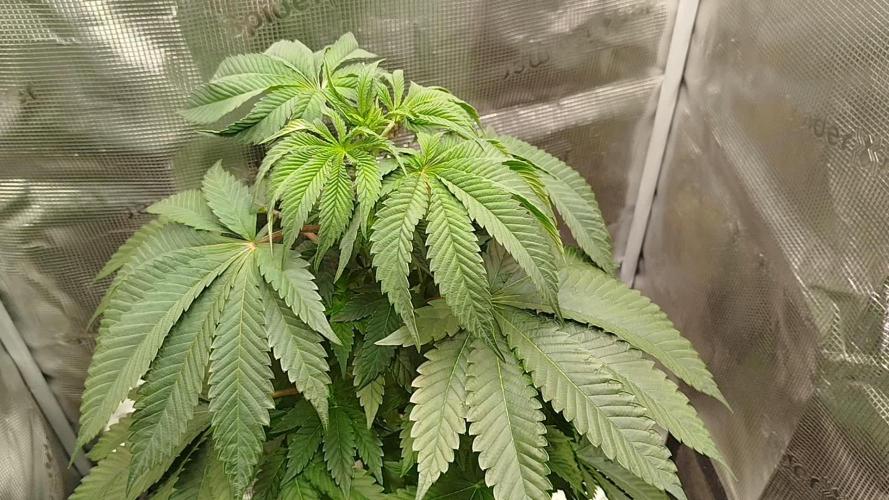
Roots were asking for more space so now it is given to a 12,5l air pot with Royal Mix as soil.
This week she is gonna be back to Sanlight LEDs and and add a nice scrog to it.

Processing
Likes
Comments
Share


@Grownewgenetics
Follow
We simple can just recommend these strain for B.s.f .seeds a company that have new Genetics, originally from southamerica , the other one is the dan Fernando Valley these one becomes in flowering these week.

Likes
41
Share


@KAPT_SAVE_Da_HOE
Follow
Gave more Sucranat frying leaves and light burn. Finishing up Forbidden Runtz soon as she is chucky. Hoping she'll put on more weight, if not oh well. Sour Stomper is catching up and feeding more now. She's starting to fill out a bit. She's still 6 days behind her sis but doing alright.
Likes
6
Share

@Chucky324
Follow
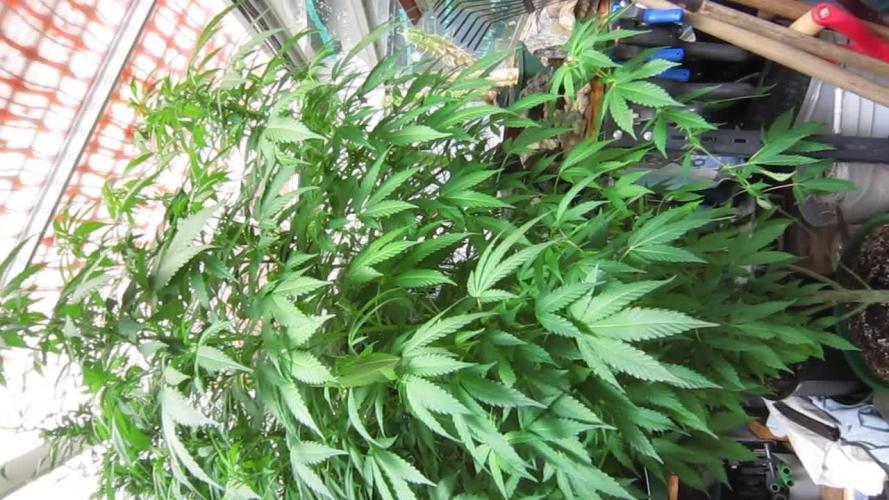
Hello. This the end of the 1st week and the start of the 2nd week of flowering.
Just a fast entry... I'm starting harvesting of the front 1/2 of this greenhouse tomorrow.
So, I'm getting ready for that. These plants have still got 6 or 7 weeks of flowering to go still.
These plant will go in the front of the greenhouse when I'm finished with the harvest in there.
Did a stock rub test of these plants and the smell reminded me of the good old days of buying land race pot.
It smelled like The Columbian sativa from the 1970's... mmm wonderful.
OK. Have Fun.
Chuck.

Likes
12
Share


@PacoMendoza420
Follow
At the second day of week 2 the first two leaves of each Mimosa look a little crinkled, but the environment is ok and the Peyote in the same tent looks good so i think it is characteristic of this particular strain.
At the fourth day of week 2 the plants show signs of explosive growth
Likes
17
Share


@Dunk_Junk
Follow
She's doing well! Not long left. Maybe a week or so. Trichomes are still all clear, pistils are 80% brown.


Likes
33
Share


@nonick123
Follow
Día 57 (10/03) Riego con 400 ml H2O EC 0,45
Día 58 (11/03) Los cogollos no paran de engordar y ponerse duros como rocas 😍💥
Riego con 500 ml H2O EC 0,45
Día 59 (12/03) Se muestra llena de tricomas! Espectacular!
Riego con 500 ml H2O EC 0,45
Día 60 (13/03) Riego con 500 ml H2O EC 0,45
Inicio un experimento a ver cuantos días aguantan sin regar habiendo regado dos días seguidos con 500 ml, ya que voy a estar 3 días fuera la semana próxima....
Día 61 (14/03) No riego
Día 62 (15/03) A las 48 horas las macetas empiezan a estar ligeras, aunque no secas, pero NO van a aguantar 3 días sin riego
Riego con 350 ml H2O EC 0,45
Día 63 (16/03) Aplicación de 0,5 Litros de PK Booster Compost Tea de nuestros increíbles amigos de BIOTABS
🚀 FastBuds 15% DISCOUNT code "NONICK" 2fast4buds.com @fastbuds.official
💦 BioTabs 15% DISCOUNT code "GDBT420" biotabs.nl/en/shop/ @biotabs_official
🌱Substrate PRO-MIX HP BACILLUS + MYCORRHIZAE @promixmitch @promixgrowers_unfiltered
💡2 x Mars Hydro FC1500 EVO Led Grow Light (2024 NEW FC 1500-EVO Samsung LM301H 150W LED) - https://marshydro.eu/products/fc1500-evo-led-grow-lights/ - https://www.amazon.de/dp/B0CSSGN5D8?ref=myi_title_dp