


Processing
Likes
Comments
Share


@Bushbanker4
Follow
Thanks for all of your replies to my questions.
I will be slowly upping the bloombastic 0.1ml every other feed until we get to 1ml.
3rd July. I done a light defoliate around the base of the plant, a few small bud sites removed that were tiny and 6/7 leaves that were dieing from the bottom to free up space around the soil.
Day 44, lowered nutrition to nearly half.


Likes
2
Share


@RawCare
Follow
Removed some fan leafs and the buds starting to explode. This lush young plant stands proud with vibrant green leaves, a testament to its great genetics. The plant is thriving under optimal nutrient uptake, its buds already beginning to form and swell with promise of a bountiful harvest of top-quality buds. This young lady is growing with a blissful ease and a resilient growth. Ample space to improve on my next run 🙏

Likes
80
Share


@OrganicNature420
Follow
• Sugar Puss, Exotic Genetix
• Cheetahs piss x Bazers (unreleased)
• 60 - 70 day flowering time
• Unknown Info nothing online
Nutrients • GreenBuzzNutrients
(DISCOUNT CODE • GD42025 ) %25
I use the whole product range and this stuff is a game changer. I've not had one bad grow with this company and it hasn't let me down once. Terps and taste are through the roof. No need for run off in coco only during flush week. Hands down the best nutrients on the market.
GREENBUZZ OUR NOW OFFEEING OUR FELLOW GROWERS A WHOOPING %25 OFF WHEN USING MY CODE ABOVE. BE AWARE IT HAS CHANGED 🌱💚 ENJOY
LIGHT/TENT • Mars Hydro FC-E6500 5x5 tent
Insanely frosty! Coated! And it f**king stinks of petrol ⛽️ .. only downside is the bud sizes. Temps Lowered.. resin time. Thanks for all your kind messages about my dad 💚


Likes
Comments
Share


Processing
Likes
3
Share


@Kushizlez
Follow
Day 40-47 (May 31st- June 7th)
(Day 41) For the first time in this grow these plants are looking halfway decent. Smell is ramping up too. I finally feel optimistic about this grow.
(Day 42) The two jacks and the chunky blueberry are showing early signs of N/Mg deficiencies. I know it’s late in flower but since I’m experimenting with this tent, I’m going to give them one final feeding of nature’s pride 2-5-5.5 (tbsp) along with a teaspoon of oyster shell flour and some rock dust. Everything else I’m going to give a teaspoon of rock dust and oyster shell. There is no way these amendments will fully break down in time to be used by the plant but they could at least use the pH buffering and trace amounts of minerals after their recent leach.
Everything but the BAOGC is covered in pistils that don’t really match their bud size. I hope they fill into their pistils because an over abundance of hairs drops the bag appeal like crazy.
Over the last few cycles, indoor and outdoor, I’ve definitely learned that different strains and phenotypes mature at different times. Sometimes really radically too.
(Day 43) None of the plants are fading at all but they’re still looking good. Black garlic I know should be fading but remains dark green and toxed. I popped a developing seed out of the main bud too. I wonder if that blueberry herm branch pollinated it at all. It seems like plants don’t really like that Destiny dark matter soil by itself. I find it works better mixed with coco or promix 1:1.
(Day 44) I’m starting to think I might be mixing up the TWOG and BAOGC. BAOGC took forever to fatten up last round and the 2 phenos I suspected already look done. I was thrown off by the similar terps. The beauty phenos are definitely TWOG
(Day 45) God these Jack Herer’s smell good. Nothing but fruity funk. Almost like a vanilla or blueberry yogurt. I would say this stuff has the most overpowering smell in the tent now. I’ve noticed they’re starting to foxtail like crazy. Blueberry#1 too.
I’m watering a final low strength feeding of seaweed extract on everything.
(Day 47) Everything really fattened up this week. Even at the beginning of the week I was saying I didn’t think they would fill out. Jack Herer and BAOGC specifically made some big gains and nearly doubled their density and still have quite a way to go on them too! The smell has ramped up and finally, everything is looking happy and healthy.


Likes
14
Share


@Pedro_88
Follow
Watermelon zkittlez va creciendo muy rápido también igual que chemical bride puedes ver el otro diario y verás que grande va

Likes
5
Share


@UnCultivadorDeWeed
Follow
Antes de podar dentro de la carpa era una selva, al cortar las ramas bajas y hojas grandes se me pasó un poco la mano y pensé que no tendrían la fuerza por ya haber pasado a floración a volver a llenar la carpa.


Likes
Comments
Share


@GanjOS_OG
Follow
We picked up the cuttings for the GanjOS Lab from High4Life on December 30th and put them in our propagator for around 3 days for acclimatization.
Likes
28
Share


@Willy_Balls
Follow
Today is the harvest day for Red hot cookies. To be honest they were ready to chop after 7 weeks of 12/12.
One green poison and one gorilla girl which is more indica leaning are also ready and I think I ll chop them too.
Two gorilla girls and two green poisons still have some days to fully mature, bu its a week tops.
One of the Red Hot cookies showed these beautiful dark purple, orange, yellow combination on its leaves which I always dreamed of having in my garden. Im super happy :) Combined with the ridiculous frostiness in the middle, she's definitely one of the most beautiful plants I've had so far.
Cheers everyone.

Likes
141
Share


@PapaNugs
Follow
This grow went well overall. No herming. No nutrient deficiencys. Can't complain there. However the bud structure wasn't there. And the smell isn't of strawberry sugar or at least during the grow. It's mostly gas with a little sweetness. No real strawberry so far.

Likes
3
Share
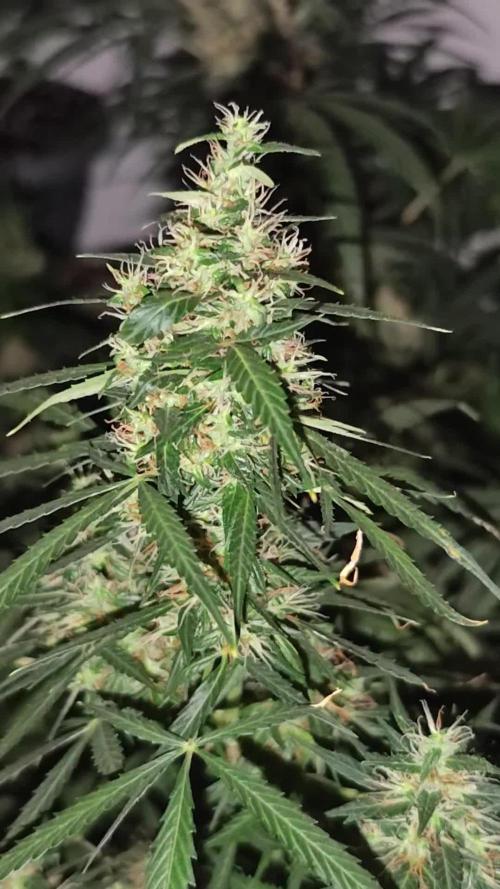

@JefyKennedy
Follow
KICKASS AUTO Day 77
Critical and Ssh bloom 50
Jack bloom 40
Fertilizers
Kickass 4th dose overdrive.
Ssh big bud 1.5ml continued
Critical and Jack 1st dose overdrive (I started overdrive 1 on Jack's 40th bloom day because I watered him incorrectly)😂
An Sensi a+b 2 ml
Big Candy 1.5 ml
Sensizym 1.5 ml
Intake ppm 850, outlet ppm 850 (all)
The temperature goes up to 34°C during the day, nothing to do anymore.
Light 480 qb ppfd 700
DLI 50

Processing
Likes
26
Share


@GrowGuy97
Follow
Day 7 & 2 of the NHLs still havnt popped, transplanting the one NHL that did pop today!
Day 12 think 1 of the orange sherbet have nute burn so flushing it out and dropping the dose a little hopefully that helps!

Processing
Likes
7
Share


Likes
5
Share


@BelBudz
Follow
Very excited to start a new grow!!
21/11/2023:
Placed the seed in a wet paper towel inside a zip lock bag and put it on the inside of the cabinet.
Whilst this is germinating I can setup and clean my tent and get the substrate ready.
This will be my first time using Biotabs nutrients and also the first time I won't be using the hydroponic DWC method.
Hoping for yet another great grow and tasty end result!
25/11/2023:
Transfered seedling to coco medium which I prepared with Bio Tabs nutrients.
Soaked the medium with Orgatrex and Bactrex disolved in tap water.
Set the light schedule to 18/6
27/11/2023:
Added some more water with nutrients because the medium felt dry.
Might have overwatered a bit since a lot of water ended up in the bottom tray.
I'll let it dry out a bit the next days before adding water again.
Processing
Likes
47
Share


@Mrs_Larimar
Follow
January 1st.
They were showing up very fast, Iam going for Day one today,,,
,,Because there are more vessels than only the " Ladyhead"
I planted 4 tealightholders in ametal Frame
I hope I can so some training on them
Until now Iam quite Happy , and we will see more soon
Thank you Silky_smooth for this Egghunt_Invitation----- i needed some Challenge for sure

Likes
30
Share


@Roberts
Follow
Watermelon auto was doing great till today. I believe I got mite symptoms on a leaf. So I am giving her a neem oil treatment. Her leaves will likely be messed up next week from this. She is under the Medic Grow Mini sun 2, in Gen 1:11 organo mineral nutrition. Thank you Gen1:11, Medic Grow, and Royal Queen Seeds.
Thank you grow diaries community for the 👇likes👇, follows, comments, and subscriptions on my YouTube channel👇. ❄️🌱🍻
Happy Growing 🌱🌱🌱
https://youtube.com/channel/UCAhN7yRzWLpcaRHhMIQ7X4g

Processing
Likes
17
Share


@Totogrowuk
Follow
Well once again I’m blown away with the genetics from Fastbuds. I only wish I had more room for them to really grow. I’m growing Fastbuds Smoothie outside and hoping that’s going to thrive in lots of space.
Anyway the Cali Snow is smelling divine and really stacking up nicely. The grapefruit continues to fatten up and smells just like over ripe grapefruit. Very acidic almost gassy. The grapefruit is a lot small so yield might be down but quality over quantity win some for me. 👊✌️🏻💚
Likes
14
Share


@Fildjoni
Follow
07.11
New flower week is here, for now all going good, still cant wait to see final product and how big and tick buds can be, but ride is joyfull and exciding.
Watering 1.3 l all 3 with nutrients and cal-mag, ph 6.2-6.5( i got ph meter without calibration fluid) but how much time i did mesuring i know how big ph is after i get water from tap [7.5-7.9(did mesuring 120 times minimum, before nutrients, after nutrients and after i add down if i need)] and yea, dont see much differnts on plants in few days without ph meter, but he is here in case, better check up,air flow is good , humidity good(above light zone 45-55%, down by plants 55-65%) and temp day 25°-27°,night 18°-24°.
I adjust pots every day 2 times minimum so every side get some correct light in all parts( maybe silly but i think its not anything bad to keep every side in some parts of day better lighted).
Wish me best for tomorrow i will need it, and them also in rest of the grow proces🍀💪🏻🍀🤞🏻🙏🏻
08.11
Today they was out to get some neem spray and see bit of light till weather is not bad, and to not spray in tent, better photos then last time i guess, they look happy and healty, today no watering i saw that soil is not dry
09.11
Today's subject..watering 1.3l pro plant with nutrients and cal mag, ph 6.2- 6.4.
How i see its good, going good and wish them best till end and more, weekend is here
10.11
Watering 1.3 l pro plant with cal mag and nutrients, ph 6-2-6.5
I saw some gold colors on end of the leafs
I think i forgot put down light intensity after spraying them with good amount of neem oil, i got some time to do it, and normal i am busy so, why not i guess
Hope its not some problems with plants, looks like burned a little not like sick and dry, and only top of leafs
Wish them bless and the best 🙏🏻🍀😋
11.11
Watering 1.4 l with nutrients and cal mag, ph 6.2-6.5
Plants looking good , still on big one bit of yellow color on leafs, hope it will go soon,
this 9 weeks was gone fast ,but this part like clock was stoped i wish till end good situation with them, good run, and all what they need🙏🏻🍀💚
12.11
I decide to try give them one day water with cal mag,ph 6.2, 1l to each of them,try to flash a little bit in hope that will help better recovery from damage, next time when i spray neem i will leave outside a bit dry and try to keep light intensity lower, bit of adjusting fen and vent, still recovering from burning down from light.. nervously waiting end😊😋😁💚🍀🙏🏻
13.11
Waterin 1.4l pro plant with cal mag and nutrients, ph 6.2-6.5
Smallest one chaching up with 2 bigger , realy happy how she turn tabels and cant wait to see how she will look on the end, plant are happy, good health with no problems, only that few of yelowing leafs that almost all had recoverd,like i said, realy happy with what i saw , now they have bit stronger smell(can feal it when i get in apartment, even if i put vent out i can taste it but ok, thats how should be, need to smell a little)
And from other stuff, today was first time snowing ❄️
Soo hard winter is in front of us, till then girls would be dryed and cured probably not 100% but enoguh to go outside, take a walk on cold and smoke one
Ladys stay hard till end and good 🍀🙏🏻💚❄️
P.S night temperature when lights are off is 15-17°[problem is with opened window becuse of vent,dont know what total resault of that would be(maybe i should let lights on night so i can have better temperature in tent, aka switch ciclus of light to be dark weil i work)] thoughts ?