


Processing
Likes
Comments
Share


Likes
27
Share


@Mr_weed_pt
Follow
Another week they are looking good . My ak47 just got some mold on the top so I already loose one top but let’s keep forward.my gorilla is showing some nice purple buds..


Likes
16
Share


@Noob_quest
Follow
So another week ticked off, with all going to plan so far.
Plants all responding well to training (just lst & some tactical defoliation).
All are showing their first pistils so expecting them to start stretching any time now.
Only plain dechlorinated ph’d water so far into my home made dry amended soil / coco / castings mix.
Will top dress at the next watering and perhaps a compost tea at the end of this / start of next week.
As for the smoking, I have started to smoke a little of the strawberry pie auto from last harvest which is just starting to cure. I might even prefer it to the gorilla cookies, it’s so dank. Therefore a little bit cross with myself for not including at least 1 this round.
Still, first world problems I guess.
Anyway thanks for reading, have a great week. 😊

Likes
5
Share

@GERGrowDesigns
Follow
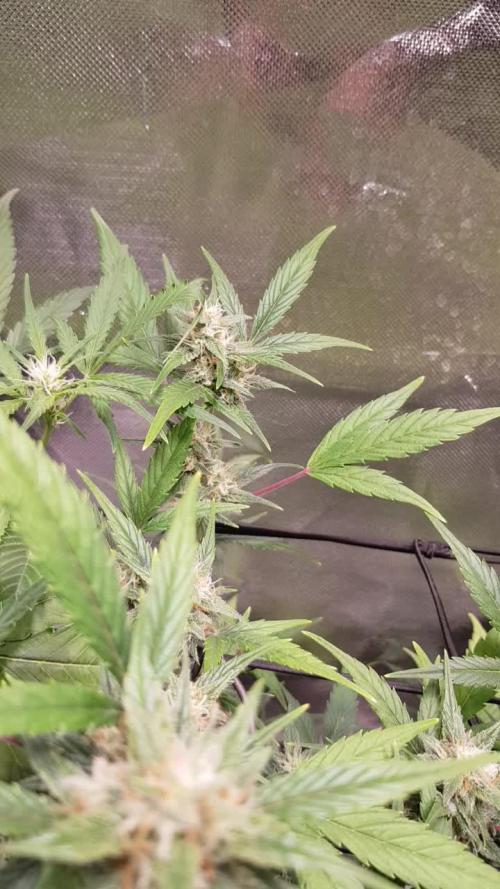
Welcome to Flower Week 2 of Fast Buds Apple Strudel Auto
I'm excited to share my grow journey with you from my
FastBuds Project . It's going to be an incredible ride, full of learning, growing, and connecting with fellow growers from all around the world!
For this Project , I’ve chosen the Feminized Auto strain Apple Strudel:
Here’s what I’m working with:
• 🌱 Tent: 120x60x80
• 🧑🌾 Breeder Company: Fast buds
• 💧 Humidity Range: 60
• ⏳ Flowering Time: 9-10 Weeks
• Strain Info: 29%THC
• 🌡️ Temperature: 26
• 🍵 Pot Size: 12
• Nutrient Brand: Hy-Pro
• ⚡ Lights : 600W x 2
A huge thank you to Fast Buds for allowing me to try my Best with this amazing collection from Automatic and Photo Strains they managed to Sponsore . Big thanks for supporting the grower community worldwide! Your genetics and passion speak for themselves!
I would truly appreciate every bit of feedback, help, questions, or discussions – and of course, your likes and interactions mean the world to me as I try to stand out in this exciting competition!
Let’s grow together – and don’t forget to stop by again to see the latest updates!
Happy growing!
Stay lifted and stay curious!
Peace & Buds!


Likes
113
Share


@Skunky
Follow
Update from last week that I forgot: I gave her a final feed at 75%...
WEEK 25 DAY 1 ... omg... 😂😂😂
It really took me half a year to finish this one... unbelievable... 😅
Well, so far I'm still super happy. Everything seems to go just fine but I'll never do this again..haha.. (vegging under a 50W bulb xD)...
Soooo... looking at the trichs, I think the harvest window has just opened. There's still a lot of clear but the cloudy ones are starting to come and there's already a little amber on the leaves. I suppose I'm really close to harvest now. I'll be flushing her next time for sure.
First, I'll feed her a low nutrient solution, maybe around 25% and half of the usual water quantity because I'm not that sure about when she really finishes so she dries out more quickly. Next, I'll use Grotek Final Flush right before I'll chop her down. I don't want to use this right away because last time my plants were dying a bit too fast so.. not to be repeated ;)
Getting impatient now. Hopefully it will be a White Christmas...haha!
DAY 2
Gave her one last feed at 25%. Poured only half of the usual water quantity. Left the BloomComplex totally aside because she seems like she's doing a little 'clawing'. Maybe there's too much Nitrogene? Trichs are beginning to get cloudy, with a little amber in between.
I'll flush her with plain ph'd water tomorrow probably or should I wait some more days? What do you think? I'm never sure when the time is right... :/
DAY 3
I just took some more pictures with a macro lens attached to my iPhone. Seems like the buds in the middle do have way more amber than the other ones around which have swollen more compared to the ones in the middle but have less amber. The last days, I didn't check the ones in the middle so I changed my mind. I just flushed her with Grotek Final Flush. I'll wait for some hours for the solution to break down the salts and then I'll flush again to get rid of the flushing solution.
I'm also gonna switch the timetable to 8/16. (16 hours of dark) and I'll drop the temperatures some 2 more degrees.
Likes
13
Share


@SpliffFarmer
Follow
Just an amazing growth 😳 it’s like a tree 🌲
I’m very happy about this plant 🌱

Likes
48
Share


@Roberts
Follow
Making first attempt at a amnesia hase auto from fast buds. Made a short video explaining the method I been using for germination and first week. Had great success with this method. Just everything after is the journey. Thanks again fast buds and supporters.
Day 6, not sure why it kept data from last week. But did not want to disturb it.
Likes
11
Share


@Skunkiest_bender39
Follow
Ende von Woche 4 ist zu sehen, die Mädels wurden geFIMt allerdings mit einer Rasierklinge.
Die beiden krumble brauchten dringend Dünger, der verbrauch steigt deutlich an. Habe von 5 auf 7 ml/L erhöhen müssen auch bei den Zake.

Likes
11
Share

@Grow_for_Happiness
Follow
Well I was saying on the last update 7-10 days to go, but four days later and here we are at harvest! Checked in this morning and saw they were fading hard, most of the fan leaves dried up and dead. Checked trichomes and yup they were ready to go! Guess she was in a hurry to join her friends in the dry tent hahaha. Cleaned up nice and easy and broke down for drying. Looks like a pretty nice yeild, can't wait to get her dried and cured to sample. Smells amazing hope the taste is the same.
Buds turned out to be a little less dense than I thought they would be, but still nice structure and for a great yeild even after trim. Just means more high grade trim for the dry sift! This has to be the most lemon smelling and tasting strain that I've ever tried. Soon as you open the bag it's like cutting a fresh lemon, such a strong clean smell! Buzz knocks you down and helps you end your day. Super relaxed and not a care or pain on the world. Pretty happy overall with this oneGot 540g buds and 187g trim.
Likes
3
Share


@Weedzoks
Follow
Welcome everyone
Here is the diaries of a friend, this is his first culture.
He chose for this session five Hulkberry from Royal Queen Seeds, a BubbleGum offered by Zamnesia, as well as a Big Bang Auto from GreenHouseSeeds.
All these ladies are under HPS 600W, 150cm square area.
Here we go!



Likes
58
Share


@m0use
Follow
The time is finally here to post the harvest. I waited till it was all done and dry before updating the dairy so will add in the dry weights next on the 2nd half of the harvest entry.
I enjoyed this plant a lot, its grew well and loved how it was shorter and fatter. I wonder if it was at the dame distance from the plant if It could have done even more. Had some issues with the yellowing that was happening on the other plant in this tent. I should have treated this faster with a flush but was super reluctant and it may have hurt the yields a bit. The top best looking buds looked and smelled amazing even the lower buds where doing well not so larfy like the other plant.
There was crazy strong smells with this plant, sour berries and hints of lemon, it was a best smelling plant I have grown to date. This would be a great plant to grow for beginners, cant take a lot of stress and still produces quite well and even on lower wattage leds it was good. It was not the most crystally looking plant, not like the maltezerz but still had some finger hash buildup but a small amount. I feel this plant would be a winner for a rosin press.
I don't plan on growing this strain out again despite me liking a lot of qualities about it. I'm only trying to grow cbd dominate plants is the main reason. If my friends really like this I have some clones so can always give them some. Speaking of clones they are doing well outside, greened up a lot and showing signs of revegging.
Took some photos of the weed hang drying on day 1 in the tent and a week later to show how much they shrink.
Only some of the lower growth is larfy, will make good edibles or hash, that will be a fun project to do and may include that in my projects diary.
That's about all I can think of if you have any questions just ask.
m0use
Disclaimers:
1. I have divided the total watts of light in half, 300w(150w) for this diary. It will accurately reflect the g/w ratio as the two plants growing in this tent are listed in two separate diaries.
2. I include any shake/trim in my gross totals as I use them to make edibles.
3. I did not follow any proper ways of listing my nutrients. Some are ml/l of total solution watered, others ml/l of total medium and some are just the total amounts I added, not as a ratio.
If you have any questions let me know!
+++++++++++++++++++++++++++++++++++++++++++++++++++++++++++++
Cost + Time Analysis Of Growing Cannabis. m0use’s Breakdown
+++++++++++++++++++++++++++++++++++++++++++++++++++++++++++++
Light Schedule
===
Veg [Dec 18th 2021 - Mar 11th 2022]
18h on 6h off - 6am-12pm
Flower [Mar 12th 2022 - May 10th 2022]
12h on 12h off - 9am-9pm
This is extra tricky this harvest as I went through 2 different hydro rates in three different periods, plus a veg and bloom switch between them.
Mon-Fri are TOU rates, all weekends are off-peak pricing all day.
Off Peak = 7pm-7am + all weekend
Mid peak = 11am-5pm
On peak = 7am-11am + 5pm-7pm
TOU rates:
Dec 18th 2021-Jan 17th 2022
Cost of kwh with on-peak "17.0c", mid-peak "11.3c" and off-peak "8.2c".
Jan 18th 2022 - Feb 7th 2022
Cost of kwh with on-peak "8.2c", mid-peak "8.2c" and off-peak "8.2c".
Feb 8th 2022 - Current
Cost of kwh with on-peak "17.0c", mid-peak "11.3c" and off-peak "8.2c".
—
Dec 18th 2021-Jan 17th 2022
Weekdays “21 days”
6am - 7am -- 1hr @8.2c/kwh off-peak
7am - 11am -- 4hr @17.0c/kwh on-peak
11am - 5pm --6hr @11.3c/kwh mid-peak
5pm - 7pm -- 2hr @17.0c/kwh on-peak
7pm - 12am -- 5hr @8.2c/Kwh off-peak
Weekends “10 days”
6am - 12am – 18hr @8.2c/kwh off-peak
6h @17.0c/kwh
6h @11.3c/kwh
6h @8.2c/kwh + 18h@8.2c/kwh weekdays/weekends
—
Jan 18th 2022 - Feb 7th 2022
Weekdays “15 days”
6am - 7am -- 1hr @8.2c/kwh off-peak
7am - 11am -- 4hr @8.2c/kwh on-peak
11am - 5pm --6hr @8.2c/kwh mid-peak
5pm - 7pm -- 2hr @8.2c/kwh on-peak
7pm - 12am -- 5hr @8.2c/Kwh off-peak
Weekends “6 days”
6am - 12am – 18hr @8.2c/kwh off-peak
18h @8.2c/kwh + 18h@8.2c/kwh weekdays/weekends
—
Feb 8th 2022 - Harvest
Veg
Feb 8th - March 11th 2022
weekdays “24 days”
6am - 7am -- 1hr @8.2c/kwh off-peak
7am - 11am -- 4hr @17.0c/kwh on-peak
11am - 5pm --6hr @11.3c/kwh mid-peak
5pm - 7pm -- 2hr @17.0c/kwh on-peak
7pm - 12am -- 5hr @8.2c/Kwh off-peak
weekends “8 days”
6am - 12am – 18hr @8.2c/kwh off-peak
6h @17.0c/kwh
6h @11.3c/kwh
6h @8.2c/kwh + 18h@8.2c/kwh weekdays/weekends
—
Flower
March 12 - May 10th 2022
weekdays “42 days”
9am - 11am -- 2hr @17.0c/kwh on-peak
11am - 5pm --6hr @11.3c/kwh mid-peak
5pm - 7pm -- 2hr @17.0c/kwh on-peak
7pm - 9am -- 2hr @8.2c/Kwh off-peak
weekends “18 days”
9am - 9pm – 18hr @8.2c/kwh off-peak
4h @17.0c/kwh
6h @811.3c/kwh
2h @8.2c/kwh + 12h@8.2c/kwh weekdays/weekends
—
Total hours in each peak period
126+144+168 = 438h @17.0c/kwh
126+144+252 = 522h @11.3c/kwh
306+378+288+300 = 1,272h @8.2c/kwh
Lights
===
LED’s I use are 48w and 18w, per stick, they are arranged on an array totaling 300w.
6400k 18w*6 = 108w + 3000k 48w*4 = 192 108w+192w=300w | 300w/1000 = 0.3Kw
* note I am using 150w as stated in my disclaimers to account for the missing plant in a separate diary.*
Using the previous c/kwh numbers above I can find out the total cost of the lamps in the 3 peak periods. I converted the cents into dollar amounts beforehand to avoid dividing by 100. 8.2c/h = 0.082$/h
438h * 0.17c/kwh = .46kw * 0.15kw = .17 on peak
522h * 0.113c/kwh = .99kw *0.15kw = .85 mid peak
1,272h * 0.082c/kwh = 4.30kw *0.15kw = .65 off peak
The "h" hours and "kw" kilowatts cancel out and we are left with a value of $ dollars per peak period, add all the peak periods up and you get your total cost of running the lights in dollars.
.17 + .85 + .65 = .67 for the grow light only.
My light grew for 20 weeks and 4 days, or 144 days. almost 21 weeks total.
.67 / 144d = 0.2477$/d average of about 25c a day in electricity
337.2kw for the entire grow.
Using the regular calculation of grams harvested divided by watts used is not accurate to me, it does not account for all the time the lamps are on, the length of grow to the over all cost. The calculation that makes sense to me is this, harvested dry weight of usable cannabis buds/trim/keif/whatever in grams divided by total kw used. Could also combine it with grams per total single use costs “anything you used only for this grow and wont reuse in the next, or fractions of multi use items like fertilizers if they ½ full” and see how much you’re investing per gram.
"kw" ÷ "g" = kw/g
"$" ÷ "g" = $/g
I have harvested 4.57oz or 129.6g on 337.2kw.
337.2kw ÷ 129.6g = 2.60 kw/g of usable cannabis. This is not an ideal ratio for me and looks like a lot of energy waste happened from the extended veg period.
.67 ÷ 129.6g = 0.28c/g
It cost 28c/g when comparing total electricity cost to gross yield, almost identical to the comparison of total electrical cost to the number of days in the grow 25c/day.
Neat!
legend,
kwh = kilowatt per hour
kw = kilowatt
w = watt
h = hour
c = cents
$ = dollars
d = day
LED= Light Emitting Diode


Likes
15
Share


@jayizrollin
Follow
First grow finally done! .
I battled a lot of inconsistencies with my environment and watering schedule.
Despite this, and my big top gun growing pollen sacs, I had a great grow, and seedless buds!
Top Gun 1 Gal harvested 25 grams dry
Top Gun 5 Gal harvested 60 grams dry
I really enjoyed the 1 gallon a lot more, easier to manage and rooted up the whole pot, going to try 3 gals next grow.

Likes
26
Share


@Ukfarmer420
Follow
Day 28 flower, things are doing well, humidity and heat are stable, plucking off leafs as I go along now anything blocking bud sites.
I'm on week 7 of the biobizz feed schedule full dose, these girls not showing any nute burn or stress so far either I could probably push them more.
Day 33 from flip.
Heat and humidity are under control. Sitting at 27°c and 40-47% humidity with lights on. And 20°c and 47% humidity lights off.
Ph levels on feeds and watering is 6.5, there really loving the biobizz range and the marshydro tsl2000 combo. So today the plants are getting fatter and nice and dense. Its super sticky and stacking on trichomes.
These 3 beans came from The same pack, and each one smells diffrent.
Closest pheno is a really lemon citrus smell and its strong.
Middle pheno is like a sherberty smell and really tickles the 👃.
Pheno 3 at the back is like a lemon skunk, really pungent and its got the fattest buds so far too.
Day 34 flower,
Feeding molasses today in 6.5ph water, I will start the next week tomorrow and will be starting on week 8 of the bio bizz nutes schedule.
Thanks for all your support so far.
Keep on growing

Processing
Likes
27
Share


@BorisGroen
Follow
visible flowering week 4 the bruce banner seems to be a late flower
there doing well on there Plagron nutrients
and there loving the new sun Spectrolight Blast 400

Likes
46
Share


@pifflestikkz
Follow
She continues to swell this week. The stretch was alot to deal with, with I am overall very impressed with Royal Queen Seeds this pheno is incredible.
The smell of banana is really coming through now, vibrant pink and purple and green plant.
Smells like a sweet sherbert still too.
Feeding every other water still she loves it.
Ill try take her to 10/11 weeks with feed before I try flush for 10 days.
All depends on her development and trichomes at end of week 9🤤🏆
Mid week 4 flower
Day 26F
Continues to swell and throw out such a banging aroma, pungent banana, then closer sweet banana sherbert, crazy.
Bud stacking nice, I love its structure. This plant impresses me daily.
Day28F- Stacking weight on, buds getting denser.
Thanks for following I'll update more pictures in the week ✌️💚
Likes
2
Share

@Daris_Growmance
Follow
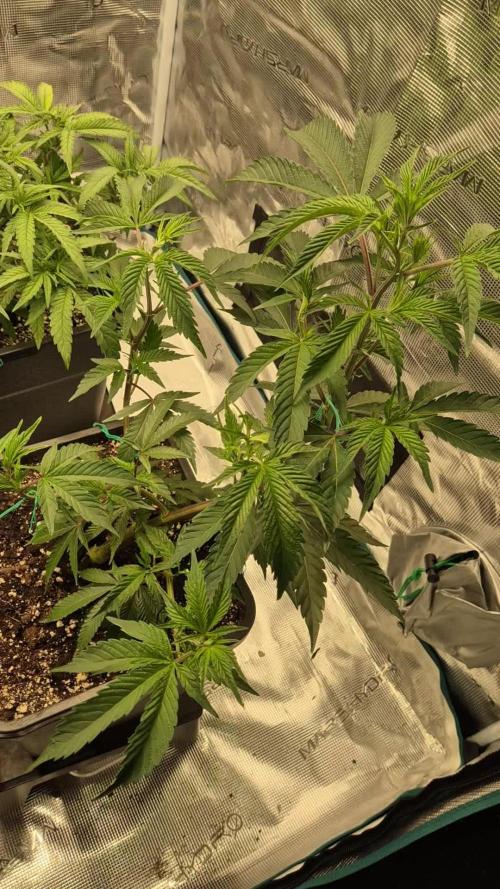
🌸 Blütetag 1 – Umstellung auf 12/12
Gestern haben wir offiziell die Blüte eingeleitet und auf 12/12 umgestellt.
Damit startet jetzt die Stretch-Phase und die Pflanzen gehen langsam in den Blütemodus über.
Heute Morgen wurde gegossen und dabei gab es eine Übergangs-Düngung mit Crazy Hills Nutrients, damit die Pflanzen den Wechsel möglichst stressfrei schaffen.
Verwendete Nährstoffe (Crazy Hills):
Upthrive (Grow Fertilizer) – weiterhin leicht mitgegeben für den Übergang
Prosper (Bloom Fertilizer) – als Start in die Blütephase
Spark (Flowering Stimulant) – zur Unterstützung der frühen Blütenbildung
Elix (All-in-One Booster) – als zusätzlicher Support im Mix
Zusätzlich wurden heute einige Blätter entlaubt (Defoliation), um die Luftzirkulation zu verbessern und mehr Licht an die unteren Triebe zu bringen. Ziel ist es, die Pflanzen jetzt sauber und offen in die Stretch-Phase zu schicken.
Die Pflanzen zeigen noch leichte Anzeichen vom Training und der Umstellung, was direkt nach dem Flip normal ist. Jetzt geht es vor allem darum, die Bedingungen stabil zu halten und sie in Ruhe in die Blüte starten zu lassen.
Training / Setup
LST bleibt aktiv, damit das Canopy möglichst gleichmäßig ist.
Die beiden hinteren Pflanzen (Roswell Code) wurden gezielt geöffnet und verteilt, damit mehr Licht ins Innere kommt.
Ziel ist ein flaches, gleichmäßiges Dach für die Stretch-Phase.
Da ich übers Wochenende unterwegs bin, wurde die Blüte bewusst jetzt eingeleitet, damit alles stabil läuft, während ich weg bin.
Jetzt heißt es beobachten, ruhig bleiben und den Stretch arbeiten lassen 🌱
🌸 Flowering Day 1 – Flip to 12/12
Yesterday we officially switched to 12/12, starting the flowering phase.
The plants are now entering the stretch period and slowly transitioning into bloom mode.
This morning they received a full watering with a transition feed using Crazy Hills Nutrients to help them move smoothly into flowering.
Nutrients used (Crazy Hills):
Upthrive (Grow Fertilizer) – still included lightly for the transition phase
Prosper (Bloom Fertilizer) – introduced to start flowering nutrition
Spark (Flowering Stimulant) – added to support early flower development
Elix (All-in-One Booster) – extra support within the mix
Today I also did some defoliation, removing selected fan leaves to improve airflow and allow more light to reach lower growth. The goal is to send them into stretch with a cleaner, more open structure.
The plants still show slight stress from training and the recent flip, which is totally normal at this stage. The main goal now is to keep conditions stable and let them settle into flower.
Training / Setup
LST remains in place to maintain an even canopy.
The two plants in the back (Roswell Code) were opened up and spread out for better light penetration.
Goal is a flat, even canopy going into stretch.
I decided to flip now because I’ll be away over the weekend, so this timing keeps everything stable while I’m gone.
Now it’s time to watch the stretch and let them do their thing.🍀

Likes
12
Share


@Leonweed10
Follow
Día 26 de floración y se ven bien definidas todas las flores,a sólo días de empezar a alimentarlas para su hermoso engorde.
Likes
12
Share


@Desertfarmer
Follow
I’ve been feeding every other day and everything is looking green, healthy, and filled the canopy out nicely. The buds are getting bigger everyday. Everything recovered well From the defoliating. Definitely starting to smell stronger. So far so good going to keep pushing these girl so hard! Cheers everyone