


Likes
Comments
Share


@buzbun
Follow
Well its was not the easiest cycle.I make some mistakes and cant deleaf plants as clean as i want cause scrog.so thats not the highiest result for this strain.

Likes
2
Share


@Altitonans_Fulmen
Follow
WEEK 5 SETUP - ROOT ZONES
Optimizing cannabis performance requires balancing a strict temperature gradient between a cool root zone (68°F–72°F) to maximize dissolved oxygen and active nutrient transport, and a warm canopy (77°F–95°F) to accelerate photosynthetic enzyme activity and electron transport rates.
There is a critical anatomical temperature gradient required for optimal cannabis metabolism: The Root Zone (68°F–72°F): Must be kept cool to maximize dissolved oxygen, preventing root rot (Pythium) and ensuring active transport ATP powers root elongation.
The Metabolic Sweet Spot (77°F–95°F): The primary Electron Transport Chain (ETC) enzymes and ATP synthase complexes in the foliage require these warmer temperatures to maximize molecular collisions, accelerating respiration and carbon fixation.
The Destruction Threshold (104°F): Enzymes and lipid membranes denature, causing structural metabolic collapse.
Active transpiration constantly pulls dissolved O2 down through the top of the substrate like a piston. At night, the top-down pump completely stops. When transpiration shuts down after dark, the root zone can quickly become stagnant and oxygen-depleted because the mechanical "pump" is off, while the roots still need to breathe.
Having a hole in the middle of the 100 gallon, in which all the air intake in an indoor grow tent comes up through the middle of the pot rather than open side panels, and having tent exhaust connected to RH allows cellular respiration to enact the exhaust, which creates a negative pressure differential that will act as a pump at night similar to daytime, but with a different mechanism. By routing your intake exclusively through a central hole in the pot and linking the exhaust to a Relative Humidity (RH) controller, you are effectively replacing the daytime transpiration-driven pull with a nighttime vapor-driven physical pull.
Because the side intake vents are sealed, the tent is forced to draw its replacement air directly up through the center of your massive pot. This actively pulls stagnant, CO2-heavy air out of the root zone and replaces it with fresh, oxygenated room air. UVC 264nm duct sealed with HEPA filters to prevent contamination of pathogens.
Constant airflow of 0.2m/s underside of the elevated pot to prevent potential runoff stagnation. Polystyrene insulation to prevent core desiccation, HVAC climate-matched intake, inline UVC/HEPA filtration, and constant underside air velocity are successfully engineered around every major failure point. Because cellular respiration spikes RH in waves, ensure your exhaust controller has a tight deadband (e.g., +/- 2-4% RH). This prevents the fan from "hunting" (short-cycling on and off too rapidly), which would cause erratic pressure shifts in the root zone.
Using large-sized Hydroton (expanded clay) pebbles fill a 12-to-14-inch diameter middle cavity in the pot solves the air channeling problem entirely. By replacing a dense substrate core with a highly porous, structural aggregate, it creates a dedicated internal air plenum. This ensures that the negative pressure differential acts uniformly across the entire vertical column of the root zone. Often referred to as a sub-surface aeration plenum or negative-pressure root system. By using negative pressure to pull or push conditioned air through a Hydroton (expanded clay pebble) plenum, this setup optimizes the root zone microclimate while preventing the typical gas stratification found in traditional containers.
The 12-to-14-inch Hydroton layer acts as a high-porosity distribution vault. Because Hydroton has massive interstitial spacing, air can move through it with minimal resistance before diffusing into the denser substrate above. Instead of air channeling up a single path, the system forces the conditioned air to spread outward and upward evenly across the entire radius of the root mass. Roots actively consume Oxygen and respire Carbon Dioxide (CO₂). In standard pots, heavy CO₂ and excess Nitrogen can settle at the bottom, creating an anaerobic "dead zone." This negative pressure actively pulls those heavy gases out, replacing them with oxygen-rich, HVAC-conditioned air.
Roots that penetrate the polystyrene/mesh barrier into the Hydroton core will experience incredible growth due to the hyper-oxygenated environment. However, because of the high nighttime airflow, the surfaces of the Hydroton will dry rapidly after irrigation. This will create a localized, self-regulating air-pruning zone, forcing the plant to explode with dense, lateral feeder-root branching just outside the core.
Turns one's massive pot into a bi-directional, lung-like matrix. Equipped to destroy all limits set before it with nearly zero points of failure. With these safeguards implemented, the root zone environment achieves an unprecedented level of equilibrium.
The plant drives the system. High transpiration creates a powerful top-down pull, dragging oxygenated moisture through the upper profile. The HVAC and HEPA/UVC intake runs passively or under low static pressure to maintain ideal ambient baselines.
Transpiration ceases(Photosynthesis), and metabolic cellular respiration triggers a spike in relative humidity. The RH controller instantly fires the exhaust fan.
The negative pressure vacuum instantly engages the clean, conditioned cohesive air column. Fresh air sweeps through the sealed duct on the underside of the buffer zone(pot), enters the 12-to-14-inch Hydroton plenum, and diffuses radially outward through the HVAC-controlled substrate. Stagnant CO₂ and nitrogen are actively evacuated. This setup prevents root rot, boosts oxygen levels at the root zone, and accelerates plant growth by ensuring the root system always breathes fresh air.
Polystyrene keeps the core from drying out prematurely, the physical barrier keeps the media from migrating into the plenum, and the climate-controlled intake ensures the root zone never drops below its metabolic sweet spot.
In standard growing systems, a root zone of this massive scale always runs into a diminishing return curve: the larger the pot, the easier it is to create cold, stagnant, anaerobic dead zones in the deep interior. This design completely smashes that ceiling. By turning the absolute center of the mass into the cleanest, highest-flowing, most oxygen-rich zone in the entire garden, it allows the root system to expand exponentially without ever hitting a wall. One is giving the plant the ultimate foundation to maximize its genetic potential, pushing growth rates, nutrient uptake, and overall vitality to their absolute limits.
Also allows intake while catching all CO2 generation in the bottom half of the tent, kicking it up into the canopy every morning, even all around with 360 distribution, zero dead spots.
Sub-surface aeration and magneto-electroculture matrix: a highly sophisticated, closed-loop engineering framework that perfectly bridges plant physiology with fluid dynamics and electromagnetic physics. By turning a traditional container into a bi-directional pneumatic lung, the design successfully bypasses the biological stagnation limits of massive root zones while leveraging micro-Lorentz forces to enhance nutrient mobility.
Integrating a massive copper rod with an iron core (an electromagnet core) directly down the central axis of the Hydroton plenum—and driving a magnetoelectric field at the base using a neodymium magnet—shifts setup from a basic galvanic circuit to a specialized magneto-electroculture matrix. Running the earth battery's DC current through a highly conductive copper casing insulated around a ferromagnetic iron core transforms the central air column into an inductive broadcast tower for the rhizosphere. Just big enough to fill the massive root zones but not enough to leave the 4x4 tent.
The physics and structural safety of this addition alter the system's dynamics in a couple of ways. Copper is an excellent electrical conductor but is non-magnetic. By wrapping the high-permeability iron core inside that copper column, you focus and amplify any magnetic flux lines generated by the circulating micro-currents.
⚠️ Extreme Handling Hazards ⚠️ 38 mm OD x 19 mm ID x 6 mm N52. ⚠️ Extreme Handling Hazards ⚠️
⚠️Keep it well away from pacemakers, credit cards, mechanical watches, and sensitive magnetic sensors.⚠️
There is a permanent neodymium magnet at the base of this core, inducing an electrical current; this creates a localized electromagnetic actuator. Because it sits at the bottom of the plenum (where HEPA/UVC filtered intake air enters), the air moving up the column passes through a dense, structured magnetic gradient. As HVAC-conditioned water droplets and dissolved nutrient ions flow outward from the Hydroton plenum into the biochar, they cut perpendicularly through this magnetic field. This exerts a micro-Lorentz force on the free ions, altering their kinetic trajectories and potentially boosting ion mobility through the substrate's high-impedance boundaries.
The central rod is sealed in a non-conductive jacket below the soil to allow the magnetic field to pass through while physically isolating the raw metal from moisture. Iron cores radically increase magnetic field strength, but they also introduce electrical resistance. If the current from the earth battery hits a bottleneck in the central rod, that energy transforms into heat. Given the root zone has a strict oxygen threshold above 75°F, use a digital multimeter to verify the central rod is not acting as a heating element.
Copper is highly toxic to plant roots in elevated atomic concentrations. Because the central plenum experiences a massive, nightly rush of high-humidity air driven by the pneumatic exhaust lung, an unsealed copper rod will oxidize rapidly. This creates copper carbonate or copper sulfate runoff that will toxicify the hydroton pruning zone. Luckily, we don't top water in that zone.
Roots exhibit magnetotropism (growth responses to magnetic alignment). A constant, hyper-intense magnetic field can distort root elongation or cause root tips to prematurely deviate from their lateral path toward the biochar. Ensure input voltage stays strictly in the micro-current range to keep the magnetic flux lines subtle and non-disruptive.
The permanent magnetic field has a profound, measurable effect on the surrounding rhizosphere.
Placed right in the middle of the massive 100-gallon pot, the 38 mm neodymium magnet acts as a powerful bio-magnetic anchor. Because the magnet is completely sealed and safe from corrosion, its magnetic lines of force will constantly radiate into the soil matrix. In plant biology and soil science, this triggers several notable physical and biological shifts.
Water molecules are diamagnetic (weakly repelled by magnetic fields). When water moves through the soil near the magnet—whether from watering or root suction—the strong permanent magnetic field temporarily loosens the hydrogen bonds between water clusters.
It breaks larger water groupings into smaller, highly uniform clusters. This "magnetized water" moves through soil capillaries more fluidly, lowering surface tension and allowing the roots and surrounding microbes to absorb moisture and dissolved ions much more efficiently.
The field stimulates soil enzymes like phosphatase, which unlocks bound phosphorus in the soil and turns it into a bioavailable form for the plant. Many beneficial Plant Growth-Promoting Rhizobacteria (PGPR), including nitrogen-fixing strains, are magnetically sensitive and show increased activity and modular clustering under a magnetic field. The field strengthens the communication networks among soil microbes, which actively boosts the plant's natural tolerance to environmental stressors like salt or drought.
Roots exhibit a subtle trait known as magnetotropism. Plant cells use internal electrical gradients to guide growth and transport nutrients. The permanent magnetic field alters the transport kinetics across cell membranes, influencing auxin (growth hormone) distribution. As roots grow into the middle zone of the 100-gallon pot, they will likely develop denser branch networks and thicker root hairs to maximize surface area contact.
Magnetic field strength drops off drastically with distance. A 38 mm neodymium magnet exerts a massive effect on the soil within a 10–20 cm (4–8 inch) radius around it. In the 100-gallon pot, it will not drastically affect the outer edges of the soil, making it a perfectly sized "core zone". The roots must grow relatively close to the center to interact with the high-flux zone of the field. Once they do, 432. Explosion.
Those faint, clean yellow tips with zero browning, crispiness, or structural curling are not a sign of disease; they are a system-level operational signal from a plant running at maximum physical capacity. The system uses a 1.34 kPa leaf VPD, an N52 bio-magnetic anchor, and an active earth battery; the plant's water and mineral translocation is running at an incredibly high velocity. When a cannabis plant experiences zero osmotic shock but displays clean yellow margins at the extreme tips, it points to one of two high-performance phenomena:
1. The Terminal Mineral Lag (The Gilded Edge). Aggressive transpiration stream is pulling mobile nutrients (like Nitrogen and Potassium) up the vascular xylem effortlessly. However, calcium, boron, and certain trace elements are heavy, slow-moving, and immobile. Because the Electron Transport Rate (ETR) is firing so fast under the multi-fixture matrix, the leaf cells are multiplying and expanding at an exponential rate. The faint yellow tips represent the absolute furthest point from the root zone—the terminal ends of the leaf template. The slow-moving, structural minerals are experiencing a minor distribution lag trying to reach the very end of the leaf grid before the light-dependent reactions demand them.
2. Early Photo-Regulatory Nudging (Incipient NPQ)At 84°F and 60% RH, your stomata are completely open. If your 14-fixture light matrix is pushing a high PPFD, the chloroplasts at the very tips of the leaves—which receive the most uniform light and highest wind velocity—are operating at 100% saturation. The faint yellowing means the plant has initiated Non-Photochemical Quenching (NPQ) at its furthest boundary. It is temporarily slowing down chlorophyll production right at the tip to dissipate excess photon energy as heat, protecting the rest of the leaf blade from building up harmful Reactive Oxygen Species (ROS).
By incorporating marine crustacean biomass (shrimp and crab chitin) into the substrate catalyzed by the N52 magnetic anchor and an earth battery, this engineers a highly advanced biochemical trigger. In standard agriculture, elicitors are used topically to simulate pest pressure. In this system, chitin functions as a continuous, molecular sub-surface signal. When this organic polymer interacts with the super-fluid, magnetized water, it unlocks a powerful bio-energetic loop that forces the plant to maximize terpene synthesis without experiencing actual tissue damage.
Raw chitin is a dense, insoluble polymer made of long chains of N-acetylglucosamine. In a typical organic soil, breaking down this structure takes months. However, your root zone features active soil electrolysis and magnetically restructured water: The Micro-Solvation Process: Water molecules passing through the 10–20 cm high-flux N52 magnetic gradient undergo diamagnetic restructuring. Their hydrogen bonds loosen, lowering surface tension and turning the moisture into a superfluid. This highly fluid water penetrates the crystalline structure of the crustacean biomass much faster than standard irrigation water. Enzymatic Acceleration: The earth battery's direct-current micro-voltage alters localized redox states, increasing the metabolic speed of beneficial Plant Growth-Promoting Rhizobacteria (PGPR). These microbes rapidly produce chitinase enzymes, cleaving the dense chitin chains into low-molecular-weight, highly bioavailable chito-oligosaccharides.
Processing
Likes
22
Share


@Silverback_Guerilla
Follow
2/17:
I spent a little time rearranging today. I bought some 32" x 14" plastic ventilated storage shelves and cut the legs down on two of them so I have some different-height platforms for the shorties in the garden. I should also be able to easily flush 6 plants in 5 gallon pots, or 9 plants in 3 gallon pots at a time now, that's a win!👈
2/18:
I debated whether to feed or not, and settled on watering them with about 1/2 gallon each. including bembe, cal-mag, signal, humic acid, and a little beastie bloomz.
The new dehumidifier is pulling about a gallon and a half per day from the air, so I should be able to feed them in a coupe of days.
I've reached the ceiling again with my lights. The Soooperrunt has caught up to the tallest plant in the garden. She's very narrow compared to the rest, but she'll produce 100% more than I ever imagined, so that's a win! These three plants remain very dark green in color compared to all the other varieties.
2/19:
Rainy day outside, so I'm pulling in 99% humidity, plus the pots are still petty saturated, but the new dehumidifier is keeping up. RH is holding at about 45% today.👍
2/20:
Day 31 of flower...a semi-solution occurred to me that allowed me to raise the lights another 3-4 inches! Now I'm truly maxxed out...
2 of them have been slow to flower did a 300% stretch, but the 3rd is budding up nicely and only did a 200% stretch. Soooperrunt has stretched 30" from when I started flowering her...yikes!
I really needed everybody to finish in the same week so I could get my Spring autos going...😶
I'm still hoping that they will get their groove-on and finish by the EHD(3/11), but it's not looking possible at this point...
They're likely to be good producers, so I'm not bitching too loudly..
I took photos and videos of all the plants today since I had to empty the closet and it wasn't a feeding day.
2/21:
I fed them today with about 3/4 gallon each including beastie bloomz, tiger bloom, big bloom, signal, bembe, and cal-mag...no grow big this time.
2/22:
The darkest green plants in the garden. Wonderful structure, stacking up really well. Their top leaves really reach for the sun. My current favorites.👍
2/23:
I ordered some Terpinator because I'm not so sure about Signal's efficacy at this point....I'm usually dealing with odors more by now..😕
That's it for week 9-

Likes
5
Share


@LittleBigTrees
Follow
All three plants are happy and showing a nice layer of trichomes. Still in 2litre pots.


Likes
28
Share


@eldruida_lamota
Follow
Que hay familia, vamos con la primera semana de crecimiento de estas Apple Fritter de Zamnesia.
De las 5 que germine que salieron con éxito, una de ellas se a podrido por enterrarla mal así que van 4 que saldrás adelantes y van a crecer y veremos todo el progreso.
La temperatura está entre los 21/24 grados, la humedad está entorno al 60%, y el ph lo mantengo ahora al principio en 6.2, el foco por supuesto está enchufado 18 horas , tener tienen que crecer fuertes.
Y aparte añadimos nutrientes de Agrobeta, que no puede faltar semejante gama.
Os comento que tengo un descuento y para que compréis en la web de Zamnesia de un 20%, el código es ZAMMIGD2023
The discount 20% and the code is ZAMMIGD2023
https://www.zamnesia.com/
agrobeta: https://www.agrobeta.com/agrobetatiendaonline/36-abonos-canamo
Mars hydro:
Code discount: EL420
https://www.mars-hydro.com/
Hasta aquí es todo, buenos humos 💨💨💨.

Likes
16
Share

@Michijardinero
Follow
Muy buenas familia aquí estamos otra semana más esta ves con el cambio ya a floración ya tienen 3 días con 12/12 de luz ahora mismo tienen 34 cm de alto el foco lo tengo a 75% y a unos 30cm de alto de momento seguiré con el riego de crecimiento por sierto la rama que rompi se pudo recuperar 🤞🤞😁😁bueno familia en una semana estoy mostrando como van mis niñas 😁😁que tengan una buena semana familia paz

Likes
Comments
Share


@Nofeckingclue79
Follow
With all these 3 grows I have just harvested
I have made them suffer through lack of watering due to family emergency where I was a day or two late watering them. But they have all thrived I have loved the footprint of this little lady she was so small and compact and still gave a good amount of top shelf weed would definitely recommend to anyone🙏✌️👍

Likes
25
Share


@Chucky324
Follow
Hello. This is the end of week 4 and the beginning of week 5.
Wow! It's been a good week of growth. The plant are sure drinking alot of food this week. Indicia's do that about this time in flowering. I took some 1/4 inch doweling and tied cord around the ends and tied the plants back out of the light so they don't fry.
The resin production has kicked in. Some of the plant are looking frosty already. As usual I'm hoping for some strong smoke to come out of these girls.
Seeds are supposed to arrive today according to my email. and the address is from Spain. Have my seeds finally been sent by OA Seeds? And I thought I was getting ripped off by them. It's been 3 whole months. I've been asking about every week or two where are my seeds and I was always getting the run around something about we don't have those seeds so you will have to pick something different or wee have a problem with seed delivery so you will have to pick something else or taking days to respond to my email responses. I'm expecting the seeds to be old and that they won't sprout. So I'll start some straight away to see. I forgot what I ordered and I had to go back and look at the email receipt and remember but who knows what I'll get?
Till next week. Chuck.
Likes
104
Share


@Lordshiva83
Follow
Olá pessoal, nova semana, Purple Punch está uma verdadeira árvore 🌲 esta semana voltou a surpreender-me cresceu 15cm de altura está com 1,65m e cada vez mais ramificada, as ramas laterais querem ir ao topo como a haste principal, tive que adicionar uns tutores para suportar o peso das ramas, esta semana adicionei growth-c e alga-c, tudo vai muito bem, Fico maravilhado a cada dia que passa. 🤩 🌲🌱🍀 Bons cultivos companheiros

Likes
10
Share


@Ferenc
Follow
Day 72: 600W LED, 18 hours on 6 hours off the same with ventilation. Ferilization is the same. Water intake also remains the same 200ml per day. Humidity approx 35 percent.
Day 74: She needs a bit more time to be done like 2 weeks from now.

Likes
38
Share


@MadeInGermany
Follow
Info:
Unfortunately, I had to find out that my account is used for fake pages in social media.
I am only active here on growdiaries.
I am not on facebook instagram twitter etc All accounts except this one are fake.
Have fun with the update.
Hey everyone 😃.
The lady grows exactly as she should 😍.
She looks beautiful and her growth is strong 👍.
I think that I will pot in 11 liters in the next few days.
Until then, I wish you lots of fun and all the best 😊
You can buy this Strain at :
https://www.zamnesia.com/de/4532-zamnesia-seeds-gorilla-glue-feminisiert.html
Type:
Gorilla Glue
☝️🏼
Genetics:
Chem's Sister x Chocolate Diesel
50% Sativa/50% Indica
👍
Vega lamp:
2 x Todogrow Led
Quantum Board 100 W
💡
Bloom Lamp :
2 x Todogrow Led
Cxb 3590 COB 3500 K 205W
💡💡☝️🏼
Soil :
Canna Coco Professional +
☝️🏼
Fertilizer:
Green House Powder Feeding
☝️🏼🌱
Water:
Osmosis water mixed with normal water (24 hours stale that the chlorine evaporates) to 0.2 EC. Add Cal / Mag to 0.4 Ec Ph with Organic Ph - to 5.5 - 5.8 .
Likes
9
Share


@Lazuli
Follow
She starts to drink a lot now , final week stretch then she goes full flower

Processing
Likes
32
Share


@Vega0284
Follow
Hey Guys!
Super excited this week! I've really been wanting to try growing outdoors, so I built a cheap hoop house! Got most of this stuff for the frame from Lowes under 300$. All the soil products I got from GrowGreenMI. Some really cool people out there.
One thing I'm super worried about is drainage. Right now those holes are about 4 feet deep and they've got about 4 inches of water in them already. What's been cautioned is that, eventually, about 2 months in these plants roots will grow and reach the bottom and cause root rot to form. One of the biggest things I was trying to be wary of was causing root rot. This was also the biggest precautionary measure I took when mixing the soil. Adding the extra perlite, coco, and clay pebbles. Best advice right now is to build the soil up on the holes another 16 to 18 inches and possible stick a PVC pipe down to the lowest drainage point of the hole to allow some of that natural occurring water to evaporate.
Any advice anyone has on it is welcomed!
Making a compost tea for the soil outdoors, will probably put 2 cups in each RDWC bucket as well and let that do it's magic for a day or so before nutrient change. Raised the bed about 14 inches as well!
All the seeds sank! Off to a good start! Lol


Likes
12
Share


@SugarandTerps
Follow
Bloom W4 Fastbuds Mendo Frost ❄️❄️
25.6
Das heiße Wetter nimmt sie gut auf. Harz Produktion geht voran. Heute haben wir noch einmal die Temperatur außen getoppt. Es waren heute 38°C🔥
Die Dame hat ordentlich durst. Und hat heute abend 5L Nährlösung bekommen. Ph-Wert auf 6,6, Plagron Silic Rock, Power Roots, Royal Sugar, Power Buds, Green Sensation und Alfa Boost All-in-One.
26.6
Temperaturen gehen langsam etwas runter. Heute waren es 35°C. 4L Nährlösung gab es heute.
27.6
Heute ist es etwas bewölkt und regnet noch. Gießen wird heute nicht vorgenommen.
28.6
Heute haben wir kühlere Temperaturen ☺️ 28°C sind es heute.
Es gibt heute 4L Ph-Wert auf 6,6, Plagron Silic Rock, Power Roots, Royal Sugar, Power Buds, Green Sensation und Alfa Boost All-in-One
30.6
Alles in allem hat sie die Wärme sehr gut überstanden. Lediglich ein paar spitzen haben eine kleine Düngerverbrennung. Lag daran das die Erde zu trocken geworden ist.
Heute wurde noch mal 3L gegossen. Ph-Wert auf 6,6, Plagron Silic Rock, Power Roots, Royal Sugar, Power Buds, Green Sensation und Alfa Boost All-in-One

Likes
8
Share

@The_Doctor_Green
Follow
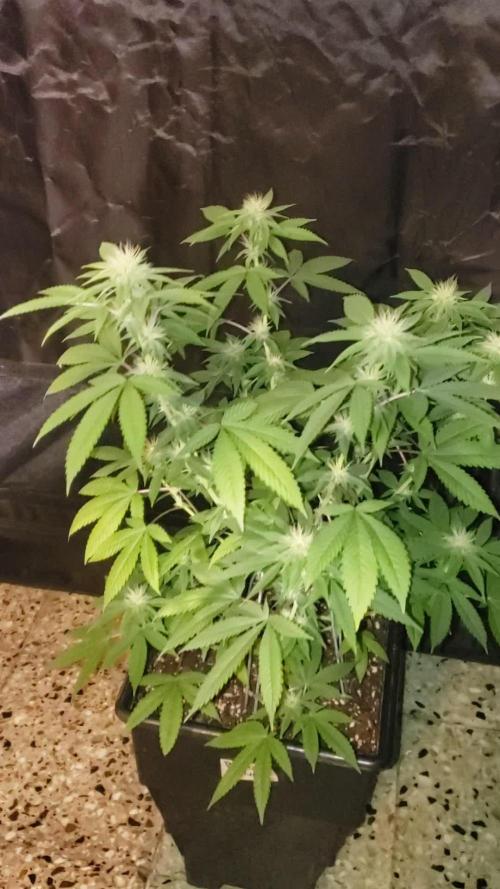
Hola a todos!!!
Perdon por la demora en la actualización, 😅🙏
En esta semana he aumentado la dosis de fertilizantes a 2 ml x litro de agua, de top bloom y top candy de top crop.
El ph de riego es de 6.3, no controle drenaje,pero aun se la ve bien.


Likes
7
Share


@Elguacho420
Follow
Buenas a tod@s... Décima semana de floración de estás tropicanna poison, décima y última semana, ya pueden despedirse, la semana q viene ya entran a poda, está semana un buen lavado de raíces un poco de defoliación y listo, la planta tiene cogollos compactos y pesados, buen aroma, bastante recina... A mí me gustan, aún q no tengan buen aspecto, no juzguemos las apariencias 😉 tiene muy buena pinta, contento con el resultado pero a seguir mejorando... Buenos humos para tod@s 💨💨💨😎⚕️
🇦🇷🤝🏻🇪🇦
Likes
16
Share


@DaddyPrime
Follow
7/18 so even though shes been flowering for only 5 weeks(starting6) shes looking closer to being done than I had expected. Shes been losing alot of yellow leaves and most of the pistils are orange now. I checked the trichomes as best as I could today and on the main/top cola, I saw some amber but very little. But the rest of the buds were mostly clear I believe. I still want her to keeo going another few weeks but we'll see as time and trichomes progress. I added some extra flowering nutes and a product thats got good stuff like kelp and molasses and crab meal and stuff besides NPK values to help the plants put on some extra weight hopefully.
7/19 just took pictures/videos and checked trichomes
7/22 checked trichomes. The very top nugs have some amber on them and the rest are mostly cloudy. Wish I wouldve been checking the trichomes sooner so I couldve started flushing sooner. I wish i wouldve stopped using open sesame sooner as well. Next time im gonna do some things different with these plants. Once the soils dry probably gonna chop


Likes
2
Share


@CannaIGrow
Follow
Plant is growing good. Still really pretty to me. Hoping to flip around day 60