


Processing
Likes
Comments
Share


@H473crew
Follow
HST - heavy feeding - defoliation this week. Should of been done last week *shameface* now some of them are very top heavy and are starting to bend, this is also due to having my clones way to long to begin with. They should have been a lot shorter. 😤
Very happy they have finally picked up from such a bad start in the beginning.
loving how short and bushy they are. 😃
Next week will be changing to Flower Cycle 👽

Likes
29
Share


@RushGreen
Follow
Pour cette semaine nous avons décider de pratiquer la défoliation, pour la première fois, bonne idée ou pas nous verrons par la suite ce que cela donne.
defoliation : 10/12/2018

Likes
13
Share


@Seven1AteChef
Follow
I’m very concerned about baby 1. Her growth pace is behind her sister baby 2. Working with someone to help me figure out how to remedy this. Fresh batch of water and nutrients for baby 1. Loving how rapid they are growing!

Likes
12
Share


@Microsemilla
Follow
Y es el turno de las resionosisimas Lebron Haze. Hermosas plantas, ya te siento cerca tu colocón!

Likes
23
Share


@Jackweed77
Follow
Eccoci qua arrivati all'ultima settimana di questa corsa...che chiude quest'anno in bellezza...le ragazze 🌱🔥sono passate sotto la tormenta di neve❄️ e sono belle imbiancate come piace a me...e anche a voi😉❤️...questa BISCOTTI di zamnesia 👌alimentate da plagron mi hanno dato davvero tanta soddisfazione durante la fioritura⚘️❤️ sono veramente ansioso di provare il fumo di queste ragazze..💘🧐💣.
27/12 raccolta qualche cima dopo tre giorni con soluzione senza nutrienti per aver la possibilità di provarla a capodanno...🧐


Likes
48
Share


@Focus420
Follow
Zdravím všechny pěstitele marijánky🌍🌞
Minulý týden sklizen BCN critilal xxl - tato rostlina měla od začátku problémy pak se spravila a nakonec vypadá celkem solidně.
Víc se dozvíte ve sklizni🌱🌱🙏
Nemůžu se dočkat dalšího růstu🌞🤗
Tento týden půjde pod kosu poslední automat (sleep)
Zbydou tam 3 celoroční odrůdy, ty vypadají nejlíp... ty ještě potřebují 2 až 3 týdny
Den 99. Hnojení
Celoročky - ph 6,3
ec 2,5
Den 100.🌱 holky vypadají úžasně😍
Dnes proběhla defoliace (focus)(franco lemon cheese)
Den 101.
Sekera🤟 (sleep) zbyly 3 celoroční odrůdy
2× focus , 1× franco lemon cheese
Proplach 8 - 10 dní
Den 102.
Kontrola trichomů -
focus = 10 % jantarových vrchů 🌱🤗
Franco lemon cheese = mléčné trichomy
Den 103.
Kontrola - Teplota,vlhkost,co2 v pořádku🤜
Den 104. Kontrola trichomu 15 procent jantar ( focus )👏
Den 105.proplach
Ph - 6,3
ec - 0,43


Likes
40
Share


@Ganjagrandaddy
Follow
Day 63 : These girls are continuing their quest for glory and still popping pistils.
#1 In her organic soil looks the most potent up close and her main stem is so fat now. I tried to reposition it a little and lost the battle as it could arm wrestle a Gorilla !!. I amended her pot today with some charge(200ml/10L) in her water along with the other LOS girls and a top dress with "life cycle" (30ml) . I think another week at least for her so she could use the boosts.
#2 Is also looking potent and smells amazing like her sister up close. she is a very thirsty girl and uses all her nutes within a day to a lighter pot slightly every feed. She has been fed with just the shogun sumo boost (20ml) , dragon force (40ml) to 10L water to compare with her MC fed sister. her height is held down with lst but if I grew this strain again , I would not train it flat but manage it as natural as possible. #3 is the reason I say this. As she had looked a little different in size and colour , I allowed her to grow untrained. She is still completely different to the others but from talking to a member here , there are about 9 different ones. wow. She smells identical but her buds look so different to her sisters from different Misters. She is being fed with Mc (10g) , sumo boost (10ml), pk warrior (6ml) , calmag(10ml) and silica (10ml) to 10L water. She is loving life and packing her weight on now. i think she may finish a bit after her step-sisters but I expect a few more weeks possibly.
Keep it green Growmies

Likes
10
Share


@CampaCavallo
Follow
4ª settimana di fioritura alla CAMPACAVALLO per la Black Muffin di SweetSeeds 💚🐘🔝
Di piccoli peni 🍌 non se ne vedono più...
Ed i bud si stanno gonfiando alla grande😛🎈
Beve 🍺 propio tanto in questa fase di crescita 🐫
🖤La CampaCavallo manda un grande abbraccio a Valencia ed alle persone colpite dalla maledetta alluvione🖤
Processing
Likes
10
Share


@GrowerGaz
Follow
No more nutrients just water the last week. Plane sailing till harvest now I hope.
Likes
11
Share


@TechDCo
Follow
Week 1
27/01/2025
TF and MS
Feed HydroSol: Increased to 8ml/5L
28/01/2025
TF and MS
Light Increased: 313watts
DLi: 35
Rapid Growth has started again.
Feed Increased: HydroSol 10ml/5L
HP 12%: 1ml/5L
Uploaded today's pictures and yesterday's for comparison on how HydroSol is doing?
I topped MS. Hopefully by doing this now TF will catch up but that's not why I topped her. She's known for being bushy; so will be good to bring her up to her second level before branching. Giving the rate she is growing; we haven't to worry about stunting Growth.
H202 is also know to to cause mutations at high levels. I tried to start this diary with HP 12% from seed and it worked until micro-organisms in the air and water; what distillation has missed the "vocs" the cardon didn't catch. Caused them to later on because of free radicals and this is why high levels of HP can cause mutations and cancer when it steals atoms by ripping them apart. "Call the bomb swaddles" when mixed correctly or 'incorrectly 💣 lol
28th Today
Little VT of the 5L jerry can starter pots (DiY)
I think this process is allowing for optimization of Air/feed pks.
I'm at least 2-3weeks ahead from a normal grow because of this style growing.
I know, I know, I lost 3weeks from the first failed attempts. But it's okay 👍 I'm okay with that. Now I know and it's logged in the dairy for future reference I can quickly glance over before I start another one. Like hey 👋 "Time is valuable, read ya diaries" honestly, I don't have dementia i have human forgetfulness/error.
Its still in the experimentental phase.
Took tf out the propagator
31/01/2024
Nothing much to see
I've did everything for TF and still looking droopy. Exactly the same as MS.
I think she'll grow out of it!
01/02/2025
I know, I know what ya thinking, it looks like spider mites on MS only leaf but honestly I think its of the h202. I deffolled her only leaf. Sprayed it with h202 and no reactions happen. No mites.
The Future TF is looking much more lively.
Oh well. No speed-run this time round!
I shouldn't of took 4wks off from growing. Rhythmic nature of thing and getting in the swing off it. It's easy to do but I am always in two minds with everything I do. I can't help but cause "Self sabotage' every time I get to ahead of myself, by running my mouth 💯 blah blah blah; always beside myself.
Aye' they say "God is next to Cleanliness" if that's true it'll be impossible for me to be beside myself haha 😄
Its all fun and games 🎮 🙃
01/02/2025
Midday
Light Increased: 560watts (max) for this power supply. I disconnected the 1200watts one for each light is 600watts. It's currently half-power with 600watts max for two lights at 300watts each. Better than having mishaps with the full power supply 1200 being turned up accidently say in a not ventilated enough little tent. I'd rather pass on that anxiety 🙃
Plants: Under jerry cans with dli at 20.
This should by dinfintion let them gather themselves for 3days; while the sun is blazing outside the can. Even though I could lower the light. I think the high light intensity outside the cans the plants know.
Midday VT
MS looks likes shes a clone 😳 👀 but she ain't!
One day I will get these protocols right. But atm ; atlas, it's all in jest n fun!
MS defiantly looks like a clone but she's not; i have taken pictures since she hatched everyday
03/02/2025
Midday
Freaky Pablo and The future 2 germinated
Sprayed with weak solution of Hydroclonic Acid + h202 very mild.
Now the fun begins!

Likes
33
Share


@LouShott
Follow
This grow has been sooooo easy apart from a slight bit of nutrient burn that you can see, she has been a pleasure to grow, she is taking longer than expected but i wouldnt have her any other way lol.
Ive noticed that the pistils really turn bright orange even red 😁- i hope she tastes and smells as citrusy as she looks😝 - also getting frosty 👍
Merry Christmas Everyone!!😉
Likes
54
Share

@RakonGrow
Follow
+
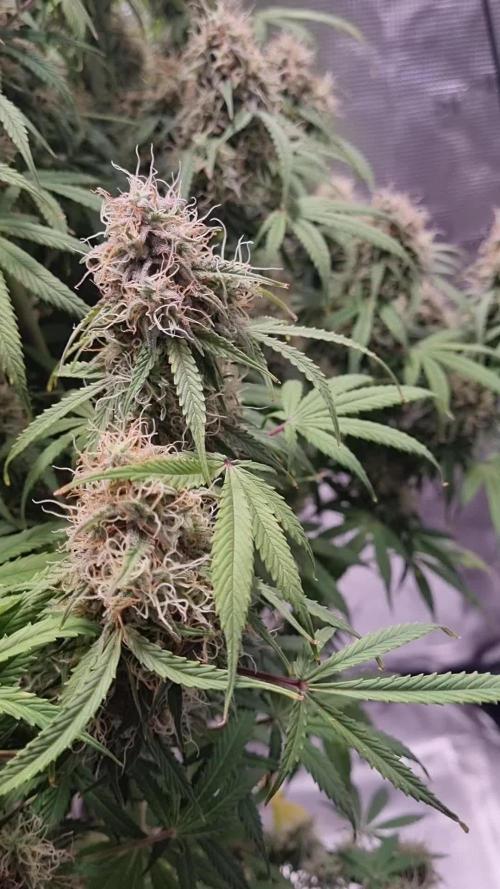
Verbrauchsdaten / Protokoll zum grow online : rakongrow.lima.zone/growme-purple-queen-auto.html
Tag 96:
Ab in den Kühlschrank ;) naja fast, umzug ins vegi zelt und dort ca 18°C über nacht . Ich will die Lila haben ;)) kaum platz , zelt 160cm , pflanze mit Topf 121cm
Tag 95:
Entlaubung 60g , mitte frei gemacht, fluffi triebe entfernt .
Tag 94 :
Läuft etwas übetrieben, die wird noch 300 Tage alt :))
+

Likes
9
Share


@TommyBVRSA75
Follow
El video mas comentado del momento...a ver qué te parece...son de plástico, no?!? Un saludo fuerte a todos los hermanos y hermanas growers...
420 Siempre y Dios Jah siempre en el comando....
Likes
50
Share


@Ferenc
Follow
Day 72, 21st of November 2020:
Great. Typical Indica no much strech after topping no problem with her at all. May be she need a bit less nitrogen.
Great work from RQS and I hope she will turrn to be purple a bit in the end. Nice smell tho.....
Buds are coming and getting fat looking great.
Fertilization is the same every 2nd day with the mix and the ratio above....
All LST has been removed as the plant remains the same so no need to keep her in "chains".
The lamp is on 11.30 min and off 12.30 min.
Last week was 15 min longer light cycle....
So every week 15 min shorter light cycle until the 5th week. So far -30 min. It switches on at 6 am and off at 17.30 pm.
Likes
4
Share


@Witteviking48
Follow
Did nothing but feed and spray on and under the leafs.
Before feeding I brew the solution for 24h. Taken from a larger vat that's aerated all the time. The water itself was filtered by reversed osmose a couple days before.
The EC-value is 0.1
Ramping up Par-levels to 480-500 at the end of this week.
At the end of the week I sowed the cover crop and mulshed it with Miscanthus


Likes
24
Share


@BillMonroe
Follow
Instead of giving nutrients I gave only water because I noticed some yellow tips on the new growth.
The plant had been getting 700ppm feed(including 220ppm tap water). Nutrient buildup in soil?
I made the switch to 12/12 today. Since 2 days the new growth has been looking funky - the same corkscrewy thing I had in my first grow.
Overall, a lot of trimming, bending, training. It has become a cool plant in my opinion :)
Info useful for my question:
*6.2-6.4ph water every time
*giving water when the soil is dry and lower leaves start to hang a little. but i suspect it is hard to overwater with these airpots
*built up nutrients to about 720ppm until last watering

Likes
2
Share


@igrowcan
Follow
[Week 5 - Rapid Growth]
In just one week, the Fat Banana plant experiences its biggest growth spurt so far within the minigrow box. The
leaves become lusher, and the stems grow stronger as the plant reaches for the light.
Likes
8
Share

@Hempface86
Follow
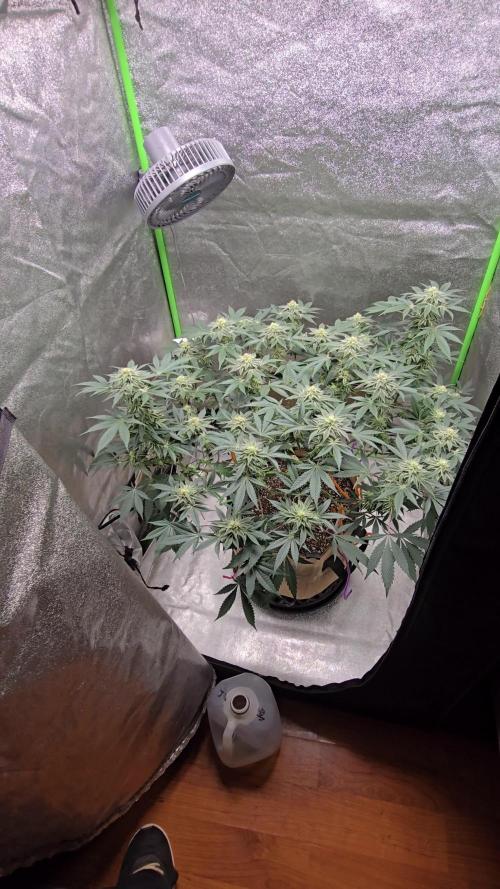
Ladies and gentlemen, hope all is well. As you can see, this lady is doing very good and it's getting super frosty even on the fan leaves =) .. big shout out to the homie @Grow4releaf for the bean.. my man ... anyhow, this girl is super frosty and I really look forward to what's to come... She is filling up the tent nicely... See you back in a week and until next time God bless and happy growing
