


Likes
Comments
Share


@Major
Follow
BSB genetic is 1 week shorter than my Tropicana Banana from Barney’s Farm but it is in full bloom and has beautiful, dense leaves. beautiful quality of seeds also congratulations to all 🙏🙏🙏👏👏👏😁😁


Likes
11
Share


@Chimney_Chief
Follow
This week she has shown the most growth overall. Shes doubled in size and shows newfoliage each day! LST continues to keep her evenly at 14cm and open for light to hit those central areas.
As stated i have upped the nutes to accommodate her new found strength and hope to see bountiful results over the following week.
Have decided to make changing water buckets every 2 weeks instead of weekly at this stage as I find the plants do not drink enough to warrant doing so, top ups over the week seem to suffice perfectly (yay money saved).
Shes alil jungle right now but tomoz I will look to exfoliate some to clean her up, didn't want to stress her too much after todays water change. Fingers crossed I'd say another 2 weeks max before flipping her into flower. (And toes).

Likes
46
Share


@GanjaReaper
Follow
At the end of last week, finally flower indicators started to show and these week it went more.
Day 32:
I sprayed them with Rhizotonic this week. This will be the last week for sprays. I don't like to spray my plants while having buds on it even thought it is organic.
Always make sure you spray from below the leafs. They will uptake it better and also spray some above. With the lights off.
Did some defoliation again and removed some lower internodes which will be crappy buds anyways.
Made a video of my feeding bucket as well, in case some of you wonder how I feed all those plants manually.
It is a pump with an gardenhose attached.
Thats it for this week, Until next week!

Likes
2
Share


@SebastianFastBuds
Follow
As you can see now I am batteling crazy hot temperatures. She is already crazy sticky and has this typical Guava smell. Strwaberry with Pear. I am proud of this plant which has been moved around all over the place and she still will give me a nice yield of yummy Nuggets.

Likes
7
Share


@Ryno1990
Follow
The Purple Goat Cheese is doing good comming threw first week of flower she's been growing good no deficiencies or anything despite the humidity problem I been having she's been loving life feeding on cultured biologix nutrients under the medic grow fold 6


Likes
11
Share


@Vegetoo420
Follow
We continue the flush!
I’ll give them 2ml/l canna flush on next watering
Purple tones appeared on dos si dos 33 !
Trichomes started to turn amber and buds are more denses ! Harvest day is for soon !!

Likes
44
Share


@Jays_Not_Here_Man
Follow
This will be the ladies last week of Veg, they will be flipped to flower at the end of the week. I have been increasing the nutrients steadily, and rotating between heavy, light and low nutrient mixes. They have been steadily getting taller and bushier. Temps have remained steady in the high 70’s and low 80’s while RH has come down a bit to between 55 and 60%. I won’t be doing much training for these girls, and I won’t be running a SCROG this time around. I’ll need to make another custome size for my tent now that I have a much larger setup. Happy Gardening 😊👊❤️

Processing
Likes
64
Share


As soon as she recovers from the defoliation and I get a couple of clones I'm going to flip her to 12 12


Likes
16
Share


@AestheticGenetics
Follow
4/9/25
This plant is beyond frosty. Stacking up super nicely. Seems like she will yeild quite a bit.
My only gripe is that she has like no smell at all.
Using the foil as a soil cover is working quite nicely. the top soil is getting filled with roots quite well.
Top dressed 1tsp of Bloom
1tsp microbe charge
1tsp bloom

Likes
5
Share

@TrickzGrowz
Follow
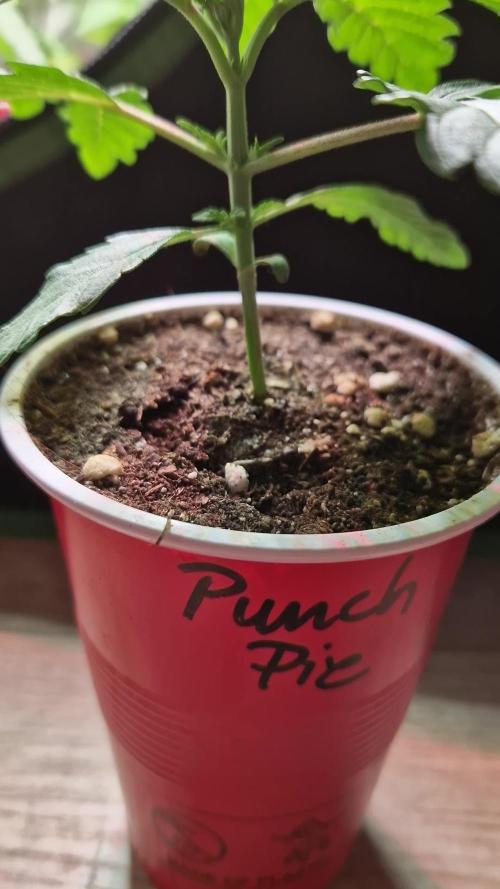
Sie wächst super und bekommt endlich diese Woche ihren ersten Dünger. Diesmal Dünge ich wieder mit meinen Favoriten vom MaryJanes Growshop.

Processing
Likes
15
Share


@DudeGrowsWeed
Follow
Lots of growth this week! 😃 So far, the indoor girls are looking fuller to me. They seem shorter with tighter nodes and more nodes than the outdoor girls. Also one of the outdoor girls seems to be a little bit of a runt. I'm hoping she catches up eventually, but I'm noticing the runty looking girl is also not symmetrical for some reason. I think this is a good comparison. I'm glad I'm growing 2 outdoors and 2 indoors so we can see a more fair comparison. If I only had one of each it might be a genetic thing causing the differences. Btw... the indoor plants are under 315w CMH on a 19/5 light cycle, 24" from the canopy. The outdoors are obviously dependent on the sunlight which is between 15-16 hours here now.
I don't care that the outdoor girls have stretched more than the indoor - they don't have a ceiling to deal with, nor will they grow too close to the light (unless I'm really lucky 😉 ). I am very happy that so far I do not see any damage due to bugs on any of the plants. I'm still feeding at 75% of the Fox Farm schedule. That seems to be the right level to me. I'm almost out of Big Bloom, just ordered another gallon.
What do you guys think? Please comment! Thanks!!!
Likes
13
Share


@J_diaz420
Follow
Bienvenidos!!
Para germinar las dejo 2 a 3 días entre papel húmedo, luego las paso a sustrato y las dejo al menos 12 hrs en obscuridad antes de encender el primer ciclo lumínico de 18 hrs donde comienzan a brotar inmediatamente.


Likes
12
Share


@Siriuz
Follow
We started week. 10
Hey there guys I've been super busy
Day 64
Check video
Fed them 1670ppm
Followed by water with lil runoff
Day 65
Check video
Day 66
Outdoors for 3hrs
Rested for 6hrs no lights
Because of blackout
I know it sucks
Humidity 60%
Day 67
Humidity 45%
Got some vids and pics for you guys
She's all good
Buds fattening up
Day 68
Water them a lil bit
0.5l each
Temp 24C
RH 45%
Day 69
Outdoors for a day since we didn't have electricity from 10am til 7pm
Good thing we have sun light right?
And it's very bright but very hot as well
Temp reached 33 Celsius but we had her on sprayed mist until it dried out completely than refresh her again and so
She didn't stress at all shes good
After thar electricity came back and we turn on the setup grow lights ac and all stuff
Back to normal again
Day 70
Same stuff than 69
Nothing wrong all is good
Temp reached 33 then dropped to 24 at night time
Coming up next week last meal nutes
Likes
Comments
Share

@BluLions
Follow
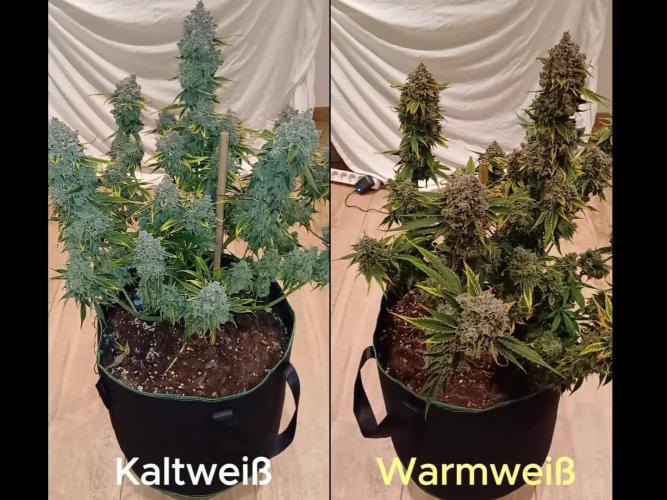
Erntetag, ein schöner Tag! ;)
Ich bin sehr zufrieden mit der Lady. Trotz meines groben Fehlers zum Start hat Sie alles super gemacht!
Schöne Dame mit wie ich finde mäßigen Geruch... Kompakte Pflanze und sehr schöne kompakte Buds.
Servus ihr Lieben
Likes
49
Share


@masterofsmeagol
Follow
IVE MADE MORE VIDEOS BUT THEY JUST DON'T SEEM TO UPLOAD AND IT'S FAR TO SLOW TO DO IT FROM HOME
6/27 Made last week a five day week to get back on track. It's still overcast and rainy. It's not raining a lot bit it's consistent. Despite the weather the plants are doing phenomenal. I'll update later. It's 1pm. It's been raining consistently since 11. Just a sprinkle but it's steady. I'm going to begun uploading the weeks weather on my diary. I may start a new diary for the plants I light depped as they are flowering pretty good. Rain stopped and it's just overcast for now. I looked at some videos and did a comparison of videos one week ago and videos today and HOLY SHIT! WHAT A DIFFERENCE. Especially the light depped 10th planet. Well everything but that was the most significant difference. I'm astonished at the health and growth despite the crummy weather. Continued to rain. Just got harder. Plants are taking it but it's flooding underneath the pallets a little but it will be fine. The light dep however has me concerned. The 10th planet is looking spectacular. The bigger purple punch I'd looking good too. The smaller one though looks to have a pollen sack coming off one of the branches. Considering its not on the otherside I assume it's not just a swollen calyx. I don't mind chucking it especially if that means I don't hurt my other girls so I want to make sure. I sent videos to a few other growers and I'll add a question on here. Those three plants have been isolated from the rest for a few days due to rain. I have the suspect isolated alone until I can confirm. It sucks cause the light Depp was going good and the6ve all got little flowers.
6/28 Well that fucking sucks. ALL THREE plants I tried to light depp hermed on me. I could see male flowers. Luckily I had been keeping a really good eye on them and it was preflowers mostly. At least I caught it. One or two stamines on each plant. Would've been really easy to miss. Only one had STARTED to elongate into a stem so I think I caught it early enough. Plus since all this rain they've been kept in a different location then my big girls. Glad I did that now. Boy the roots looked good on those plants. I just grabbed the stalk and lifted and it came right out of the pot. I held it there admiring it for a minute. This sucks. At least the real plants are doing good. As far as I know. No male preflowers that's for sure. I've got some feedback from other growers and the videos are a little blurry but I had found a light leak and I'm certain these plants hermed. I know I could've tried to save them but I didn't want to risk it. I compared what I was seeing with Google photos and other websites. Aside from the larger ball with its stem, there were also several little bumps besides developed calyxes that were weaving into little buds. Trust me that I wouldn't cut down my plants if I wasn't 110% sure. I might've been able to "save them" but to me it's just not worth the risk.
6/29 I was second guessing myself pretty hard last night due to some responses I got on my light dep and messages I got from other growets. Made my anxiety horrible but I looked on several video's I'd taken again and I know what I saw. I felt better after that. This was after I researched and waited THREE days until I saw the ball on the stem and the groupings of small nubs under a fresh yellow flower. These plants were flowering good and it sucks to lose them. One MAY have been ok but one was a runt and had all the characteristics of a true hermaphrodite. They were only in 3's and I couldn't risk my harvest for an experiment. Still sucks. Oh well. Sun is starting to come out. Plants seem to be doing fantastic. I have one spot on a leaf that looks like a pillar munched on a leaf so I'll probably get the bt out soon as I have a dry day that I can apply it. I'll have to check the weather. I need to start a nute regiment but the plants aren't telling me they need anything yet.
6/30 I fucked up dates or dodnt do it yesterday or it didnt save right so I'm leaving this blank today is the 1st.
7/1 I have still only watered s couple times and I haven't had to feed. This week I'm going to start nutes. I had some external ersonal situations that have kept me from my plants. I'm hoping to get back on track. I noticed some pillar damage so I'll need to dig out the BT. This morning I saw this giant ground hog by my cage. Hated too but had to get rid of him. Of course some of the blowback landed on the leaves of one of my plants. I tried to clean it as best I could. Better than that fat bastard eating everything in one night. I broke a branch either falling around it or bulling through when I was pissed or I LST it the wrong way and the wind broke it against the tomato cage. Nice big branch too on top. I tried to fix it with duct tape but we'll see. The plants need me to spend sometime with them. I need to clean them up. Apply bt and give them their first feeding. I'll update as I go. They don't seem nutrient deficient by any means but I don't think it would hurt to start the nutes.
7/2 Bags were lighter today and if it wasn't going to rain tonight and tomorrow I'd he watering. Plants look great so soil isn't depleted yet I guess. They're growing rather rapidly. The branch I broke didnt make it. Had an idea it wouldn't but I had to try. I waited on the BT on account of the rain. I may go back over and change my mind and water with silica or a mild nute solution or maybe apply the BT. Depends what time I get back. I have some work I need to do over there. There's a few that I need to clean up the bottoms on. Pest damage is minor and limited to one or two plants and a leaf or two only.
7/3 More rain. It was supposed to rain this morning too but it didn't. We got .33in yesterday and through last night so I thought that was ok. Looking back on my previous diaries I'm doing things significantly different than before. I had used a lot more nutes earlier on. This morning I mixed two gallons of 2tsp of big bloom and fed it to the 9 plants in smart pots leaving the container plants as they have much more water in them. Looking back at other diaries I previously had, WPM and septoria by this time not to mention a shit ton of other pests I was fighting by this time. Since I poisoned where the cagexwas multiple times and sprayed the cage before it was moved I luckily don't have that problem yet knock on wood. I'm planning to apply BT tonight to deal with the moth larvae if there are any. I'm looking at plants around this area and im seeimg SOME septoria and pm on raspberry bushes and burdock so it is around. I made sure my cage is not by any other vegetation this year and is sitting on asphalt with the bags on raised pallets. Good thing I did or I guarantee they'd be flooded by now. I've been seeing multiple complaints from maine growers online (AND THEY HAVE HEALTHY PLANTS!) saying this is the worst year ever. Maybe they need a dose of fusarium oxysporum to keep them humble. This is maine. If you don't like the weather just wait five minutes. Meanwhile I'll be doing my sun dance hoping for sun. "Hard to grow cannabis with no sunlight" said another grower on my forum.

Likes
5
Share


@VividLeaf
Follow
These girlies are really taking off. I had a slight calcium deficiency at the beginning of week 2 so I started adding some CALMAG supplement. They seem to be really enjoying the extra nitrogen too!


Likes
1
Share

@Earthsower
Follow
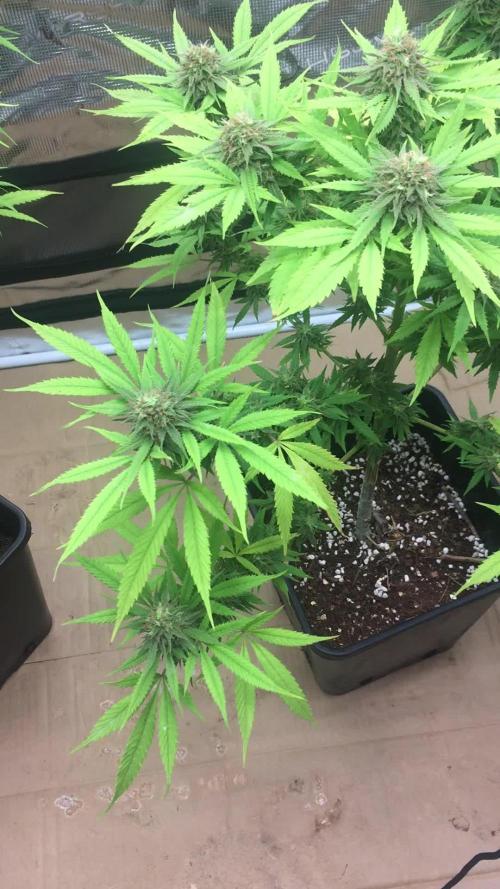
At the end of week 8 the blackberry cake feminised is doing well as the bud formation tightens and the stigmas fade, leaves paled it’s looking like the end is nigh. All of her energy is being used to complete the bloom. The try chromes glistening over the flowers are mostly milky. The blackberry cake feminised stalk is beginning to dull/decay. In the last stage of defoliation she will be flushed thoroughly for the last two weeks. She stands at 67cm tall.
