




Processing
Likes
5
Share


@sercultiveta
Follow
35 dias de actividad en el indoor, foto periodo de 20 horas de luz y 4 de oscuridad


Likes
12
Share


@Donbehzad
Follow
In this week, same method as week 1 still no nutrients just balance ph water (6.2-6.8), temperature still 22-24C and humidity 50-70% but im having some issues with my humidifier it exceeds my desire humidity level that should be 60%, it goes up to 80-85% but nonetheless everything is doing fine.


Likes
34
Share


@BOMbolenath
Follow
Very robust plant with a lot of big buds. It smell very sweet like a mango with citrus and floral. Amazing.

Likes
21
Share


@Ultraviolet
Follow
Heyókȟa
I desire to study nature, and to know better the mind of God, the creator, Holy art thou, O Father.
12x12=144, A dodecahedron is a polyhedron with 12 faces, and in coordination chemistry, it refers to a geometry where ligands surround a central metal atom (in this case, Magnesium) in a specific, 8-coordinate arrangement. Dodecahedrane is a hydrocarbon, meaning it's composed solely of carbon and hydrogen atoms. The carbon atoms are arranged at the corners of a dodecahedron, a 3D shape with 12 pentagonal faces. The water molecules in the dodecahedron form hydrogen bonds that are individually slightly weaker than in either the dimer or the tetramer. However, because three-quarters of the O -H groups in the dodecahedron form hydrogen bonds, it has a more negative energy per molecule than has either the dimer or the tetramer. Magnesium (Mg2+) is the essential, central metal ion in the chlorophyll molecule, crucial for photosynthesis by enabling light absorption and energy transfer. It is chelated by four nitrogen atoms within the porphyrin (or chlorin) ring structure. Chlorophyll appears green because it reflects light in the green region of the visible spectrum, specifically between 490 and 570 nm. The main resonance electronic frequency of a neutral Magnesium (Mg) atom corresponds to the transition from the ground state to the first excited state. Resonance Line Wavelength of Mg2+: 285.1nm (UVB light). The central atom of the chlorophyll molecule is Magnesium (Mg2+), which is coordinated within a porphyrin ring. The electronic "resonance frequency" of this central atom—meaning the frequency at which its electrons absorb energy—is primarily driven by the electronic transitions (ETR) of the surrounding conjugated chlorin ring structure, rather than a discrete atomic transition of the Magnesium atom itself. The resonant electronic frequencies of the chlorophyll porphyrin (technically, a chlorin) ring are determined by the energy required to promote π-electrons within its conjugated system, primarily appearing in the blue and red regions of the visible spectrum.
In standard physics, Chloryphyll b has peak absorption at 460nm (Blue). If we take the peak wavelength 460nm and a UV-B, UVR8 peak absorption wavelength 285nm Tryptophan-285 (W285) Sensing protein. 460/285=1.618 Φ, "natural harmony" and the "structure of light". The cryptochrome photoreceptor (CRY) is a UV-A/blue light receptor that shares this dual sensitivity with several other biological structures and functions, including significant sequence similarity and a common evolutionary ancestor with DNA photolyase enzymes. These are light-activated enzymes that use blue/UV-A light to repair DNA damage caused by UV-B radiation in plants.
Dodecahedrane (C20H20) is a hydrocarbon with a cage-like structure where carbon atoms form 12 pentagonal faces (a regular dodecahedron). It is highly symmetric (icosahedral), contains no delocalized electrons (no aromaticity), and has minimal angle strain, but significant torsional strain. Water Dodecahedron (H2O) forms hydrogen-bonded cages. While individual hydrogen bonds in this structure are weaker than in the linear dimer or tetramer, it has a more negative total energy per molecule. This is because three-quarters (75%) of the groups are involved in hydrogen bonding, creating a very stable, closed-shell configuration. a 3D carbon hydrocarbon (C20H20) to stable water clusters in hydrate, while the Magnesium ion acts as the central activator within a conjugated ring in biological systems, with its electronic absorption dominated by the ring, not the atom itself.
Effective quantum efficiency of photosystem II, often denoted as ΦPSII
In horticultural lighting, adding 730 nm (far-red) LEDs alongside standard red/blue lights has been shown to increase canopy photosynthesis by 20–30% in several crops by acting synergistically with shorter wavelengths. However, the limitation is that excessive, pure IR/Far-red light (without accompanying red light) can trigger the "shade avoidance response," causing plants to grow tall, weak, and spindly rather than robust. Knowing is half the battle however, engineering or utilizing infrared light (specifically the 700-750 nm far-red range) is a viable method to boost photosynthetic efficiency. It acts as a bridge to allow PSII to utilize a broader spectrum of light, breaking the traditional 700 nm barrier.
Extend, then multiply.
UVR8-mediated signaling (often in conjunction with CRY proteins) triggers protective mechanisms that maintain the stability of the photosynthetic apparatus (including LHCII and reaction center proteins), thus ensuring that the efficiency of Photosystem II remains higher in UV-B-exposed plants compared to plants lacking this receptor. ΦPSII indictates the rate of electron transfer from water to plastoquinone, which drives the production of ATP and NADPH. There is a close link between ΦPSII and the true rate of CO2 fixation (Φ*co2), particularly in C4 plants.
Effective quantum efficiency of photosystem II, often denoted as ΦPSII, represents the proportion of light absorbed by Photosystem II (ΦPSII) that is actually used in photosynthetic electron transport. It is a key indicator of how efficiently a plant is using light for photosynthesis, as opposed to losing it as heat or fluorescence. ΦPSII (effective quantum yield of photosystem II) functions primarily as a "multiplier" (a coefficient of efficiency) rather than an additive factor when estimating the overall photosynthetic electron transport rate (ETR). Multipliers are considered far more beneficial than additions because they generate exponential growth, leverage existing resources to their full potential, and create sustainable, self-multiplying capacity, rather than just incremental, linear increases.
Humans, and most other mammals, rely on other mechanisms, such as nucleotide excision repair, to manage and repair UV-induced DNA damage. As such, humans do not have the direct, light-driven repair mechanism that photolyase offers in plants.

Likes
19
Share


@spacecream
Follow
Not a lot happening, just filling out rectangles in the scrog net. Need smaller rectangles, these are 15cm...
Likes
8
Share


@Alejangrow
Follow
This one may be over but theres more going on right now! Check out my other grows to see what I'm up too.😉
Likes
13
Share


@cookingwithninja
Follow
Week 5 day 1. I have a favourite for next run. I’m very happy, I haven’t really defoliated at all this grow, just letting it grow. Wish I was going for mains(topping) but still very good. Going to wait around week 9 so seeds will be good for next run. I have decided to do very hard hst next round to show max potential. Very happy with supercropping so will do it very heavy with scrog. I will try to reveg the one I really like but it is difficult having only 1 set of lights and 1 tent. Plants are about 7ft tall, might just run 2 next round in 4x8 or will still continue to go 4 in the 4x8.


Likes
14
Share


@Simsim
Follow
Hi guys !
This week was a little bit tricky : I got bugs into my coco coir (Video above), and my EC out was a little bit to high.
I've tried to give her 1.5 EC because the blooming started (J29), but few hours later, the leaves of the plants was "eagles claw", So i flushed the coco with a bit of flawless to return to an EC out at 1.3. PH is still 5.8
The plant don't seem to be affected by the bugs.. But i've read that they could kill the roots..
I will treat the bugs tomorrow with Neem oil, I wish everything will be fine..
>> Please comment if you met this shit, and what have you done to solve this problem ?
About the feeding, I will stop the humic fulvic and start to ad slowly the pk boost when the first buds will come.
I also add 1ml/l of Calimag cause i use RO water.
See you next week !! 😄🕉️


Likes
2
Share


@Munchiesfrommars
Follow
11th week
Overdrive did his work absolutely great
Weight is very heavy
Smell is stronger than before
Like mango and grapefruit together
Check I hope you will like this !
I don't understand why I can't add photos on this week ((( Error uploading all the time
Likes
88
Share


@NAS_Garden
Follow
🍋🍊 Lemon Orange #1 - #4 🍊🍋
First time diving into the Lemon Orange grow, and the excitement is real! 🙌 As a huge fan of Green House Seed Company, choosing this strain for the first cultivation is a dream come true.
Strain Information:
Lemon Orange (Super Lemon Haze x Clementine)
Genetics: Super Lemon Haze x Clementine
Type: 70% Sativa - 30% Indica
THC: 29.50% | CBD: 0.20% | CBN: 0.36%
Effects: Balanced euphoria with a sweet head buzz, courtesy of citrusy terpenes and an earthy background.
Flowering (Indoor): 9 weeks, High Yield
Harvest (Outdoor): 4th Week of September, 170 - 200 cm height, 800g/plant yield
Awards: 2nd Place Homegrown CUP 2021
Super thrilled with the progress so far—this Lemon Orange plant is growing like crazy with no issues.
Germination & Veg Timeline:
🍊 Day 1: Seeds hit the scene, into cotton pads for that cozy germination kickoff.
🍊 Day 3: Transferred to small rockwool cubes, enjoying a splash of RO water at a perfect pH 5.5.
🍊 Day 6: Celebration time! Started feeding nutrients by Terra Aquatica with the first true leaves emerging. Used 80% of the recommended dose. Noticed a hint of calcium deficiency, so switched to dechlorinated tap water.
🍊 Day 9: Upped the game, into large rockwool cubes (15x15 cm). The roots are spreading their wings.
🍊 Day 12: Nutrient dance continues. Adjusted the ratio to the Growing phase, still giving 80% of the recommended amount. pH is grooving at 5.8.
🍊 Day 24: It's topping day! Right between the 4th and 5th nodes, shaping the plant for greatness.
🍊 Day 27: Time for a scrog net to guide those branches into a harmonious canopy.
And now, the grand finale of veg 🍊 Day 36: Last day of veg. The Lemon Orange #1 - #4 has been a joy to nurture. Ready to witness the flowering stage unfold. 🌸💚

Likes
20
Share


@Insaniac_0
Follow
8set Mainline & 6/4set Manifold in Auto Pot - Selfie Seeds Sweet Slurry x Sugar Cane (6X4) - Week 10
Flower Week 1 Day 7 to 13 - 3/25 to 3/31
Simply watching the stretch from this point. Both plants recovered very nicely from Schwazze extreme defoliation and all of the colas/branches are mostly even at top.
Feed this week was again an auto pot reservoir feed at 650ppm total before add-ins. I used 325ppm Veg concentrate mix (recipe week 2) and 325ppm Bloom concentrate mix (recipe week 5). However, I also added 1ml/gal of CaliMagic (General Hydroponics 1-0-0) and ph balance this week was for 5.8 where Io plan to maintain it until harvest.
Next week nutes will increase in Bloom mix again but also reduce in Veg mix. Feed will be 700ppm before add-ins with 5.8ph before feeding.
Likes
21
Share


@GrowGuy97
Follow
Ladies got cut down on day 61, the gorilla girl wasn’t the biggest but she has super frosty, tight little buds should be a great smoke! The CM on the other hand had some huge buds & was probably the frostiest plant of all, she smells amazing as well🔥😋 will post a harvest update as soon as these ladies get dried & trimmed! Thanks for following & happy growing friends!🙏🏼🌱✌️🏼
Likes
18
Share


@eldruida_lamota
Follow
Que pasa familia, vamos con la primera semana de floración de estas Tropicana Cookies Fast Flowering, de FastBuds.
Vamos al lío , las 3 plantas se colocaron en macetas de 7 litros definitivamente.
El ph se controla en 6.2 , la temperatura la tenemos entre 21/24 grados y la humedad ronda el 60%.
Ir van creciendo y no llevan ni mal ritmo ni mal color, veremos como avanzan las próximas semanas.
Mars hydro:
Code discount: EL420
https://www.mars-hydro.com/
Agrobeta:
https://www.agrobeta.com/agrobetatiendaonline/36-abonos-canamo
Hasta aquí todo, Buenos humos 💨💨💨

Likes
Comments
Share

@GoodTimesOrganics
Follow
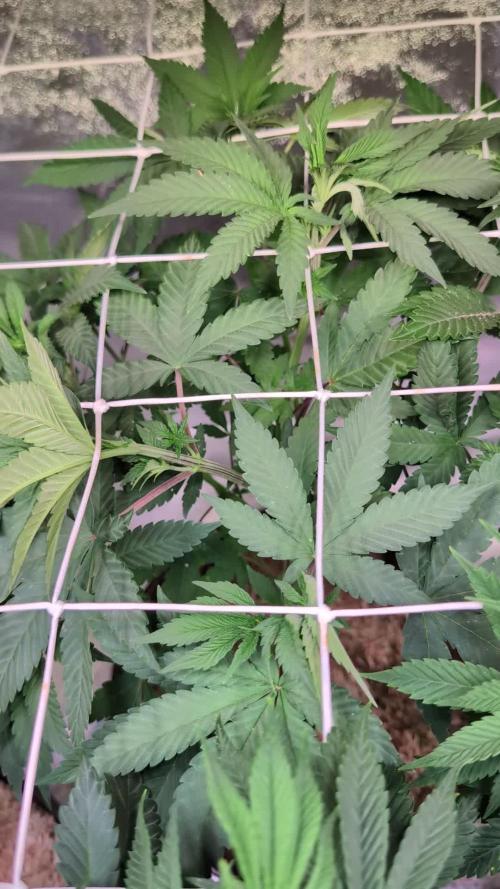
Nun wurde meine Eigenkreation dem Netz unterbunden und sie entwickelt sich prächtig.
Nach einer weiteren Woche des Wachstums wird es Zeit die Damen in die Blüte zu schicken.
Das Wachstum ist außerordentlich homogen und die Interniodenabstände relativ Kurz.
Eine schöne Hybridform mit aktuell überwiegenden Indica Einschlag. 💚🌲🥦
Likes
2
Share


@Mr_nugs_lover_David
Follow
This is a funny story. This strain M8 came from an AUTO M8 package and I didn't realice that until she was like 2 months, that's when I started to force flower with my other Photoperiods because I was seeing that it wasn't normal to see an autoflowers without any signs of flower. The aroma it's just super pure and sweet it's been such a big surprise. I really have fallen in love with this strain, the only thing that makes me sad is that she's not gonna give me too much of those amazing sweet like candy flowers. She's been 100% organically and probiotically grown. With Florians Organic living soil and Silicium flash by biotabs which contains bug shit between as well as aminoacids and natural npk. My soil is very rich in life, every time I water I can see the soil just bubbling man. It's been a beautiful surprise to grow this strain. Very nice discover. Thank you everybody hope you enjoy the journey! ✌️💚👨🌾🌱

Likes
1
Share


@The710Garden
Follow
Athena for the win
I know the Ogs goin on Plan with a defo on Day 21 from Switch but we reachin new ways and i switched from the normal schedule defo on Day 21
So what i did is short that period and instead of a Heavy defo and 🍭 on Day 21 i did the 🍭 on Day 14 and a slightly but good defo and on day 21 another not so Heavy defo so the shock for the Girls is not so Heavy like you make a Big defo and 🍭 on day 21!