


Likes
Comments
Share


@AlienScrOG
Follow
Some wrong i do .... But She Is strong and grow well ... The EC for grow.go ti 3000 but only 2 day ... After go to 900 .. and now After 5 day 700 ... She grow very well .. i want Stretch so much i have put the lamp on 80%.... ???
.... Need to grow in tall .... I dont have ir light ...

Likes
3
Share


@Marlboro
Follow
Новая неделя пошла, докупил BatBoost, потому что как мне кажется есть небольшая нехватка калия наровне с передозом фосфора. Видимо я переборщил с экстрактом и порошком. Буду умнее. Последний полив был просто вода. Вроде девочкам лучше. Да. По мимо всего прочего из за передозировки фосфором вылезли дефициты цинка магния и железа. Постараюсь выправить ситуацию энзимами и порцией микроэлементов. Вроде приходят в себя девочки. Наблюдаем дальше

Likes
11
Share


@blackcald
Follow
All fine, keep fight with high humidity. Plant B get some yellow leafs, waiting answers about it in grow question. Fun fact: plant b (no toping) smells muuuuuuuuch better.

Likes
19
Share


@eldruida_lamota
Follow
Buenos días familia, finalizamos la segunda semana y es que van a muy buen ritmo están bastante sanas y sin problemas.
Ph controlado en 6,2 poco a poco iremos alimentándolas ya que tienes algo menos de tiempo que el resto.
La temperatura es ideal al día, por la noche algo baja pero sin problemas mayores.

Processing
Likes
5
Share


Likes
Comments
Share

@AkatsukiVirtue
Follow
All plants are doing fine.
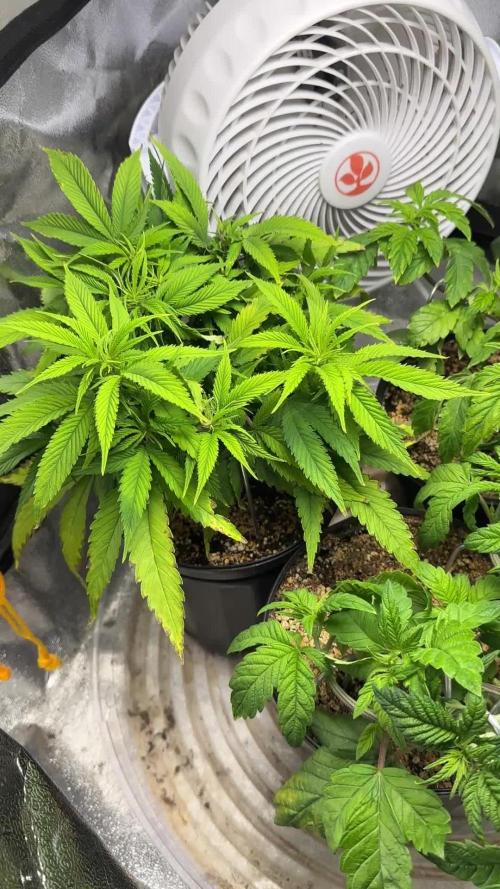
Chocolate Skunk - CSK is showing some signs of nutrient deficiency, however I plan to water with nutes next week same with the other strains.
Both GPA Cookies are doing really well. They seem to stretch quite a bit so I did some tie down to help spread the leaf base
Money Maker is doing excellent! Great foliage, deep green and lush. I FIMmed to slow it down a bit while the rest caught up.


Likes
4
Share


@grower1212
Follow
Me atrase en actualizar el cambio de semana, pero las tuts están prácticamente igual, solo cambiando de colores.
El problema con las arañas rojas ha estado controlado, no he visto que la colonia haya pasado a las otras plantas, pero una vez que las corte haré una limpieza profunda.

Processing
Likes
18
Share

@eldruida_lamota
Follow
Que pasa familia, estamos de vuelta para actualizaros la 4 semana de floración, las flores van cogiendo forma , en esta variedad las flores Se ponen como pelotas de tenis.
Todo va bien , ph controlado , humedad no aumenta por encima de 50%. Y asimilan genial todo el alimento aportado.
Hemos hecho defoliación para dejar acceso a mas luz a la altura media de la planta.

Likes
15
Share


@TokyoStreet
Follow
Missed taking photos last week and most of this week due to busy work schedule. They grew without issues all two weeks.
Ended up feeding with an aerated nutritive and enzyme tea. Roughly 1 gal each plant, once a week.
Also moved the pots to the bigger flowering tent as the space was getting tight. Small tent will accommodate the new plants which can be found in my other journal!
Enjoy the video of pre and post defoliation of the Afghan Kush!


Likes
2
Share


@DjHairy
Follow
This was my second grow ever. I started with a blueberry headband seed from a bud I got from the dispensary. This strain was very easy to grow and very forgiving. Final product had some seeds but wasn’t too bad.
Likes
18
Share


@MisterAeroponics
Follow
Ran into sulfur and phosphorus deficiency week 7. Added the small scoop beastie blooms and like an 1/8 tsp of silver bullet sulfur terp enhancer. Still running about 9ml per gallon at 5.8 possible hydrogen.. AC motor went out on one of the ac’s, will have it fixed by Wednesday been cooler temps and storms lately so been okay.

Likes
9
Share


@Thatgoodgas93
Follow
So far I’ve had a strain of diesel & candy kush sprout & the ww was not successful in the coco coir as it’s been quite dry & overcast outdoors lately so I decided to take an indoor approach which has been more successful & pest free. I put another candy kush & turbo diesel seed in a glass of water & already got the seed of candy k to split open so I’ve moved it into to a moist paper towel in a zip bag &’ll plant it in coco coir once the root is nice n long enough to transfer into a pot. Also I’m smh 🤦♂️🏽 because I’ve had more success with a $24 grow light bulb from homedepot but none whatsoever with my $160 viper spectra 1500 grow light for the vegetative cycle🤷♂️🏾. Can someone tell me what’s the best brightness range & distance from 5%-100% when using the viper spectra 1500 for all stages? Because I’m ready to resell it on Amazon at this point.

Likes
34
Share


@SalocinSpecial
Follow
D89 (18/02/2021): Copy paste of last week... I think max one week and she is done 😁 I gave around 2L of tap water. Glue Gelato is dry and in jar since one week. I did not move back Banana Kush in the tent since I was sure it was her last week. At this point I should have move her back in the tent. I think being in the closet might have slow her down since there is no reflective wall but at least the environment conditions are good.
- temp in the closet: 18-21C
- water: 2L of tap water
- RH in the closet: 33-35%
D90 (19/02/2021): I can definitely see more resin gland forming on buds and can also tell that the calyx are swelling nicely.
- temp in the closet: 18-21C
- no water
- RH in the closet: 33-35%
D91 (20/02/2021): I gave 1.75L of tap water.
- temp in the closet: 18-21C
- water: 1.75L, PH7.5
- RH in the closet: 33-35%
D92 (21/02/2021): I checked the trichomes and they are more abundant. It's beautiful to see the buds becoming frostier day by day 😍
- temp in the closet: 18-21C
- no water
- RH in the closet: 33-35%
D93 (22/02/2021): She is starting to show some amber trichomes but not enough. I will let her some days to ripen but she is close to harvest!
- temp in the closet: 18-21C
- no water
- RH in the closet: 33-35%
D94 (23/02/2021): I gave 3L of tap water.
- temp in the closet: 18-21C
- water: 3L, PH7.5, 130PPM
- RH in the closet: 33-35%
D95 (24/02/2021): Trichomes are all cloudy with some ambers. Due to a timing issue, I will need to chop her this weekend in two or three days. Yesterday I did reduce light intensity to 50% power. She will pass 2 days with this light intensity and then 2 days in complete darkness.
- temp in the closet: 18-21C
- no water
- RH in the closet: 33-35%
D96 (25/02/2021): I will not change for week 14 since she is going into darkness tonight for two more days. Trichomes are not exactly where I would like. More ambers would be better but at least they are all milky white with some amber. She's at her peek in term of THC potency.
- temp in the closet: 18-21C
- no water
- RH in the closet: 33-35%
D97 (26/02/2021): 24h into complete darkness is done
- temp in the closet: 18-21C
- no water
- RH in the closet: 35-40%


Likes
123
Share


@MrHightimes
Follow
Well My friends gave me a bigger tent so I got a little more time to let them develop!
I'm very ready to take them down just waiting a bit longer for a few more amber trichomes.
I'm still feeding them ripen but i wish last week i'd given them a feed in addition too.
They look nice in the new tent, there is loads more room, and while the lighting didn't go up as much as I'd like,
They have a nice big fan oscillating on them now and room to stretch.
________________________________________________________________
I suppose I'm glad I waited. I wanted to take a few more pics and get one last video in! I'm def seeing a bit more amber in the trics and
i think it will make em a bit better for these 2 extra waterings! Probably gonna chop them soon!!!!
Likes
7
Share


@OG_NordGrow
Follow
Die Blüten fangen an sich schön zu bilden Geruch kommt auch langsam. Im Moment noch muffig

Likes
3
Share


@hillbilly705
Follow
they are getting close too the end now there getting frosty. smells kinda like blue berry . the colas are densin up nicely . can't wait til harvest.
Likes
13
Share


@NordicClosetGrower
Follow
Thought I would have harvested already, but from the little I'm able to see, there still aren't really many, if any amber colored thc crystals, so I might wait some more days.
The second plant remains 1 week or so behind but might soon catch up and they could come down at the same time.
Still only flushing with water, some leafs are starting to curl and dry off. I'm just a bit paranoid that it is time to cut, I'm just not seeing the amber color because the camera can't pick it up. ¯_(ツ)_/¯
Likes
6
Share


@Edwinbarragan
Follow
Cada día crecen más esta semana las pasamos a floración y mostraron un buen desarrollo sin estrés ni deficiencias alguna, detectamos en la candy crush que se volvió hermafrodita,posteriormente la retiramos del cuarto de cultivo........
Likes
47
Share


@Lady_NugWitch
Follow
Topped these girls and repotted into final resting places. Lol. Happy growing!!
Likes
7
Share

@StonedSteve
Follow
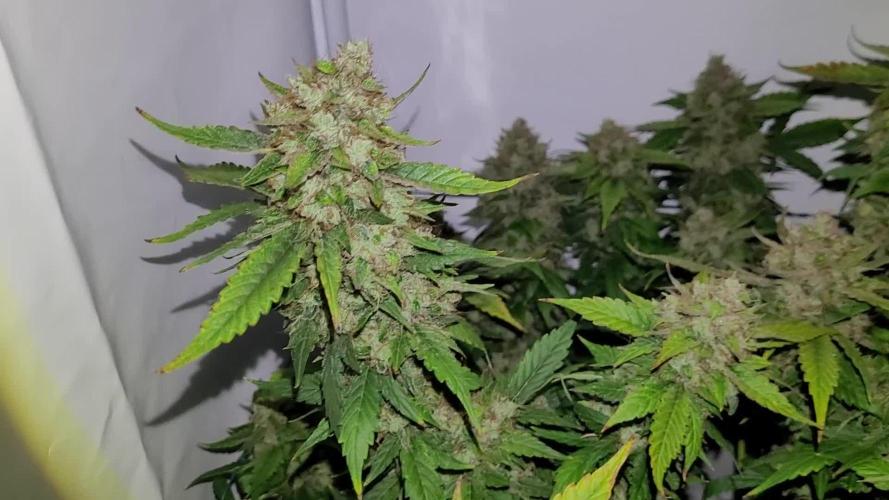
Zdravim všechny co sledovali tenhle deník Apollo Haze od Mephisto Genetics, je to tady dnes 16.9. jsem Apolla po 77 dnech příjemného a žádným větším problémem nerušeného pěstu seknul😌.
Apollo krásně dokynul a přesto jakýho byl malýho vzrůstu se nakonec vyšvihl v docela solidní keřík obrostlý velkými tvrdými a cukrem obsypanými palicemi grower je spokojenej👌
Poslední týden se do něj vešli už jen 2 zálivky po 6L obě s výtokem 900ml takže super. Do zálivek jsem dal už jen po 2ml Flawless Finish od AN.
Přikládám fotky a videa ze sklizně 16.9. další ještě přidám po usušení a ostříhání, děkuju za rady komentáře a inspirace, zatím se všichni mějte a vidíme se u dalšího deníku ať se daří😎

Likes
27
Share


@ButterfliesLittleFarm
Follow
Hello Diary.
A new diary, a new beginning. In the fifth farm we have three residents again, two Haze Berry Automatic and Fat Banana Automatic, both strains from Royal Queen Seeds. 😍
I would like to thank the team from the Royal Queen Seeds who have recognized my efforts in keeping a diary and greatly support me in what I love. 🙏
I always try to make a balance between sativa and indica, since I do creative work, I am a big fan of sativa, although in the evening, when my obligations are over, I like to relax with indica. So this time I planted two Haze Berry Auto that are predominantly sativa and one Fat Banana which is more indica. 😵
WHY HAZE BERRY?
Haze Berry Automatic is the sativa-dominant successor to the legendary Haze Berry. Haze Berry Automatic inherited Haze Berry (Blue Dream’s) characteristic high. The sativa-dominant effects ramp up central nervous system activity and engage the mind. However, her flowers only contain a THC content of 13%. While this might seem comparatively low, it’s absolutely ideal for me. This makes it a great strain to use intermittently throughout the day. Haze Berry Automatic can be smoked in-between tasks or during a work break to produce a similar effect as a cup of coffee. It provides light stimulation and refreshes the mind for a more creative outlook.
LET'S START FIRST WITH THE FARM SET-UP:
Box - Secret Jardin DS120W 120x60x178
Lights - MIGRO 200+
Ventilation - Blauberg Turbo - E 100
Filter - Primaklima filter PK 100/125
Fan - Oscillating Koala Fan
Humidifier - Beurer LB 45
Soil - BIOBIZZ Light - Mix
Pot - 11L AirPot
Seed - Royal Queen Seed
Nutrition - BioBizz and RQS Organic nutrition
LET THE DIARY START OFFICIALLY:
14/09/2020
Planting. I prepared everything I needed for planting, cleaned the farm and changed the filter. I put Primaklima filter - PK 100/125. This time I decidet for AirPots, I also used them in the first two farms, BioBizz-Light Mix is already standard on my farm and Easy Boost and Easy Roots Mycorrhiza Mix from RQS as organic nutrition. Since the first farm I use only organic fertilizers and for now I have used BioBizz and RQS organic nutrition.
After I put the soil in the pot, I added 50g of Easy Boost Organic nutrition and mixed it well with the soil, after that I added 5g of Easy Roots Mycorrhiza Mix and also mixed everything once more.
I prepared 7 liters of water in which I regulated p.H with Plagron’s Lemon Kick, and soaked the soil well before making a hole in which I put the seed. Otherwise, the water would have pushed the seed much deeper into the ground.
After the planting is completed, they enter their new home. The temperature in the Box at that time was 26 degrees and the humidity was slightly below 60%.
I set the lights 35cm from the pots as Migro recommends.
14 - 17/09/2020
I sprayed the surface of the soil with water a couple of times to keep the soil moisture at the surface.
Also the humidity dropped so I put on a humidifier for a couple of days.
17/09/2020
The first Haze Berry has sprouted, and I'm still waiting for the second.
19/09/2020
The other Haze Berry didn’t germinate, so I soaked the soil with water again and put the seed back on. I hope it works out this time. This is the first time since I planted that my seed has not germinated.
Also the first Haze Berry got a liter of water with regulated p.H at 6.3
23/09/2020
The big day, the second Haze Berry sprouted the first one got watering. As for p.H. values, I always regulate, in my case I lower the value between 6.2 and 6.5. I removed the humidifier.
Temp / Humidity on the farm - 26 degrees and 57% humidity.
I would like to thank Grow Diaries for making germination week an option. I think that's a great thing. It will be interesting to follow the development of both Haze Berrys since the second one is a week late, but this time I will be photographing and filming just one plant in detail. See you next week.
