








@AutoCrazy
Volgen
Another week has brought more new growth. She is drinking 4 gallons of water every 2-3 days now.
I think I will likely transplant her into a 20 gallon pot this upcoming week. I can’t wait for this plant to start to flower. Although I am mildly worried about her stretch. I have grown this strain before and it can double in size when flowering starts 😬. But I can always do another round of lst to spread her out and keep her low.
I will also be taking off a bunch of foliage in the coming days.
Stay tuned
😎🍿🍻🌱


@eldruida_lamota
Volgen
Bueno familia ya finalizamos con el proyecto de las Runtz de seedstockers, son una cepa bestial.
La verdad que el secado muy bien 9 días en Malla y a los botes, 40% humedad y 21 grados es la temperatura ambiental que han tenido en el secado, aparte deshumidificador enchufado 24 horas al día.
En resumen la cepa es muy fácil de cultivar, el germinado se me resistió igual es complicado el germinado pero el resto es simple resistente fácil de alimentar pienso que es rápida los tricomas ya estaban hechos y se me hecho el tiempo encima.
Por lo demás de miedo os la recomiendo.
Gracias a Seedstockers, Agrobeta y Mars hydro, sin ellos este proyecto no sería igual 🙏.
Agrobeta:
https://www.agrobeta.com/agrobetatiendaonline/36-abonos-canamo
Mars hydro:
Code discount: EL420
https://www.mars-hydro.com/
Buenos humos 💨💨💨


@MrGrowMan
Volgen
week 20-21
1 nutrient water
1 non nutrient water
LsT and Scrog
Diesel and Mimosa Harvest
day 62 start 12/12 light period (genetically damaged plants)
2 break up cake day 67 start flowering
17.03 day 130 Left flush.
21.03 day 134 Right Flush.


@PEAKYPLANTERS
Volgen
hello to all, fellow cultivators!
my girls are starting to show the first symptoms of pre-flowering ...
they eat regularly and have formed a beautiful and solid structure.
stay on track for the next updates
also follow us on instagram


@Ferenc
Volgen
Lovely buds sweet and fruity with citrus smell. Taste is the same ;) She has a potential to have a good yield if you have a good lamp. Nice buds really sticky, with nice trichomes. :) It must be tried.


@Santica_Garden
Volgen
The ladies have reached the end of Week 6 of Flower, things are going well, I have uploaded a video to show you guys some Bud Porn 🤤🤤🔥🔥 Happy Growing guys 👍🏾🌱💚


@pifflestikkz
Volgen
Day 64
05/07/24 Friday
Start of week
Big feed today 4L pH 6.2 only 20% run off.
So I have done final LST on her, I'm proud of what she has grown into over this veg period.
What a BEAST 🙌💪🤯💚
I'm allowing this week to be final veg week before I flip her.
She has so many tops I'll count them and add to diary tomorrow ✌️💚
Day 65
06/07/24 Saturday
The day after LST, she has bounced straight back 💪, she's a damn beast 👌
Picture update
Day 66
07/07/24 Sunday
Watering with De-chlorinated tap water, pH 6.0 and added cal-mag 7ml for 5L.
No run off but bottom of fabric pot is lovely and moist so will leave it there today 😁
Day 67
08/07/24 Monday
De-chlorinated tap watering today 5L with DyNoMyCo. Hoping this will help root zone uptake more nutrients during flush- we will see.
Updated short video
Day 69
10/07/24 Wednesday
Feed today! De-chlorinated tap water pH 6.0. did a 3L run through had about 1ltr run off due to high humidity this week, she never needed it I guess. But just wanted something to pull fresh oxygen through substrate.
She's getting so damn big, have to flip her tomorrow else she'll never fit under 600w hps in tent 🤦♂️😍





@Ultraviolet_
Volgen
We become aware at such times of man's wonderful ability to bring seemingly unrelated elements into harmonic balance, and receive a glimpse into a world where everything exists in conscious sympathetic attunement to everything else. When we listen to a piece of music that seems to strike a beautiful chord somewhere inside us, or view a painting that simply glows with harmonic awareness well executed, we probably do not spare much time to contemplate the wonderfully intricate combination of vibrations that our sensors make it possible for us to perceive. We tend to appreciate the relationship between the parts of something by an awareness of the harmony or dissonance of the whole. This ability enables us to say "what a beautiful house!" instead of "analysis has proven that this collection of building materials exhibits certain elements of harmonic proportion." While this ability to instinctively appreciate the beauty of true harmony has an important role to play in evolution, a more analytical understanding of the laws involved can be most useful. This is especially so if we wish to create works of art where each part exists in true harmony, not only with the other part of that particular whole, but with the universe within which the creator and the created exist.
Everything vibrates. From the most dense matter to the most subtle cosmic rays, everything which our senses allow our thoughts to become aware of, can be specified in terms of wavelength or frequency of vibration. These two terms define the same thing, but from different points of view.
The following are the approximate wavelengths of various energy carriers:
Cosmic rays 0.000,000,001 mm
Gamma rays 0.000,000,1 mm
X rays 0.000,500 mm
Ultraviolet rays 0.003 mm
Visible light 0.006 mm
Infrared 0.01 mm
Sound waves 1 meter
Radio waves 300 meters
Violet light 400 nm to 450 nm
Blue light 450 nm to 500 nm
Green light 500 nm to 570 nm
Yellow light 570 nm to 590 nm
Orange light 590 nm to 610 nm
Red light 610 to 700 nm
1 nanometer (nm) = 0.000,000,1 cm = 1/10,000,000 cm
If a guitar string is plucked and we hear a sound, it is not too difficult for the human mind to associate this sound with the vibration of the guitar string. With color it is quite different. It is difficult for us to conceive that the color of a substance is not an inherent property of the substance itself, but an indication picked up by our senses of that substance's ability to absorb or reflect the light which happens to be shining on it at that moment. Neither the matter nor the light is colored. What happens is that the brain learns to differentiate between the frequencies reflected or transmitted by the substance the eyes are focused on. The same thing happens with sound. When we say "Oh! Listen, they're playing my favorite song," what we really mean is: "My brain has stored within it a particular pattern of frequencies. I have compared the new information being received with this stored pattern and have deduced the answer that the two patterns are similar within certain specified tolerances." The 'pleasure' involved could have something to do with our running the pre-recorded pattern at the same time, in 'sympathy' with the new pattern as it is received.
The word sympathy describes very well our ability to appreciate color and sound. It also describes the reason behind certain elements of harmony. For instance, if a substance vibrating at 100 cycles per second (tone 1) is in the proximity of another substance vibrating at 200 cycles per second (tone 2), we could perceive, if we had the right equipment, a certain sympathetic relationship between the two.
We will see from this that there is a uniform doubling of the first tone seen in the second. At various points along the waves, the two are the same in amplitude. At other points, they are at opposite poles to each other. This doubled frequency has more points of similarity to the original than any other frequency except the original itself. If the equipment we had available for measuring these two frequencies was a soundboard amplifier and a pair of ears, then we would hear what would sound to us like one tone. If we had the opportunity to hear one at a time, we would hear that although they sound the same, one is higher in pitch than the other. This characteristic of 'the same but different in pitch', musicians have called the octave. Any two tones produced where one has exactly doubled the frequency of the other is called an octave. Speaking in ratios, an octave would appear then as the ratio 2:1 or 1:2, depending on whether we are talking of an octave up or down.
A single note produced by almost any instrument will contain more than one wavelength or frequency. It will have a dominant frequency, the wavelength of which we would call the note's 'fundamental' or 1st harmonic. It will also have a varying number of upper harmonics, gradually fading in intensity into infinity or silence.
Natural harmonics always have the same pattern of intervals between them. The interval between the 1st and 2nd harmonic is a perfect octave; between the 2nd and 3rd a perfect fifth; between the 3rd and 4th a perfect 4th; and so on, the intervals becoming smaller and smaller until they lose any relationship with the western 12 tone scale as it exists at the moment. Just as an octave has certain elements of sympathy with its fundamental, so some intervals have been noted to be more perfectly in sympathy with the fundamental than others. The ratio of the 'perfect 5th' or interval of 7 semitones, as it occurs in the harmonic series, is 3:2 or 2:3, while that of the 'perfect fourth" is 4:3 or 3:4. All the tones in the western 12 tone scale can be expressed in terms of the ratio between the upper tone and its fundamental. This would seem to be an ideal way of generating a scale from any given fundamental and several attempts have been made to do this, the Pythagorean system being probably the most well known. Although when working with a single tone instrument playing on its own, the Pythagorean formula works wonderfully well, if we had several instruments tuned this way together and asked them to play almost any western music, we would find that at times they sounded quite out of tune to each other.
The lack of flexibility of the various scale systems based on the harmonic series has led to what is known as the 'tempered' scale. This uses as its primary unit of interval the ratio of the octave or 2:1. It then proceeds to divide the interval between any fundamental and its upper octave into 12 smaller intervals by applying the ratio: two to the one-twelfth power, to one (21/12:1). This equals 1.059463094, so by multiplying any frequency by this number, we will obtain the tempered semitone next up from our fundamental. We will also find that any tone twelve semitones up from any other tone, in a scale generated in this way, will have exactly double the frequency.
If we took the note middle C on a piano and halved the wavelength, we would have the note C one octave above. If we halved this, we would have the C above, and so on. However, within about 6 octaves, we would find that although a 'sound' was being produced, no human ear could perceive it. If we kept on going, halving and producing upper octaves of our fundamental C, we would proceed through the infrared band, into the visible light spectrum. If we happened to be outside during the day, we would, for one octave only, see the note C with our eyes. The next octave above would already be in the ultraviolet band, and outside the eye's sensitivity range. If we can think of color as being an indication of a substance's vibratory rate or wavelength, we may begin to see a relationship that could exist between the color and sound spectrums.
The logical extension of what has so far been said is that there exists a scale in the color spectrum that corresponds exactly to the scale in the sound spectrum, each color tone being an octave of the equivalent note in the sound range.
This is not the end of the story but only the beginning. If we can for the moment accept that any wavelength in one band has upper and lower octave stretching out to infinity, then the next question is 'fine, but what shall we use as our fundamental? A particular color? A particular sound frequency?' The musicians among us will probably say 'A 440'. This means that the note A should vibrate at 440 Hertz, or 440 times per second. They would tell us that this is standard pitch has been adopted by most orchestras around the world; pianos are tuned to it, instruments are constructed to formulas based on it, and so to them it would probably seem the most appropriate place to begin. Some of these musicians may know of the battle that is still raging with regards to this being the standard, but few would know why A = 440 Hz was chosen except that it worked when it was set to be a suitable compromise between the many different pitches in use at the time.
432 Hz is said to be mathematically consistent with the patterns of the universe. Studies reveal that 432 Hz tuning vibrates with the universe’s golden mean PHI and unifies the properties of light, time, space, matter, gravity, and magnetism with biology, the DNA code, and consciousness. When our atoms and DNA start to resonate in harmony with the spiraling pattern of nature, our sense of connection to nature is said to be magnified.
Another interesting factor to consider is that the A=432 Hz tuning correlates with the color spectrum, while the A=440 Hz is off. Audiophiles have also stated that A = 432 Hz music seems to be non-local and can fill an entire room, whereas A=440 Hz can be perceived as directional or linear in sound propagation.
Once you adopt the idea that sound (or vibration in general) can have an equalizing and harmonizing effect (as well as a disturbing effect), the science of harmony can be applied to bring greater harmony into one's life or tune to specific energies. There is a form of absolute and relative harmony. Absolute harmony can, for example, be determined by the tuning of an instrument. The ancients tuned their instruments at an A of 432 Hz instead of 440 Hz - and for a good reason. There are plenty of music examples on the internet that you can listen to in order to establish the difference for yourself.
Attuning the instrument to 432 Hz results in a more relaxing sound, while 440 Hz slightly tenses up the body. This is because 440 Hz is out of tune with both macro and micro cosmos. On the contrary, 432 Hz is in tune. To give an example of how this is manifested microcosmically: our breath (0,3 Hz) and our pulse (1,2 Hz) relate to the frequency of the lower octave of an A of 432 Hz (108 Hz) as 1:360 and 1:90.
It is interesting to note that 432 Hz was the standard pitch of many old instruments and that it was only recently (19th and 20th century) the standard pitch was increased. This was done in order to be able to play for bigger audiences. Bigger audiences (more bodies) absorb more of the lower frequencies, so the higher pitch was more likely to “cut through”. One of the oldest instruments of the world is the bell ensemble of Yi Zeng (dated 423 BC), tuned to a standard F4 of 345 Hz, which gives an A= 432 Hz. The frequency of 345 Hz is that of the platonic year! Similarly, many old organs are tuned in A=432 as well; for example, St. Peter’s Capella Gregoriana, St. Peter’s Capella Giulia, S. Maria Maggiore in Rome.
Maria Renold’s book “Intervals Scales Tones and the Concert Pitch C=128 Hz” claims conclusive evidence that 440 Hz and raising concert pitch above scientific “C” Prime=128 Hz (Concert A=432 Hz) disassociates the connection of consciousness to the body and creates anti-social conditions in humanity.
The difference between concert pitch A=440 Hz and Concert A=432 Hz is only 8 cycles per second, but it is a perceptible difference of awareness in the human consciousness experience of the dream we share called existence.



@PavementPunk
Volgen
Snapped the main branch a little but its been healing ok. Besides that shes been getting bigger filling out her new pot. Also took the smaller lowest branch for my first clone attempt. Probably gonna experiment with a couple more cuttings maybe even an auto clone for laughs. Been raising the light an inch at a time as i noticed signs of light stress. All in all good week happy growing friends


@eldruida_lamota
Volgen
Bueno pues ya llegamos al final familia, do sweet dos es una variedad bastante productiva. De cuatro plantas casi 180gs y la verdad que bastante contento, no tuve tiempo para poder hacer más fotos y trabajar más este post pero con la prisa y la mudanza pues bueno, bastante e cosechado.
Humedad en el secado relativamente baja al 40% y la temperatura estuvo entorno a 23 grados ambientales.
Hasta aquí todo familia, os recomiendo también la gama de productos de agrobeta, ya que los resultados son llamativos.
shorts_status_processing


@blazin_skywalker
Volgen
Day 64 - I've been patiently waiting for the time to come, and it's finally here! Changed the lights over to 12/12 to send the tent into flower. Current light settings R99 W99 B50 as suggested by California Lightworks.
I did a full reservoir change - switching over to bloom nutes. I also added some Si28 and P31 Microbes to the reservoir to test out this new product that I was fortunate enough to receive samples of. I've seen the results of others with crazy booming root growth.... Let's see what happens!
Day 65 - I swear, it's like she's been waiting for me to flip the light cycle. I kicked one plant out of the tent so now there's even more room for improved air circulation and light distribution.
This plant is a serious beast!
Day 67/ Day 3 of Flower - Last massive round of defoliation before I sit back and let her do her thang. ✌️



@MrWeeedWorld
Volgen
Guava Sundae Automatic – Woche 5
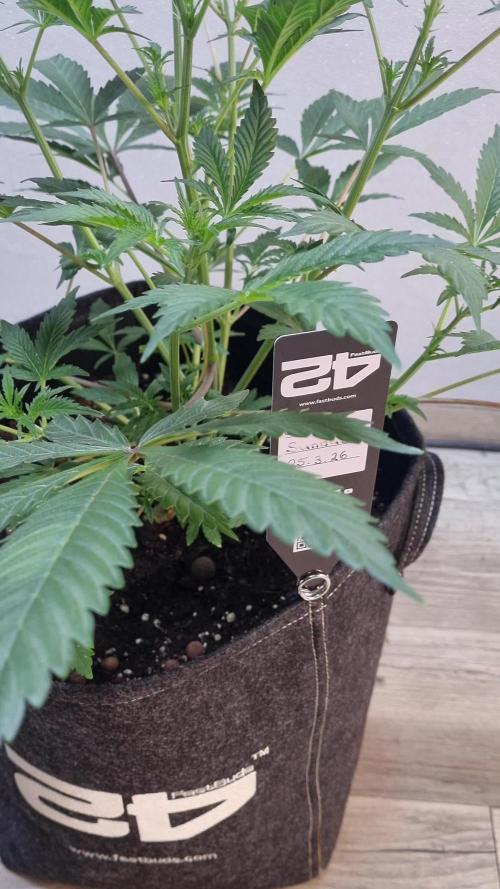
Meine Guava Sundae Automatic befindet sich aktuell in Woche 5 und zeigt ebenfalls einen sehr schönen, buschigen Wuchs, der mir richtig gut gefällt.
Sie wächst kompakt und gleichmäßig, wirkt dabei äußerst gesund und vital. Ihre Struktur ist stabil und gut aufgebaut, was eine perfekte Grundlage für die kommenden Wochen schafft.
Bis jetzt sind noch keine eindeutigen Anzeichen der Blüte zu erkennen, aber es dürfte nicht mehr lange dauern, bis sie in die nächste Phase übergeht. Alles spricht dafür, dass sie kurz davor steht.
Sie macht insgesamt einen sehr starken Eindruck, und ich bin mir sicher, dass auch sie ordentlich abliefern wird.
Neue Updates gibt es jeden Sonntag – bleibt dran!
---------------------------------------------------------------------------------------------------------------------------------------------------------------------
Guava Sundae Automatic – Week 5
My Guava Sundae Automatic is currently in week 5 and is also showing a very nice, bushy growth structure that I really like.
She is growing in a compact and even way, while looking extremely healthy and vigorous. Her structure is strong and well-built, providing a perfect foundation for the coming weeks.
So far, there are no clear signs of flowering yet, but it shouldn’t take much longer before she transitions into the next phase. Everything indicates that she is close.
Overall, she gives a very strong impression, and I’m confident that she will deliver great results as well.
New updates every Sunday – stay tuned!


@deseed_uy
Volgen
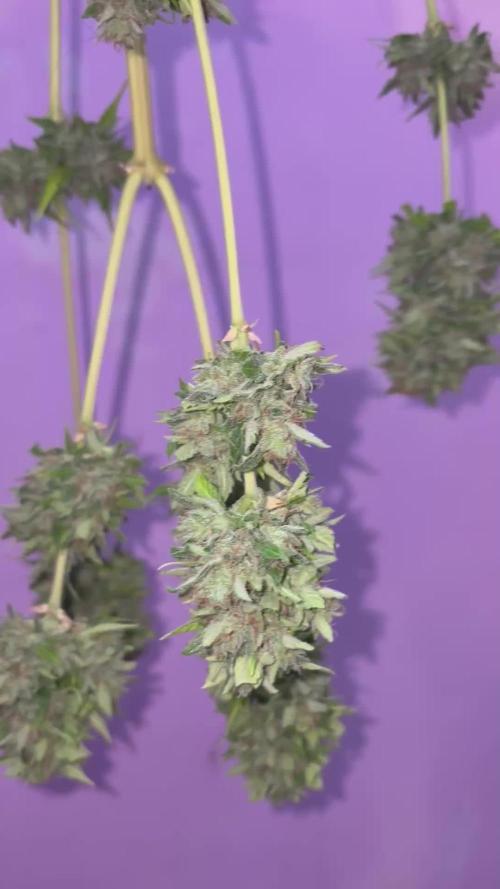
Llegó su dia, hermosa planta fue una de las q no hizo ningun problema en todo el ciclo, al fin logre una auto sana y con cocos densos🤩 es chiquita pero mucho mejor q otras auto q me quedaban siempre enanisimas. Me quedó una semillita para tirar ahora con el clima mas a su favor😃 Tiene un aroma muy rico dulce


@Erich2025
Volgen
The plants are done stretching. They did stretch a lot and grew very quick. As soon as I open my tent, my whole room is smelling. And I can tell you it just smells 🔥🔥🔥🌴🍪⛽️🌲.
The small pheno that is producing purple buds smells like I expected the Tropicana Cookies, 🍊🌴⛽️🌲. The other 2 smell more 🍦⛽️🌲 and not fruity at all at the moment.
In overall my plants are very healthy and they seem to feel very comfortable in my tent✌️