


Likes
Comments
Share


@Cannabinatek
Follow
Crescimento saudável. Meninas a ramificar bem , bem alimentadas e prontas a iniciar a 3.ª semana de crescimento… Zimbora 💚💚💚


Likes
17
Share


@maelxich
Follow
Saw spidermites setting up camp on the dark side of the plant on 1 bud site. There was no sign of them anywhere else. This plant is becoming more trouble than it’s worth and I’ve decided to chop her early after.

Likes
1
Share


@Skunkinyabag
Follow
Finishing off shortly one last push and then just some water to clean her up.


Likes
17
Share


@Nedyah420
Follow
On average flowering technically truly begins 7 days after 12/12 switch...i waite 7 days because plants dont instantly Flower right at 12/12 switch most take 4-8 days to start actually flowering...it takes time for the hormones to be triggered and start taking effect, so i waite 7 days an consider that the transition period...i suggest waiting on any bloom boosters until after the transition period..also ((Brut worm casting and natures living soil is mixed into soil at listed rates not mixed into water water, all other nutrients are mixed with distilled water.))


Likes
51
Share


@Chumpkilla
Follow
12/30/23 - Day 54 - Hello All! I started this week a day early. I wanted to update everyone on something I have been thinking about a lot. Curing. I feel if there was a hole in my growing skills it would be curing. Last grow there was more than I had anticipated. I was not set up for curing 1 lb. I threw in an audible at the last minute. It worked out but I know I can improve with some trial and error and hands-on experience. So after reading a ton, and going off of some of my prior builds for drying, I came up with this design.
I have a controller that will turn the air on and will run when the contents inside the box hit whatever RH% I want to set it at. I think the first week I will set it for 78%RH, then every couple of days go down a % until I hit 62%.
The thought is that if the bucket gets above the set RH% then the air will kick on and distribute air across the buds until the RH% is back down to where you want it. It will force the humidity out. I won't need to worry about burping. It will happen on its own.... in theory.
Ill update tomorrow with some pictures after the water change.
12/31/23 - Day 55 - Everything is looking good. The water change completed this morning while I was in the shower. Its adding nutes now and will do so over the next hour or so. She is starting to get stinky. I had to add the extra carbon filter to the room. I've got some pics up top of that.
Happy New Year! Next time I post it will be in 2024! Have a great night and be safe! Dont drink and drive, your life and anyone else involved in an accident is too important! C' YA!
1/4/24 - Day 58 - I have been thinking of trimming her for a while.... I got a comment on the bushy-ness and I got self-conscious and gave her a trim. Lol I have been going bath and forth for a while and that gave me the push to give her a little trim.
She looks great and is growing really quickly. Ill update with more pics as it goes along.



Likes
9
Share


@BeanCrop420
Follow
During week 7 I accidentally snapped one of the branches while defoliating. It was a clean break but nearly snapped clean off. I have managed to prop and strap it up so hopefully with a bit of care she can hold on. It's now been 5 days since it snapped and seems to still look healthy so keeping my fingers crossed 🤞 Other than that this girl seems to be coming along really well. She has a lot of bud sites and seems to be taking nicely to my DIY Aero/Hydroponic system. I'm really pleased with how she is turning out for my first ever grow and I'm looking forward to seeing her at harvest!
Happy growing 🌱

Likes
8
Share


@reirrac1
Follow
She’s been steadily blooming! As she’s gets thicker and thicker her calyxes show off just how much purple they have in them. Still going in often to trim her up and give her room to breathe. Feed pH 6.3, EC 1.9.

Likes
2
Share


@Cornfed
Follow
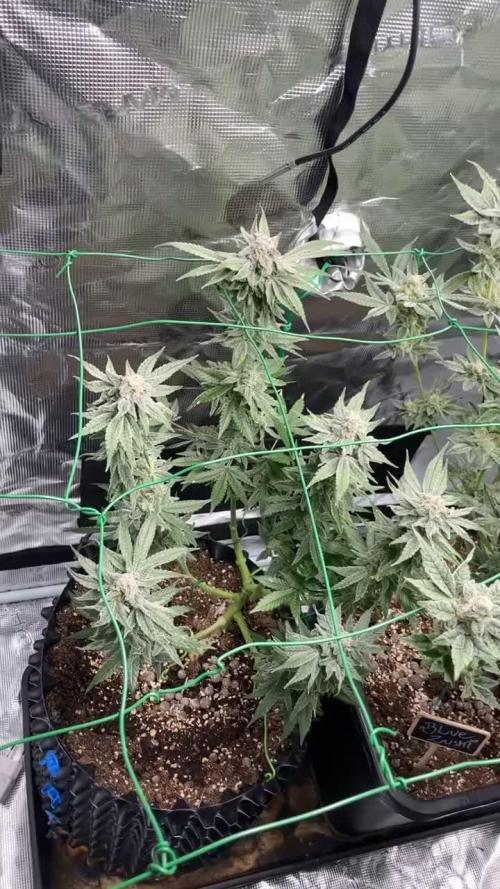
Welcome to week 3 of veg. They’ve been growing about 1” per day lately. I’m planning to SCROG these three girls with a portable scrog screen. Supplies arrive today and I’m anxious to test this. (Note that my portable scrog screen didn’t work, so I’m using a 2x4 stretch screen).
So far the self watering feeders are working well. The reservoir ph does tend to climb, so I make regular adjustments by adding RO water to the nutrient mix and using ph down. The PPM of the nutrients is climbing too, so adding RO dilutes that. As an example, it had climbed from 925 ppm to 1080 ppm overnight. I diluted it back down to 880 ppm.
Saturday: installed scrog net
Sunday: checked reservoir ph (6.4) and ppm (970). Added ph down. Adjusted scrog net. Discoloration in leaves appears to be worsening. Waiting for a new dehumidifier to arrive. With all of the humidity that the fiber pots put off, I’m going to need a dehumidifier in flower.
Monday: ran pipes for humidifier, heater and dehumidifier through a different tent outlet. I’m ready to start dehumidifying at flower flip. Removed humidifier since I won’t need it until after the harvest (I dry in my tent ideally). Topped off reservoir water with a heavy emphasis on CalMag. Reservoirs are at a ph of 6.0 and 750ppm. Lowered ppm due to start of burnt leaf tips on one plant.
Wednesday. Lowered ph in reservoir from 6.4 to 6.1 with ph down and diluted nutrients. Lowered ppm from 780 to 700. Removed growth below the SCROG net. Adjusted lighting to a DLI of 35 which proved too intense for the plants, so I backed it down to 30 DLI.
Thursday: wrapped up the week by giving them a foliar spray after lights went out. Feeding 5ml/g or CalMag and 30ml/g of Seaweed Extract. Topped off reservoirs using 6ml/g of micro, 9ml/g of Bloom, Seaweed and 2ml CalMag.



Likes
6
Share


@DogDoctorOfficial
Follow
🚂 8×8 Adventure – Week 14 🌸
Cash Express – Pheno B
💚 Beast Mode Activated — Big Flowers, Big Presence, and Absolutely No Hurry to Follow Anyone Else's Rules!
Welcome back to another chapter of the 8×8 Adventure! 🌱💚
My friends...
LOOK AT THIS GIRL! 😂🚂🌸
Seriously.
Look at her.
Look at those flowers.
Look at that structure.
Look at the way she's carrying herself in the room.
This is Cash Express Pheno B, and I think we can officially say that her beast mode is still very much switched on!
💚🔥
And after everything that happened with her sister, there's something especially satisfying about seeing this girl continue her journey without losing her main cola.
Her sister had a rough chapter.
We lost a beautiful flower, and that was a proper bummer.
But this girl?
She's still carrying hers.
And what a beautiful main cola it is!
😂🌸
She's shining.
She's developing.
She's continuing to evolve.
And she's doing it in her own way, at her own pace, without asking anyone for permission.
She's not waiting for the other plants.
She's not checking the calendar.
She's not asking me when she's supposed to finish.
She's simply doing her thing.
And honestly?
I love that.
We are getting into the later part of her journey, but I'm not going to pretend I know exactly when she'll be finished.
She'll get there when she's ready.
Until then, we're going to keep observing, keep documenting, and keep giving this beautiful beast the spotlight she deserves.
🚂💚🌸✨
────────────────────────
🌱 THE 8×8 ADVENTURE — SAME ROOM, DIFFERENT STORIES
────────────────────────
For anyone discovering this diary for the first time, welcome to the 8×8 Adventure!
The idea behind this project is simple:
Different genetics and phenotypes sharing the same general environment.
Same room.
Same 12/12 light schedule.
Same general environmental conditions.
Same lighting ecosystem.
Same nutritional program.
Same grower.
And yet...
completely different personalities.
😂🌿
That's the part I love most about this experiment.
Some plants are compact.
Some stretch.
Some build enormous structures.
Some take their sweet time.
Others seem to wake up every morning and decide that today is another opportunity to surprise us.
And Cash Express Pheno B?
She's bringing the beast mode.
🚂🔥
Her sister has experienced a very different journey, including the unfortunate loss of her main cola.
This girl has kept hers, and we're continuing to follow her development as she moves toward the later part of her flowering journey.
Two phenotypes.
Shared genetics.
Shared environment.
Different experiences.
And that's exactly why every plant gets her own diary.
We're not simply documenting a cultivar name.
We're documenting the individual plant in front of us.
And this girl has plenty of personality to document!
────────────────────────
💚 HER MAIN COLA IS STILL HERE — AND SHE'S SHINING!
Let's give this flower the appreciation it deserves.
😂🌸
After what happened to her sister, I think it's impossible not to pay a little extra attention to this girl's main cola.
It's beautiful.
It's substantial.
And it's still part of the plant.
That's something worth celebrating.
When you've watched a flower develop over so many weeks, you start appreciating all the little changes that brought it to this point.
The structure.
The way the flowers develop together.
The way the surrounding foliage frames the cola.
The changing appearance as the plant progresses.
And now, here we are, looking at a beautiful main flower that's still very much part of her story.
💚🌸✨
I'm not going to make predictions about exactly how much longer it has.
I'm not going to put a finish date on her.
And I'm certainly not going to start calling the run finished just because the plant looks impressive.
We're going to keep watching.
We're going to keep observing the whole plant.
And we're going to let her development tell us where she is in the journey.
For now?
I'm enjoying the view.
And this girl is giving us plenty to enjoy!
────────────────────────
🔥 BEAST MODE — A MEDIUM PLANT WITH A BIG PRESENCE
────────────────────────
One of the things I really like about Cash Express Pheno B is that she doesn't need to dominate every centimetre of the room to make herself noticed.
She's got presence.
She's got character.
And those flowers certainly know how to attract attention.
😂💚
There's a difference between a plant being physically enormous and a plant simply having an impressive expression.
You can have a giant plant that doesn't necessarily produce the individual flower structure you're looking for.
And you can have a more moderate-sized plant that develops some seriously impressive flowers.
Cash Express Pheno B is a great reminder that plant height alone never tells the entire story.
Look at the structure.
Look at the individual flowers.
Look at the way the plant has developed.
Look at her main cola.
And then tell me she isn't bringing some serious beast energy to this adventure!
🚂🌸🔥
She's doing her thing.
And we're here to appreciate it.
────────────────────────
🌸 MOVING TOWARD THE FINISH — BUT WHO SET THE DATE?
────────────────────────
This is where things get interesting.
We're moving into the later part of her journey, and she's continuing to evolve beautifully.
But when is she going to be finished?
Honestly?
I don't know.
😂💚
And that's not me avoiding the question.
It's simply me refusing to pretend that a calendar can tell us everything we need to know about a living plant.
The week number gives us context.
The photographs help us track changes.
The appearance of the flowers gives us information.
But no single observation tells us everything about the plant's overall maturity.
Different phenotypes can develop at different rates, even when they're grown under the same general conditions.
And Cash Express Pheno B has already shown us that she has her own rhythm.
So we're not going to force a deadline onto her.
We're going to keep observing the overall development and document what we actually see.
No guessing for the sake of guessing.
No promises.
No imaginary finish date.
Just the plant, the camera, and another week of the 8×8 Adventure.
🌿📸💚
────────────────────────
🌱 SAME ROOM, SAME OPPORTUNITY — DIFFERENT GENETIC EXPRESSION
────────────────────────
The room remains under the same general setup.
We're not changing everything around simply because one plant is developing differently from another.
The lighting ecosystem remains in place.
The nutritional program remains consistent.
The environmental strategy remains the same.
And the plants continue to express themselves individually.
This is one of the most important things to understand about the 8×8 Adventure.
Keeping the environment consistent doesn't mean every plant will behave identically.
Genetics influence plant architecture, development, flowering patterns, and how individual plants respond to their surroundings.
The environment provides the conditions.
The plant's biology determines how it responds to them.
And the results can be fascinating.
The Blueberry Muffin sisters have been taking their time.
Cash Express Pheno B is showing a very different rhythm.
And even within Cash Express, Pheno A and Pheno B have experienced different journeys.
That's not a problem with the experiment.
That's precisely what makes the experiment interesting.
Same room.
Different stories.
And we're documenting every one of them.
────────────────────────
💡 THE ARTIFICIAL SUN — FUTURE OF GROW BLACK SERIES
────────────────────────
The lighting setup remains unchanged this week.
The Future of Grow Black Series LEDs continue to provide the main lighting for the room, with the two additional Black Series 600W fixtures remaining part of our upgraded setup.
After adding those fixtures, we reduced the output to approximately 59% from the plug rather than running everything at maximum.
Our working reference remains around:
☀️ ~1,500 PPFD across the upper canopy.
Actual intensity varies depending on the plant's height and position, so this is an upper-canopy reference, not a claim that every flower receives exactly the same amount of light.
And Cash Express Pheno B continues her journey beneath that lighting environment.
Same artificial sun.
Same general setup.
Different plant.
Different response.
Different expression.
💡🌿
The extra fixtures have given us more lighting capacity and more flexibility in how we use that capacity.
And that is worth highlighting.
More available capacity doesn't automatically mean we need to operate every fixture at maximum output.
The useful question is how the lighting performs within the complete environment and how the plants respond.
That's part of what we're exploring throughout this adventure.
A massive thank you to Future of Grow for supplying the additional Black Series fixtures and giving us the opportunity to test this expanded lighting setup!
────────────────────────
❤️ THE RED-LIGHT DISCUSSION — WHAT DOES IT ACTUALLY DO?
────────────────────────
Now, let's talk about the extra 15 minutes of red light after the main lighting period.
Since we're documenting this lighting routine across the individual reports this week, I want to explain the science rather than simply repeat a claim.
Plants have photoreceptors that help them interpret their light environment.
One important group is the phytochromes, which respond to red and far-red wavelengths.
These photoreceptors participate in signalling processes that can influence plant development and responses to changing light conditions.
Red and far-red light are related, but they are not interchangeable.
Their effects depend on the wavelengths involved, the intensity, the duration of exposure, the timing, and the plant's physiological state.
Our additional 15-minute red-light period is part of the lighting routine we're documenting.
However, we shouldn't automatically claim that this short period guarantees better flowering, larger flowers, increased yield, or a better transition into darkness.
Those are specific outcomes that would need appropriate evidence.
For this run, we're recording what we're doing and keeping the scientific explanation separate from any assumptions about the result.
That's important.
It's possible to explore lighting techniques while remaining honest about what we know.
And if we want to understand what a particular treatment actually changes, we need to look at the evidence and the plants' responses rather than assuming the result in advance.
❤️💡🌱
────────────────────────
🔬 THE EMERSON EFFECT — A LITTLE PHOTOSYNTHESIS SCIENCE
────────────────────────
Since we're already talking about light, let's take a moment to look at the Emerson effect.
This is a genuine phenomenon in photosynthesis, and it's a fascinating example of how plants use light.
In simplified terms, the Emerson effect describes an increase in photosynthetic activity observed when certain red and far-red wavelengths are supplied together, compared with what would be expected from their individual effects under the experimental conditions.
Why does that happen?
Photosynthesis involves two cooperating photosystems:
🌿 Photosystem II — PSII
🌿 Photosystem I — PSI
Both are involved in the light-dependent reactions that help convert light energy into chemical energy.
The two photosystems have different absorption characteristics, and their cooperation is essential to the overall process.
Under suitable conditions, combining particular wavelengths can improve the balance between the activity of the two photosystems.
The resulting photosynthetic response can be greater than expected from either wavelength acting alone.
That's the key idea behind the Emerson effect.
But here's where we need to be careful.
The Emerson effect does not simply mean that adding red light at the end of the day automatically increases photosynthesis.
The classic effect concerns the combined action of red and far-red wavelengths under particular illumination conditions.
Our additional 15-minute red-light period after the main lights is a different situation.
We shouldn't assume that it reproduces the Emerson effect or that it automatically produces a measurable benefit.
The actual spectrum matters.
The intensity matters.
The timing matters.
And the response being measured matters.
So, yes, the Emerson effect is an important and interesting part of photosynthesis research.
But we need to distinguish the established phenomenon from the particular lighting routine we're using in this grow.
That's how we keep the science useful.
Curiosity is good.
Experimenting can be interesting.
But understanding what an effect actually describes is even better.
🔬🌱💡
────────────────────────
🌙 RED LIGHT, FAR-RED LIGHT, AND DARKNESS ARE NOT THE SAME THING
One final clarification, because these subjects are often mixed together.
Red light and far-red light can influence plant signalling in different ways.
The phytochrome system responds to these wavelengths and helps plants interpret changes in their light environment.
But the response to a particular treatment depends on the exact conditions.
A short red-light period after the main lights switch off is not automatically equivalent to a far-red treatment.
And neither treatment should be assumed to guarantee a particular outcome without supporting evidence.
For this report, the important point is simple:
We're documenting the additional 15-minute red-light period as part of our current lighting routine.
We're explaining the relevant science.
And we're not claiming that the Emerson effect proves this particular treatment will improve the plant.
If we want to understand the actual effect of a lighting treatment, we'd need suitable comparisons and measurements.
That's the difference between an interesting idea and a demonstrated result.
And I think growers deserve that distinction.
💚🔬
────────────────────────
🌱 NUTRITION — KEEPING THE ROOM CONSISTENT
────────────────────────
The nutritional program remains unchanged this week.
We're continuing with the same general recipe across the room rather than creating a new feeding plan for Cash Express Pheno B simply because she's developing at her own pace.
The current recipe remains:
🌱 Plagron Pure Zym — 1 ml/L
⚗️ Plagron pH Plus — 0.03 ml/L
🍋 Plagron Lemon Kick — 0.03 ml/L
🌸 Plagron Terra Bloom — 2 ml/L
🌱 Plagron Power Buds — 1 ml/L
🍯 Plagron Sugar Royal — 1 ml/L
🌿 Plagron Green Sensation — 1 ml/L
Current solution readings remain approximately:
⚗️ pH — 6.04
⚡ EC — ~2.05 mS/cm
Same general program.
Same room.
Same opportunity.
And the plant continues to show us her own expression.
We're not trying to make every phenotype follow the same timeline.
We're watching the plants and documenting what happens.
────────────────────────
✂️ NOT MUCH INTERVENTION — JUST OBSERVATION
One thing that hasn't changed is our approach to the plant itself.
We're not looking for unnecessary work.
We're not trying to manipulate her simply because she's entering a later stage.
We're observing.
We're documenting.
We're keeping an eye on her overall condition.
And we're letting her continue her journey.
The plant has already developed her structure.
The flowers are there.
The room is stable.
So there's no reason to invent an intervention just to make the week feel busy.
😂🌿
Sometimes the grower needs to take action.
Sometimes the grower needs to solve a problem.
And sometimes the grower needs to put the camera down, take a step back, and appreciate what the plant has become.
Cash Express Pheno B is definitely giving me plenty of reasons to do that last one.
────────────────────────
🌡️ WEEK 14 — ROOM CONDITIONS
The room continues under the same general setup used across this week's individual reports:
🌸 Flowering — Week 14
💡 Light schedule — 12/12
💡 Future of Grow Black Series LEDs — upgraded setup
🔌 Approximate lighting output — ~59% from the plug
☀️ Upper-canopy PPFD reference — ~1,500
🌡️ Day temperature — ~27°C
🌙 Night temperature — ~26°C
💧 Relative humidity — ~61%
⚗️ pH — ~6.04
⚡ EC — ~2.05 mS/cm
🌡️ Nutrient solution temperature — ~25°C
🌱 Substrate temperature — ~25°C
🌬️ CO₂ — ~693 ppm
🌱 Pot size — 15 L
💦 Irrigation — ~1.45 L per plant / 24h
These are the shared room readings and setup references, rather than measurements unique to this individual plant.
Same room.
Same lighting ecosystem.
Same general nutritional program.
Different phenotype.
And Cash Express Pheno B continues to show us what she can do within that environment.
────────────────────────
💚 HER SISTER'S STORY IS DIFFERENT — AND THAT'S OKAY
I think this comparison deserves a moment of its own.
Cash Express Pheno A lost her main cola.
It was unfortunate, and we documented it honestly.
Cash Express Pheno B has kept hers, and we're continuing to follow her development.
It's tempting to think that two plants sharing the same genetics and room should experience the same journey.
But living plants don't work like that.
Their individual structures, development, and responses can differ.
And sometimes their experiences differ for reasons that have nothing to do with a simple comparison of the cultivar name.
We don't need to turn the two sisters into a competition.
One plant's setback doesn't diminish the other plant's success.
And one plant doing well doesn't make the other plant's difficult chapter any less important to document.
They each deserve their own report.
Their own photographs.
Their own observations.
And their own story.
Cash Express Pheno B is bringing her beast mode this week.
So that's what we're celebrating.
🚂💚🌸
────────────────────────
📸 THE CAMERA LOVES THIS GIRL
And honestly?
I could keep taking photographs of this plant.
😂📸
There's something satisfying about looking at a plant you've followed for weeks and seeing how her appearance has changed over time.
The structure.
The flowers.
The main cola.
The way she occupies her space.
All those details become part of the record.
And that's why I enjoy keeping the reports separate.
A single overview of the whole room would never tell us everything about each plant.
Here, we can stop and appreciate Cash Express Pheno B individually.
We can admire her flowers.
We can follow her development.
We can compare this week's photographs with previous weeks.
And we can document the journey without pretending we already know how the final chapter will look.
That's the beauty of keeping a proper diary.
One plant.
One week.
One more piece of the story.
💚📸🌸
────────────────────────
🔭 WHEN WILL SHE FINISH?
The million-dollar question!
😂💚
And my answer is still:
I don't know yet.
She's moving toward the later part of her journey, and her development is continuing.
But I'm not going to invent a finish date simply because we're at Week 14.
The calendar gives us context.
It doesn't make the decision for the plant.
We'll continue to observe her overall maturity and development, and we'll document what we actually see.
No false certainty.
No promises.
No pressure to finish on somebody else's schedule.
Cash Express Pheno B gets to write her own ending.
And we'll be here with the camera when the next chapter arrives.
────────────────────────
✨ FINAL THOUGHTS — BEAST MODE, BRIGHT LIGHTS, AND HER OWN FINISH LINE
Week 14.
Cash Express Pheno B.
And what a beautiful beast she is!
🚂💚🔥
Unlike her sister, she hasn't lost her main cola.
She's continuing to develop.
She's looking beautiful.
She's showing us her own structure and her own personality.
And she's moving toward the later part of her journey without giving us a reason to rush her or invent a deadline.
I'm loving what I'm seeing.
I'm enjoying the photographs.
I'm enjoying the opportunity to follow this phenotype individually.
And I'm especially enjoying the contrast between the two sisters.
Same genetics.
Same room.
Different experiences.
Different expressions.
Different stories.
That's what this adventure is all about.
We've also taken the opportunity to discuss the extra 15-minute red-light period and the Emerson effect.
Red and far-red light have fascinating roles in plant signalling and photosynthesis, but the science deserves to be explained accurately.
The Emerson effect describes a specific photosynthetic response involving the cooperation of photosystems under particular illumination conditions.
It doesn't automatically prove that our short end-of-day red-light period produces the same effect.
We're documenting our lighting routine, learning about the underlying science, and keeping our conclusions grounded in what we actually know.
Because growing is not just about watching plants develop.
It's also about asking questions, exploring ideas, and learning to separate observations from assumptions.
And this girl?
She's giving us plenty to observe.
😂🌸💚
So let's celebrate the beautiful main cola that's still here.
Let's appreciate the flowers.
Let's enjoy her beast-mode personality.
Let's keep the room stable.
Let's keep learning.
And let's allow Cash Express Pheno B to reach her own finish line in her own time.
She's not following the calendar.
She's following her own journey.
And we're here to watch it unfold.
🚂🌸💚✨
────────────────────────
🙏 THANK YOU
A huge thank you to Zamnesia for the Cash Express genetics and for giving us the opportunity to explore these individual phenotypes throughout the 8×8 Adventure. 🌸💚
Thank you to Plagron for supporting the nutritional side of the journey and helping us maintain consistency throughout the room. 🌱
A massive thank you to Future of Grow for the Black Series lighting and especially for supplying the two additional Black Series 600W fixtures that have expanded our lighting capability. 💡🙏
Thank you to LumiFlora for adding another lighting dimension deeper into the canopy.
Thank you to TrolMaster for helping us monitor and maintain the environment behind the scenes.
And, of course, thank you to everyone following along on GrowDiaries.
Thank you for the comments.
Thank you for the questions.
Thank you for the support.
And thank you for appreciating the individual stories behind these plants.
Because that's what makes the 8×8 Adventure special.
We're not simply showing you a room full of plants.
We're documenting different genetics, different phenotypes, different experiences, and everything we learn along the way.
Sometimes we celebrate a beautiful main cola.
Sometimes we document a setback.
Sometimes we explore the science behind a lighting technique.
And sometimes we simply stand there, look at a plant, and say:
"Damn...
you're beautiful."
😂💚🌸
Cash Express Pheno B is giving us one of those weeks.
So keep shining, beautiful beast.
Keep doing your thing.
Keep following your own rhythm.
And whenever you're ready to finish your story...
we'll be here to document it.
🚂💚🌸✨
Growers Love & Happy Growing! 🌱💚🚂

Likes
24
Share


@1Right_Angle
Follow
Mar 20,
- These plants are putting on a show, about how to fill a Bud.
The Maui Wowie are stuffing the buds into hard little nuggets. First-time I have seen true Nuggets indoors. Week 9 is going to be fun.
- White Pistils have begun to turn Brown/Amber and are getting “crinkly”.
- not to mention sticky as hell
- final Flower meal (Sunday) posted above = 8L
- TDS = 1125ppm for the final feeding.
Mar 22nd
- some fresh air for a few Pictures in Daylight and a thorough Flushing; 15 gal pot w/ 2 plants and it took 35 gallons of prepared h20 to get the TDS below 130ppm
- Drip-dry in the Sun for a couple of hours then back inside before any insects find us. Early spring warmth here in southern Ontario.
Mar 24
- it’s an amazing plant with the canopy looking like it’s full of Buttons. But in reality each of these buds are getting Longer every day, all at the same time.
Harvest will be a real Surprise.
I’ve not been poking around too much, these girls have simply run their course without needing any Help !
Great work Beaver Seeds!!!
When the time comes, I look forward to seeing what an Outdoor one produces. And how the plants would look without 1 aggressive LST session.
- Trichome-check tonight = large number of cloudy, with very few Amber. Still some clear with ~ 70% cloudy
26th,
- A gallon of Molasses / Rezin / H20 tonight to keep the juices flowing. Plant rotation etc. Day 5 since flush. Fluff the plants and arrange for Max exposure for the final couple of weeks.
No A/C in the small tent, humidity is just over 50%.
Air is being kept moving

Likes
9
Share

@CheeRz
Follow
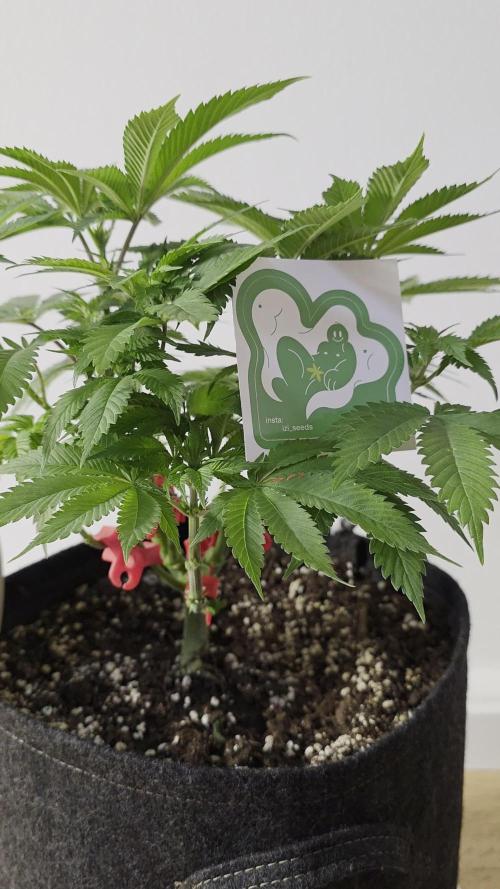
Blue is now around 30 cm tall. I don't think she'll catch up with the others, but we'll do our best. However, since she's been getting fish mix, you can see that she's growing better. Perhaps I should have started giving her protein earlier. Keep it IZI 💚

Likes
27
Share


@Dunk_Junk
Follow
Last couple of weeks she's been affected by high tent temps, hence all her curled leaves 😓
She is also a big plant in her little 10L fabric pot. I've noticed fabric pots really do dry out faster than airpots. That is a good thing, but you have to watch her drying out too quickly also!
I think she'd make a monster plant in a 20L or 40L airpot.😍
Likes
4
Share

@BobbersDown
Follow
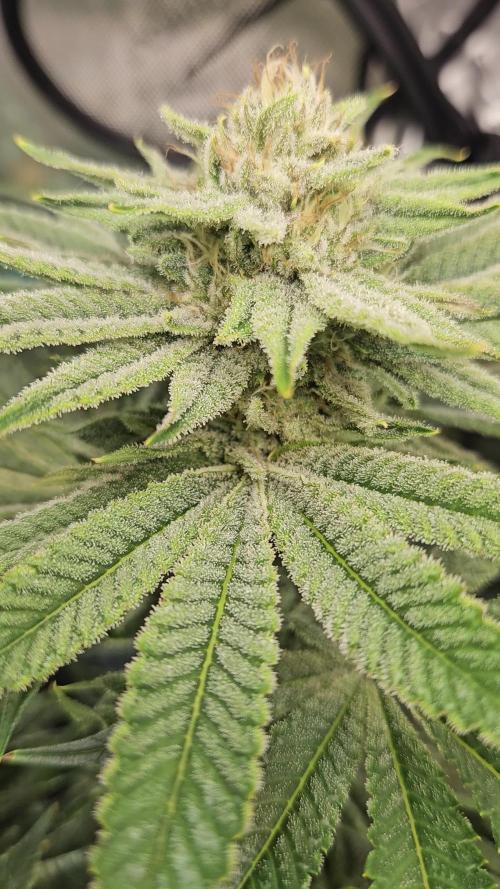
Stacking continues. Pardon the fly catcher have a few fruit flies in the house. The smell is more subtle and fruity/citrus than some I've grown. Outside the tent... Well the carbon filter isn't holding everything back. Touching the buds leaves a very nice smell on the fingers. This things ridiculously frosty! Might end up looking damn near white. Probably 2 or 3 weeks to harvest, hoping for it to be smooth sailing from here.

Likes
15
Share


@GERGrowDesigns
Follow
Welcome to Flower Week 4 of Kannabia Pink Gelato
I'm excited to share my grow journey with you from my
Kannabia Seeds Project . It's going to be an incredible ride, full of learning, growing, and connecting with fellow growers from all around the world!
Check out Kannabia Seeds with my link [https://www.kannabia.com/de?ref=61966] and grab the germination device or the strains I used . Trust me – it’s worth it for sure !
Get another 20% Discount at all products using the code [GGD] at the checkout.
For this Project , I’ve chosen the Feminized Photo Strain Pink Gelato:
Here’s what I’m working with:
• 🌱 Tent: 225x150x150
• 🧑🌾 Breeder Company: Kannabia Seeds
• 💧 Humidity Range: 50
• ⏳ Flowering Time: 56-63 Days
• Strain Info: 23%THC
• 🌡️ Temperature: 26
• 🍵 Pot Size: 20
• Nutrient Brand: Hy-Pro
• ⚡ Lights : 600W x 2
A huge thank you to Kannabia Seeds for allowing me to try my Best with this amazing collection from Photo Strains they managed to Sponsore . Big thanks for supporting the grower community worldwide! Your genetics and passion speak for themselves!
Let’s grow together – and don’t forget to stop by again to see the latest updates!
Happy growing!
Stay lifted and stay curious!
Peace & Buds!


Likes
13
Share


@SillyTrippyHippy
Follow
Turned lights to 100% a few days ago, top dressed some frass & oats for terp production. Wateted in a bit of coconut water and microbes.

Likes
16
Share

@Psychopat_od_vedle
Follow
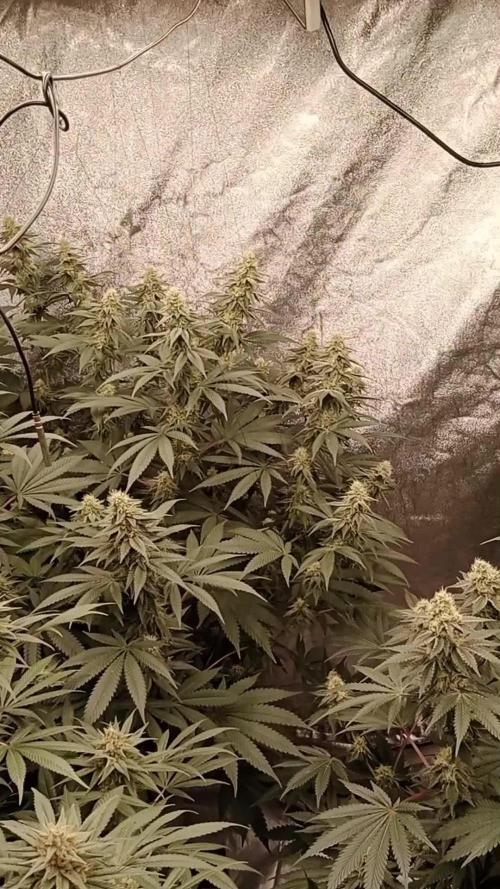
Zdarec bando máme tu 38 den a holky vypadají skvěle pH 6.1 vlhkost 55% jinak žádný problém nic tak doufám že to bude v pohodě až do konce.