


Likes
Comments
Share


@smoking_hills9
Follow
Plants are doing great, but very annoying slow fase of preflower. That's why I do mostly auto. Let's c maybe this harvest will change my mind. Start using spirulina powder as natural PGR.

Likes
2
Share


@Bluemels
Follow
Tag 24: Umgetopft in einen 15L Topf.
Tag 25: getoppt bei 4 Nodien.
Tag 27: Ich beginne die Seitenarme runterzubiegen, dazu drücke ich Diese 1× täglich runter.
Tag 28: Leider ist beim runterbiegen 1 oberer Seitenarm fast durchgebrochen, ich versuche i mit Klebeband und Draht zu retten.

Likes
7
Share


@SebastianFastBuds
Follow
Right before harvest I took some more videos and photos of the ladies.

Likes
24
Share


@Doubleb84
Follow
Rough week, seeing the full effects of nute burn and at the same time cal mag deficiency. Making some newbie mistakes here, didn’t realize how often I needed to give them cal mag so fan leaves started to yellow. Also didn’t realize the importance of watering until runoff with the medium I’m using so there was some build up causing the nute burn. PPM was 4000 when I flushed.
I finally think I’ve got it all figured out thanks to friends with much more experience whom I should have reached out to sooner.
Oh well, expected to make some mistakes and learn from them my first time around. Still have some big fat frosty colas! Can’t wait to take what I’ve learned into the next grow!

Likes
15
Share


@RamirezDusha
Follow
Honestly, last week I switched to watering exclusively with water with the recommended pH level. I defoliated, perhaps even did some kind of partial trimming in vivo. Expect my results, friends, it will be a rich harvest of delicious cones!


Likes
39
Share


@Randyb4
Follow
Day 120 First Day of the week, 46 days of flowering.
Day 123 49 Days of flower
Trichomes look about ready of Plants B and D.
Day 124 50 Days of flower, First day of Week 8 of flower
Chopped plants B and D( had to chop in sections, because of the trellis net), hairs were mostly orange/brown, soil was dry, cut off most of the dead and dying fan leaves. Buds look beautiful. Hang drying at 65°F@50%RH. Plenty of airflow, but not blowing on the plants. Watered Plants A and C with 2 gallons of plain non ph'd water. PH shouldn't matter at this stage in the grow.
Day 126 52 Days of flower
Watered with 2 gal of spring water non ph'd.


Likes
5
Share


@soupthefruitdude
Follow
An Tag 80
nach 48h Licht und 48h Dunkelheit habe ich sie jetzt zum trocknen aufgehängt.

Likes
18
Share


@Finedakine
Follow
I was out of town this last week so my wife just watered them. She accidentally disabled the timer on the lights so I'm not sure how long they had light or didn't. All seems ok though. Starting their flush soon.
I moved the lights up to 30". I think they're getting burned a bit.


Likes
4
Share


@FourTwenty_Plants
Follow
So far so good.
Frost Banger is showing some purple hues and the Purple Haze is full on developing purple buds.
The FBA2504 is my fav in this run shes tall and still growing, looking healthy except she has a lil Phosphorus deficiency at her top leaves but other than that they all are doing good.
We are already on day 43 with this run!
Likes
22
Share


@ShowsWorld
Follow
Starting flush tomorrow. Everything looks very frosty but the buds haven’t begun to swell just yet I’m hoping they pack on some weight in the last two weeks.

Likes
80
Share


@Roberts
Follow
The Pure Ice Cream clone is growing well. Nothing special has been happening. She is waiting on another plant to finish so she can go to flowering. It will be about 3 or 4 weeks from now. Everything is going smooth. Thank you Pure Instinto Seeds, and Spider Farmer. 🤜🏻🤛🏻🌱🌱🌱
Thank you grow diaries community for the 👇likes👇, follows, comments, and subscriptions on my YouTube channel👇. ❄️🌱🍻
Happy Growing 🌱🌱🌱
https://youtube.com/channel/UCAhN7yRzWLpcaRHhMIQ7X4g

Likes
45
Share


@Ultraviolet
Follow
2nd net is up. Early bud formations are promising. holding up to the extremes pretty well, some leaves taking minor damage, but overall, she is holding up, gave her 1 night at 50F see how she would react, stressful. Not advised as it messes with her metabolism, but I want to see if it triggers any anthocyanin response. Love to see her purp up but no signs yet.
My homework.
Rubisco regeneration is intrinsically linked to nitrogen supply because Rubisco is a major sink for nitrogen in plants, typically accounting for 15% to over 25% of total leaf nitrogen. The regeneration phase itself consumes nitrogen through the synthesis of the Rubisco enzyme and associated proteins (like Rubisco activase), and overall nitrogen status heavily influences the efficiency of RuBP regeneration.Structural Component: Nitrogen is an essential building block for all proteins, and the sheer abundance of the Rubisco protein makes it the single largest storage of nitrogen in the leaf.
Synthesis and Activity: Adequate nitrogen supply is crucial for the synthesis and maintenance of sufficient Rubisco enzyme and Rubisco activase (Rca), the regulatory protein responsible for maintaining Rubisco's active state. Nitrogen deficiency leads to a decrease in the content and activity of both Rubisco and Rca, which in turn limits the maximum carboxylation rate, Vmax, and the rate of RuBP regeneration Jmax, thus reducing overall photosynthetic capacity.
Nitrogen Storage and Remobilization: Rubisco can act as a temporary nitrogen storage protein, which is degraded to remobilize nitrogen to other growing parts of the plant, especially under conditions of nitrogen deficiency or senescence.
Nitrogen Use Efficiency (NUE): The allocation of nitrogen to Rubisco is a key determinant of a plant's photosynthetic nitrogen use efficiency (PNUE). In high-nitrogen conditions, plants may accumulate a surplus of Rubisco, which may not be fully activated, leading to a lower PNUE. Optimizing the amount and activity of Rubisco relative to nitrogen availability is a target for improving crop NUE.
Photorespiration and Nitrogen Metabolism: Nitrogen metabolism is also linked to the photorespiration pathway (which competes with carboxylation at the Rubisco active site), particularly in the reassimilation of ammonia released during the process.
To increase RuBisCO regeneration, which refers to the process of forming the CO2 acceptor molecule Ribulose-1,5-bisphosphate (RuBP) during photosynthesis, the primary methods involve optimizing the levels and activity of Rubisco activase (Rca) and enhancing the performance of other Calvin-Benson-Bassham (CBB) cycle enzymes.
Biochemical and Environmental Approaches:
Optimize Rubisco Activase (Rca) activity: Rca is a crucial chaperone protein that removes inhibitory sugar phosphates, such as CA1P (2-carboxy-D-arabinitol 1-phosphate), from the Rubisco active site, thus maintaining its catalytic competence.
•Ensure optimal light conditions: Rca is light-activated via the chloroplast's redox status. Adequate light intensity ensures Rca can effectively maintain Rubisco in its active, carbamylated state.
•Maintain optimal temperature: Rca is highly temperature-sensitive and can become unstable at moderately high temperatures (e.g., above 35°C/95F° in many C3 plants), which decreases its ability to activate Rubisco. Maintaining temperatures within the optimal range for a specific plant species is important.
•Optimize Mg2+ concentration: Mg2+ is a key cofactor for both Rubisco carbamylation and Rca activity. In the light, Mg2+ concentration in the chloroplast stroma increases, promoting activation.
•Manage ATP/ADP ratio: Rca activity depends on ATP hydrolysis and is inhibited by ADP. Conditions that maintain a high ATP/ADP ratio in the chloroplast stroma favor Rca activity.
Enhance Calvin-Benson-Bassham (CBB) cycle enzyme activity: The overall rate of RuBP regeneration can be limited by other enzymes in the cycle.
•Increase SBPase activity: Sedoheptulose-1,7-bisphosphatase (SBPase) is a key regulatory enzyme in the regeneration pathway, and increasing its activity can enhance RuBP regeneration and overall photosynthesis.
•Optimize other enzymes: Overexpression of other CBB cycle enzymes such as fructose-1,6-bisphosphate aldolase (FBA) and triose phosphate isomerase (TPI) can also help to balance the metabolic flux and improve RuBP regeneration capacity.
Magnesium ions, Mg2+, are specifically required for Rubisco activation because the cation plays a critical structural and chemical role in forming the active site: A specific lysine residue in the active site must be carbamylated by a CO2 molecule to activate the enzyme. The resulting negatively charged carbamyl group then facilitates the binding of the positively charged Mg2+ion. While other divalent metal ions like Mn2+ can bind to Rubisco, they alter the enzyme's substrate specificity and lead to dramatically lower activity or a higher rate of the non-productive oxygenation reaction compared to Mg2+, making them biologically unfavorable in the context of efficient carbon fixation. The concentration of Mg2+ in the chloroplast stroma naturally increases in the light due to ion potential balancing during ATP synthesis, providing a physiological mechanism to ensure the enzyme is activated when photosynthesis is possible. At the center of the porphyrin ring, nestled within its nitrogen atoms, is a Magnesium ion (Mg2+). This magnesium ion is crucial for the function of chlorophyll, and without it, the pigment cannot effectively capture and transfer light energy.
Mg acts as a cofactor: Mg2+ binds to Rubisco after an activator CO2 molecule, forming a catalytically competent complex (Enzyme-CO2-Mg2+). High light + CO2) increases demand: Under high light (60 DLI is a very high intensity, potentially saturating) and high CO2, the plant's capacity for photosynthesis is high, and thus the demand for activated Rubisco and the necessary Mg2+ cofactor increases. Mg deficiency becomes limiting: If Mg2+ is deficient under these conditions, the higher levels of Rubisco and Rubisco activase produced cannot be fully activated, leading to lower photosynthetic rates and potential photo-oxidative damage.
Optimal range: Studies show that adequate Mg2+ application can enhance Rubisco activation and stabilize net photosynthetic rates under stress conditions, but the required concentration is specific to the experimental setup.
Monitoring is key: The most effective approach in a controlled environment is to monitor the plant's physiological responses e.g., leaf Mg2+ concentration, photosynthetic rate, Rubisco activation state, and adjust the nutrient solution/fertilizer to maintain adequate levels, rather than supplementing a fixed "extra" amount.
In practice, this means ensuring that Mg2+ is not a limiting factor in the plant's standard nutrient solution when pushing the limits with high light and CO2.
Applying Mg2+ through foliar spray is beneficial to Rubisco regeneration, particularly in alleviating the negative effects of magnesium (Mg) deficiency and high-temperature stress (HTS). While Mg can be leached from soil, within the plant it is considered a mobile nutrient, particularly in the phloem. Foliar-applied Mg is quickly absorbed by the leaves and can be translocate to other plant parts, including new growth and sink organs.
Foliar application of: NATURES VERY OWN MgSO4 @ 15.0g L-1 in a spray bottle.
Foliar sprays are often recommended as a rapid rescue measure for existing deficiencies or as a supplement during critical growth stages, when demand for Mg is high. Application in the early morning or late evening can improve absorption and prevent leaf burn.
The starting point [of creativity] is curiosity: pondering why the default exists in the first place. We’re driven to question defaults when we experience vuja de, the opposite of déjà vu. Déjà vu occurs when we encounter something new, but it feels as if we’ve seen it before. Vuja de is the reverse—we face something familiar, but we see it with a fresh perspective that enables us to gain new insights into old problems. Come walk in the enchanted forest.
Likes
2
Share


@Green_Peace
Follow
Transplanted to a 5 gallon pot half way through the week and heavily watered/fed for the next 2 days, then topped for the first time at the end of the week.
She's doing really well.
Now it's about keeping the plants trained and the same height.
2 timelapses this week. Enjoy!
Likes
10
Share
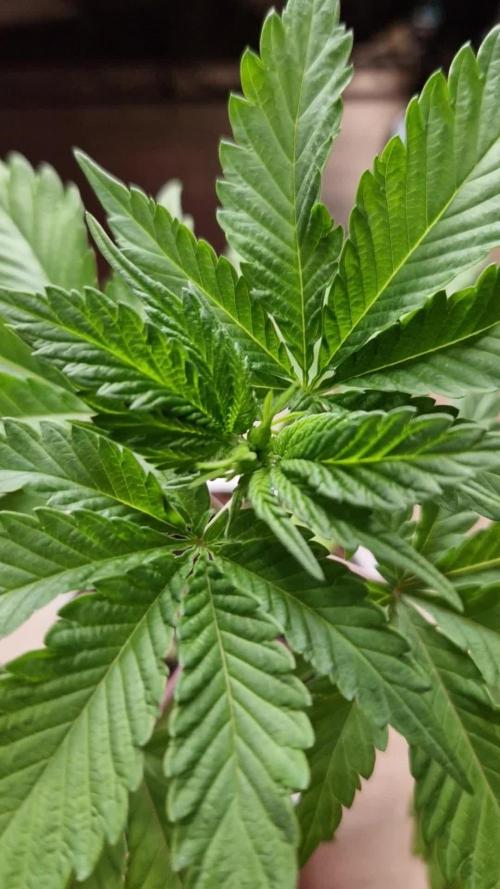

@TrickzGrowz
Follow
Servus Moin!
Die Super Double Cherry wurde heute auch getoppt. Sie ist mittlerweile auch schon sehr groß geworden. Jetzt können sich 4 neue Triebe nach oben Ausbilden.
Likes
18
Share


@TheGrowHouse
Follow
Wow these girls are growing fast now they have been flipped, had to put net in to control stretch over the next few weeks, slight smell at the moment mostly a slight ammonia smell mainly.
See you next week 💚🌴🌱🙏
Likes
17
Share


@FatalFarmer
Follow
Week 4 and growing strong, Pineapple Skunks are doing amazing, accidentally fed some water/mega crop that was PH'd way too low, I've been noticing more orange/brown spots developing on my Pineapple skunk, other one is still good, hopefully its just a PH issue.
Probably going to actually top/FIM the GDP soon and maybe top the Pineapple Skunk that wasn't FIM'd to get more than 2 main colas.
Happy Danksgiving!
Decided not to do any more topping, hoping the screen helps even the canopy enough maybe will flip to flower on the 9th, after week 6? we will see...
Started noticing preflower/pistils on the cheese and a very pleasant aroma in my tent :)

Likes
17
Share


@CanadianFillmore
Follow
Welcome growfessors to another episode of growfessor theatre! Week 2F begins for the 10 ladies in the 4X8 tent. Did a little defoliation on them, mostly removing dead/dying leaves.
Added big bud coco to the feed mix, the ladies look happy and healthy!
No up close pictures this week, not much to show yet.
Thanks for stopping by, tune in next week! 👽🌳💚


