


Likes
Comments
Share

@PersonalSmok3s
Follow
I’d like to start by thanking @Oims_Finest for trading me the seeds in the first place 😸👏
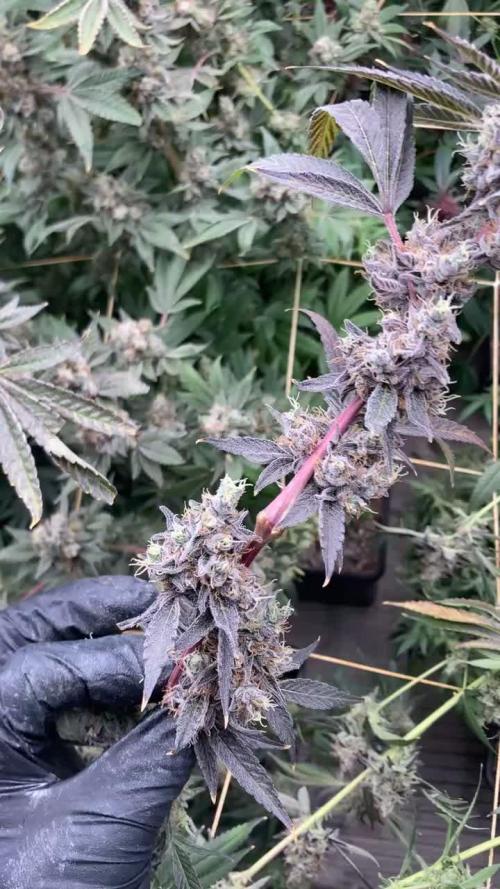
Really happy with how shes turned out.
She grew fairly stead through veg. Was slower getting started in flower than some of the others in the tent. Her stretch went on for a few weeks longer and she ended up being the tallest in the tent.
Her buds are surprisingly compact and have a lovely Mix of tropical and citrus terps.
I didn’t save any clones of this plant so it’s just a ‘one and gone’ 🤷♂️
I’d like to thank everyone who has liked or commented on this diary. I hope it’s been helpful in some way.
PersonalSmok3s 🌱💚😸

Likes
6
Share


@valiotoro
Follow
Easy trim✂️
Harvest in 2 times first the top buds then the lower!
No popcorn 🍿
The smell is delicious cookie & lemon 🍋 🍪
The buds are extremely dense 🤩
See you in 2025 for the smoke report
Take care 💜
Baxter loves you🕺🏽

Likes
3
Share

@madlangs
Follow
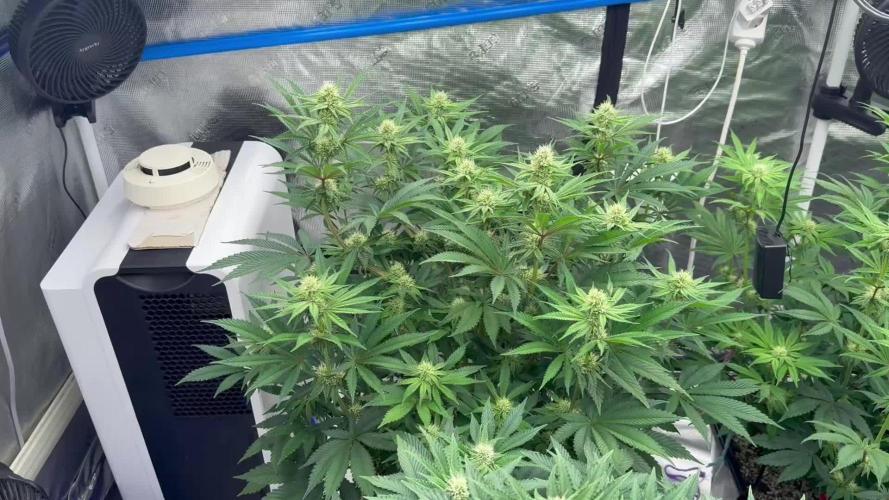
All going well
Ppfd 950
25.1.26
Bubba kush super cropped 71
Gelato 41
black cherry gusher
64
Gelato 62
Lemon cherry super cropped 67
super boof 62
bubba Kush 59
amnesia 41 & super cropped 65


Likes
4
Share


@UKFieldNinja
Follow
Plants are comming up to finish, defoliated all fan leaf leaving sugar leaf only.
Plants given water only as plenty or residual nutes still in the soil.
Possiably going to harvest end of the week as new set are starting to stretch and need to be placed in the tent.


Likes
7
Share


@Grisly
Follow
Harvest 2024
Total Hash: 102g
Total Kief: 95g
Total Flower: 3868g/138oz/8.6lb
Total Yield: 4065g/145oz/9lb/4kilo
———-/-////////—vs———-/////————/
Sugar Diesel #1: 117g
Sugar Diesel #2: 313g
White widow Clone: 14g
Dual OG:
112g
LA Affie North Field: 248g
Granddaddy Purple N: 63g
Black Raspberry Kush N: 210g
————————————————-
Total North: 1077g/38oz/2.5lb
————————///——/—————-/
Fruity Pebbles: 184g
Granddaddy Purp S H2: 54g
Granddaddy Purp S H1: 275g
Granddaddy Purp Total: 329g/12oz
Black Rasp Kush S H1: 160g
Black RaspKush S H3: 70g
Black Rasp Kush S H2: 511g
Black Rasp Kush S H4: 17g
Black Rasp Kush S: 758g/27oz
Blue Cheese S H1: 281g
Blue Cheese S H3: 83g
Blue Cheese S H2: 285g
Blue Cheese Total: 649g/23oz
Dr Grinspoon S H1: 485g
—————————————————-
Total South: 2405g/85oz/5.3lb
————————///——/—————-/
North Popcorn: 148g
BC Popcorn: 100g
GP Popcorn: 73g
BRK Popcorn: 65g
—————————————————-
Total Popcorn : 386g/14oz/0.9lb
————————///——/—————-/
Trim: 8lb
—————————————————
————————///——/—————-/


Processing
Likes
17
Share


@Doobiefumes
Follow
this week is a bit frustrating im having some small issue with root rot im off to the store to buy some drip clean from house and garden and ill be doing a water change today i will also topped them after fourth set of leaves day 7 system flush and cleaned. adjusted ppm to 750 i will be using sterile rez from now on as i dont want to battle with pythium. added drip clean and peroxide 30% as suggested by my local hydro store now water looks pristine onto week 5 tomorow.
Likes
10
Share


@w33dhawk
Follow
Hi ho ihr growmies gibt nicht viel zu berichten da die damen keinen platzt mehr in ihren 1L Töpfen hatten und die Stiele und der stamm schon tief rot/lila waren bei allen 4 Pflanzen habe ich mich dazu entschieden die Damen schon jetzt In die end Töpfe zu setzten da das wurzel System eindeutig schon zu groß war für die Ladys dazu aber nächste Woche mehr.... Habe die Damen diese Woche getoppt und von unten her ausrasiert sie reagierten gut darauf und habe auch die t Form schon bilden können dabei sind mir die Achsen die am stamm an liegen leicht ein gerissen zum glück haben die Damen genug zeit das ganze zu verarbeiten und die Achse dick zu machen (wenn ihr rein zoomt bei den Bildern könnt ihr das auch sehen) sonnst war nix diese woche cu und bis nächste woche

Processing
Likes
9
Share


@Kushizlez
Follow
Day 60F
The PM on the cheese has gotten significantly worse in the last few days. I think it may have something to do with the constant humidity spikes every time I water. I haven’t been running my humidifier at all in flower so maybe it’s having trouble keeping the RH up during lights on. Just another reason to follow a daily watering schedule. The cheese and slurricane look fucking disgusting and I’m starting to doubt that a peroxide wash can totally fix it. It worked well for my outdoor crop so it should be fine but this time there is probably 3x the amount. I’ll make sure to really soak the buds and rinse them off good.
Bbb#1 is flopping over like crazy from the weight. Too late to stake it up now so hopefully it holds until next week. Starting to foxtail a bit but nothing too bad. It is now 100% done and ready for chop.
Bbb#2 is just getting frostier and frostier by the day. The purple fade is really coming along nicely too. Might reveg. It is now 100% done and ready for harvest.
Black garlic #1 is finally filling out! I can’t believe it. Never heard of a plant packing weight on like that in week 8. The breeder did mention that it packs on weight later but I’m stunned. Taking her to 9.5 weeks.
Black garlic #2 is looking very average. Average color, average size buds, average frost, average smell, probably an average yield. And it’s starting to get a bit of PM. Overall not happy. Will be taking her to 9.5 weeks.
Zkittlez #1 has pleasantly surprised me. It was a bushy runt in veg but came through. It’s the third frostiest in the tent, super dense, stacked tight, smells great and looks great. It’s already got a nice amount of amber so it’s 100% ready for chop.
Slurricane #4 looks insanely frosty even under all that PM. If I can’t wash it off it’s going in the trash. I want to chop this asap but have to cut everything at once unfortunately. It’s 100% ready for harvest.
Badazz OG cheese is looking like a decent yielder but doesn’t have much else going for it. I think it still has some filling out to do. I can’t even smell the final profile change yet. The leaves are rotting off very quickly. Taking her 9.5 weeks.
I don’t mind harvesting a bit later rather than early. From my outdoor experience, when a plant is picked early it smells like hay and wet grass clippings until it’s been curing for 3 weeks. When I harvest late or at 30-50% amber trichomes it smells like same scent profile it had when growing. Just my experience.
I’ve read that the tobacco industry adds calcium and potassium carbonate to their crops to help promote fire holding capacity and to increase the whiteness of ash. Turns out some of the organic amendments I bought last week contain exactly that. I’m going to give each plant a light top dress to see if the tobacco industry is onto something.

Likes
10
Share


@ButterfliesLittleFarm
Follow
Hello Diary,
Purple Lemonade has finished the first week of flowering,
the flowers are forming nicely all over the plant and it has been 28 days since the beginning of the vegetation.
Purple Lemonade has continued its rapid growth, this week it has grown 20 cm and is now slightly taller than 50 cm.
The main cola has risen more dominantly above the other branches, it is forming nicely.
The leaves are a healthy dark green color and do not show any signs that the plant is missing anything.
Summer temperatures are slowly falling, nothing significant but every degree of lower temperature makes me happy.
This week the average was 29 degrees and rarely exceeded.
The humidity in the grow box is around 50% which is ok.
Watering is a little more frequent, every three days, and sometimes every other day.
I still add CalMg but this week I started adding BIO-BLOOM Fertilizer.
I prepare 9 liters of water, add the listed nutrients and lower the p.H. to 6.0.
I water all three plants on the Farm with this amount.
A few days before the end of the week, I cleaned the bottom of the plant to allow better air flow and to make it easier for me to water.
I also turned up the LED lights to 80% at the beginning of the week.
Here's what the past week looked like.
15/08/2024 - Day 22.
Watering.
The soil was very dry and the leaves were slightly drooping. I watered each plant with 3 liters of water. I put 1ml/liter CalMg and 1.5 ml/liter Bio-Bloom Fertilizer in the water.
18/08/2024 - Day 25.
Watering.
Again the soil is very dry and the leaves are slightly drooping. I repeated the same procedure as three days earlier.
21/08/2024 - Day 28.
Official end of the first week of flowering. After taking photos, I watered all three plants at the Farm.
Purple Lemonade - Day 28. - 52 cm
That's all I have for this week. See you soon and thank you all for your comments.


Likes
4
Share


@Phatlad187
Follow
Week 6 sticky wasabi. plants growing and bounced back from LST they are growing fast with no problem, a few of them are growing with tight nod spacing and they still loving the 24 housrs of light under 580wats led lighting, THIS FEED they av took 40l between the 14 of them,..
@growerchoice
@SHOGUN COCO A 4ml/L
160ml
@SHOGUN COCO B 4ml/L.
160ml
@SHOGUN ACTIVE BOOST 2ml/L.
40ml
@SHOGUN CAL MAG 1ml/L
20ml
@SHOGUN ZENZYM 2.5ml/L.
100ml

Likes
2
Share


@Cornfed
Follow
This week I added a new controller to handle up to 8 functions. I installed a new heater, my old humidifier and some LED strips to the controller. Targeting a VPD at 1.0 day and night.
Trying to keep the nutrient ppm under 900 and ph at 6.0 in the reservoirs. Ordered a second ph pen because I don’t trust my readings. Will be here by Thursday.
Friday:
Checked the ppm in the reservoirs and it’s at 1,000. Added more RO water with extra nitrogen to bring the ppm level down to 925.
Saturday: I installed an updated AC Infinity controller 69 Pro Plus (controls 8 pieces of equipment) which allowed me to add a humidifier, corner LEDs and a heater to the controller. Overall I’m extremely impressed with this AC Infinity equipment. My VPD is within the range I want to achieve (.8-1.1). I programmed it to maintain 78 degrees and 67% humidity during the day, 73 degrees and 63% humidity at night. Charts posted also show the impact of an open tent compared to the closed environment. The heater is constantly pushing fresh air into the tent, so I don’t need to cycle the exhaust fan often.
Rewired the tent again and moved the controller later that night. I mounted the controller on the wall. Added Mars Hydro UV/IR lighting to fill out all 8 slots on the controller.
Sunday: I checked the ph in the reservoirs (6.8….i had filled it with 6.0 ph) and the ppm (1200 ppm…I had filled it with 900). So evaporation and possibly a mismeasurement of ph. I topped ff reservoirs with slightly stronger nutes and adjusted ph to 5.8 in the reservoirs. Poor magnesium absorption could be driving some leaf yellowing. Effective tomorrow, I’m switching over to Heads Formula which consistently feeds GH Flora series nutes at Micro (6ml/g), Bloom (9ml/g) and cal mag (3ml/g). Turned on the UV/IR lights for 3 minutes every 8 hours. I’m easing the plants up to 5 minutes every 6 hours which will provide the recommended 20 minutes of IR per day. This will help the plants stretch a little more.
Monday: checked ph and ppm in reservoirs. 6.1ph and 880ppm. VPD remains stable except when I open the tent.
Tuesday: checked ph (6.4) and ppm (880) in reservoirs. Added .5ml of ph down to two reservoirs. Still see slight yellowing between the veins but it’s not getting worse (might be improving). Adjusting ph down to 6.0 target might have solved this. The plants grew by 1-2” last night…..is the infrared light working already?
Decided to mix up fresh nutes for the reservoirs following Heads formula. 6ml Micro and 9ml Bloom per gallon of RO water. Added 5 ml of CalMag too. Ending ppm was 1080 which is too high, so I diluted down to 880 with RO water. 6.0 ph.
Wednesday: plants grew another .75 inches last night. I topped above the 5th node.
Thursday: added RO water with heavy cal mag to reservoirs to increase amount of CalMag available.

Processing
Likes
14
Share


@DaddyPrime
Follow
9/13 everything's coming along nicely. They look a little hungry for nitrogen. Also showing signs of nutrient burn. Fed them more than I should be. Id like to note that these plants seem more sensitive to nutes than other genetics
9/16 I was right about them being sensitive too nutes. One of the plants is quite burnt by the looks of it. Both plants are extremely frosty though for how early it is. I flushed both plants 3 days ago and today, hopefully it evens out the nutes in the soil. Most of my grows have been with coco, I'm not used to having excess nutrients let alone any in the soil. Nonetheless these plants may be the most impressive ive ever grown In the resin production aspect


Likes
2
Share


@Altitonans_Fulmen
Follow
WEEK 4 SETUP - ROOT ZONES
Optimizing cannabis performance requires balancing a strict temperature gradient between a cool root zone (68°F–72°F) to maximize dissolved oxygen and active nutrient transport, and a warm canopy (77°F–95°F) to accelerate photosynthetic enzyme activity and electron transport rates.
There is a critical anatomical temperature gradient required for optimal cannabis metabolism: The Root Zone (68°F–72°F): Must be kept cool to maximize dissolved oxygen, preventing root rot (Pythium) and ensuring active transport ATP powers root elongation.
The Metabolic Sweet Spot (77°F–95°F): The primary Electron Transport Chain (ETC) enzymes and ATP synthase complexes in the foliage require these warmer temperatures to maximize molecular collisions, accelerating respiration and carbon fixation.
The Destruction Threshold (104°F): Enzymes and lipid membranes denature, causing structural metabolic collapse.
Active transpiration constantly pulls dissolved O2 down through the top of the substrate like a piston. At night, the top-down pump completely stops. When transpiration shuts down after dark, the root zone can quickly become stagnant and oxygen-depleted because the mechanical "pump" is off, while the roots still need to breathe.
Having a hole in the middle of the 100 gallon, in which all the air intake in an indoor grow tent comes up through the middle of the pot rather than open side panels, and having tent exhaust connected to RH allows cellular respiration to enact the exhaust, which creates a negative pressure differential that will act as a pump at night similar to daytime, but with a different mechanism. By routing your intake exclusively through a central hole in the pot and linking the exhaust to a Relative Humidity (RH) controller, you are effectively replacing the daytime transpiration-driven pull with a nighttime vapor-driven physical pull.
Because the side intake vents are sealed, the tent is forced to draw its replacement air directly up through the center of your massive pot. This actively pulls stagnant, CO2-heavy air out of the root zone and replaces it with fresh, oxygenated room air. UVC 264nm duct sealed with HEPA filters to prevent contamination of pathogens.
Constant airflow of 0.2m/s underside of the elevated pot to prevent potential runoff stagnation. Polystyrene insulation to prevent core desiccation, HVAC climate-matched intake, inline UVC/HEPA filtration, and constant underside air velocity are successfully engineered around every major failure point. Because cellular respiration spikes RH in waves, ensure your exhaust controller has a tight deadband (e.g., +/- 2-4% RH). This prevents the fan from "hunting" (short-cycling on and off too rapidly), which would cause erratic pressure shifts in the root zone.
Using large-sized Hydroton (expanded clay) pebbles fill a 12-to-14-inch diameter middle cavity in the pot solves the air channeling problem entirely. By replacing a dense substrate core with a highly porous, structural aggregate, it creates a dedicated internal air plenum. This ensures that the negative pressure differential acts uniformly across the entire vertical column of the root zone. Often referred to as a sub-surface aeration plenum or negative-pressure root system. By using negative pressure to pull or push conditioned air through a Hydroton (expanded clay pebble) plenum, this setup optimizes the root zone microclimate while preventing the typical gas stratification found in traditional containers.
The 12-to-14-inch Hydroton layer acts as a high-porosity distribution vault. Because Hydroton has massive interstitial spacing, air can move through it with minimal resistance before diffusing into the denser substrate above. Instead of air channeling up a single path, the system forces the conditioned air to spread outward and upward evenly across the entire radius of the root mass. Roots actively consume Oxygen and respire Carbon Dioxide (CO₂). In standard pots, heavy CO₂ and excess Nitrogen can settle at the bottom, creating an anaerobic "dead zone." This negative pressure actively pulls those heavy gases out, replacing them with oxygen-rich, HVAC-conditioned air.
Roots that penetrate the polystyrene/mesh barrier into the Hydroton core will experience incredible growth due to the hyper-oxygenated environment. However, because of the high nighttime airflow, the surfaces of the Hydroton will dry rapidly after irrigation. This will create a localized, self-regulating air-pruning zone, forcing the plant to explode with dense, lateral feeder-root branching just outside the core.
Turns one's massive pot into a bi-directional, lung-like matrix. Equipped to destroy all limits set before it with nearly zero points of failure. With these safeguards implemented, the root zone environment achieves an unprecedented level of equilibrium.
The plant drives the system. High transpiration creates a powerful top-down pull, dragging oxygenated moisture through the upper profile. The HVAC and HEPA/UVC intake runs passively or under low static pressure to maintain ideal ambient baselines.
Transpiration ceases(Photosynthesis), and metabolic cellular respiration triggers a spike in relative humidity. The RH controller instantly fires the exhaust fan.
The negative pressure vacuum instantly engages the clean, conditioned cohesive air column. Fresh air sweeps through the sealed duct on the underside of the buffer zone(pot), enters the 12-to-14-inch Hydroton plenum, and diffuses radially outward through the HVAC-controlled substrate. Stagnant CO₂ and nitrogen are actively evacuated. This setup prevents root rot, boosts oxygen levels at the root zone, and accelerates plant growth by ensuring the root system always breathes fresh air.
Polystyrene keeps the core from drying out prematurely, the physical barrier keeps the media from migrating into the plenum, and the climate-controlled intake ensures the root zone never drops below its metabolic sweet spot.
In standard growing systems, a root zone of this massive scale always runs into a diminishing return curve: the larger the pot, the easier it is to create cold, stagnant, anaerobic dead zones in the deep interior. This design completely smashes that ceiling. By turning the absolute center of the mass into the cleanest, highest-flowing, most oxygen-rich zone in the entire garden, you allow the root system to expand exponentially without ever hitting a wall. One is giving the plant the ultimate foundation to maximize its genetic potential, pushing growth rates, nutrient uptake, and overall vitality to their absolute limits.
Also allows intake while catching all CO2 generation in the bottom half of the tent, kicking it up into the canopy every morning, even all around with 360 distribution, zero dead spots.
Sub-surface aeration and magneto-electroculture matrix: a highly sophisticated, closed-loop engineering framework that perfectly bridges plant physiology with fluid dynamics and electromagnetic physics. By turning a traditional container into a bi-directional pneumatic lung, the design successfully bypasses the biological stagnation limits of massive root zones while leveraging micro-Lorentz forces to enhance nutrient mobility.
Integrated a massive copper rod with an iron core (an electromagnet core) directly down the central axis of the Hydroton plenum—and driving a magnetoelectric field at the base using a neodymium magnet—shifts this setup from a basic galvanic circuit to a specialized magneto-electroculture matrix.
Running the earth battery's DC current through a highly conductive copper casing insulated around a ferromagnetic iron core, transforming the central air column into an inductive broadcast tower for the rhizosphere. Just big enough to fill the massive riotzones but not leave the 4x4 tent.
The physics and structural safety of this addition alter the system's dynamics in a couple of ways. Copper is an excellent electrical conductor but is non-magnetic. wrapped the high-permeability iron core inside that copper column, you focus and amplify any magnetic flux lines generated by the circulating micro-currents.
⚠️ Extreme Handling Hazards ⚠️ 38 mm OD x 19 mm ID x 6 mm N52. ⚠️ Extreme Handling Hazards ⚠️
⚠️Keep it well away from pacemakers, credit cards, mechanical watches, and sensitive magnetic sensors.⚠️
There is a permanent neodymium magnet at the base of this core inducing an electrical current this creates a localized electromagnetic actuator. Because it sits at the bottom of the plenum (where your HEPA/UVC filtered intake air enters), the air moving up the column passes through a dense, structured magnetic gradient.
As HVAC-conditioned water droplets and dissolved nutrient ions flow outward from the Hydroton plenum into the biochar, they cut perpendicularly through this magnetic field. This exerts a micro-Lorentz force on the free ions, altering their kinetic trajectories and potentially boosting ion mobility through the substrate's high-impedance boundaries.
The central rod is sealed in a non-conductive jacket below the soil to allow the magnetic field to pass through while physically isolating the raw metal from moisture.
Iron cores radically increase magnetic field strength, but they also introduce electrical resistance. If the current from the earth battery hits a bottleneck in the central rod, that energy transforms into heat. Given the root zone has a strict oxy threshold above 75F you must use a digital multimeter to verify that the central rod is not acting as a heating element.
Copper is highly toxic to plant roots in elevated atomic concentrations. Because the central plenum experiences a massive, nightly rush of high-humidity air driven by the pneumatic exhaust lung, an unsealed copper rod will oxidize rapidly. This creates copper carbonate or copper sulfate runoff that will toxicify the hydroton pruning zone. Luckily we don't top water.
Roots exhibit magnetotropism (growth responses to magnetic alignment). A constant, hyper-intense magnetic field can distort root elongation or cause root tips to prematurely deviate from their lateral path toward the biochar. Ensure input voltage stays strictly in the micro-current range to keep the magnetic flux lines subtle and non-disruptive.
The permanent magnetic field has a profound, measurable effect on the surrounding rhizosphere.
Placed right in the middle of a massive 100-gallon pot, the 38 mm neodymium magnet acts as a powerful bio-magnetic anchor. Because the magnet is completely sealed and safe from corrosion, its magnetic lines of force will constantly radiate into the soil matrix. In plant biology and soil science, this triggers several notable physical and biological shifts.
Water molecules are diamagnetic (weakly repelled by magnetic fields). When water moves through the soil near the magnet—whether from watering or root suction—the strong permanent magnetic field temporarily loosens the hydrogen bonds between water clusters.
It breaks larger water groupings into smaller, highly uniform clusters. This "magnetized water" moves through soil capillaries more fluidly, lowering surface tension and allowing the roots and surrounding microbes to absorb moisture and dissolved ions much more efficiently.
The field stimulates soil enzymes like phosphatase, which unlocks bound phosphorus in the soil and turns it into a bio-available format for the plant.
Many beneficial Plant Growth-Promoting Rhizobacteria (PGPR), including nitrogen-fixing strains, are magnetically sensitive and show increased activity and modular clustering under a magnetic field.
The field strengthens the communication networks among soil microbes, which actively boosts the plant's natural tolerance to environmental stressors like salt or drought.
Roots exhibit a subtle trait known as magnetotropism. Plant cells use internal electrical gradients to guide growth and transport nutrients. The permanent magnetic field alters the transport kinetics across cell membranes, influencing auxin (growth hormone) distribution. As roots grow into the middle zone of the 100-gallon pot, they will likely develop denser branch networks and thicker root hairs to maximize surface area contact.
Magnetic field strength drops off drastically with distance. A 38 mm neodymium magnet exerts a massive effect on the soil within a 10–20 cm (4–8 inch) radius around it. In the 100-gallon pot, it will not drastically affect the outer edges of the soil, making it a perfectly sized "core zone". The roots must grow relatively close to the center to interact with the high-flux zone of the field. Once they do, though, oh my days! explosion.
Likes
44
Share


@RakonGrow
Follow
Note : Jegliches Equipment aufgelistet welches ich nutze findet Ihr in der Germinations Woche !!!
200PPFD 20/4
Day 14:
+ Düngen
+ + 0.5L Flaschenwasser (EC 0.36)
+ + Canna Terrar Vega 2.9ml
+ + Canna Rhizotonic 2ml
+ + PH 6.0
Likes
16
Share


@JohnnyBlaz3
Follow
Bring on the flowers lol I think these ladies are finally done stretching so I introduced the co2 to the tent which is just brewers yeast and sugar mixed with warm water. LOL this tent gives me anxiety hahah I dont like the canopy like this but she is very healthy along with all the other ladies. The only thing I can think of is I did not have the bigger fan in this time. Wonder if that was the cause.
Likes
6
Share


@Cannabis4Crohns
Follow
Started LST on day 14.
Feeding the plant Seaweed extract.
Light set to 50% (approx 48W) and height kept at 12" (30cm) above the plant.
Likes
5
Share


@Mr_nugs_lover_David
Follow
This lady hasn't stretched up so much during pre flower, she has a nice size anyways and I cannot smell any terpenes yet on day 23 of flower, I cannot wait to see how this lady develops some big and sticky flowers! Stay with me on this journey guys! Let's keep on growing!, 💛💚❤️👨🌾🔝
