


Likes
Comments
Share

@4hundert20
Follow
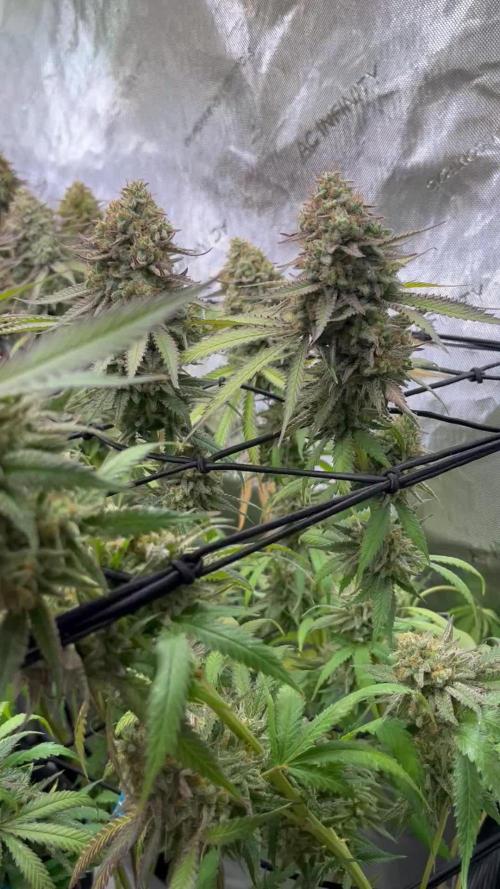
Morgen wird abgeerntet..
Die Pflanzen haben ihr meistes Chlorophyll bereits abgebaut, Trichome milchig + bernsteinfarbend.
Das zusätzliche Netz musste ich spannen, um die Blüten etwas zu stabilisieren.
Denn einige biegen sich unter ihrem eigenen Gewicht.. was an sich ja nicht schlecht ist 😆

Likes
4
Share


@Tomdm123
Follow
The nematodes worked great against the fungus gnats and i almost completely got rid of them. Starting to feed her this week. Also started with low stress training this week.
Likes
58
Share


@GreenHouseLab
Follow
Results are starting to come in now, going to be Cake all the way to the end. Time to grab your popcorn and stay tuned in 🤡🎪
Short Phenos is Pure Michigan lean, obvious now with the purple starting to form from bud sites. Tall girl is Sugar Cane Pheno what a stake, huh!?
GHL out 🚀
Likes
13
Share


@Yiyis_Grow
Follow
Bestva Quantum Board 2000 W & MrHide Seeds
Semana sin problemas. Se aplicó a modo preventivo tierra diatomea disuelta en agua y pulverizada foliar.
También se utilizó hongo Clonostachys, trichoderma, levaduras lácticas y transformadoras de celulosa, y Streptomyces; todos para evitar enfermedades bacterianas y hongos.
Se están regando con agua llovida, regulada a un ph de 6.3 - 6.5.
Se empezó a utilizar fertilizante de flora a razón de 4ml por litro de agua.
Se ha defoliado 2 veces (1 en vegetación y otra apenas empezó a florar). Las hojas se están recolectando para hacer aceite full espectro medicinal sin THC.
Suerte y buenos humos

Likes
17
Share


@Totogrowuk
Follow
So now they have both been chopped down and are hanging to dry. I was slightly unhappy with the density of Cali Snow and wonder if I should of let her go another couple of weeks. Or maybe she didn’t have enough room. Grapefruit however has some of the biggest buds I’ve grown. So it’s all good. Just got to get them dry and manicured now.

Likes
2
Share


@Ultraviolet_
Follow
Electrical Conductivity refers to how easily a material or solution allows electrons or ions to flow continuously when an electrical potential is applied.
Electrochemical Reactance is the opposition to alternating current (AC) caused specifically by the temporary storage of energy in electric or magnetic fields, rather than energy being lost as heat. Reactance does not directly alter a material's intrinsic electrical conductivity. Instead, it dictates how the system stores and releases energy over time, which creates a temporary barrier to current flow in AC circuits. Together with resistance, reactance makes up total impedance. Electrical impedance (the combination of resistance and reactance) in the rhizosphere dictates how easily ions and water move into plant roots, directly impacting the Electron Transport Rate (ETR). High impedance restricts ion mobility, leading to nutrient deficiencies that decrease ETR and stunt overall plant growth.
Using copper and zinc plates in the plant medium to form a natural earth battery to assist with Electrochemical Reactance. The moist soil acts as an electrolyte, while zinc serves as the anode and copper as the cathode. Zinc is a highly reactive metal and oxidizes, losing electrons into the soil. These electrons travel through an external wire to the copper plate. The moisture and dissolved salts in your plant medium allow charged ions to move freely between the plates, completing the circuit and generating a small direct current (usually between 0.8 and 1.1 volts). This micro-current subtly alters/the Electrical Conductivity (EC), allowing more effective breaking apart of chemical bonds in the soil (electrolysis), making soil nutrients like phosphorus, calcium, and potassium more accessible to roots. Buried the zinc plate on one side of the plant’s root zone and the copper plate on the opposite side. Ran an insulated copper wire above ground to connect the zinc plate to the copper plate, creating a closed loop. Make sure your soil remains moist and contains natural mineral salts; entirely distilled water or bone-dry medium will prevent ion exchange and block the current.
Not all minds think the same; it's a hard concept to grasp for one who has only ego. When someone operates solely from the ego, they tend to view their own perspective as the objective truth. To them, if someone else thinks differently, it is seen as a flaw, a lack of intelligence, or a personal affront, rather than simply a different, valid experience. The ego assumes that others are just extensions of itself. It cannot easily differentiate between "I think this" and "This is the universal truth". This is called the Mirror Fallacy. True understanding of another mind requires stepping out of oneself. The ego, by definition, is obsessed with self-preservation and being "right," which blocks empathy. Different perspectives are interpreted as attacks on the ego's stability. Instead of curiosity, it feels defensive. Acknowledging that others have entirely different internal worlds—with unique motivations, fears, and histories—requires dismantling the illusion that the world revolves around one’s own viewpoint. It’s a shift from "Why are they wrong?" to "How did they get to that perspective?"
Gospel of Thomas #17 "I shall give you what no eye has seen, what no ear has heard, and no hand has touched, and what has not come into the human heart." precedes saying #18, which questions the "beginning" and "end".
First, you need The Eyes to See, The Ears to Hear & The Mind of the Heart.
"Alpha to omega" refers to the first (Α/α) and last (Ω/ω) letters of the Greek alphabet, symbolizing "the beginning and the end". It represents totality, eternity, or the entirety of something.
Revelation 22:13, "I am the Alpha and the Omega, the First and the Last, the Beginning and the End" (NKJV, NIV).
Both originate from Greek. Alpha (Α/α) is the first letter of the Greek alphabet (representing the beginning). Atom comes from atomos, meaning "indivisible," often seen as the foundational "first" particle of matter. In some esoteric and linguistic theories, the biblical name "Adam" (Hebrew for man/earth) is connected to "atom" because both represent the original, foundational unit (the first man vs. the first particle). Alpha Particles are particles emitted during radioactive decay, named "alpha" because they were the first type of nuclear radiation discovered. They are atomic nuclei consisting of two protons and two neutrons.
The study of the atom often deals with the "beginning" (alpha) of chemical reactions and fundamental building blocks. The terms are linked primarily as symbols for "the beginning" (Alpha), the "fundamental unit" (Atom), and the "original man" (Adam).
The uppercase symbol Omega (Ω/ω) is primarily used in electronics and physics to measure electrical resistance in ohms, representing how materials resist electron flow. It is also used in various fields to represent the density parameter in cosmology, solid angles in physics, and special constants or asymptotic growth rates in mathematics.
In quantum mechanics, "Omega" (Ω/ω) can refer to several concepts related to measuring or representing quantum coherence, generally categorized into dynamical, mathematical, or physical parameters:
Dynamical Coherence Measures
Omega Pattern (Superconducting Circuits)
Coupling Strength
Angular Frequency
Quantum Coherence Framework v24.0
Electron flow is not the same as electrical conductivity, but they are intimately related. Electron flow is the physical motion of electrons, while electrical conductivity is the material property that determines how easily that flow can happen.
Electron Flow (The "What"): The physical movement of negatively charged electrons through a conductor (usually from negative to positive). It is the act of carrying a charge.
Electrical Conductivity (The "How Well"): An intrinsic material property that measures how easily a material allows electrons (or other charge carriers) to move through it.
Electron Flow (The Action): The actual physical movement of electrons from one molecule (donor) to another (acceptor) in a pathway, such as the photosynthetic electron transport chain or cellular respiration. The current itself (dynamic electricity).
Electrical Conductivity (The Property): An intrinsic property of a material (like copper,glass,soil) that measures how easily it allows electric current (electron flow) to pass through it. A measure of ease. A high-conductivity material has low resistance and lets electrons move freely.
Electron transport rate (ETR), the rate at which electrons travel through the chain.
You can have Electron Flow occurring (electrons moving through the chain), but a very low Electron Transport Rate if the plant is in the shade. If light increases, the Electron Flow still follows the same path, but the Electron Transport Rate increases because more electrons are moving per second. In summary, ETR is a quantitative measure of electron flow. Think of "Electron Flow" as the movement itself, and "Electron Transport Rate" as the speed or quantity of that movement.
Photosystem II (PSII) is a critical multi-subunit protein complex in thylakoid membranes that initiates photosynthetic light reactions by splitting water and transferring electrons.
"Et lux in tenebris lucet, et tenebrae eam non comprehenderunt," John 1:5

Likes
2
Share

@Aslanko
Follow
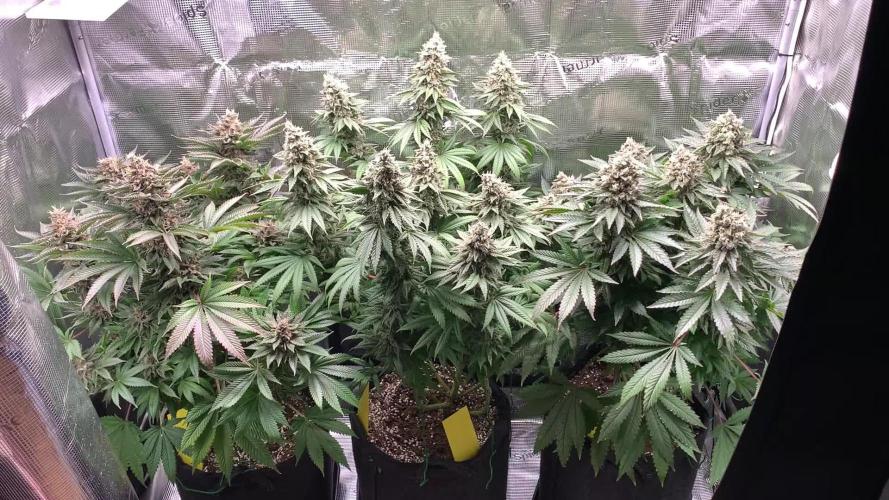
Day 58 Flower 🌿🔥
We’re getting close to the finish line and the buds are looking better every day. They are still putting on a bit more weight, getting denser, and resin production is now really noticeable.
A large portion of the pistils are already turning orange, especially on the left plant, which seems to be the fastest finisher. The smell is currently sweet and fruity, but with some interesting cheesy notes — kind of like parmesan cheese with grape wine 😁
The last feeding with nutrients has been done and from now on it’s only plain water until harvest. Right now the main goal is just keeping the environment stable and letting the plants finish naturally.
Environment:
* 25–27 °C day / ~20 °C night
* 45–55 % RH
Really looking forward to harvest ✂️🌱
_
58. den květu 🌿🔥
Blížíme se do finiše a květy vypadají každý den lépe. Palice ještě lehce nabírají na objemu, tvrdnou a produkce pryskyřice je už opravdu výrazná.
Velká část pestíků už začíná být zrzavá, hlavně na rostlině vlevo, která dozrává nejrychleji. Vůně je momentálně krásně sladká a ovocná, ale zároveň má zvláštní „cheesy“ tóny – trochu jako kombinace parmazánu a hroznového vína 😁
Proběhla poslední zálivka s hnojivy a teď už pojedu jen čistou vodu až do sklizně. Snažím se hlavně udržovat stabilní prostředí a nechat rostliny v klidu dojet do finiše.
Prostředí:
* 25–27 °C den / ~20 °C noc
* 45–55 % RH
Těším se na harvest ✂️🌱
Likes
Comments
Share

@Budhunter
Follow
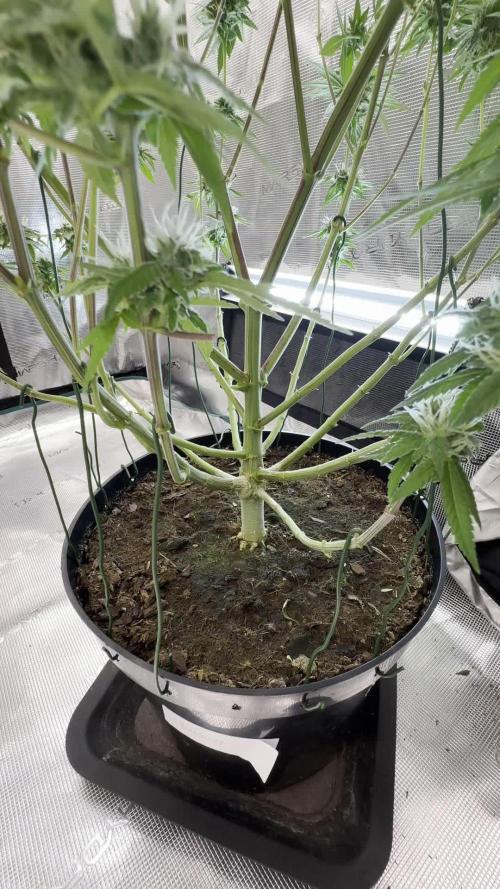
Week 6 Day 42 of flower Day 98 of life
Jealousy is going great, at least in appearance. Plants completed 6 weeks so I made one more defoliation for the last few weeks. It’s smelling nicely and buds are fattening up. Hopefully they will get more and more trichomes and smell even better. By her looking I believe she will have at least 3 weeks. Let’s go

Likes
76
Share


@Theia
Follow
She will be getting chopped now. She's cloudy with a nice sprinkle of amber's showing.
So much crystal 😍
Thanks for all who followed I shall post some updates with a wet weight once I get around to chopping her she's sitting in the dark for the last 24hrs .
Happy grows 🌿🌱
Stay safe😷😷


Likes
3
Share


@Organic473
Follow
I’m so loving this girl… this was my last seed of the pack and she made me proud. No complaints thus far, I am just getting ready to flower.

Likes
13
Share


@Prozak
Follow
Hi people!
I want to say thank´s to Royal Queen Seeds.... It is a sponsored diary by Royal Queen Seeds. Thanks for all the seeds and package. ;)
Please guys go and check them out https://www.royalqueenseeds.pt and get some nice strain ;)
@royalqueenseeds
Thanks!
Regards.
Istart this grow with 4 amazing Triple G femenized seeds
24 horas num copo de agua e depois passei para o starter kit da RQS.
3 dias e estavam de fora! (:
Processing
Likes
7
Share


@Dunk_Junk
Follow
Flowering stretch almost done!!
She is a good sized plant for a tiny 1 litre airpot.


Likes
Comments
Share

@ellioschka
Follow
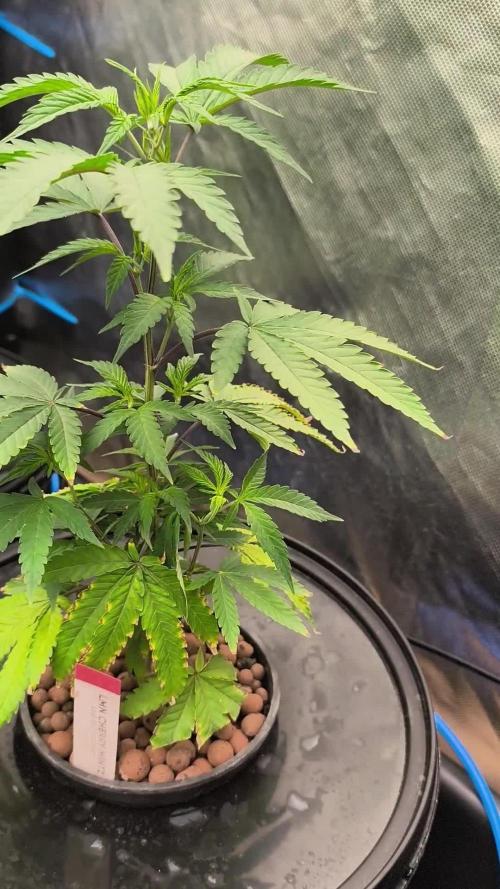
Die Lemon Cherry Mintz Ladies erholen sich langsam von ihrem Stress (Schande über mein Haupt). 😐
Erst einen Tag in den großen Aeroponik-Töpfen und sie fühlen sich schon sichtlich wohler. Die Wurzeln treiben sauber aus und sind strahlend weiß. Die Sprühdauer wurde um 2 Sekunden erhöht. Drainmenge und Wurzelbild werden weiter beobachtet, Intervall und Dauer entsprechend angepasst.
440nm Blaulicht (55W) läuft jetzt durchgehend mit. Bald werden die stärksten Triebe selektiert und der Haupttrieb getoppt.😷

Likes
14
Share


@VT__Homegrown_Fun
Follow
Really starting to flower everywhere. Was hoping for some more height before flowering started, but now I just need to make sure the baby girl packs on as much flower as possible! Got a new camera so the pictures should be better as well! Let me know what you think…. About the height of the plant and the new camera!!!
I think I’m going to get some really nice bud off this plant, but we will see!!! Thanks FastBuds!
Likes
8
Share


@Gonjuk
Follow
GreenHouse seeds è sempre una garanzia, super lemon haze più volte vincitrice di premi non delude mai, una pianta fantastica


Likes
2
Share


@Ultraviolet_
Follow
Remember that, however you are played, or by whom, your soul is in your keeping alone. Even though those who presume to play you be kings or men of power, when you stand before God, you cannot say, 'But I was told by others to do thus,' or that virtue was not convenient at the time. This will not suffice. Remember that.
Day:18
84°F and 65% RH (VPD) for the vegetative stage. Approximately 1.15kPa(assuming leaf temperature is about 2°F cooler than the air), which falls right into the ideal vegetative sweet spot (0.8kPa to 1.2kPa). At 1.15kPa, plants can draw water and nutrients efficiently without risking stress or wilting. It keeps the leaf pores (stomata) open, allowing for ideal carbon dioxide intake and maximizing vegetative growth. VPD is determined by the leaf's temperature, not just the ambient air. Because leaves usually run 1° to 3°F cooler than room air under bright grow lights, my actual VPD will be slightly lower, closer to the 1.0kPa mark. As she transitions from vegetative growth to flowering, one can gradually lower the humidity (to around 45–60%) and drop temperatures slightly to prevent disease from settling inside dense buds when they appear.
Night:6
At 70°F and 60% relative humidity, Vapor Pressure Deficit (VPD) is 0.86 kPa. This is right on the cusp of whats optimal for the vegetative stage. During the nighttime, plants generally close their stomata and undergo cellular respiration rather than photosynthesis. Transpiration slows to a near stop, making VPD less critical at night than during the day. However, maintaining a nighttime VPD between 0.8 and 1.0 kPa is highly beneficial in that it ensures the air is dry enough to prevent powdery mildew or bud rot, but moist enough to keep the plant from undergoing unnecessary stress. This range keeps the environment comfortable for cellular processes and prevents large atmospheric swings. Keeping it all flowing.
(Not pushing them yet, these are photoperiods)
The optimal soil (root zone) temperature for cellular root respiration and nutrient uptake in cannabis is between 68F & 72F This narrow range balances biological energy production (cellular respiration) with the dissolved oxygen levels in the soil, maximizing plant growth and health. Warmer soils hold significantly less dissolved oxygen. When soil temperature exceeds 74F oxygen depletion occurs, inhibiting cellular respiration almost entirely, At 68-72F root cells generate optimal adenosine triphosphate (ATP) via respiration to power root-tip elongation and the active transport of water and nutrients.
Too Hot (Above 78F) Root respiration increases, demanding more oxygen, while the water's oxygen-carrying capacity drops. This creates a prime environment for anaerobic pathogens and Pythium (root rot).
Too Cold (Below 60F) Root metabolism and cellular respiration slow to a crawl. This severely impairs nutrient and water absorption, leading to yellowing, wilting, and phosphorus deficiencies.
A lot depends on whether it's automatic or photoperiod; with photoperiod, there is not as much of a need to push "hard" as the real countdown only begins once the flower is initiated. Automatics, on the other hand, the chronological "clock" begins ticking the moment the seed germinates. It is of critical importance that the seedling growth gets off to the races, understanding that early growth is like compound interest, which will pay off come harvest. This reality is why getting autoflowers "off to the races" early on yields such exponential benefits. The "compound interest" is directly related to the surface area of the leaves. Larger, faster-growing seedlings process more light and build bigger root networks early on, which translates into an explosion of vertical and lateral growth during their short vegetative window.
The margins for error are so thin with autoflowers; this early-stage momentum depends on several critical practices. Seedlings exposed to increased atmospheric CO2 levels early in life will develop at an increased rate. To effectively "extend" or optimize the capacity of Photosystem II (PSII) for increased photosynthetic efficiency. In standard oxygenic photosynthesis, Photosystem II (PSII) is naturally limited to the red-light spectrum, peaking at 680nm. Extending its light-harvesting capacity past 700nm into the far-red region requires bypassing the natural limits of standard chlorophyll a. Adding 730 nm (far-red) LEDs alongside standard red/blue lights has been shown to increase canopy photosynthesis by 20–30% in several crops by acting synergistically with shorter wavelengths. However, the limitation is that excessive, pure IR/Far-red light (without accompanying red light) can trigger the "shade avoidance response," causing plants to grow tall, weak, and spindly rather than robust. Utilizing infrared light (specifically the 700-750 nm far-red range) is a viable method to boost photosynthetic efficiency. It acts as a bridge to allow PSII to utilize a broader spectrum of light, breaking the traditional 700 nm barrier. UVR8-mediated signaling (often in conjunction with CRY proteins) triggers protective mechanisms that maintain the stability of the photosynthetic apparatus (including LHCII and reaction center proteins), thus ensuring that the efficiency of Photosystem II remains higher in UV-B-exposed plants compared to plants lacking this receptor. ΦPSII indictates the rate of electron transfer from water to plastoquinone, which drives the production of ATP and NADPH. There is a close link between ΦPSII and the true rate of CO2 fixation (Φ*co2).
ETR stands for Electron Transport Rate. It measures the speed at which electrons are moved through the thylakoid membranes in a plant's chloroplasts during the light-dependent reactions of photosynthesis. Infrared light (particularly Near-Infrared or NIR) improves cellular energy by interacting directly with the electron transport chain (ETC) in mitochondria. This process boosts adenosine triphosphate production, which acts as a metabolic coefficient multiplier by accelerating enzyme activity dramatically.
Extend then multiply.
Far-Red photons interact with plant photoreceptors to accelerate the plant’s biological "clock" or trigger a shade-avoidance response. Autoflowers don't use the plant's biological clock, although the IR will initiate a shade avoidance and make them stretchy. You can just add equal measures of 660nm-680nm to negate the shade avoidance effect. Replacing nights' "darkness" with a combination of IR+ and 660nm. Because autoflowers don't require a dark period to flower, many growers just blast them with light. 18/6 24/0. However, this ignores the plant's metabolic rhythms, where daytime photosynthesis (light reactions) must be perfectly balanced with nighttime carbon fixation and assimilation (Calvin cycle) to avoid bottlenecking plant development. Cellular respiration is a 24/7 process, but it can only function while the plant has the free oxidative capacity to do so. A 100% photosynthetically active leaf cannot perform cellular respiration. The viral trend of defoliation of every leaf that isn't "getting enough light" is of great detriment overall, putting 100% of the cellular respiratory "workload" and responsibility on the 0/4/6 hours of darkness in sub-optimal conditions for enzymatic activity. Photosynthesis captures nearly 100% of the initial energy as carbon, while cellular respiration is the process that unlocks 90% of that captured energy into usable ATP so the plant can use it. Respiration is considered only roughly 30% to 40% efficient. It captures enough of the potential energy in glucose to synthesize around 30 to 38 ATP molecules per glucose molecule. The remaining 60% to 70% of the energy in the sugar is not captured in ATP; instead, it naturally escapes into the environment as heat, which helps regulate plant temperature. In plants, the primary enzymes of the Electron Transport Chain (ETC) and the ATP synthase complexes are typically adapted to function optimally in warmer temperatures (roughly 77°F to 95°F, depending on the specific plant strain). As temperatures rise within this physiological range, molecular collisions increase, speeding up respiration and ATP production. The cannabis plant has a branched respiratory pathway. During heat or cold stress, plants activate Alternative Oxidase (AOX). AOX burns sugars to dissipate energy as heat rather than coupling it to ATP production. This pathway actually functions optimally at elevated temperatures to help protect the cell from the damaging build-up of Reactive Oxygen Species (ROS) during heat stress. Enzyme activity generally scales with heat; there is a strict biological limit. If canopy temperatures in a grow room exceed 104°F, the enzymes and their supporting lipid membranes lose stability. Not saying you need to go crazy, just optimize nights the same as we optimize days.
Phosphorus is the driving force behind early seedling development. It acts as the "energy hub" of the plant, directly driving cell division, robust root growth, and the creation of DNA. Without an adequate, easily accessible supply early on, the plant's overall growth potential and final yield can suffer permanently.
Likes
3
Share


@LeosLivingSoil
Follow
Eine ein Fuß Bud an einer auto ist schon Wild, dadurch das Sie die Anfangszeit aber draußen war hat sie Blattläuse mit reingeschleppt, das war arsch. Semi Outdoor kann ich also nicht 100% weiterempfehlen :D