





@phenohunterx
Volgen
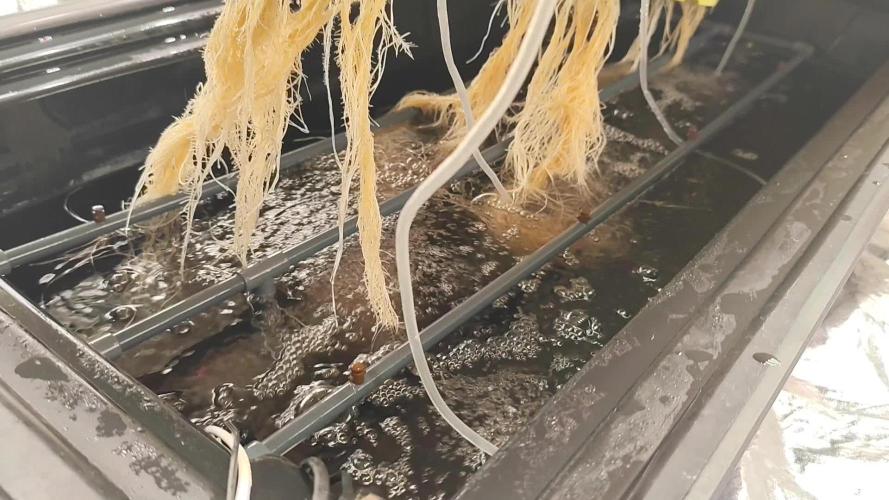
Kurzzeitig sehr hohe Wassertemperatur von 24-25grad...musste mit Kühlakkus gegensteuern um auf 22 Grad zu kommen...
Vegi Tag 18
Alles läuft zur Zufriedenheit...Düngelösung nun 50% Herstellerangabe und 400w wurden aktiviert...
Mittlerweile haben 2 Stk den Endschnitt erreicht nur die Air Lemon ist noch kleiner...Rest wird dann um Blütewoche 3 (21Bt) gelollipopt 😉
Angedacht ist den noch 2 Wochen Vegi zu geben ...
Vegi Tag 20
Alles soweit so gut...


@vicisdope
Volgen
Ms Mia Wallace went to town and blew the f up. Lots of leaf growth but no sign of bud spots- I know it’s early days tho.
Watered with half serving of bloom nutes. Not the ideal nute mix I think, but served me well last grow.
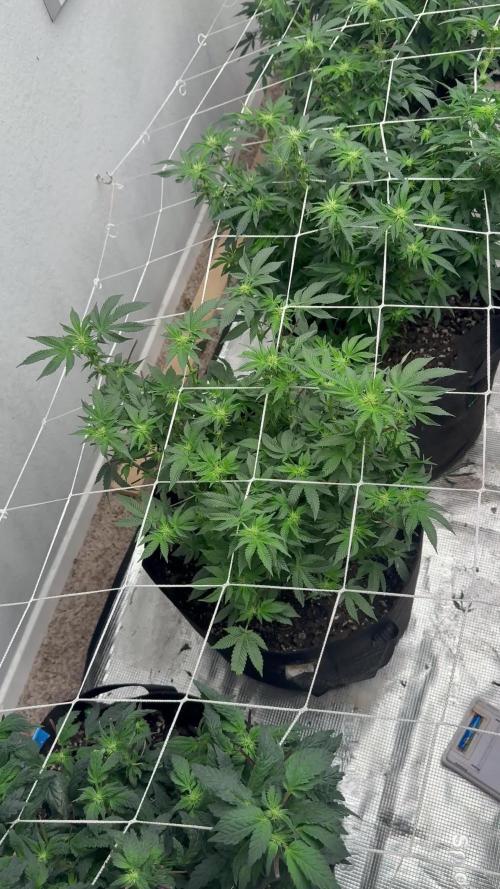
Also, as I turned up the light to max power, I noticed heat stress so i turned it down and successfully installed the worlds most eco friendly trellis - one minute- hockey net - next minute - weed trellis. It’s called upcycling boys and girls.
I know it’s shit, I’m gonna reinstall it one more 1/4 ass so it’s a full half-ass scrog.
Point is, the canopy is flat, pushed that puppy down so there’s more distance. Light back to 100%.
Humidity was a little higher under the canopy, even with the dehumidifier, so I put my inline fan back in (was just a booster in-line fan before) and the temp and humidity is dropping.
Saw a little bug. Hit the top & bottom canopy layer with light neem oil spray then incecticidle soap.
I saw a small critter so I put Diatomaceous Earth on a upside down Tupperware lid. Don’t know if that works. Last time I did a top coat of the stuff on top of the soil - something happened and bad nute burn. Anyone know anything about this?
Finally, also tied down a bunch of branches to let the light hit the lower areas.
Tune in next time, where I’ll show you how to make a trellis from a pair of spandex Leggings , Peanut butter and a single streamer from the handlebars of a kids bicycle.
Keep your buds green, and your grow room clean.



@Nony_grows
Volgen
Flowers are starting to form and I’m just watching these closely because it’s my first time running them and I’ve seen a few people have issues with herms


@Professor_Chaos
Volgen
Beginning of week..
I raised the lights a little.. They are at 50% power at 18" (roughly) from the plants. The ladies are getting from 420 to 500 PPFD. Went ahead and fed them some extra FloraMicro this week.. I'm guessing they are just very hungry girls.. And I'm thinking the pH in the rootzone issue is not clearing up at all.. BUT.. It seems like no matter what pH I water them with.. The runoff ALWAYS comes out at 5.8 or 5.9 with the Mandarin Cookies and 5.8 or 5.7 with the ETHOS Cookies.. So if you want to reuse your coco coir.. Make sure to remove ALL the roots. The girls dont look too bad at all.. And that's why I'm guessing they just needed more nutes in the mix.. We shall see how this week goes!
Mid week..
They are looking alot better! Mandarin Cookies is exploding woth growth.. ETHOS Cookies is growing slow but she is growing for sure.. I think I may need to remove a node or 2 on the ETHOS Cookies.. I could just leave it.. But the very top 2 are covering alot of tops.. I could make some clones from it.. Hmm.. All-in-all.. I'm happy with how these girls are growing for now tho.. This rootzone issue isnt going away.. But I think I found a way to make it work out.. I've been watering a little differently.. Here is a bit of an example:
Day 1: Feed at 6.5
Day 3: Water at 6.4
Day 5: Feed at 6.3
Day 7: Water at 6.2
Day 9: Feed at 6.5
Day 11: Water at 6.4
Day 13: Feed at 6.3
Day 15: Water at 6.2
Etc...
The runoff is staying above 5.5 each time.. But as I lower the pH, the runoff pH lowers as well (obviously).. So I think watering this way has helped keep these gorgeous ladies happy.. And theyare also very hungry.. I may have to start watering one plant every other day.. Water plant 1 tomo.. Water plant 2 the next day.. Then plant 1 the next day and then plant 2 the next day etc... 1 reason I want to start doing it that way is because I think the ETHOS Cookies isn't needing as much nutes as the Mandarin Cookies.. But they are looking great. Very happy and so are they! The heat has been insane lately.. So at the hottest part of the day I try to just turn the light down to 25% for 4 hours or so.. I hate having to do that.. But it's all I can do for now.. Or maybe change the light/dark hours.. Blah.. Whatever, they are happy!
End of week..
I supercropped 2 branches.. They pretty much healed up and are already back to normal.. Like it didnt bring them down any lower at all lol.. It straightened back up and its as if nothing happened.. Just a big ass (MOOSE) knuckle lol.. But I stopped using the Kushie Kush and was just using the normal Gen Hydro FloraBloom in the mix. Will be upping the FloraGro next week! Wow.. Such hungry ladies! It's been so long since I've grown a bigger photo period.. I forgot how much they can take!.. On to the next!...






@Ultraviolet_
Volgen
Remember that, however you are played, or by whom, your soul is in your keeping alone. Even though those who presume to play you be kings or men of power, when you stand before God, you cannot say, 'But I was told by others to do thus,' or that virtue was not convenient at the time. This will not suffice. Remember that.
Day:18
84°F and 65% RH (VPD) for the vegetative stage. Approximately 1.15kPa(assuming leaf temperature is about 2°F cooler than the air), which falls right into the ideal vegetative sweet spot (0.8kPa to 1.2kPa). At 1.15kPa, plants can draw water and nutrients efficiently without risking stress or wilting. It keeps the leaf pores (stomata) open, allowing for ideal carbon dioxide intake and maximizing vegetative growth. VPD is determined by the leaf's temperature, not just the ambient air. Because leaves usually run 1° to 3°F cooler than room air under bright grow lights, my actual VPD will be slightly lower, closer to the 1.0kPa mark. As she transitions from vegetative growth to flowering, one can gradually lower the humidity (to around 45–60%) and drop temperatures slightly to prevent disease from settling inside dense buds when they appear.
Night:6
At 70°F and 60% relative humidity, Vapor Pressure Deficit (VPD) is 0.86 kPa. This is right on the cusp of whats optimal for the vegetative stage. During the nighttime, plants generally close their stomata and undergo cellular respiration rather than photosynthesis. Transpiration slows to a near stop, making VPD less critical at night than during the day. However, maintaining a nighttime VPD between 0.8 and 1.0 kPa is highly beneficial in that it ensures the air is dry enough to prevent powdery mildew or bud rot, but moist enough to keep the plant from undergoing unnecessary stress. This range keeps the environment comfortable for cellular processes and prevents large atmospheric swings. Keeping it all flowing.
(Not pushing them yet, these are photoperiods)
The optimal soil (root zone) temperature for cellular root respiration and nutrient uptake in cannabis is between 68F & 72F This narrow range balances biological energy production (cellular respiration) with the dissolved oxygen levels in the soil, maximizing plant growth and health. Warmer soils hold significantly less dissolved oxygen. When soil temperature exceeds 74F oxygen depletion occurs, inhibiting cellular respiration almost entirely, At 68-72F root cells generate optimal adenosine triphosphate (ATP) via respiration to power root-tip elongation and the active transport of water and nutrients.
Too Hot (Above 78F) Root respiration increases, demanding more oxygen, while the water's oxygen-carrying capacity drops. This creates a prime environment for anaerobic pathogens and Pythium (root rot).
Too Cold (Below 60F) Root metabolism and cellular respiration slow to a crawl. This severely impairs nutrient and water absorption, leading to yellowing, wilting, and phosphorus deficiencies.
A lot depends on whether it's automatic or photoperiod; with photoperiod, there is not as much of a need to push "hard" as the real countdown only begins once the flower is initiated. Automatics, on the other hand, the chronological "clock" begins ticking the moment the seed germinates. It is of critical importance that the seedling growth gets off to the races, understanding that early growth is like compound interest, which will pay off come harvest. This reality is why getting autoflowers "off to the races" early on yields such exponential benefits. The "compound interest" is directly related to the surface area of the leaves. Larger, faster-growing seedlings process more light and build bigger root networks early on, which translates into an explosion of vertical and lateral growth during their short vegetative window.
The margins for error are so thin with autoflowers; this early-stage momentum depends on several critical practices. Seedlings exposed to increased atmospheric CO2 levels early in life will develop at an increased rate. To effectively "extend" or optimize the capacity of Photosystem II (PSII) for increased photosynthetic efficiency. In standard oxygenic photosynthesis, Photosystem II (PSII) is naturally limited to the red-light spectrum, peaking at 680nm. Extending its light-harvesting capacity past 700nm into the far-red region requires bypassing the natural limits of standard chlorophyll a. Adding 730 nm (far-red) LEDs alongside standard red/blue lights has been shown to increase canopy photosynthesis by 20–30% in several crops by acting synergistically with shorter wavelengths. However, the limitation is that excessive, pure IR/Far-red light (without accompanying red light) can trigger the "shade avoidance response," causing plants to grow tall, weak, and spindly rather than robust. Utilizing infrared light (specifically the 700-750 nm far-red range) is a viable method to boost photosynthetic efficiency. It acts as a bridge to allow PSII to utilize a broader spectrum of light, breaking the traditional 700 nm barrier. UVR8-mediated signaling (often in conjunction with CRY proteins) triggers protective mechanisms that maintain the stability of the photosynthetic apparatus (including LHCII and reaction center proteins), thus ensuring that the efficiency of Photosystem II remains higher in UV-B-exposed plants compared to plants lacking this receptor. ΦPSII indictates the rate of electron transfer from water to plastoquinone, which drives the production of ATP and NADPH. There is a close link between ΦPSII and the true rate of CO2 fixation (Φ*co2).
ETR stands for Electron Transport Rate. It measures the speed at which electrons are moved through the thylakoid membranes in a plant's chloroplasts during the light-dependent reactions of photosynthesis. Infrared light (particularly Near-Infrared or NIR) improves cellular energy by interacting directly with the electron transport chain (ETC) in mitochondria. This process boosts adenosine triphosphate production, which acts as a metabolic coefficient multiplier by accelerating enzyme activity dramatically.
Extend then multiply.
Far-Red photons interact with plant photoreceptors to accelerate the plant’s biological "clock" or trigger a shade-avoidance response. Autoflowers don't use the plant's biological clock, although the IR will initiate a shade avoidance and make them stretchy. You can just add equal measures of 660nm-680nm to negate the shade avoidance effect. Replacing nights' "darkness" with a combination of IR+ and 660nm. Because autoflowers don't require a dark period to flower, many growers just blast them with light. 18/6 24/0. However, this ignores the plant's metabolic rhythms, where daytime photosynthesis (light reactions) must be perfectly balanced with nighttime carbon fixation and assimilation (Calvin cycle) to avoid bottlenecking plant development. Cellular respiration is a 24/7 process, but it can only function while the plant has the free oxidative capacity to do so. A 100% photosynthetically active leaf cannot perform cellular respiration. The viral trend of defoliation of every leaf that isn't "getting enough light" is of great detriment overall, putting 100% of the cellular respiratory "workload" and responsibility on the 0/4/6 hours of darkness in sub-optimal conditions for enzymatic activity. Photosynthesis captures nearly 100% of the initial energy as carbon, while cellular respiration is the process that unlocks 90% of that captured energy into usable ATP so the plant can use it. Respiration is considered roughly 30% to 40% efficient. It captures enough of the potential energy in glucose to synthesize around 30 to 38 ATP molecules per glucose molecule. The remaining 60% to 70% of the energy in the sugar is not captured in ATP; instead, it naturally escapes into the environment as heat, which helps regulate plant temperature. In plants, the primary enzymes of the Electron Transport Chain (ETC) and the ATP synthase complexes are typically adapted to function optimally in warmer temperatures (roughly 25°C to 35°C depending on the specific plant strain). As temperatures rise within this physiological range, molecular collisions increase, speeding up respiration and ATP production. The cannabis plant has a branched respiratory pathway. During heat or cold stress, plants activate Alternative Oxidase (AOX). AOX burns sugars to dissipate energy as heat rather than coupling it to ATP production. This pathway actually functions optimally at elevated temperatures to help protect the cell from the damaging build-up of Reactive Oxygen Species (ROS) during heat stress. Enzyme activity generally scales with heat; there is a strict biological limit. If canopy temperatures in a grow room exceed 40°C, the enzymes and their supporting lipid membranes lose stability. Not saying you need to go crazy, just optimize nights the same as we optimize days.
Phosphorus is the driving force behind early seedling development. It acts as the "energy hub" of the plant, directly driving cell division, robust root growth, and the creation of DNA. Without an adequate, easily accessible supply early on, the plant's overall growth potential and final yield can suffer permanently.
E=MC2 looks like a simple multiplication problem; it describes a fundamental physical truth: mass and energy are the same thing. The equation doesn't just calculate a value; it reveals that mass is effectively "congealed" energy. Energy is just numbers. Energy isn't a physical "substance" you can hold or touch. It is essentially an abstract, calculated number that we assign to a system to predict how it will change, interact, or move. A numerical label we attach to matter to track how it behaves. Because the universe runs on laws of symmetry (specifically, that the laws of physics don't change over time), a single global number must be conserved. We call that number "energy".
We don't grow; we facilitate energy conversion.
How well a seedling grows is essentially down to how much knowledge one can acquire to increase the level of conversion to occur. Applying knowledge effectively requires intuition, which comes from hands-on experience. A seasoned stoner learns to read subtle signs—like a slight change in leaf turgor (stiffness), subtle color shifts, or the specific texture of the soil—before a textbook diagnosis can be made. Ultimately, growing is the application of botanical science blended with active observation. Knowledge dictates your potential, but adaptability and attentiveness to the plant's immediate environment determine your results.
1.618 nature mathematically optimizes quantum energy transfer and light absorption efficiency within the photosynthetic machinery, as it naturally dictates energy scaling hierarchies and resonance dynamics. External vibration or electromagnetic wave that perfectly matches a plant's natural frequency directly influences plant growth. Low-frequency sound waves and targeted electromagnetic fields stimulate cellular processes and boost photosynthetic efficiency
Does it produce better yields?
How long is a piece of string? As long as you cut it. But isssss the juice worth the squeeze? The quantum framework of the IVM seems to think so. Good enough for the quantum firmware, good enough for the DNA software. Genetics are not dictated; they are expressed; the rate of that expression is dictated by the environment in which growth occurs.
Quantum Coherence in Photosynthesis occurs When a photon of sunlight strikes a leaf, the energy it carries must travel to a reaction center to be converted into chemical energy. This process operates at nearly 100% efficiency. If the energy moved in a traditional "bunching" or random hopping manner, a large portion of it would be lost as heat. Instead, plants utilize quantum superposition. The energy particle (exciton) doesn't just take one path; it exists in a wave state and explores multiple pathways simultaneously. It essentially "chooses" the most efficient route to the reaction center simultaneously. Research shows that molecular vibrations and the specific network arrangements of chlorophyll molecules (like the naturally evolved Chlorophyll A & B ratios) actively protect against energy overflow, optimizing light capture across different light intensities. Enzymes are the biological catalysts that speed up chemical reactions within a plant's cells, allowing them to grow, metabolize, and repair. Rather than relying solely on the classical kinetic energy of molecules colliding, plants use quantum tunneling. Subatomic particles like electrons and protons (hydrogen ions) can literally "teleport" through energy barriers that they normally wouldn’t have the energy to climb over. This makes vital metabolic reactions happen far faster than classical physics could ever explain.
Chloryphyll b has peak absorption at 460nm (Blue) and at 647nm(Red). If we take the blue peak wavelength 460nm and a UV-B, UVR8 peak absorption wavelength 285nm, Tryptophan-285 (W285) Sensing protein. 460/285=1.618 Φ If we take chlorypyhll b's Red absorption peak 647nm and a UV-A of 400nm, we get 647/400=1.618 Φ. "Structure of light". The cryptochrome photoreceptor (CRY) is a UV-A/blue light receptor that shares this dual sensitivity with several other biological structures and functions, including significant sequence similarity and a common evolutionary ancestor with DNA photolyase enzymes. These are light-activated enzymes that use blue/UV-A light to repair DNA damage caused by UV-B radiation in plants. Synergistic. But Shhh, it's a secret.
Effective quantum efficiency of photosystem II, often denoted as ΦPSII, represents the proportion of light absorbed by Photosystem II (ΦPSII) that is actually used in photosynthetic electron transport. It is a key indicator of how efficiently a plant is using light for photosynthesis, as opposed to losing it as heat or fluorescence. ΦPSII (effective quantum yield of photosystem II) functions primarily as a "multiplier" (a coefficient of efficiency) rather than an additive factor when estimating the overall photosynthetic electron transport rate (ETR). Multipliers are considered far more beneficial than additions because they generate exponential growth, leverage existing resources to their full potential, and create sustainable, self-multiplying capacity, rather than just incremental, linear increases. This fascinating observation is rooted in the intersection of subatomic geometry, fractal scaling, and quantum dynamics. In specific molecular arrangements—such as in conjugated polymer networks or biomolecular architectures—the Golden Ratio (PHI) naturally dictates energy scaling hierarchies and resonance dynamics. Mathematically tied to the fine-structure constant, which defines the strength of the electromagnetic interaction. The Golden Ratio can be mapped geometrically as the Golden Angle (137.5 degrees) in atomic structures, linking the charge of the electron to fundamental quantum constants like Planck's constant.
Electromagnetic.
The Golden Angle (137.5): This angle is derived from the Golden Ratio (1.618). It is the smaller of two angles created when a circle is divided such that the ratio of the arcs equals the Golden Ratio.


@wascanna
Volgen
👹 Oni Seed Co.
🍭 Dub Trop BX1 // Dubble Trop x Tropicanna Cookie F1
🍓 Straw-Picanna // Strawberry Bananna x Tropicanna Cookies
🌿 Tropicanna Kush // SFV OG x Triangle Kush
🔥 Sunburn // TKT (Triangle Kush x Tangie) x Tropicanna Cookies
🍁 BLOOM WEEK 6
📅 Day 1
- Each drinking different amounts now
📅 Day 2
- Top dress SW-Bloom
📅 Day 3
📅 Day 4
📅 Day 5
📅 Day 6
📅 Day 7


@Ju_Bps
Volgen
Hello growmies 👩🌾👨🌾🌲🌲,
👋 The end is here,
Final lap to the harvest,
No water this week,
Harvest tonight ✂️
💡Mars Hydro - SP 3000
80% 41 cm.
🔥 Thanks community for follow, likes, comments, always a pleasure 👩🌾👨🌾💚🌲.
Mars Hydro - SP 3000 💡💡
https://www.mars-hydro.com/sp-3000-samsung-lm301b-greenhouse-led-grow-light
NUTRI NPK 💥🔥
https://www.nutrinpk.com/product/npk-mix-pak-for-4-to-5-plants-cannabis-fertilizer/
Pure Instinto - Strawberry Shortcake Auto🌲🌲
https://pureinstinto.com/product/strawberry-shortcake-autoflower/


@nonick123
Volgen
Día 51 (22/07) Las plantas han reaccionado bien al 2º topping! 💥 Algunas de ellas ya empiezan a formar los nuevos brotes justo debajo del nudo cortado!
Hoy NO necesitan riego, tras regar ayer con 1 Litro de Té Vegetativo de Lurpe! 💨😁
Día 52 (23/07) Las plantas empiezan a formar rapidamente nuevas ramas tras el topping! 😍
A pesar del alto calor (35 - 38 ºC), gracias al sombreado y el mulch se mantienen frescas y con la tierra humeda, ¡perfecto para los microorganismos del living soil!
Riego: Solo es necesario regar a OnionOG #1 con 1 Litro de H20 pH 6,5
Día 53 (24/07) Riego: Solo es necesario regar a OnionOG #1 con 1 Litro de H20 pH 6,5. Esta planta se muestra muy sedienta comparada con el resto!
Día 54 (25/07) Los nuevas ramas se lanzan al cielo! 💥
Me encanta ver como los nuevos brotes de un color verde palido (casi radiactivo) nacen entre el intenso verde oscuro de las hojas de abanico ya formadas
Hace un dia nublado y con 29 ºC de maxima. No es necesario regar!
Día 55 (26/07) Riego con 500 ml H2O pH 6,5
Día 56 (27/07) Retiro los ajustes de LST a la mayoria de las plantas, para que crezcan libres ahora que se acerca el stretch
No es necesario regar
Día 57 (28/07) Riego con 1 Litro H2O pH 6,5 con 25 ml/L de Humus de Lombriz Liquido
Aplicación foliar Kelp hidrolizado de Lurpe Solutions a 0,25 ml/l
💦Nutrients by Lurpe Solutions - www.lurpenaturalsolutions.com
🌱Substrate PRO-MIX HP BACILLUS + MYCORRHIZAE - www.pthorticulture.com/en/products/pro-mix-hp-biostimulant-plus-mycorrhizae


@Staffedition
Volgen
Привет друзья. Моей растихе сегодня 119 дней
20.10 перевёл свет в режим 12/12
Начал применять LST технику на 19 дне и продалжаю применять её через день, а 18 августа добавил ДЕФОЛИЗАЦИЮ
С 20.08 ДЕФОЛИЗАЦИЮ делаю каждые 3,4 дня
С 20.08 LST технику делаю каждые 4.6 дней
На сегодняшний день влажность 54%
5.09.2023 заметил высокий Ph 7.9
С 48 дня Ph не ниже 5.8
На сегодняшний день Ph 6.0
Начал кормить с 60 дня Canna Terra Vega
PPM 870
Всем мира и добра!
Не забудь поставить лайк❤️, если понравилась как прошла неделя
И читайте наш TELEGRAM: https://t.me/smail_seeds
#Smail_Seeds 😀




@Crashoverite
Volgen
Hi all👨🌾👋
Welcome to my another week update
Hope everyone keeping well 🧑🌾
Week 7
Mar 15 - Mar 21
Another easy and pleasant week. Girls are super healthy and strong. It's seems that both will go full purple 😁 absolutely love it 😍
On Mar 17 Selective defoliation, training on branches and watering with bloom nutes. 7 ltrs beetwen both. Small runoffs with perfect 6.5 ph. Didn't notice any signs of stress. Girls bounced back within an hour. Second watering on Mar 21 7ltr beetwen both. Light dimmer at 65 watts. Humidity at 45% on avg when lights on and 50-55% when off.
Really enjoyable grow this one. Almost no work around as no issues at all. Pure joy to watch how these grils growing 😁🧑🌾
Thank you very much for all your likes, follows and comments. 🙏💚❤️💜
Wishing you all amazing rest of the week✨🍀
Peace and love brothers and sisters 👨🌾✌️💚
Stay tuned for new week update soon
Links
https://2fast4buds.com/seeds/TROPICANA-COOKIES-AUTO
https://www.biobizz.com/
https://fishheadfarms.com/
shorts_status_processing


@UKLEEDSGROWER
Volgen
So the girls are 4.5 weeks old there abouts. Happy with 4 of them (ish) seem to be transitioning to flower now so hopefully they get a nice stretch as there really short making me panic a little. Can see purple straight away.


@Fatnastyz
Volgen
10/22
She grows! 😁 In the home stretch, just giving water when needed.
Shes so photogenic!
.


@adam_pawloski87
Volgen
Today is Day 50 !! We have started flower an they are just looking amazing! We have switched up the nutrients for flower, instead of 1 tsp bloom and 3 tsp of veg , we just swap 3 tsp of bloom and 1 tsp of veg !! Can’t wait to see what these laddies do this week!!


@StarLorr
Volgen
Welcome to my Ðivine ØĠ Ķush diary.
In this diary:
Seeds: sponsored by Ðivine Șeeds
Media: Promix HP
Nutrients: Advanced Nutrients, Diablo Nutrients, Gaia Green Power Bloom.
Light and Weather: Şun☀️and Mother Earth.🌎
___________________________
Feeding:
Tue 06Aug: 4L nutrients pH'd 6.5 and 4L water not pH'd
Wed 07Aug: 8L water not pH'd
Thu 08Aug: top dressed Gaia Green Power Bloom 6 tbsp
Sat 10Aug: 2L water not pH'd
Sun 11Aug:6L water not pH'd
Mon 12Aug: 8L water not pH'd
___________________________
*please note that most water only feedings are 2L at the time throughout the day in bottom saucer*
___________________________
Ķush Ķush survived the wrath of Debby(Tropical Storm)she stood her ground(in her pot)😂she did very well, check out the video😉
______________________________
Ķush Ķush and other sisters got the defoliation treatment, mostly fan leaves.
_______________________________
Top dressed her up with Gaia Green Power Bloom about half a 3/4cup as i can't keep up feeding her liquid nutrients in such industrial amounts😅but the results are already showing and she seems to like it, i will continue liquid nutrients feeding once or twice a week.
______________________________
Thanks for stopping by, likes and comments are appreciated!👊🏻😎
Keep on growin!
Keep on tokin!!!
😙💨💨💨💨💨


@BrigadeDesTerps
Volgen
Pour l’instant la Frosty purple freak a une bonne croissance, les changements de température en belgique n’ont pas l’air de lui posé problème, les feuille sont saines , croissance visible quand tu repasse le lendemain, les limaces sont encore présentes mais ne s’attaque plus au plantes saines, mise à part la vigne à kiwi qui doit être le saint graal de ses bestiole sinon à part ça plus de problème à déplorer




@FarithAriasFajardo
Volgen
El registro corresponden a los dias 28, 30 de abril y 2,3,4 de mayo Despues de realizar corte apical y algo de lst junto defoliación leve. Hasta ahora las plantas van muy bien, creciendo muy bonitas y con fuerza. Tratando de llevar todo de la mejor manera ya pude ajustar algo el set donde tengo mis planta y cada vez más contento con estos resultados! Ya hoy la white widow ibl cumple 30 dias desde germinada y la zinfandel 23.





@GERGrowDesigns
Volgen
Dear Growers ,
Welcome to Week 5 // Day 35-42from Narcos Seeds Kingping Kush .
Incase of Moving to a New Home . I Decided to skip 3-4 Weeks from every Diarie of the 12x12 Automatic Project . Everything should be Normal in the next Weeks .
Project Setup & Conditions:
• Brand/Manufacturer: Narcos Seeds
• Tent: 222cmx150cmx150cm
• Light: 2x 720 Watt Full Spectrum
• Humidity: 50%
• Soil: Narcos Organix Mix
• Nutrients: Narcos Products
• pH Value: 6
If you want Germinitation results like mine , check out Kannabia Seeds with my link [https://www.kannabia.com/de?ref=61966] and grab the germination device or the strains I used . Trust me – it’s worth it for sure !
Get another 20% Discount at all products using the code [GGD] at the Checkout .
Stay curious and keep up Growing —we look forward to welcoming you back for the next chapter soon!


@Beedog
Volgen
Day 70 Really struggled with high temperatures this week everyday was 33 plus and nights wasn’t much cooler just glad it’s over now got a week left until I have to harvest hopefully they be ready to go by then most of em anyways


@Elogrower
Volgen
17 weeks now and I'll give one more week for my Dwarf to see how the trichomes will being. About the Northern Lights, I don't know if I'll wait for her to get the point that I'd like. I'm having problems drying my two Jacks because I don't have a proper space to do it so I had to improve. So, maybe I'll cut both together using the Dwarf as reference...cuz she's going big, maybe the biggest yield among them. As a first attempt to growing, I'm quite excited.
