


Likes
Comments
Share

@GreenHobbit
Follow
Laughing Buddha – Wochenbericht #21 | Blütewoche 6
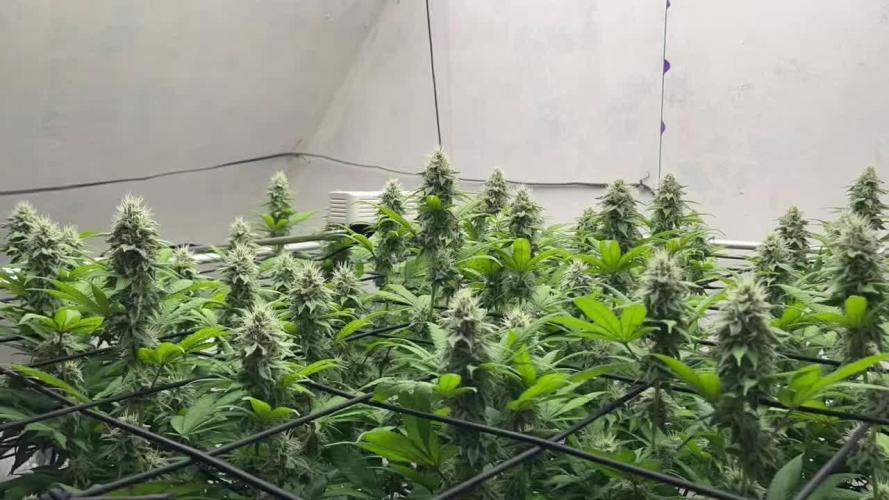
Blütewoche 6 ist geschafft und trotz der bekannten Blattprobleme entwickelt sich die Laughing Buddha bei den Blüten weiterhin richtig stark.
Der Unterschied zur vergangenen Woche wird besonders im Zeitraffer deutlich. Ohne die Dunkelphasen lässt sich die Entwicklung diesmal sehr schön verfolgen: Die einzelnen Buds haben sichtbar an Masse gewonnen, mehrere Blütenstände beginnen immer stärker zusammenzuwachsen und die größeren Colas werden zunehmend kompakt. Gleichzeitig produziert sie weiterhin sehr viele frische, helle Blütenfäden – hier ist also noch lange nicht Schluss.
Auch die Harzproduktion macht richtig Spaß. Die Zuckerblätter sind inzwischen stark mit Trichomen überzogen und einige Buds sehen schon jetzt ordentlich „frostig“ aus. ❄️
🍃 Blattentwicklung
Weniger schön bleibt der Zustand des Laubes. Die bereits vorhandene Aufhellung ist weiterhin deutlich sichtbar und an einigen Blättern haben die nekrotischen bzw. rostfarbenen Stellen zugenommen.
Nachdem in der vergangenen Woche bereits verschiedene mögliche Ursachen überprüft und die Bedingungen angepasst wurden, möchte ich momentan nicht mit weiteren großen Veränderungen reagieren. Boden-pH und EC waren bei der Kontrolle unauffällig. Gleichzeitig wurden die zuvor sehr hohen Temperaturen bzw. der hohe VPD entschärft und der Abstand bzw. die Lichtbelastung angepasst.
Die alten Schäden werden natürlich nicht verschwinden. Entscheidend ist jetzt, ob sich die weitere Verschlechterung verlangsamen bzw. stoppen lässt. Trotz des angeschlagenen Laubes zeigt die sichtbare Entwicklung der Blüten momentan jedenfalls, dass die Pflanze weiterhin ordentlich arbeitet.
💧 Bewässerung
Zwischendurch wurde überwiegend Regenwasser verwendet, da kein vorbereitetes Leitungswasser zur Verfügung stand. Künftig werde ich wieder hauptsächlich Leitungswasser verwenden und eventuell einen Teil Regenwasser beimischen, um die hohe Kalkbelastung meines Leitungswassers etwas abzumildern.
Nach dem versehentlichen Verschieben eines Bodensensors wurde dieser außerdem wieder korrekt eingesetzt. Dadurch waren die vorherigen Feuchtigkeitswerte teilweise irreführend – nach dem erneuten Einsetzen zeigte der Sensor wieder plausible Werte.
💡 Licht & Technik
Diese Woche gab es noch zwei kleine technische Geschichten. 😅
Einmal wurde das Licht morgens manuell eingeschaltet, damit ich vor der Arbeit gießen konnte. Abends habe ich leider zu spät daran gedacht, sodass sie an diesem Tag ungefähr 13 statt 12 Stunden Licht bekommen hat. Ein einmaliger Ausrutscher – danach ging es wieder normal mit 12/12 weiter.
Außerdem hatte der Spider-Farmer-Controller seit einiger Zeit seine Netzwerkverbindung verloren. Lokal funktionierte die Steuerung weiterhin, in der App wurden allerdings keine aktuellen Daten mehr übertragen. Ich habe den Controller schließlich auf Werkseinstellungen zurückgesetzt und sämtliche Geräte neu verbunden – seitdem funktioniert wieder alles wie vorgesehen. 👍
🌸 Fazit Blütewoche 6
Die Blattgesundheit bleibt ganz klar der Punkt, den ich in den kommenden Wochen am genauesten beobachten werde. Dafür gibt es nichts schönzureden: Für die noch verbleibende Blütezeit hätte ich natürlich lieber deutlich mehr gesundes, sattgrünes Laub.
Auf der anderen Seite steht eine Blütenentwicklung, mit der ich wirklich zufrieden bin. Die Buds haben innerhalb dieser Woche sichtbar zugelegt, die Harzproduktion läuft auf Hochtouren und über die gesamte Fläche stehen inzwischen zahlreiche ordentliche Colas.
BW6 war damit eine etwas widersprüchliche Woche: oben werden die Buds immer schöner, darunter macht mir das Laub weiterhin Sorgen. 😅
Jetzt heißt es möglichst stabile Bedingungen halten, genau beobachten und ihr die Ruhe geben, ihre Arbeit zu machen.
Auf in Blütewoche 7. 🌿✌️

Likes
14
Share


@Pleasant_Internet
Follow
Mainlining was too stressful on these plants. Changed my mind to just lst and small topping.
Size and color of each plant are varying making it difficult to choose what to feed. Just started adding gro nutrients. Some look like they need more and others are getting too much N.
Not particularly impressed with this veg at day 43, but i knew it wouldn't be the easiest grow considering the strain. Still excited for flower and to smoke it at the end of this summer.

Likes
21
Share


@BudXs
Follow
First week of flower for this healthy and happy FFT. Really looking forward to Fastbuds releasing the names of these strains, because they all grow very differently. I'm guessing at #8 being cheese, but it will be a complete surprise on all the others.
This girl is sitting pretty and taking up her designated space perfectly. A heavy defoliation on F1 opened up some tops to the light. There has been a massive growback in just 3.5 days of flower, as well as a massive stretch. I have all the headroom in the world, so I will let these maximize. All healthy, no spots or bugs, so these are just booming. They will get a final heavy defoliation on F21, and then maintenance plucking to maximize cola exposure.


Likes
Comments
Share


@Algar
Follow
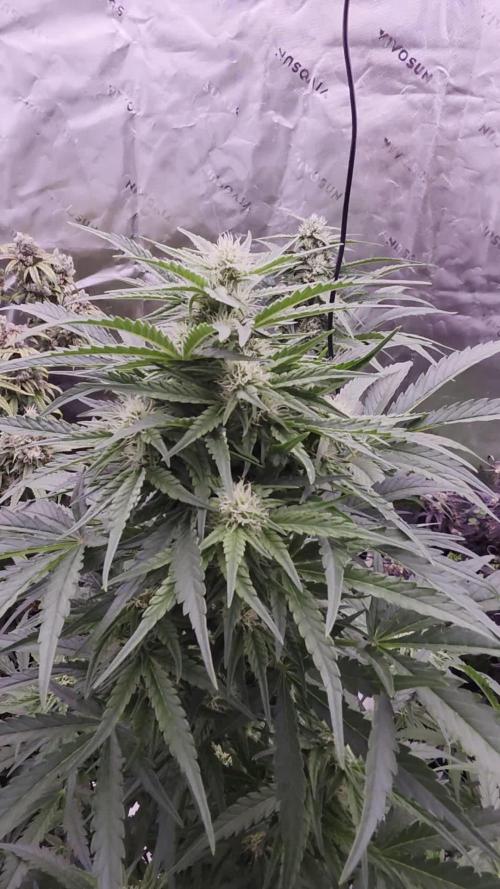
Just feeding her water and getting her ready for harvest, she’s almost there. Buds are really full and heavy. Branches are tilting down from the weight. I believe, i’ll harvest at the end of this week, but the rain might might put a dampner on that.


Likes
2
Share


@HighOhioAn
Follow
I do not usually top but we’re going to give it a go. Rainbow melon had an issue with hurm on my first Grow so this is round two for her. She is doing amazing just like her sister Was at this time so fingers crossed seems like the third week of flower is when I started noticing the hurm FastBuds4204LiFe💯🔥
Likes
6
Share


@HUMO_Cultiva
Follow
Update of Goofiez 2 of compound genetics!! On RDWC it’s literally super fast grow !! We are doing a pheno hunting of 12 plants and we seed 4 of them that are the best at the moment


Likes
32
Share


@Scandinavia
Follow
This week i will flush the plants, meaning i will only give them tapwater with the right ph and with around 450-500ppm. I have overwatered some of the plants under the LED so i will let them dry almost out before giving them water next time.. I have made alot of mistakes i think in this grow but they seem to be doing okay, i have a goal of atleast 50g from each plant, so we will see if thats realistic. Please comment if you have any advise for me or any feedback, thank you and peace out
Day 29 the plants are just doing their thing and im waiting for them to dry out before i will give them water again
Day 31 Giving the plants water, they are growing quick now though i have some small problems with some deffereinces caused by overwatering i think, because i started the seeds in so big a container it was hard not to. But for my expercince autoflowers dont like to be transplanted
Will update doing the week
Likes
8
Share


@TommyBVRSA75
Follow
** Edición semana - se ha aportado al sistema 14 litros de agua con las cantidades discriminadas en función del número de litros considerado. Al sistema ya se ha empezado a introducir el Canna Zym y la consideración para el agua a 14 litros, se ha echo para que el día 17/08, se empiece la nutrición de floración y el cambio de ciclo lumínico a 12/12. Las próximas dos semanas corresponderán a un total de 5 semanas de vegetativo y por las tasas de crecimiento, seguramente en dos semanas tendremos la correspondencia a la dimensión final en altura del cultivar. (Mi cuenta a la altura del grow la hago, doblando la dimensión del grow cuando se produce el cambio de ciclo de luces. Así si a un vegetativo de 30 CMS cuando se produce el cambio a 12/12, representará que al final de floración la altura final estará siempre algo más del doble. O sea que si en dos semanas el grow esté sobre los 30/35 cma, al final de floración como máximo tendremos un grow sobre los 70 cms.
Los grows siguen presentando un maravilloso desarrollo y la cepa fast afgana de Sweet Seeds se ha revelado un acierto magnífico para las condiciones de elevada temperatura y baja humedad que llevamos.
Semana 1 1/2 - casi he cortado algo com tres días en total de la presente semana de desarrollo vegetativo y si miráis la entrada del diario anterior a esta, podrá resultar increíble lo cuanto se ha disparado el crecimiento de las "Afghanis" Fast de Sweet Seeds. Un acierto en casi toda la linea...líneas de fenotipo cara a la familia de genes del Hindu Kush. Plantas que reaccionan maravillosamente al calor y ya os había dicho que con una constancia de temperaturas que en luces está con más de 30ºC y que incluso a oscuras, sobre los 26,27ºC y donde la HR se.encuentra siempre entre máximos de 50% y mínimos abajo de 40%, y justo por su "pasado" de las montañas norte de la raya de Afghanistan/Pakistán, es muy claro que la genetica está lista para el calor...o también a frío, en otras cepas de las cuales destacó lo de Mazar-i-Shariff.
Pues hoy la entrada de diario con video (en inglés) y con un nuevo set de fotos pone clara la cosa. Las plántulas pasada de jiffy al sustrato actual sobre el día 20 de julio, hoy 29 de julio - ocho días después, son muy reveladoras de lo que son las virtudes de asociar una de las más sencillas formas de hidroponia (pasiva o de APU, o sea de acción de gravedad) y que permite sin carencia ó exceso que la irrigación por Smart Mat (una forma especial de tejido, que toma la solución de agua y nutrientes desde un tablero/maceta de 10 litros y quedándose además otros 10 litros de solución en una cuba que irá vertiendo hacia el tablero por gravedad según la velocidad de absorción del sistema radicular de las plantas (o sea con gravedad se ponen a circular 20 litros en total del sistema y sobre el preparo de estos 20 litros que son la base para el calculo de PH y EC que los distintos momentos del cultivar,.necesitaran).
Lo más sorprendente pasa por la siguiente análisis: cantidad de agua necesaria y cantidad utilizada, ahorro de nutrientes y cálculo mucho más efectivo en el control de cuestiones que cuando comparadas, por ejemplo, cuando hacemos riego por ejemplo, al echar 1.5 L con nutrientes y regarla cada dia y que conlleva desde temprano momento de desarrollo a aportar más agua y nutrientes que los necesarios y que al final, acostumbran a ser demasiado,.pues los cultivars se acostumbraran a una filosofía de "exceso" y con ello en regla, los flush finales muchas veces tienen que ser muy agresivos de modo a romper los cristales de nutrientes que se formam por exceso de sales en el sistema.
Ya había tenido contacto con cultivars en coco, pero el cultivo en este medio cuando expuesto a las condiciones en que se hace uso racional de la introducción de agua y nutrientes en el sistema, se está revelando casi espectacular, el modo como dia pós dia, el crecimiento de las plantas sea un "espejo" del equilibrio de racionamiento de agua y nutrientes.
Por ejemplo, comparar la anterior entrada antes de esta y ver lo que la estructura de tallo y hojas, su inserción y los cortos espacios internudos, es muy revelador de la principal virtud de los cultivos en coco y hidropónicos por gravedad. Algunos amigos con mayor experiencia, me habían referido que el crecimiento en vegetativo es simplemente, explosivo y lo que nos es enseñado en tan solo cuatro/cinco dias de vegetativo, pondrá el listón de calidad en esta temporada, muy por arriba.
Según los entendidos, este crecimiento explosivo en vegetativo, ocurre por la manera proporcionada como el sistema de raíces que se encuentra junto al Smart Mat, termina siendo la única area mojada del medio de crecimiento
Si comparáis con algunos de otros diarios que aquí presento y donde cultive en suelo, queda muy claro que tan solo en regla sobre la quinta a sexta semana se dá un estirón cualitativo y cuantitativo de los cultivars. En regla y si pensamos el riego normal en suelo y más en verano, lo primero serían las macetas que para suelo serían mayores que las padrones de hidroponia de 11 Litros. 11 litros en macetas de hidroponia corresponden a 23 litros en suelo regular. Después con temperaturas en la linea de las que estamos pasando, corresponderían a riegos de 2 Litros diarios de agua con nutrientes y con la temperatura y la adicción de agua necesarias, para suelo, en estas fechas, el estrés de temperatura y sobre todo el hídrico (por la cantidad de agua aportado) pasarían factura en el crecimiento. A contrário de otras temporadas (de suelo y riego diario), no tenemos, en primer lugar, áreas de suelo en la maceta que se sobrecargan de agua cuando aún no tiene materia radicular. Una de las señales que los grows en suelo y riego directo presentan en verano, suele ser las hojas curvadas hacia bajo y que el set primario de hojas, ya se habría puesto amarillento.
Después uno de los sales más prófugo en bloquear otros sales por su exceso en el sistema, es el nitrógeno. Lo que los riegos diretos en verano crean, pasa por cuando saturan áreas de suelo que aún no tienen raíces, el nitrógeno tiende a quedarse fijado en sales en esas áreas y después si bien habrá muchas veces una cantidad muy larga de nitrógeno, al existir ese exceso, más tarde habrá influencia negativa en otros sales y sobretodo microelementos, que no se agregaran de la mejor manera al cultivar.
Mucha gente no acostumbra a reflexionar sobre la forma como se hace la nutrición de raíces a través del suelo y si hay factores reductores en la integración de sales cuando más necesarios se convierten, eso pasa por ejemplo, por no haber conocimiento que por ejemplo excesos de nitrógeno pueden impedir que Fósforo o Magnésio o elementos como Boro, Hierro, Manganeso o Zinc, se integren al cultivar cuando más necesarios se hacen. En regla, los iniciados no entienden que un "overfert" de nitrógeno, que suele ocurrir más a común que se imagina (esa idea que se está haciendo la nutrición correcta cuando por ejemplo, el iniciado echa un vistazo a su "plantita" y la ve de un verde muy fuerte y lujuriante. En regla la gran mayoría de sobre fertilización ocurre con el aporte de agua. Un iniciado no será muy preocupado con el PH de su agua y con ello, también le dará poca importancia al EC y os dejo un poco esta idea " no es lo mismo preparar todos los días, soluciones de nutrición en base al preparo de 1,5 litro de solución (en base a una botella de agua de las normales) que por ejemplo preparar por ejemplo un botellón de 6 o 7 litros y usar ese botellón para riegos diarios sucesivos. Aún con medidas es muy distinto, que como en el sistema de hidroponia por gravedad que tengo a uso, pues preparó 20 litros de solución que pondré en una cuba, de esta cuba por una manguera con un sistema APU -bloqueo por gravedad- se llenará el tablero/cuba con cerca de 10 litros y en estos 10 litros estarán sumergidas las tiras Smart Mat, que al llenarse hasta el tope conducen el riego solamente en el área donde ya se encuentran formados los sistemas radiculares de la planta. O sea que en el sistema entrará justo el agua y nutriente necesario a lo que las raíces absorben....mientras que cuando haces riego directo sobre suelo, lo normal es que existan una área en proporción mucho mayor donde se satura el medio con agua y nutriente.
Os explicaba que para lo que se puede controlar en PH y EC, hay diferencias muy significativas entre el preparo de 1,5 litros de solución para un día; que un botellón de 6/7 litros para riego a lo largo de 5 o más días ó que el preparo para mi sistema de hidroponia con 20 litros de solución que serán empleados tan solo por la estructura radicular que los absorbe paulatinamente.
A quien en verano, perante el dilema del riego al ver incluso indoor que el suelo se seca rápidamente por la temperatura alta y baja humedad y que con eso puede en una maceta para suelo con 23 litros, llegar a hacer riego al menos dos veces al día con un total de 3/4 litros de agua y donde parte de esa agua con solución de sales será vertido en el suelo, pero en áreas del suelo donde no hay raíces...casi seguro, lo que estamos mirando con estos riegos es que tendremos seguro hojas de un verde muy bello y sin dar importancia a que las hojas se pondrán como gruesas y enrolladas hacia bajo y por el verde "bonito" no entender que la sobre fertilización ya esta en plena marcha y que más tarde en floración, por la presencia excesiva de cantidad de nitrógeno, por ejemplo lo que en floración ocurrirá, será que cuando necesitemos sobradamente de Fósforo y Magnésio, para las funciones de floración, engorda y evolución de terpenos y resinas, incluso para el "rippen", lo que suele pasar hace la alegría de los fabricantes de nutrientes, que se llenan de líneas de incluso 25 productos destinados en parte "a corregir las incorrecciones de formulación con que desarrollamos nuestros productos iniciales y a que decimos a nuestros clientes con menos experiencia, que debemos poner más que la cuenta, para que después necesitemos de otros productos en exceso, para equilibrar autênticas bombas químicas - ya sean biológicas o minerales-.
Pues y sin alongar más el raciocinio, y por las evidencias y más por lo empírico de la cosa, lo que veo al menos para el periodo de verano y con la conjugación de los siguientes factores :FACTOR 1: semilla F1 Fast con genética Hindu Kush tanto por padre como madre y que guardan plantas que son por antonomasia, resistentes perfectas a las condiciones de mucho calor y poca humedad +
FACTOR 2: sistema de hidroponia pasiva por gravedad, cuatro macetas de 11 Litros y responsable por una forma de riego óptima y en la cual la agua con la solución integra agua a partir de tejido Smart Mat y de aquí al sistema radicular que se desarrolla en el contacto del Smart Mat con el medio de cultura +
FACTOR 3: medio de cultura formado por: Coco peat/powder con trichodermas naturales -bloque Ugro Basic 70 litros (75%) - Perlite fina (20%) + Bolas Arcilla Expandida Europebbles Plagron (5%) . A las áreas de colocación de las semillas germinadas en jiffy peat, se aporta como medio de refuerzo de protección mycorrizas Kraken - Glomus iranicus sob. + Tricofor 50 (Trichoderma harzanium) + FACTOR 4 - linea de nutrición CANNA Coco.
Los cuatros factores son la base y eje de lo que de mejor tiene, en mi opinión, el sistema Quadgrow. Como hidroponia sencilla, creo que es muy buena cara a condiciones de verano, pues permiten que los riegos ocurran de modo muy regular. Habrá dudas con condiciones de invierno, pero en invierno a lo mejor habrá que contrarestar la cantidad de solución preparada y en vez a los 20 litros para una media de 12/14 días a lo mejor, será más interesante hacer el preparo de cubas de no más de 12 litros que podrán en máximo prorrogarse por un máximo de 11 dias.
Para ejemplo, queda la enorme dimensión de este comentario y algunos análisis sobre las cuestiones técnicas del grow en hidroponia. Si todo lo técnico es importante, darle a la fé en el buen Dios Jah, para que todo pueda ocurrir en paz, para que los grows se hagan sin contratiempos y para que las miradas y habladurías de vecinos nunca acarreen problemas y eso siempre, por qué la más bella planta del universo, no es para generar una ganancia mayor que le de los amigos disfrutando de buenas películas, buena musica, buena compañía y en eso la mayor virtud de la cannabis como elemento de desarrollo del ser humano hace su hermano humano.
Green greets y os invitó, a que disfruten del vídeo y de las fotos...

Likes
17
Share


@ganzigunnu
Follow
this week I defoliated so many leaves and continued LST. EC is around 1.0 this time. Everything is going well.
Likes
1
Share


@LiamF
Follow
I was not home half of this week.
The buds getting really fat and full of trichomes.
About 60-80% of pistils are orange now
Wierdly some of the leaves are dying

Likes
13
Share


@IQuSX
Follow
Hi, topman!
Last week was very difficult in my live, but all behind of out and we completed
1. Defoliation - for cut off leaf option
2. Topping - cut got head of plants for doable-head option
3. Zigzag for lighting power of potential
4. In began of week Completed 25 concentration cleaning substitute .
Check in the future.
See you.

Processing
Likes
3
Share


@ZJRDUDEZ
Follow
Alright, happy month of 420 to all🤙🌲 This is 3 days into week 4 of bud for these ladies (day 25). They have all definitely started swelling up and putting on frost. For some reason I’m not recognizing any of theses bud structure. The two seed grown plants up front are way different phenotypes than the plants I grew last round. And even the clone I took that’s in the back is way crazy different than the mother I took her from. So I’m assuming these genetics aren’t to stable. But they aren't done yet so I guess I can’t quite judge till it’s finished. Anyways once’s I get a strong mother of that Dark Plasma and Tropic Moon I’ll probably stop running these strains and only run those two strains for a bit
Likes
31
Share


@420DeepGrow
Follow
Gracias al equipo de AnesiaSeeds, Marshydro, XpertNutrients y Trolmaster sin ellos esto no sería posible.
💐🤯 39%Thc Wham Boom:
Sube al ring con WHAM BOOM de Anesia Seeds, donde la energía electrizante de Wham choca con las vibraciones frías de RS54, creando una variedad que es todo equilibrio, potencia y sabor. Este peso pesado feminizado ofrece una mezcla perfecta de 50% Sativa y 50% Indica, proporcionando una experiencia que te hará flotar de euforia mientras tu cuerpo se sumerge en una serena relajación.
WHAM BOOM es una productora prolífica, con rendimientos en interior de 600g/m² y en exterior que alcanzan la asombrosa cifra de 900 - 1200g por planta. Con una floración de entre 65 y 70 días, esta variedad está lista a principios de octubre, lo que la convierte en una competidora ideal para los cultivadores que aspiran a una cosecha de campeonato. Con una imponente presencia de 100-140 cm en interior y 160-220 cm en exterior, WHAM BOOM se alza como testimonio de su destreza genética.
🏠 : Marshydro 1.50 x 1.50 x 1.80, carpa 100% estanca con ventanas laterales para llegar a todos los lugares durante el grow
https://marshydro.eu/products/diy-150x150x200cm-grow-tent-kit
🌬️💨 Marshydro 6inch + filtro carbon para evitar olores indeseables.
https://marshydro.eu/products/ifresh-smart-6inch-filter-kits/
💻 Trolmaster Tent-X TCS-1 como controlador de luz, optimiza tu cultivo con la última tecnología del mercado, desde donde puedes controlar todos los parametros.
https://www.trolmaster.com/Products/Details/TCS-1
🍣🍦🌴 Xpert Nutrients es una empresa especializada en la producción y comercialización de fertilizantes líquidos y tierras, que garantizan excelentes cosechas y un crecimiento activo para sus plantas durante todas las fases de cultivo.
Consigue aqui tus Nutrientes:
https://xpertnutrients.com/es/shop/
📆 Semana 2:
Gran primera semana, ella ha dado un gran estiron estos días, si sigue así será una gran cosecha.
Esta semana se practica defoliacion, poda de ramas bajas y se le agrega Sticky Fingers .
La carpa está ocupada al 100%, sigue una floracion explosiva gracias a @Marshydro y @Xpertnutrients y @Trolmaster con esta gran genética 💪.
Potencia de la lámpara: 70%
Likes
Comments
Share

@DogDoctorOfficial
Follow
💜 Week 7 – Purple CousKush Auto (Pheno B)
Quiet Confidence
One of the things I love most about growing multiple phenotypes side by side is discovering that every plant has its own way of telling a story.
Some demand attention from the very beginning.
Others slowly earn it.
This Purple CousKush has always belonged to the second group.
Since germination she's chosen her own rhythm, never trying to become the tallest plant in the room or the fastest to flower. Instead, she's quietly built herself into an incredibly balanced, healthy and elegant little lady.
For anyone joining this 8×8 Adventure for the first time, this entire project is about growing multiple phenotypes side by side under exactly the same conditions. Every plant receives the same environment, nutrition and care, allowing their unique genetics and personalities to tell the story.
This Purple CousKush is proving that sometimes the quietest phenotype becomes one of the most rewarding to watch.
Week after week she's reminded me that confidence doesn't always need to be loud.
Sometimes it simply grows.
🌱 Plant Development
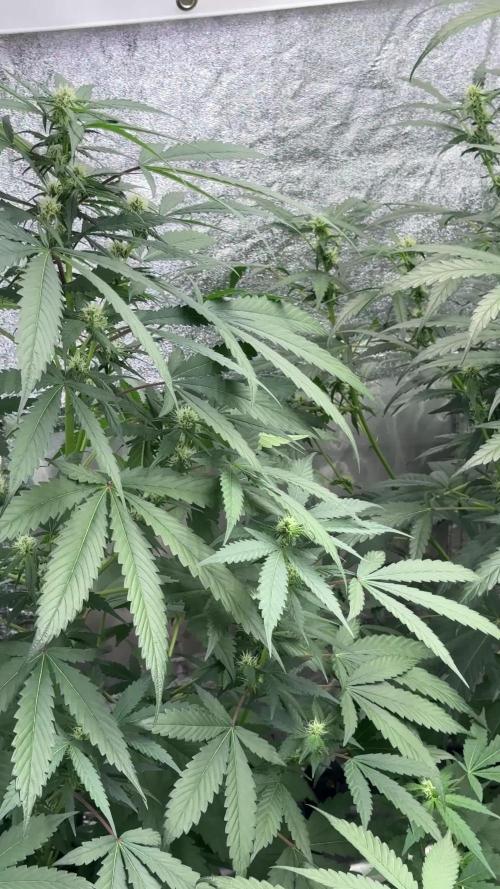
Week 7 finds this beautiful phenotype standing at approximately 88 cm, adding another impressive stretch since last week's update while maintaining the same wonderfully symmetrical structure she's displayed from the beginning.
Although she still isn't the tallest Purple CousKush in the tent, she's becoming one of those plants that immediately catches your eye for all the right reasons.
Every branch has continued developing evenly, creating a beautifully open canopy where light reaches almost every flowering site. The spacing between nodes has proven to be nearly ideal, giving each future cola plenty of room to develop without feeling crowded.
The flowers themselves have taken a noticeable step forward this week.
Fresh white pistils continue exploding from every bud site, while the individual flowers are beginning to connect into the first recognizable colas. They're still young, but the direction is becoming very clear.
One thing that really stands out is her colour.
The foliage has shifted into an incredibly rich emerald green that almost glows under the lights. Every leaf looks healthy, every stem feels strong, and the entire plant gives the impression of being perfectly comfortable in her environment.
She may not be shouting for attention.
But she's certainly earning it.
🌿 Environment & Growing Conditions
Another week of stable environmental conditions has allowed this phenotype to continue flowering without interruption.
• 12/12 light schedule from seed
• Future of Grow Black Series LED delivering approximately 850 PPFD
• Lumiflora under-canopy lighting now supporting lower flower development
• Mammoth Pro grow tent
• Day temperature around 29°C
• Night temperature around 25°C
• Relative humidity averaging 60%
• CO₂ approximately 639 ppm
• pH 5.8
• EC 1.95 mS/cm
One exciting addition this week has been introducing the Lumiflora under-canopy lighting.
While the main Future of Grow Black Series continues driving the canopy from above, the Lumiflora fixtures now provide additional light beneath the canopy, helping lower flowering sites receive energy that would normally be lost in the shadows.
As the flowers continue stacking over the coming weeks, this extra light should contribute to more uniform bud development throughout the entire plant instead of concentrating production only at the top.
It's another small detail that helps maximize every square centimetre of the grow space.
💧 Feeding Program
Growing in a 15 L Plagron Lightmix container and receiving approximately 1.1 litres of solution per irrigation, she continues responding beautifully to the current bloom programme.
This week's nutrient solution consisted of:
• Terra Bloom – 2 ml/L
• Pure Zym – 1 ml/L
• Sugar Royal – 1 ml/L
• Power Buds – 1 ml/L
• Green Sensation – 1 ml/L
The slightly increased EC has been welcomed without hesitation.
Leaf colour remains beautifully vibrant, new flower growth is accelerating and the plant continues showing absolutely no signs of nutrient excess or deficiency.
Sometimes the best feeding schedule isn't the most complicated one.
It's simply the one the plant happily accepts.
🌸 Phenotype Notes
This Purple CousKush continues reminding me that beauty isn't measured in height.
She's growing with incredible balance.
The main stem has become noticeably thicker, every branch is supporting itself confidently, and each flowering site appears to be developing at almost exactly the same pace.
There's something incredibly satisfying about watching a plant where nothing seems forced.
Everything feels natural.
The rich green foliage frames the developing flowers perfectly, while the bright white pistils almost sparkle against the darker leaves.
She isn't trying to steal the spotlight.
She simply shines in her own quiet way.
Sometimes those become the most memorable plants of the entire run.
🔍 Looking Ahead
The stretch now appears to be slowing, which means the next phase should become increasingly exciting.
Over the coming week I expect the flowers to begin stacking much more aggressively as the plant redirects more of her energy into building density rather than height.
The introduction of the Lumiflora under-canopy lighting should also begin showing its benefits as the lower bud sites receive additional usable light, helping create a more consistent canopy from top to bottom.
The framework has been built.
Now comes the part every grower loves watching.
The swelling.
The stacking.
And slowly, the first hints of the beautiful Purple CousKush she's been promising all along.
💭 Final Thoughts
This week made me smile.
Not because she's suddenly become the biggest plant in the room.
But because she's becoming exactly what she was meant to be.
Healthy.
Balanced.
Elegant.
Every photograph tells the same story.
Deep green leaves.
Strong stems.
Beautiful flower formation.
And a plant that looks completely at peace with herself.
She reminds me that growing isn't always about chasing the biggest harvest or the tallest canopy.
Sometimes it's simply about appreciating a plant that's doing everything right.
And this beautiful lady...
She's doing exactly that.
🙏 Thank You
A huge thank you to everyone following this 8×8 Adventure. Every comment, every question and every shared experience make this journey even more rewarding.
A special thank you to the amazing companies helping bring this grow to life:
💜 Zamnesia for the incredible Purple CousKush genetics.
💜 Plagron for providing the nutrition that keeps these ladies thriving.
💜 Future of Grow for delivering outstanding lighting from above with the Black Series LED.
💜 Lumiflora for helping illuminate the canopy from below, ensuring every flower has the opportunity to reach its full potential.
💜 TrolMaster for maintaining the stable environment that allows these plants to perform at their very best.
And finally, thank you to the entire GrowDiaries community. Whether you're here to learn, share your own journey or simply enjoy watching these phenotypes develop, I truly appreciate every visit, every comment and every conversation.
Until next week...
Growers Love and happy growing! 🌱💚
Likes
Comments
Share


@420blazeit666
Follow
I overfeed them once,but except that all went good.Hyped to see the results after drying.
update coming soon :)
