


Likes
Comments
Share


@Altitonans_Fulmen
Follow
Α,α (alpha) and Ω,ω(omega)
Here we grow again.
LAST GROW.
344g+280g+445g+255g=1324g dry bud.
Yielding 1,324 grams of dry cannabis using a 600W light in a 4x4 tent is exceptionally efficient. This breaks down to roughly 2.21 grams per watt, far exceeding the standard indoor benchmark of 1.0 g/W and outperforming elite professional targets (1.5–2.0 g/W). For carbon and energy efficiency, this output drastically lowers the carbon cost per gram compared to typical indoor grows. Achieving 1,324 grams (47.2 ounces) of dry cannabis from a 600W light in a 4x4 tent is exceptional, yielding roughly 2.21 grams per watt. This is an elite-tier result that reflects world-class photosynthetic conversion, highly optimized canopy light distribution, dialled-in CO2 supplementation, and precise environmental control.
Growing 1.3kg of dry in a 2x2 with 1 plant is just being silly and not understanding how carbon and energy conversion works towards mass.
Took 6 years and 10,000+ Hours to break the 2 grams-per-watt barrier not exactly 600W, in honesty, though—even with modern, high-efficiency LEDs—is an incredible feat that requires hitting the absolute genetic ceiling of the cultivar and maintaining flawless environmental parameters for the space.
Photosynthesis is the literal conversion of light energy (photons) into chemical energy (carbohydrates). Leaf temperature, driven by radiation from fixtures and mitigated by latent heat of vaporization (transpiration), dictates metabolic rates. If your room's thermal dynamics are off, enzyme activity inside the plant stalls, grinding growth to a halt. Anyone else pretending to have done so with nothing but Plagron nutrients at 75F is telling porkie pies *cough*, otherwise known as a liar, liar with a bum that's on fire, but it seems that's the new norm these days on GD. *cough cough*.
Using copper and zinc plates in the plant medium to form a natural earth battery to assist with Electrochemical Reactance. The moist soil acts as an electrolyte, while zinc serves as the anode and copper as the cathode. Zinc is a highly reactive metal and oxidizes, losing electrons into the soil. These electrons travel through an external wire to the copper plate. The moisture and dissolved salts in your plant medium allow charged ions to move freely between the plates, completing the circuit and generating a small direct current (usually between 0.8 and 1.1 volts). This micro-current subtly alters/the Electrical Conductivity (EC), allowing more effective breaking apart of chemical bonds in the soil (electrolysis), making soil nutrients like phosphorus, calcium, and potassium more accessible to roots. Buried the zinc plates around the sides of the plant pot's root zone and the copper plate in the middle. Ran an insulated copper wire above ground to connect the zinc plate to the copper plate, creating a closed loop. Making sure the soil remains perfectly moist and contains everything it needs; entirely distilled water or bone-dry medium will prevent ion exchange and block the current. Leave that up to the rhizosphere.
Currently testing new parameters for a couple of weeks. Seeing what she can do with a new and upgraded ducting closed loop and double the water capacity. Also added 6kg of inoculated biochar along with a slew of small improvements. Keeping an eye on. Zinc toxicity vs. consumption, given how sacrificial zinc is. Want to make sure the biochar stabilizes first.
A Synganic closed-loop bioengineering-logic grow room merges synthetic inputs (precision minerals/chelated nutrients) with an organic living soil matrix (microbial life/bio-stimulants), managed via automated, data-driven automation. Master Operating Procedure (MOP): The system balances a sterile environment with a thriving, dynamic rhizosphere, merging the biological resilience of living organic soil with the high-precision chemical control of modern Controlled Environment Agriculture (CEA).
Synganic blends a biologically active living soil or microbe-rich substrate with targeted, low-dose mineral or synthetic fertigation to optimize both metabolic yield and secondary metabolite expression (terpenes/flavonoids).
What else is alive!
Eisenia fetida (Red Wigglers) will continuously process organic matter into plant-available nutrients and aerate the media.
Stratiolaelaps scimitus (Hypoaspis mites) provides excellent biological control against fungus gnats and pupating thrips.
Armadillidium vulgare (Pillbugs) excel at breaking down tough, woody organic matter and toxic heavy metals.
New "Closed-Loop Sealing" Isolates the internal microclimate from external weather, vectors, and pests. Air is scrubbed 264nm UV-C, recirculated, and enriched rather than openly exhausted.
Operational Parameters (MOP Framework). Microbes act as biological buffers for the mineral inputs, preventing salt toxicity and ensuring continuous nutrient availability.
Precise management of Vapour Pressure Deficit (VPD) day and night to force optimal stomatal conductance without stressing the biological media.
Strict clean-room protocols prevent pathogen intrusion while maintaining non-sterile, highly active beneficial bacteria and fungi populations in the root zone.
Looking at a grow room as a closed-loop system changes everything. You aren't "growing a plant"; you are managing a mass and energy balance equation where the plant is a biological transducer. Every watt of light introduces sensible heat. Every drop of water turns into latent heat via transpiration. When a deficiency appears, a grower flushes or adds a bottle of "magic" additive. A master looks at the HVAC duty cycle, realizes the dew point spiked, the stomata closed, and calcium transport stalled due to lack of transpiration, not lack of nutrients.
Protocol-driven logic can be automated, replicated, and optimized. Legacy growing and anecdotal habits fail the moment the room moisture volume changes. ADD CALMAG!
Comprehensive Substrate Composition: Because why not.
1. Substrate Base & Aeration Media
Expanded Clay Aggregates (Hydroton Pebbles)
Coir Chunks & Horticultural Coco Coir
Sphagnum Peat Moss
Horticultural Perlite
Horticultural Vermiculite
Horticultural Pumice
Volcanic Basalt Rock
2. Mineral Amendments & Soil Conditioners
Agricultural Gypsum (Calcium Sulfate)
Wollastonite (Calcium Silicate)
Dolomitic Limestone (Calcium Magnesium Carbonate)
Basalt Rock Dust (Trace Mineralizer)
Azomite (Micronutrient-Rich Volcanic Ash)
Glauconite (Greensand)
Crushed Seashells (Calcium Carbonate Source)
Pyrolyzed Carbon Feedstocks (Biochar & Horticultural Charcoal)
Shungite (Carbonaceous Mineraloid)
3. Organic Nutrient Amendments
Steamed Bone Meal (High Phosphorus)
Dehydrated Blood Meal (High Nitrogen)
Fish Bone Meal (Phosphorus & Trace Calcium)
Cold-Processed Kelp Meal (Ascophyllum nodosum)
Dehydrated Moringa Oleifera Powder (Botanical Nutrient)
Spirulina Powder (Arthrospira platensis / Cyanobacteria Nutrient)
Marine Crustacean Biomass (Shrimp & Crab Chitin)
4. Biological Inoculants & Organic Acids
Mycorrhizal Fungi Inoculant (Endomycorrhizae / Ectomycorrhizae)
Vermicompost (Premium Worm Castings)
Humic & Fulvic Acids (Concentrated Humates)
Soil-Plant-Atmosphere Continuum (SPAC): An ecological concept referring to the pathway of water moving from the soil, through the plant, and into the atmosphere.
Humidity of the air dictates the moisture in the medium, which dictates the rate of pull from the terracotta stakes 15 in total.
Terracotta (unglazed, low-fired clay) is highly porous, acting as a breathable, permeable membrane that transports water based on the moisture gradient between the potting medium (soil) and the surrounding air. White terracotta and brown terracotta often have different pore sizes and overall porosity, primarily driven by differences in clay composition, impurities, and firing temperatures. While both are considered porous, brown terracotta often has higher iron content and impurities that behave as fluxes, affecting how the pores form during firing, while white terracotta is generally derived from more refined clays, with smaller pores making it more suited to pure water.
This mechanism is driven by capillary action and evaporation. When the surrounding soil is dry, the terracotta acts as a wick, pulling water out of the pot and into the soil. If the soil is very saturated, the terracotta absorbs water from the soil and allows it to evaporate from its outer surface, increasing the drying rate of the soil. Terracotta tends to keep the potting mix at an optimal saturation point, wicking up more water when the outside surface evaporates water into the air. The greater the difference in moisture between the soil and the outside air, the faster the water transfers through the ceramic. In low humidity and hot weather, the evaporation rate from the terracotta surface is high, creating a rapid drying effect. Newer terracotta pots often have a denser, lighter-toned structure that is less porous than traditional, red-orange terracotta, slowing down the moisture transfer rate. Over time, dissolved salts from fertilizer or tap water build up and block the pores, reducing the permeability of the clay. Water is all that is used or needed, thanks to the biochar and the massive storage bank of nutrients. Just waiting until something creeps up.
Clay pot irrigation (Ollas), an ancient farming practice, utilizes this property by burying unglazed jars in the soil, allowing water to slowly seep into the surrounding soil only when the soil dries out. Remember to clean terracotta stakes in mild acid after each grow. Submerge the stakes in a solution of 1 part distilled white vinegar to 3 or 4 parts water. Let the stakes soak for 20 to 30 minutes. You will hear a fizzing sound as the acid reacts with and dissolves the mineral salts. Use a stiff-bristled brush or an old toothbrush to scrub away the loosened residue. Rinse the stake thoroughly in clean water to wash away any leftover vinegar. BOOM good for next grow!
Indigenous Amazonians created, or at least significantly enhanced, the fertile, dark soil known as Terra Preta de Índio (Portuguese for "Indian Black Earth") by incorporating biochar and other organic materials into the soil. This anthropogenic (human-made) soil technique, which dates back roughly 2,500 to 8,000 years, allowed ancient civilizations to flourish in regions with naturally poor, acidic, and nutrient-poor tropical soils.
Electrical Conductivity refers to how easily a material or solution allows electrons or ions to flow continuously when an electrical potential is applied.
Electrochemical Reactance is the opposition to alternating current (AC) caused specifically by the temporary storage of energy in electric or magnetic fields, rather than energy being lost as heat. Reactance does not directly alter a material's intrinsic electrical conductivity. Instead, it dictates how the system stores and releases energy over time, which creates a temporary barrier to current flow in AC circuits. Together with resistance, reactance makes up total impedance. Electrical impedance (the combination of resistance and reactance) in the rhizosphere dictates how easily ions and water move into plant roots, directly impacting the Electron Transport Rate (ETR). High impedance restricts ion mobility, leading to nutrient deficiencies that decrease ETR and stunt overall plant growth.
Electrolysis in the rhizosphere can reduce the direct ATP energy cost for a plant by electrochemically altering soil chemistry, changing pH gradients, and splitting or reducing compounds so that nutrients become easier to absorb or break down.
Electrolysis uses an external electrical voltage to drive chemical reactions (like splitting water or reducing ions). This external electricity performs thermodynamic work on the soil solution. Rather than directly fueling plant enzymatic machinery or lowering biological ATP synthesis costs inside root cells, electrochemical reactions alter surrounding nutrient forms (e.g., changing pH, altering redox states, or breaking tight mineral bonds). By electrochemically making mineral ions more mobile or bioavailable, the plant may spend less root exudate carbon or membrane-transport ATP trying to scavenge locked nutrients, though the plant's baseline respiration and ATP costs for active uptake still apply.
Laws of math are conceptual, laws of math are universal, the laws of math are invariant, and the laws of math are exceptionless.
The laws of mathematics are the foundational rules that govern structure, quantity, space, and change. Unlike the laws of physics, which describe how our specific universe behaves, mathematical laws are absolute truths independent of physical reality.
Think of electricity like highway traffic to easily understand the difference between the movement, the road, and the speed.
•Electron Flow is the traffic (the cars moving).
•Electrical Conductivity is the highway (how wide and smooth the road is).
•Electron Transport Rate (ETR) is the speedometer (how many cars pass by per second).
ETR stands for Electron Transport Rate. It measures the speed at which electrons are moved through the thylakoid membranes in a plant's chloroplasts during the light-dependent reactions of photosynthesis.
Mass is effectively "congealed" energy. Energy is just numbers. Energy isn't a physical "substance" you can hold or touch. It is essentially an abstract, calculated number that we assign to a system to predict how it will change, interact, or move. A numerical label we attach to matter to track how it behaves.
ATP (adenosine triphosphate) is the primary energy carrier in cells, including plant cells. It powers various cellular activities like nutrient uptake, protein synthesis, and cell division. Without ATP, the plant's metabolic machinery would grind to a halt, regardless of the presence of nutrients, oxygen, or carbon. Nutrients, like nitrogen, phosphorus, and potassium, are essential for building plant tissues and various molecules. They are incorporated into proteins, nucleic acids, and other vital compounds. While crucial, their uptake and utilization rely on ATP-driven processes. Oxygen is vital for cellular respiration, a process that generates ATP. While plants can produce ATP through photosynthesis, oxygen is essential for maximizing ATP production in mitochondria through oxidative phosphorylation. Carbon is the backbone of all organic molecules, including carbohydrates synthesized during photosynthesis. It's the fundamental building block of plant structures and fuels. However, its incorporation into organic molecules is also ATP-dependent. We don't grow we facilitate energy conversion.
Everything is energy. Energy is represented by numbers. Numbers are frozen music. Music is moving sacred geometry of the Uni-verse.
Likes
2
Share

@BudBeezy
Follow
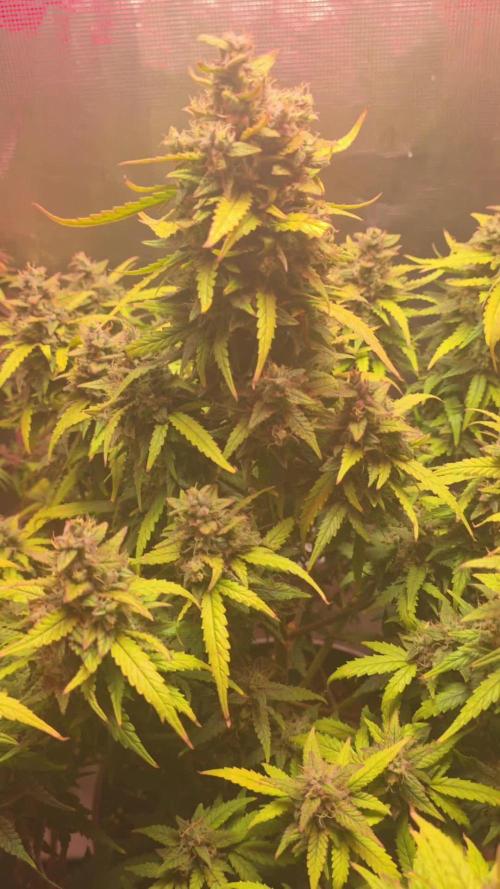
Welcome to week 11 of my grow diary. Now it's time for the final sprint. The trichomes are 80% milky. You can tell that the weather is getting worse and worse. I'm thinking about harvesting the plant soon because the weather forecast looks really bad for the next few weeks. Some days it's supposed to rain 20-30 liters per day. That would be certain death for the plant. Let's wait and see how it actually turns out. I have stopped applying fertilizer for now. In addition, watering has been reduced to cause some drought stress and thus stimulate terpene production.
See you next week!

Likes
9
Share

@Dottgreenthumb
Follow
Ancora un paio di giorni e sono pronti al taglio
run off ec 0.4
ph 6.1


Likes
13
Share


@SkunkyDog420
Follow
Hallo zusammen 🤙.
Sie wächst sehr schön und macht keine Probleme.
Rabattcode für den BIOTABS-Webshop https://biotabs.nl/en/shop/ GDBT420, damit erhalten Sie 15 Prozent

Likes
6
Share


@2xdzdadalt
Follow
Starting to drop the night time temps down a but but keeping the total change from day to night with in reason. The stretch is coming to an end and the bud sites are showing a lot of pistils. A lot of frost on the sugar leaves already. Things are looking good so far.

Likes
16
Share


@Sadhus
Follow
Rempotage en 13 litres, pleine santé rien a signaler, jolie feuille fine et pointues avec de belles dentelure bien prononcé , plantes très élancé, les sept sont très belles, encore une semaine ou deux et floraison et j'ai hâte de voir sa !
#kannabia
#madamegrow
#trolmaster

Likes
10
Share


@4F1M6
Follow
Amazing structre, form, and build. Hardy and full of colas. These 2 are creating a absolute sea of flowers. I'm in love with these plants.
Stacking away and its been all flowers. I'm just sitting back enjoying the show.
They got treated with Dr zhymes as a preventative. That will basically wrap up their treatments ...possibly once more with lost coast.
Upped the pk intake as they are blooming strong now. Gotta keep those engines well fuelled. Response was stellar. Happy happy happy ladies.
Until next update. Happy growing and stay lit fam.

Likes
50
Share


@ThatoneAKguy
Follow
Fall is in the air even in my tent. The roots went dry for about 6 hours and that was long enough to make her angry. Her and her neighbors started using quite a bit more nutrients and between a little complacency and some personal chaos it was totally my fault. She’s still on track though and going to be a high yielding behemoth that would surprise me in she nears the 6oz mark. And the ROTATE BUTTON AND TEXT IS STILL NOT WORKING ON IOS.
Likes
1
Share


Likes
5
Share


@GrowLegend
Follow
Bien aquí esta el día esperado la cosecha, es mi primer cultivo y considero que lo logre. En muchos medios de lectura y en especial en vídeos mencionan que no puedes esperar mucho es tu primer cultivo. En mi caso es falso y lo demuestro ya que si aprendes, investigas por cuenta y lees lo suficiente, obtendrás un alto porcentaje de que los resultados se den. Muy contento con mi plantas y sus tonos morados. Puntos a mejorar tener una carpa de cultivo y por su puesto un extractor de humedad para que baje la humedad preferiblemente a 45 grados
Vendrán mejores contenidos y cosechas mas abundantes. Gracias a todos por su vistas y comentarios. Saludos y bendiciones!

Likes
9
Share


@Rastaluna
Follow
Helloo, planties are roughtly 3 week into vegetative growth.
Into second week our cat snucked into the tent and being the motivated gardener she is, dug out quick one and speedy chille, we put them both back into place gave planties some water, and with time they recovered, speedy chille got most stress, but being photoperiod, recovered slowly aswell, still the shortest and very loved.
:) so everythings good
Royal kush has the strongest smell of them all, few leafs we defoliated we grind in our hard and smell a deep green canna scent.
Northen lights is the leader in hight since begining
When planties grew 5 tops we topped them, began doing LST and a bit of defoliation, bended stems away from the lamp and taking off leaf that blocks light reaching tops.
The stems hardened and remind me now more of a tree
Likes
5
Share


@Hanffanatiker
Follow
Die 3x Z-Up Autoflower von FastBuds sind sehr schnell gekeimt. Sie wurden in einem Glas mit klarem Wasser gekeimt. 💦
Es hat ~3 Tage gedauert. Dann ging es in den Lightmix von Plagron.
Likes
3
Share

@JNSGenetics
Follow
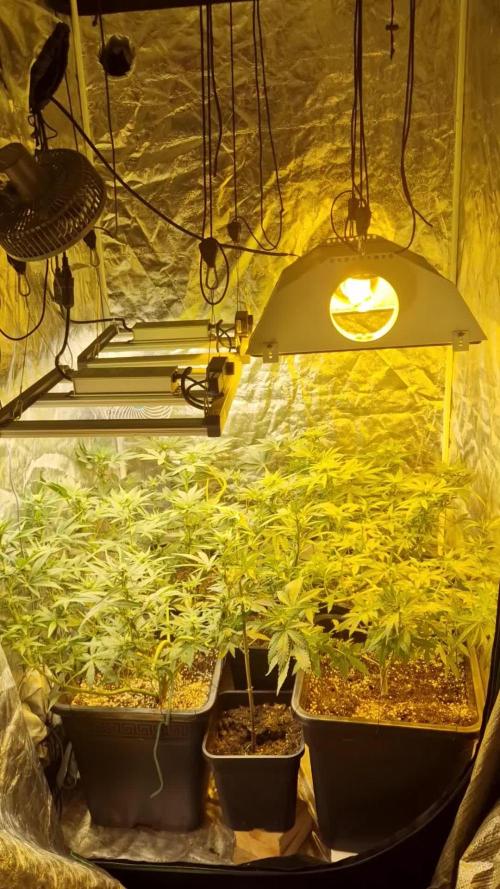
Day 15 and they were watered 2 days ago. They all got around 3 - 4 liters of water and they are drinking alot now. The lemon tree is the winner so far. The permanent jealousy auto is ahead in flower. The slurrups clones from in house genetics are starting to flower as well in their 6 liter pots. I just make them for fun. Was hoping for a male plant.
Still early flower. So far so good
Day 17 the orange sherbert is slow to transition into flower. I have tied it down further to expose the lower buds while allowing it to stretch fully


Likes
21
Share


@cheetah844
Follow
She is the shortest one, healthy but short - just her genetics. 💚💜 my Blueberry strains. I have both a Blueberry & Blueberry OG in, I'm excited for both.

Likes
17
Share


@JoeGrows420
Follow
Dr greenthumbs bud and bloom doing its thing and i added some inorganic heavy pk fert as you can mix organic with synthetic so google says, so will be interesting to see the results

Likes
24
Share


@Doubleb84
Follow
Great harvest! Ended up a little shy of 12 ounces from the two plants, all super dense sticky top buds!! It’s smooth, flavorful and strong! Love it!

Likes
32
Share


@Hawkbo
Follow
Everything's in flush mode, didnt take any pics this week we had alot of work to do with the flush and harvest of the big citradellic and everything is so close to the chop I figured I would just wait until the day of to get the final pics. The video is from Tuesday which is when the harvest happened. The fades are coming in hot and the aromas are heavy filling the tent. Over the next week they will be coming down and will do another update.


Processing
Likes
11
Share


@Grass_castle2020
Follow
Day 15 wow they are growing so fast
Day 16 all girls got a flush we thought we might be putting to much nuts in it
Day 17 I still can’t believe how fast these girl’s grow
Day 18 all girls growing good
Day 20 girls got over watered yesterday so taking the day off
Day 21- last day of week 3 and growing great girls got watered today
Likes
12
Share


@OilyEliteOrganics
Follow
This soil is very good , a transplant is needed. It's seems as if it grows great in the sun..
