


Likes
Comments
Share

@DogDoctorOfficial
Follow
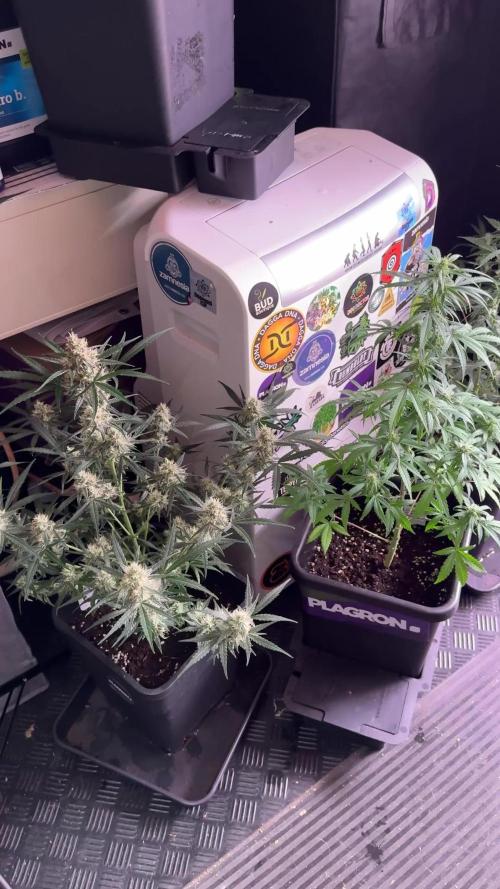
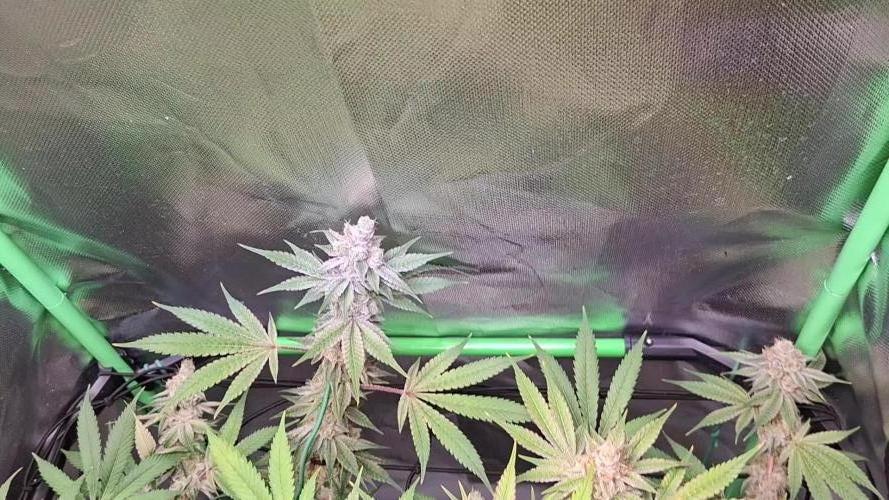
🌿 Frosted Guava Auto by Zamnesia | Pheno B | Week 8 (Flower Week 5) 🌿
Small Plant. Big Personality. And Now… A Little Less Green.
There are plants that follow the plan.
And then there are plants that write their own story.
Frosted Guava Pheno B has been doing the latter from the beginning.
She has never been the biggest plant in the room. She hasn't chased height, hasn't tried to dominate the canopy, and hasn't demanded much intervention.
Instead, she has quietly developed her own personality.
Compact.
Elegant.
Beautifully structured.
And increasingly covered in flowers.
Now, entering her fifth week of flowering, she has reached another important moment in her journey.
This week, she joined the group receiving a selective flowering defoliation.
Not because she was struggling.
Not because she was unhealthy.
And certainly not because every plant needs to be defoliated.
Quite the opposite.
She was looking fantastic.
But after looking carefully at her structure, her development, and the way light and airflow were moving through the plant, I felt that removing some unnecessary foliage was the right decision.
So we went in.
We cleaned her up.
And now we're going to see what she does with the extra space.
🌸 Week 5 Flower – Her Own Story
Frosted Guava Pheno B is currently around 108 cm tall.
That still makes her one of the more compact plants in the room.
But honestly?
I don't think she cares.
😂
She has found her own architecture and she's sticking with it.
The flowers continue developing beautifully, with increasingly visible frost and those characteristic white pistils reaching outward from the developing buds.
Her foliage has remained lush and healthy, with that beautiful deep green colour we've been following since the beginning.
The plant looks comfortable.
The flowers are developing.
And now we're starting to see more definition between the different parts of the plant.
This is exactly the kind of moment where stepping back and looking at the whole plant becomes important.
Because sometimes the question isn't:
"Can I remove this leaf?"
The better question is:
"Does this leaf still have a useful job to do here?"
And that's where this week's defoliation came from.
✂️ Defoliation – What We Actually Did
This wasn't a complete strip.
It wasn't a race to make the plant look naked.
And it wasn't about removing leaves simply because they were large.
The approach was selective.
I removed most of the fan leaves carrying their own petioles, particularly where they were contributing to unnecessary shading or creating congestion inside the plant.
I also cleaned the lower and interior portions of the plant where some flowering sites were positioned so far below the productive canopy that I didn't expect them to develop into meaningful flowers.
Those areas are what I would consider the true bottoms on a compact plant like Frosted Guava.
And that's an important distinction.
Because this plant is small.
Her lower sites really are lower.
Even with the Lumiflora under-canopy lighting helping bring additional photons into the lower canopy, the primary productive zone of the plant remains higher up.
So rather than allowing the plant to spend resources maintaining foliage and very low sites that are unlikely to contribute much, I decided to clean those areas selectively.
But I didn't remove everything.
Some lower flowering sites remain.
I want to see what they can actually do.
That's part of the experiment.
🌿 What Is Defoliation?
For anyone new to growing:
Defoliation is the intentional removal of selected leaves from a plant to alter the structure of the canopy.
The goal isn't simply to have fewer leaves.
The goal is to create a better balance between:
light penetration + airflow + canopy structure + productive flowering sites.
Leaves are extremely valuable.
They're the plant's solar panels.
So removing them should never be treated as something automatically beneficial.
Every leaf removed is a piece of photosynthetic machinery removed.
That's why I don't approach defoliation as:
"Flower started. Time to strip the plant."
Instead, I look at the plant in front of me.
Is the canopy becoming too dense?
Are leaves heavily shading developing flowers?
Are there congested areas where airflow is poor?
Are there leaves that are doing very little because they're buried underneath several layers of foliage?
Are there lower sites that realistically have very little opportunity to develop?
If the answer is yes, then selective defoliation can make sense.
If the answer is no...
Leave the plant alone.
🚫 What Defoliation Is NOT
This is probably even more important.
Defoliation is not:
❌ Removing every fan leaf
❌ Trying to expose every single flower to direct light
❌ A substitute for good plant structure
❌ A guaranteed way to increase yield
❌ Something every plant needs at the same time
❌ An excuse to strip a healthy plant simply because you can
The objective isn't to make the plant look clean for the sake of appearance.
The objective is to improve the functional canopy.
And there's a big difference.
A beautiful green leaf isn't a problem simply because it's a beautiful green leaf.
If it's healthy, receiving light, contributing to photosynthesis and helping the plant, I have no reason to remove it.
But when the canopy becomes crowded and certain leaves are contributing more obstruction than productivity, that's when selective removal becomes interesting.
✂️ How I Approach It
My approach is simple:
I observe first.
I don't start with a predetermined number of leaves that must disappear.
I start by looking at the structure.
Then I work from the outside toward the interior and from the top toward the lower portions, looking for unnecessary congestion.
Leaves that are heavily shading productive flowering sites can be candidates.
Leaves buried underneath several other leaves can be candidates.
Leaves occupying congested interior areas can be candidates.
And lower growth that is so far beneath the productive canopy that it has little realistic opportunity to develop can also be considered.
But I always keep the plant's overall health in mind.
The goal is balance, not maximum removal.
That's why Pheno B still has plenty of green.
She's not naked.
She's simply better organized.
💡 The Under-Canopy Question
This is particularly interesting with Frosted Guava Pheno B because we're running Lumiflora under-canopy lighting.
Someone might reasonably ask:
"If you have light underneath, why remove the lower growth?"
That's a very fair question.
And the answer is that under-canopy lighting doesn't magically make every lower flower equal to a top flower.
On a compact plant like this, the very lowest parts are still extremely low relative to the main productive canopy.
The under-canopy lighting is helping reinforce the lower and interior areas, but I still want to observe where the plant naturally allocates its energy.
That's why I deliberately left some lower flowering sites behind.
I don't want to assume.
I want to watch.
Will those remaining lower sites develop?
Will the extra light make a noticeable difference?
Will the upper flowers continue dominating?
That's exactly the kind of question this project allows us to explore.
And the harvest will eventually give us the answer.
☀️ More Light Where It Matters
The Future of Grow Black Series LED continues providing the primary light from above, with approximately 1,000 PPFD across the upper canopy.
Frosted Guava may be compact, but she certainly isn't short on photons.
She's been sitting underneath that light throughout flowering, converting those photons into leaves, flowers, structure and now increasingly visible resin.
And with the selective defoliation, we're changing how some of those photons move through her architecture.
We're not creating more photons.
We're simply trying to make better use of the ones already available.
That's the idea.
Don't waste energy chasing light.
Build a canopy where the available light can actually do its job.
❄️ And The Frost Is Getting Serious
The name Frosted Guava continues becoming more appropriate every week.
The flowers are developing beautifully, and the resin production is becoming increasingly visible.
Those white pistils are still everywhere, creating an incredible contrast against the deep green foliage.
And underneath all those hairs, the flowers are beginning to gain more structure and density.
This is the stage where I love looking at the same plant from week to week.
Because the change isn't always dramatic overnight.
But compare the plant to where she was a few weeks ago...
And suddenly you realize:
She's building.
She's filling out.
She's gaining flower volume.
She's becoming increasingly defined.
She's becoming Frosted Guava.
🌿 Small Plant. Big Character.
I've said this about her before, but this week makes it even more obvious.
Frosted Guava Pheno B doesn't need to be the tallest plant in the room.
She's already found something more interesting.
Character.
Her sister Pheno A has followed a different path.
And that's one of the beautiful things about running phenotypes together.
Same genetics.
Same room.
Same light.
Same nutrition.
Same philosophy.
Different personalities.
Pheno B has chosen to remain compact and elegant.
And now, as flowering progresses, she's showing us exactly what that compact structure can become.
💧 Nutrition & Hand Watering
We're continuing with hand watering throughout the room.
Current feeding remains centered around the Plagron flowering program:
Terra Bloom — 2.2 ml/L
Power Buds — 1 ml/L
Sugar Royal — 1 ml/L
Green Sensation — 1 ml/L
Lemon Kick — 0.03 ml/L
Current recorded parameters are around:
pH: 6.0
EC: approximately 2.0 mS/cm
Solution temperature: 21°C
Root-zone temperature: 21°C
Watering: approximately 1.2 L per 24 hours
Hand watering has also given me another opportunity to observe this plant closely.
Every time I water her, I get another chance to look at the flowers, inspect the leaves, check the structure and notice those tiny changes that are easy to miss when everything is automated.
It takes more work.
But it also brings you closer to the plants.
And sometimes that's where the best observations happen.
🌡️ Environment
The room continues running under stable conditions:
Day temperature: 29°C
Night temperature: 25°C
Relative humidity: approximately 72%
Solution temperature: 21°C
Root-zone temperature: 21°C
CO₂: approximately 639 ppm
With the canopy becoming increasingly dense, airflow and humidity management become even more important.
That's another reason selective defoliation can be useful at this stage.
Not because leaves are inherently bad.
But because a dense flowering canopy can create small pockets where air movement becomes less effective.
Opening selected areas gives the room a little more breathing space.
And that's particularly valuable as the flowers continue developing.
🔭 Looking Ahead
Now comes the interesting part.
We've changed the architecture.
We've removed some unnecessary foliage.
We've cleaned the lower sections.
We've opened some of the interior.
And now...
we wait and observe.
I want to see how quickly she responds.
I want to see how the flowers develop with the improved canopy structure.
I want to see what happens to those lower sites we deliberately left behind.
And most importantly, I want to see how Frosted Guava Pheno B continues writing her own story.
Because she's already made one thing very clear:
She doesn't need to follow anybody else's timetable.
❤️ Final Thoughts – Let Her Shine
Frosted Guava Pheno B has been one of those plants that quietly earns your attention.
She didn't arrive in the room demanding the spotlight.
She didn't become the tallest.
She didn't become the biggest.
She simply kept growing.
And week after week, she became more beautiful.
Now she's entered another chapter.
A little less foliage.
A little more breathing room.
A little more light moving through the canopy.
And plenty of flowers left behind to show us what she's capable of.
The important thing about this week's defoliation isn't how many leaves we removed.
It's why we removed them.
Because good cultivation isn't about following a recipe blindly.
It's about looking at the plant in front of you and making decisions based on what she's actually telling you.
And Frosted Guava Pheno B was telling me:
"I'm ready."
So we listened.
Now let's see what she does.
A huge thank you once again to Zamnesia for these beautiful genetics, Plagron for the nutrition, Future of Grow for the Black Series lighting, Lumiflora for helping illuminate the lower canopy, TrolMaster for environmental control and of course to everyone following this 8×8 Adventure on GrowDiaries.
Every week, every phenotype tells us something different.
And that's exactly why I love this project.
Until next week...
Let her shine. She has earned her spotlight. ✨🌿❄️
Growers love and happy growing! 🌱💚


Likes
21
Share


@PeterSage
Follow
Plant is fine, except one stormy night the weather is just fine.
Heard that is gonna be a nice September, hope they are right. I plan to cut the tree on the second/third week of September.
Yes some yellowing leaves, I still think is the aging process and a little bit of K deficiency, that should have decreased, and looks like it has, new growth are just fine and there is no worsening.
Still watering with:
Big bud, 2 ml x L
CalMag 2 ml x L
Bio Bloom 3 ml x L
silica, one tablespoon
neem oil
propolis
aloe

Likes
Comments
Share
@DogDoctorOfficial
Follow
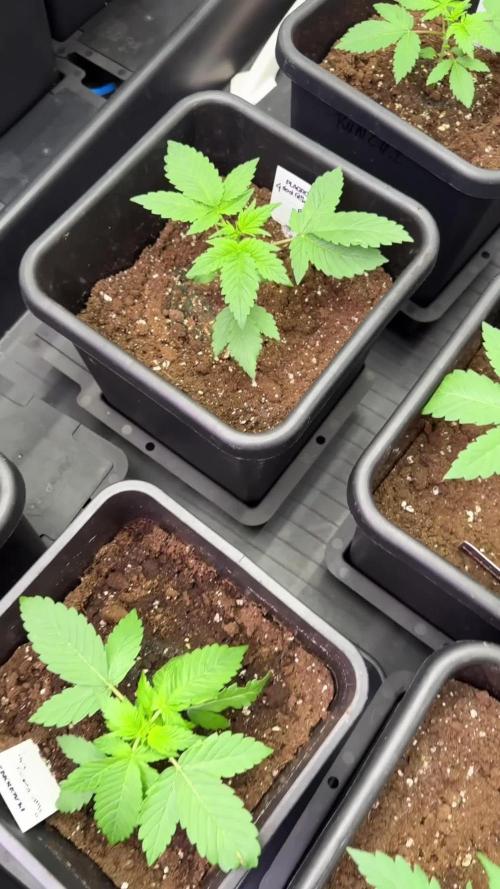
Cash Express – Pheno B | Week 3
Small Sister, Big Potential
Welcome back to another week of the 8×8 Adventure, where every phenotype earns its own place in the spotlight. While sister plants may share the same parents, they rarely tell exactly the same story—and that is one of the most fascinating parts of growing from seed.
This week brings us to Cash Express Pheno B, the quieter sister of the pair.
At first glance she may appear slightly behind Pheno A in overall size and development, but spending a little time with the photographs reveals something far more interesting.
This is not a weak plant.
This is a plant writing her own chapter.
⸻
Week 3 Environment
🌡️ Temperature: 27.4°C
💧 Relative Humidity: 55%
💡 PPFD: ~700 µmol/m²/s
🌱 Medium: Plagron Lightmix
? Growing Method: 12/12 From Seed
💦 Water Consumption: ~0.9–1.2L per day
Feeding Schedule
Days 18
* EC 1.0
* pH 5.99–6.0
* Approximately 1L
Days 21
* EC 1.3
* pH 6.0
* Approximately 1.2L
The environmental conditions remained stable throughout the week, allowing differences between phenotypes to become increasingly visible.
⸻
Cash Express Pheno B
If Pheno A represents symmetry and textbook structure, Pheno B represents individuality.
She is slightly smaller.
A little less aggressive.
A little less imposing.
But she possesses something equally valuable.
Character.
Looking at the canopy from above, the first thing that stands out is how compact and tidy she remains. While her sister is charging forward with obvious vigor, Pheno B appears to be investing more energy into establishing structure before accelerating upward.
The leaves are healthy and evenly colored.
The stems remain strong.
The new growth is vibrant and active.
Most importantly, the plant shows no signs of struggling despite her slightly slower pace.
In fact, many experienced growers learn over time that the fastest seedling is not always the plant that finishes strongest.
Some phenotypes sprint.
Others build momentum.
Right now, Pheno B feels very much like the second type.
⸻
A Different Growth Rhythm
One of the most interesting aspects of growing multiple phenotypes side by side is seeing how differently plants can respond under identical conditions.
Same tent.
Same nutrients.
Same environment.
Same light.
Yet each plant interprets those conditions through its own genetic lens.
Cash Express Pheno B seems to prefer a more measured approach.
The internodes remain relatively compact.
The branching is beginning to establish itself.
The center of the plant is becoming increasingly busy with fresh growth.
And while she may not command attention immediately through sheer size, she rewards closer observation.
There is a quiet confidence developing here.
A feeling that she is preparing rather than rushing.
⸻
Healthy Signs Everywhere
Several positive observations stand out this week:
* Excellent leaf color throughout the canopy
* Strong, healthy petiole development
* Compact structure
* Good node formation
* Active new growth
* Positive response to increased feeding and PPFD
The fresh growth emerging from the center is particularly encouraging.
Those younger leaves display the lighter green color typical of rapidly expanding tissue, showing that the plant is actively building new biomass and continuing to adapt to the increased light levels.
Nothing about this plant suggests limitation.
Only a slightly different timetable.
⸻
The Beauty of Phenotype Variation
One of the goals of documenting every phenotype separately is to capture these subtle differences.
If both sisters looked identical, there would be little to learn.
Instead, we get to observe how two related plants express themselves in unique ways.
Pheno A currently impresses through vigor and structure.
Pheno B impresses through balance and composure.
Both approaches are valid.
Both are beautiful.
And both deserve their own spotlight.
Sometimes the plant that receives less attention early on becomes the one that surprises everyone later.
I’ve seen that story play out many times before.
Perhaps Pheno B has a surprise waiting for us too.
⸻
Looking Ahead
Over the coming week I will be watching closely for:
* Increased branch development
* Changes in growth rate under the higher PPFD
* Early flowering indicators from the 12/12 schedule
* Structural differences compared to Pheno A
* Signs of unique phenotype expression
At this stage she remains healthy, happy, and steadily progressing.
And honestly, that’s exactly what I want to see.
No drama.
No problems.
Just growth.
⸻
Thank You
A huge thank you to everyone following along with this project.
Thank you to the GrowDiaries community for creating a place where growers from around the world can learn from one another.
Thank you to Plagron for supporting this cultivation journey.
Thank you to Zamnesia for the genetics and the opportunity to document these cultivars from seed to harvest.
And thank you to every grower who takes the time to stop by, leave a comment, share advice, or simply enjoy the journey.
Every plant has a story.
Some tell it loudly.
Others tell it quietly.
This week, Cash Express Pheno B reminds us that quiet stories are often worth listening to.
🌱💚
Growers Love and see you next week, little lady. Keep growing your way.
Likes
3
Share


@Mismatas
Follow
APROXIMADAMENTE CUARTA SEMANA EMPEZAMOS POR PRIMERA VEZ NUESTRO LST Y UNA LIGERA PODA DE BAJOS.
SEGUIMOS CON EL CABLE DE CALOR PUESTO Y TAMBIÉN AÑADIMOS UN CALEFACTOR PARA MINIMIZAR LAS BAJAS TEMPERATURAS

Likes
72
Share

@Growbody
Follow
Meine lieben Freunde und Freundinnen, Brüder und Schwestern im Geistigen und Tatkräftigen, herzlich Willkommen zum Greenhouse Summer Outdoor Grow 2026.
Der erste Strain des Outdoor Grows den ich Euch vorstellen werde ist die Purple Lemonade FF von 2Fast4Buds, eine 60% Sativa die laut FastBuds etwas nebulös als eine Kreuzung aus purple und citrus Cali Genetik beschrieben wird. Egal, sie soll sehr fruchtig und zitronig schmecken und könnte schöne Farben bekommen. Außerdem soll Sie eine kurze Blütezeit haben. Hier ist die URL:
https://2fast4buds.com/de/seeds/purple-lemonade-fast-flowering#description
Der zweite Strain der im Set mit dabei ist, ist die Mimosa x Orange Punch fem. von Barney's Farm, die ihre Genetik und den Taste bereits im Namen trägt, eine 65% Indica, die laut Barney's "ein wirklich sensationelles, zitrusähnliches und mandarinenartig-süßes Aroma" haben soll. Auch sie könnte interessante Farben bekommen. Hier die URL:
https://www.barneysfarm.de/mimosa-x-orange-punch-552
Last but not least, der dritte Strain ist die Chocolate Sherbet fem. von Grower's Choice, eine 70% Sativa, deren Eltern Chocolope x Sunset Sherbet sind. Auf den Geschmack bin ich schon jetzt gespannt, cremiges Haschisch. Mit bis zu 240cm könnte sie die größte im Greenhouse werden und würde dann bis zur Decke wachsen. Hier ist die URL:
https://www.growerschoice.nl/de/chocolate-sherbet.html#description
EDIT:
Nachdem die oben aufgeführten Pflänzchen nicht so recht loslegen wollten, habe ich mich entschlossen, fertige Stecklinge von Hanfgarten aus Österreich dazuzubestellen. Die Stecklinge kommen in die Mörtelwannen, die selbst gezogenen kommen in die bereits bewährten 15 und 20 Liter ROOTiES. So kann ich die auch mal direkt in die Sonne stellen.
Der erste Steckling ist die Blueberry von Hanfgarten, eine 80% Indica, einer Kreuzung aus Afghan Indica x (Thai Sativa x Mexican Oaxacan Sativa), die nach 8 Wochen Blüte Mitte Oktober fertig sein soll. Außerdem soll sie fruchtig, beerig und süß schmecken. Auch hier gibt es eine URL:
https://www.hanfgartenshop.de/blueberry.html
Der zweite Steckling ist die Runtz, ebenfalls von Hanfgarten, ein Hybrid aus Zkittlez × Gelato, die auch nur 8-9 Wochen Blüte hat, mal sehen. Wenn sie ein ähnliches Aroma hat wie die Wurlz bin ich happy. Die URL:
https://www.hanfgartenshop.de/runtz.html
Der dritte Steckling ist die Super Lemon Haze, eine 80% Sativa von Greenhouse Seeds, deren Genetik von Lemon Skunk x Super Silver Haze stammt. Mit 9-10 Wochen Blüte steht sie wohl mit am längsten im Greenhouse. I💖Haze und hier sind die URL's:
https://www.hanfgartenshop.de/super-lemon-haze.html
https://shop.greenhouseseeds.nl/feminised-cannabis-seeds/1-seed-pack/super-lemon-haze/?variation_id=604
Auch dieses Jahr gibt es wieder etwas Neues:
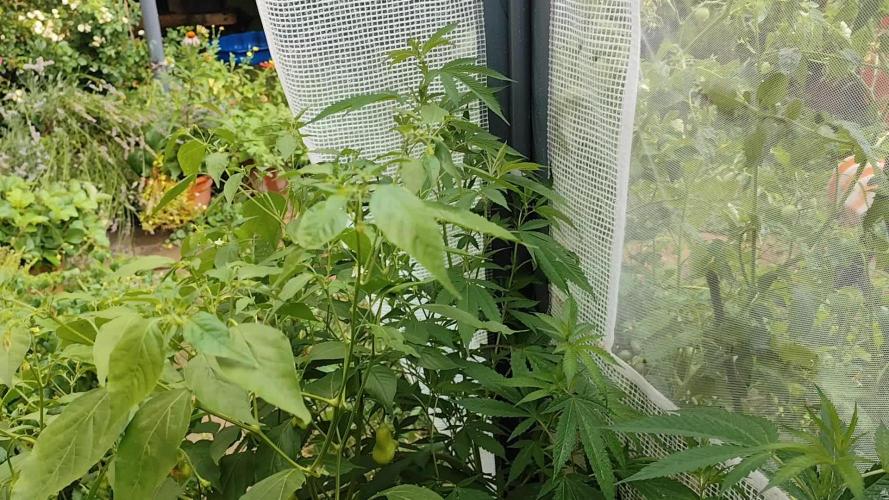
Mir ist vor einigen Wochen im Baumarkt ein Foliengewächshäuschen begegnet. Die Aussicht, meine Schätzchen immer im Trockenen zu Wissen, lies mich sofort (also sofort nach einem Recall mit meiner Liebsten) zuschlagen. Danach war nur noch ein teilweiser Umbau unseres Gartens nötig, einen kleinen Weg anders verlegen, ein Fundament ausheben, Bordsteine zersägen, 2 Zentner Beton verbuddeln, Löcher bohren, verdübeln und verschrauben ohne das der Beton ausplatzt, einen haufen Astwerk vom Wein opfern und viel Rasen neu anlegen, das war's schon fast.
Neu:
Sind auch die zwei 90 Liter Maurerbottiche, in denen sich meine Pflanzen wohlfühlen dürfen, 4x soviel Platz wie im letzten Summer Outdoor Grow. Zur Drainage habe ich Rheinkiesel 9-18 verwendet. Da drauf kam mein altes Erdmischungsrezept mit frischem Kompost von Piluweris, Lehm, den die Wühlmäuse ständig in unserem Rasen aufwerfen und Sand aus'm Kieswerk mit gaaanz viel Staub drinne, praktisch Gesteinsmehl. Auch hier gab's was Neues: Hornmehl zusätzlich, hatich früher schon verwendet und ganz vergessen. Der erste Sack Sonnenerde Hanferde wurde mit der oberen Schicht meiner Mischung vermischt. Der zweite Sack kam dann blank obendrauf.
Neu:
Für mich ist auch die angewendete Keimmethode noch neu, die Samen zuerst in einem Marmeladenglas mit temperiertem Wasser mit Zusatz von Wasserstoffperoxyd keimen zu lassen.
Neu:
In die Wannen kommen zusätzlich Gäste als da wären erprobte und neue sowie überwinterte Chilisorten, verschiedene Basiliken oder -kums, Weiße Melisse, Roter Klee, paar Blumen und so.
Tag 84: Endlich etwas Abkühlung, bewölkter Himmel mit stetem leichtem Regen, 14 Liter pro m² bei tags 35°C (39%) und nachts 17°C und 94% RTL. Die Mörtelwannen bekommen dennoch morgens und abends 10 Liter, die Töpfe ~2 Liter Brunnenwasser. Beim Rundgang durch das Greenhouse während des Regens kam etwas Regenwasser durch die Nähte für die Halterung am Dach. Das muss ich abdichten, die Pflanzen werden zu nass. Auf den Videos ist das gut zu sehen.
Tag 85: Tagestemperatur im Greenhouse heute 32°C bei 45%, nachts leichter Regen mit 1 L/m² und 19°C bei 90% RLF.
Tag 86: Die Blueberry von Hanfgarten ist in dieser Woche um 15 cm auf jetzt 123 cm gewachsen. Die Runtz von Hanfgarten wächst weiter auf 115 cm. Für die Expansion der beiden schneide ich die Zebrange zurück. Die Super Lemon Haze Hanfgarten/Greenhousseeds ist mit 105 cm immer noch die kleinste im Greenhouse, hat jetzt mehr Platz und mehr Licht. In der selben Mörtelwanne steht die Aji Amarillo, nach der Gurke die zweitgrößte Pflanze hier, hat jetzt 3 große Hauptäste, jede Menge Verzweigungen, wirft aber jede Blüte ab. Wenn sich das nicht bald ändert, wird sie kräftig eingekürzt. Die Purple Lemonade FF von 2Fast4Buds hat mit ihren 122 cm 14 cm zugelegt und steht jetzt im Freien. Die Chocolate Sherbet von Grower's Choice kommt auf 160 cm, die Minosa x Orange Punch auf 141 cm, das Höhenwachstum wird etwas langsamer. Auch die beiden stehen jetzt im Freien. Nachts 2 Liter/m² Regen.
Tag 87:



Likes
5
Share


@Bak2Blk
Follow
The girls have grown so much and they already smell pretty good. I'm trying to decide if I should SCROG. I have a trellis net but it's just a net, not the boxy thing that I've seen others with. What do yall think, should I SCROG? GDP2 is in her 5th week. If she were the same age as GDP1 and BK, I'd flip them next week but I'll try waiting at least another couple of weeks to give her some time to grow a little more although she's catching up with the other 2 height. I'll be posting more throughout the week.
7/4/22: Defoliation... I know it's needed but they're my babies.... lololol
7/7/22: Look at my girls... they don't look like they've recently been defoliated. You can tell which ones are the Granddaddy Purples... they have a purple tint to them. The Bubba Kush is super green... 😍😘😍

Likes
15
Share


@Northern_Ent
Follow
Aug 1: strong start to the week- it’s been hot and sunny lately and this will be our third and final day at 30 C.
Lemon Cream Kush looks great and is flowering now after two full weeks of force flowering (12h of darkness).
Aug 4: added another loose Scrog net layer to hold it together but to also allow separation of the colas to expose them to sunlight.
Aug 5: plants in this wagon are getting too big to move easily into garage. Will stop forcing and switch back to 15.5 h of daylight in yard. Still using far red light at dusk as a bloom booster.

Likes
3
Share


@Elguacho420
Follow
Muy buenas a tod@s... Buenas otra semanita para las Green poison... Me van gustando, las veo fuertes, crecen bien... De momento todo en orden, buen ambiente y buena luz, una semana más y a floración... 💪🏻💪🏻 A ver q tal salen... Bueno espero les guste... Un saludo y buenos humos para tod@s... 🔥🔥💨💨💨
⚕️😎💎
🇦🇷🤝🏻🇪🇦
Processing
Likes
9
Share


@russrahl
Follow
Going good so far, end of week 2 and roots are hitting the water on all plant. Topped 3 of 4 Plants at 5th node And the last one is a bit smaller so we will wait a few days to top it still. Changed the water in the system at end of week 2 and added Remo lineup at 3/4 strength along side UC Roots at 5ml/gal.

Likes
2
Share


@Boomdrawfyah
Follow
78 dias de vida hace dos semanas que empezaron la floración la 1051 esta mucho mas avanzada que sus hermanas han sacado un lado genetico más sativo y van a tardar mucho mas en cogollar en general esta todo bien, ha sido temporada de lluvias, tormentas y hay una humedad constante el clima no ayuda, en el mediterraneo siempre en final de temporada vienen lluvias y hay que pelear con el tiempo para poder sacar buenos resultados y evitar plagas

Likes
59
Share


@DogDoctorOfficial
Follow
she performed like a champion and delivered the same way, the fruit quality is out of this world, now needs rest for full potential but i can already tell she is a winner to me!!!
As always thank you all for stoping by, for checking my journey , for the love support and for it all, i am blessed and humble with you all.
Just a reminder , all i grow is medicine for myself, for me and for my best friend with is me nothing to sell, so don’t even ask.
All info and full product details can be find in can find @
https://ganjafarmer.com
https://aptus-holland.com/
#aptus #aptusplanttech #aptusgang #aptusfamily #aptustrueplantscience #inbalancewithnature #trueplantscience #Ganjafarmer #growerslove
With true love comes happiness 💚🙏 Always believe in your self and always do things expecting
nothing and with an open heart , be a giver and the universe will give back to you in ways you could not even imagine so 💚💚💚
More info and updates @
https://growdiaries.com/grower/dogdoctor
https://instagram.com/dogdoctorofficial
https://youtube.com/channel/UCR7ta4DKLFMg2xxTMr2cpIg
💚💚💚Growers love to you all 💚💚

Likes
3
Share




Likes
101
Share


@Ferenc
Follow
Day 73, 25th of November 2020:
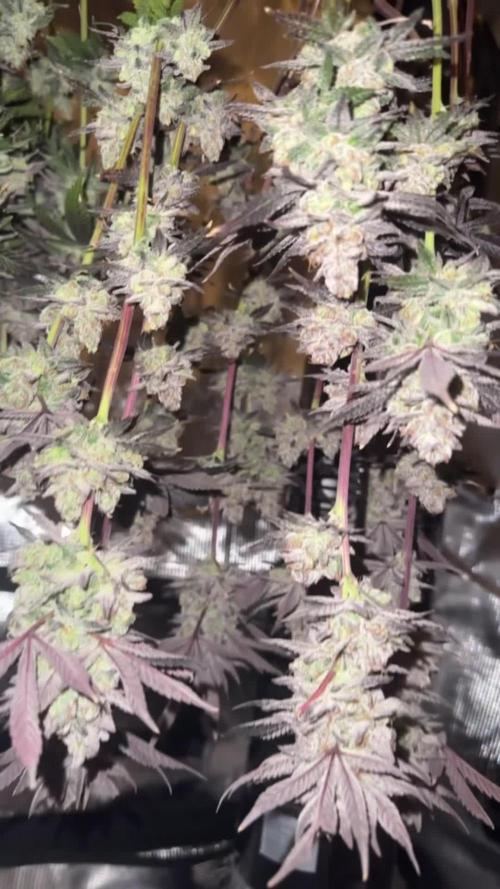
Hi! Well they are getting nice maturing buds getting bigger and all good.
I love the red colour of the Red Hot Cookies. Unfortunately, Tropicanna Poison and Red Mandarnine does not show any signs of purple or red colour.
Kalini Asia neither albeit, the bonsai version gets purple.
Gelato is little beauty. So yes, basically not much to say.
Fertilization is still the same every second day with the ratio and mixture above stated.
The lamp is on 11.15 min and off 12.45 min.
Last week was 15 min longer light cycle....
So every week 15 min shorter light cycle until the 5th week. So far -45 min. It switches on at 6 am and off at 17.15 pm.
Likes
1
Share


@lalee
Follow
first time I grew Dutch passion, and it was orange bud auto. I love Sativa dominant strains, and this strain is now on my favorite list. First on my list is Amnezia haze auto, which is 70% Sativa dominant seedstockers and fastbud seeds. I love it. The second is chocolope DNA genetics feminized; this strain is really heavy and many thc. Three is orange bud auto from Dutch Passion, really nice buds, many thc, and long-lasting sativa effect. This strain really tells you that you are really high.

Likes
13
Share


@Nealrigga
Follow
Week 9.5 been really busy ,I added the light bar under the canopy to help with light penetration as well as a few rounds of defoliation ...they have been very thirsty recently so I've upped the amount of food .

Likes
2
Share

@Psykixx
Follow
Alles viel zu heiß, aber was will man machen... Hoffen das es ab Montag etwas abkühlt.
Ende der neunten Blütewoche sind die Temperaturen zum Glück etwas runter und so langsam kommt auch Farbe rein.
Likes
3
Share


@TheBudWhisperer
Follow
2nd week of stretch in the books and the males showed up on time. We pared the grow down by 4/5 plants. I think I’ve got at least one more male to cull from the lot. Still having serious struggles with getting the females to transition in earnest and cut back all the fan leaves pretty severely to try and encourage some stress induced fruiting.
Still very unhappy with the strain to date and now they’re just taking up space. No issues, nor were any expected in this system and I’ll be happy to be done with these. Now it’s just waiting for the finish.