Likes
Comments
Share

@Terp-A-Derp
Follow
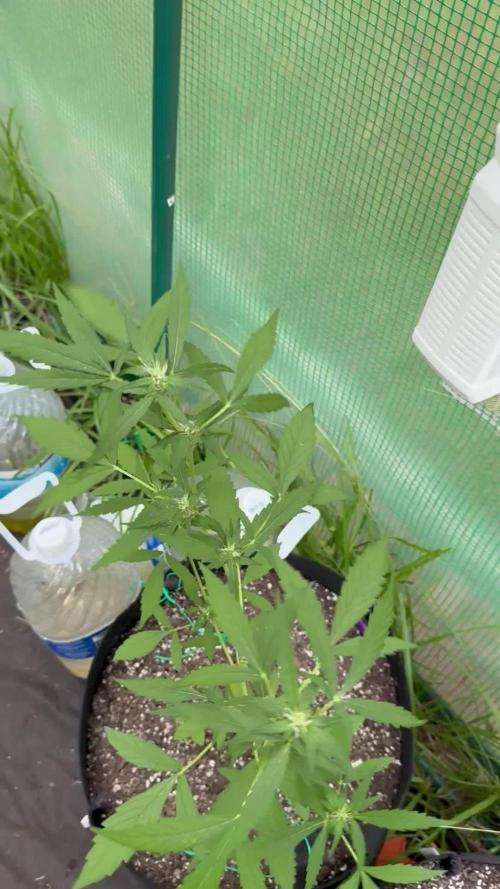
Had a little issue trying to bend the frost banger buds for more spacing.bud tired to brake off so I tried to keep it together like a splice (fingers crossed).Idk if topping the plants have helped or hurt me in the long run but hey there’s a first try for every ting. Tropical like temps this week hopefully they hold up too the heat well. Thanks for following

Likes
57
Share
@Arcadium
Follow
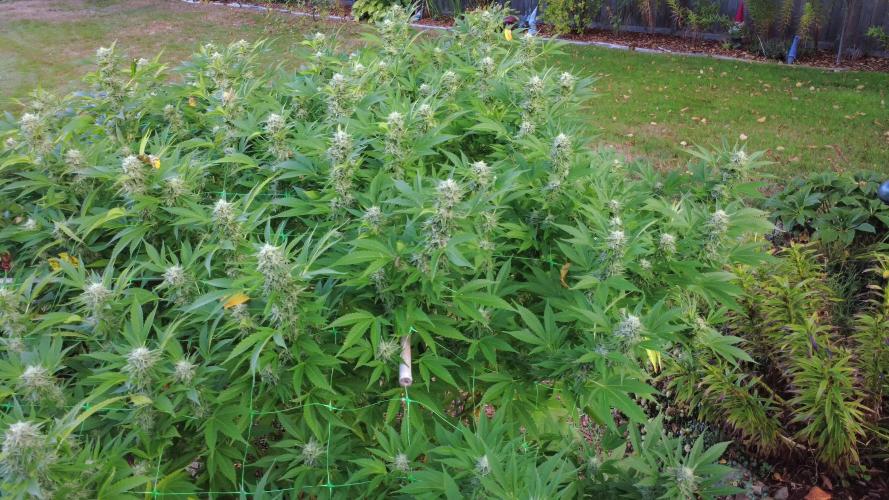
Another amazing week of weather, 24c highs 8c lows, full sun no rain, humid mornings but the large cherry tree above my plant really does minimize morning dew. No matter how much I inspect I can't find any budrot (knock on wood), snipped 1 tiny nug suspect but that's it, I'm utterly shocked. Good genes, even better weather, and incredibly healthy eco system and root zone.
Plan is 1 more week and I will harvest, wash, and dry maybe 1.5lb of tops. Then 1 week later harvest the mid and lower sections straight to freezer for bubble hash. Maybe I'll leave a third to for another week to see how far it will go.
Caught moth laying eggs, very cool to see, so one more spray of BT today and dropping drip irrigation to 45min every 3 days for the rest. It's been over 30weeks total for this one so far, that's 8 months! Wild to think how long that is. Hardly anytime in 12 months I'm not growing something. Those 3 months off will be hash making time.


Likes
27
Share


@TheHollyweed
Follow
GERMAN:
In dieser Woche lief der Grow auch wieder wunderbar und ich kann mich nicht beschweren, es ist einfach nur wunderbar den kleinen beim wachsen zuzuschauen, ich freue mich immer wieder, sobald ich mein Zelt aufmache und mir die kleinen anschaue. Das Topping hat am 26.04.2024 stattgefunden und heute 28.04 geht die Woche auch schon wieder zuende. Mein Plan für die nächste Woche, ist es die kleinen mit Main-Lining-Technik zu biegen und noch ein 2. mal zu Toppen in den nächsten 2 Wochen.
Pink Rosay: 12cm
North Thunderfuck: 12cm
Kings Juice: 17cm
Gegossen wurde diese Woche nur mit Wasser von der Leitung und angepasstem PH Wert, pro Pflanze ca. 700ml. Das ganze wird meine Strategie zum bewässern in den nächsten 2-3 Wochen
ENGLISH:
In this week the grow seems wonderfully again and I can't complain, it's just wonderful watching the little ones grow, I'm always happy as soon as I open my tent and look at the little ones. I'v done the Topping on April 26th, 2024 and today (April 28th) , the week ends. My plan for the next week is to bend the small ones using LST-Technic and topp them a second time in the next 2 weeks.
Pink Rosay: 4,72441 zoll
North Thunderfuck: 4,72441 zoll
Kings Juice: 6,692 zoll
This week I only watered with water from the tap and an adjusted PH value, approx. 700 ml per plant. And this is my watering strategy for the next 2 to 3 Weeks.


Likes
15
Share


@DailyhighclubNLyara
Follow
Okay so the result of my LST surprised me like a lot. The plant looks great under the light, it’s still my second grow so I hope to learn a lot about the beautiful plants and how they respond. I want to experience everything to learn from them and know how to respond.
I think this week went good but the dry wet cyclus is something I really needed to learn this week. I first tried watering every day but i noticed that the soil wasn’t dry at all, so I thought no that’s maybe just the soil. *Ive learned this cycle in the next week* spoiler alert: it wasn’t
I still give around 1 tbsp of the molasses because the plant is really responding good to it.
The small plant is also looking healthy so perfect, just keep giving her love.
I did a big oops:
So, the plant grew bigger and bigger and faster then I could keep up. So I decided to lst some more, Olga went perfect and I build a lot of confidence from that. So... busy with the other “big” plant and I started doing the head top, but the band was just to tight, but I noticed that to late *SNAP*. Did I just snapped the biggest branch of the middle plant? Yes, I hated myself for 4 days until I thought: there are no mistakes, just happy..... (fill in with your brainpower) well see what happens

Likes
52
Share


@jmsky
Follow
In veg, it responded well as I learned about how to best train it. In flower, the smell was insane... after the first smell my eyes rolled back. Sweet floral orange citrus with a hint of chemical cleaner smell that comes together to smell like a tropical sunscreen.
When I was trimming the tester, my friend was walking by and stopped in his tracks, "whoa which one is that!?" - this one is loud! The smell is super strong even after drying, and really translates into the smoke. This was the star of the show, and made the best smoke. 10/10 would grow again.
One small issue was that this plant was by far the most susceptible to powdery mildew. It started on this plant, and any time it popped up in the tent, this plant had some. I had to stay on the Dr Zymes and trimming any affected leaves, but it was worth it.
Overall I ended up with just under 40g, but I smoked a bunch while trimming and took a sample cut, so really it was 7-10g more... this one was chopped on day 64. The buds were fat and firm and the trichomes looked ready, with a good mix - probably 5% clear 85% cloudy 10% amber.
I trimmed this plant 2nd and was getting better at it, ended up with some really nice looking nugs... so of course I took a ton of pics!


Likes
5
Share


@GrowFunMD
Follow
Harvested Plant #2 and Plant #3 at 11 weeks. Still have #4 and #5 to go. They are just about ready. Been waiting until the leaves turn purple. These plants have been flushing for weeks because I thought they were going to be done sooner, but they haven't missed a beat. They have a very strong, sweet smell. I highly recommend Cobbler Crisp!!!

Likes
2
Share


@Gumbassman
Follow
She is B-E-A-UTIFUL, she has a very nice smell to her. Small burns from nut. But plenty bud sites and biggest of the bunch.

Likes
12
Share


@Ge252
Follow
The 7 blue gelato 41s are doing ok theyre hermie/pollinated perhaps as the calyxes have swelled but gonna run them the whole way through as an experience for my first grow.
The stems also smell very good like blueberry/ cookie

Likes
Comments
Share

@DonEspas
Follow
Nous sommes maintenant à la 4 ème semaine et pour nous proche du passage box de floraison 🌺
Arrosage TCO cette semaine
Topping de la plupart des apex de chaque branche
Soin des coupures avec la cannelle
Installation du filet de LST
Les orties les plus vigoureux ont été tordu pour ralentir leur croissance et faciliter l'installation u plant de canna

Likes
2
Share


@Ultraviolet_
Follow
Topped once, turned off IR @ nights, slowed vertical growth back down, and took off both of the very lowest internodes on each plant.
Eisenia fetida
Stratiolaelaps scimitus
Armadillidium vulgare
Red wigglers (Eisenia fetida) are highly beneficial. They are considered an ideal choice for "no-till" or container-based organic growing because they live in the upper layers of soil, feeding on organic mulch rather than the plant's root system. Red wigglers accelerate the breakdown of organic amendments and produce high-quality, nutrient-dense worm castings directly in the root zone. Clover is another exceptional component of an organic rhizosphere, offering a sustainable, self-sustaining alternative to synthetic nitrogen fertilizers produced via the energy-intensive Haber-Bosch process. By forming a symbiotic relationship with Rhizobia bacteria, clover converts atmospheric nitrogen N2 into ammonium NH4, providing a steady, slow-release nutrient source that enhances soil health and reduces environmental impacts. Red clover offers superior nitrogen fixation and biomass production compared to white or yellow clover, making it the premier choice for maximum soil vitality, particularly for improving soil structure and providing a high-volume nitrogen credit for subsequent crops.
If it is fully functional and efficient soil, the rhizophagy cycle is superior long-term than any synthetic delivery when it comes to preventing deficiencies, not because it's "better," per se. The medium will require a very high CEC to make it to harvest without re-fertilization. The rhizosphere acts as a dynamic, interactive exchange where plants and soil microbes trade resources based on immediate needs. When a plant lacks a specific nutrient, it changes its physiology and releases specialized chemical cocktails—root exudates—into the surrounding soil. These exudates, which include sugars, amino acids, and organic acids, serve as a "shopping list" to attract specific microorganisms, which in turn return higher levels of desired nutrients. There is nothing in comparison when using synthetic delivery, which can cause plants to stop producing exudates, effectively "starving" the beneficial soil life, over time turning the soil barren and void of microbial life. Responsible use, applying the right amount at the right time, can minimize these negative effects. Relying solely on synthetic fertilizers without replenishing organic matter is what typically leads to exhausted soil. The use of synthetic fertilizers can utilize the Cation Exchange Capacity (CEC) of the soil, but without a robust rhizosphere and active microorganisms, the efficiency of this process is significantly reduced. This makes synthetic growing more difficult to prevent deficiencies overall compared to an efficient organic living soil with a robust rhizophagy cycle, as there is no "one size, fits all" when it comes to different nutrient profiles of strains/genetics, making it trickier to "guess" and prevent creeping deficiencies.
CEC does not contribute towards EC. Add more CEC using biochar, problem solved. If you keep pH between 6.3 and 6.7, hydrogen is exudated to cycle the medium's CEC for its needs. Keeping the pH between 6.3 and 6.7 creates an environment where plants release H+ to displace positively charged nutrients (like Ca2+, Mg2+, K+ held on soil particles or within artificial media this cycle through nutrients via the medium's Cation Exchange Capacity (CEC)
Microorganisms generate a stable potential of approximately 0.5 V EC. The rhizosphere creates its own food, similarly to chelation, using 1000's of varying combinations to create its own food.
Start to finish, just add water. Eventually, more materials will need to be added at the beginning of each new grow, but very attainable to go from seed to harvest without ever fertilizing.
ATP is important when it comes to biomass accumulation. Cellular root respiration and cellular respiration are essentially the same biological process, the breakdown of glucose to create usable energy (ATP) in the presence of oxygen, just taking place in different parts of the plant. Synthetic (salt-based) grows have significantly lower levels of total rhizosphere respiration, often referred to as root-zone activity, compared to organic living soil grows. While the plant roots themselves may respire in both systems, the surrounding soil ecosystem in a living soil setup is vastly more active, teeming with bacteria, fungi, and beneficial microorganisms.
2 pools of ATP, it won't double in growth buuuut, but improving root respiration by ensuring high oxygen in the soil is crucial. Good aeration ensures roots can fully utilize glucose to generate the ATP necessary for nutrient uptake, leading to healthier and more productive plants, even if growth isn't exactly doubled. The ATP created using root respiration is dedicated to rootzone growth; the ATP created using regular cellular respiration in a synthetic system would have to dedicate a lot of ATP to the roots when there is little or no root respiration. It's true that there is less of an initial ATP cost in breakdown when nutrients are already in their final form (synthetic), but you lose a solid chunk of ATP when the entire plant is reliant on cellular respiration alone; a large portion of ATP is dedicated to root zones for "forced" nutrient uptake rather than traded. Making it overall less efficient, even if the initial cost of breakdown is higher. Not sure if I butchered that but one can hope It makes sense.
Oxygen is of critical importance when growing in living soil compared to synthetic soil because it supports the metabolic needs of the microbial, fungal, and insect ecosystem, rather than just the root respiration required by the plant itself. While synthetic grows can survive in lower-oxygen environments with precise mineral feeding, living soil systems rely on aerobic microbes to decompose organic matter (microbial mineralization) to create plant-available nutrients, which is an oxygen-intensive process. While a specific fair percentage is difficult to guess, my experience points to a massive, compound difference between the two methods and the amount of oxygen required. All the ATP spared is used on more biomass, not only that, but the extra root respiration can achieve a much higher CO2 compensation point naturally than you could with synthetic and atmospheric CO2 alone.
As a plant grows faster and increases in size, its demand for nutrients to support that growth increases, requiring a higher rate of nutrient uptake. As plants enter phases of rapid vegetative/floral growth, their metabolic demand for nutrients increases exponentially. Without a robust buffer zone—whether in the soil (cation exchange capacity) or in a hydroponic reservoir—deficiencies will occur rapidly because the instantaneous demand for specific nutrients can quickly exceed the rate of supply.
A growing body of evidence suggests that organic living soil provides superior long-term soil health and environmental benefits compared to synthetic fertilizers, which are often criticized for promoting a cycle of dependency and degradation. While synthetic fertilizers offer short-term convenience and high yields, they often come at the expense of long-term soil health, sustainability, and increased corporate control over growers/ farmers. Organic living soil, while slower and requiring more care to establish, creates a sustainable, resilient, and, ultimately, more fertile environment.
We don't really grow; we facilitate energy conversions, and energy is just numbers. Because the universe works the same way today as it did yesterday, there is a single, fundamental mathematical quantity that remains constant. We call this quantity energy. You cannot put "energy" under a microscope. You observe matter and forces (like heat, motion, or light), but energy is just a scalar number calculated to help predict how these things will change and interact. When an object falls, or when a battery powers your phone, matter shifts and changes form. Through it all, the universe ensures the "total score" of the numbers remains exactly the same.
Once all water is removed, approximately 95% to 97% of a plant’s dry matter consists of carbon, oxygen, and hydrogen. These three elements form the structural backbone of all plants. NPK & all the rest 3-5%.
Indigenous Amazonians created, or at least significantly enhanced, the fertile, dark soil known as Terra Preta de Índio (Portuguese for "Indian Black Earth") by incorporating biochar and other organic materials into the soil. This anthropogenic (human-made) soil technique, which dates back roughly 2,500 to 8,000 years, allowed ancient civilizations to flourish in regions with naturally poor, acidic, and nutrient-poor tropical soils.


Likes
27
Share


@Salokin
Follow
Nothing to be mentioned, the plants reek like crazy, I cannot keep tent open for too long without stinking up the entire house. Other than that, they are freaking amazing. Will probably start flushing next week, if the trichomes start turning brown. Loving this strain, sooooo strong and tasty and this clone looks even better than the plant.
Likes
10
Share


@little_Boncannasai
Follow
🌱 Dulræntgosas kleines großes Reiseabenteuer 🌱
Hallo ihr feurigen Abenteurer.
Vielleicht hat der ein oder andere gedacht, "Dass wird sie niemals schaffen!" Nun, was soll ich sagen, mir geht es den Umständen entsprechend eigentlich ganz gut. 😁
Ja es ist noch eine Herausforderung und es strengt auch sehr an. Aber meine Wasserspenderin kümmert sich rührend um mich.
Der besondere Zaubertrank für meine Wurzeln und die andere Zutat fürs Wachsen, sind sooooo lecker.
Und das lässt sich wirklich sehen. Wie ein wilder Drache sprieße ich langsam in die Höhe. Meine Wurzeln bahnen sich sichtbar ihren Weg durch die Erde. Groß und stark, kann ich meinen Schatz bewachen.
Und seit heute, bin ich wild!
Ja, ihr habt richtig gelesen. Mit meinen zarten 17 Tagen, stehe ich nun endlich unter der grellen brennenden Scheibe am Himmel. Die Zeiten in meiner Drachenhöhle sind vorbei.
Ich bin frei, wild und mutig für das neue Abenteuer!
Monstergeschichten machen mir keine Angst. Im Gegenteil, sie fordern mich gerade zu heraus. Sollen sie kommen, die Fraßlinge aus den dunklen Schatten, in der Nacht. Denn meine Wasserspenderin wird sich was einfallen lassen!
Viel mehr gibt es zur Zeit noch nicht zu erzählen. Aber bleibt gespannt, das Abenteuer wird mit Sicherheit noch aufregend werden.
Liebe Grüße eure Dulræntgosa
"die Drachen-Lady"
Likes
46
Share


@LittleBigTrees
Follow
Defoliated and trimmed lower fluff from The plant day 20 flower ,
Lots of air and light can now get to the plant and hopefully grow some nice buds
Likes
Comments
Share

@DonvitoCultivation
Follow
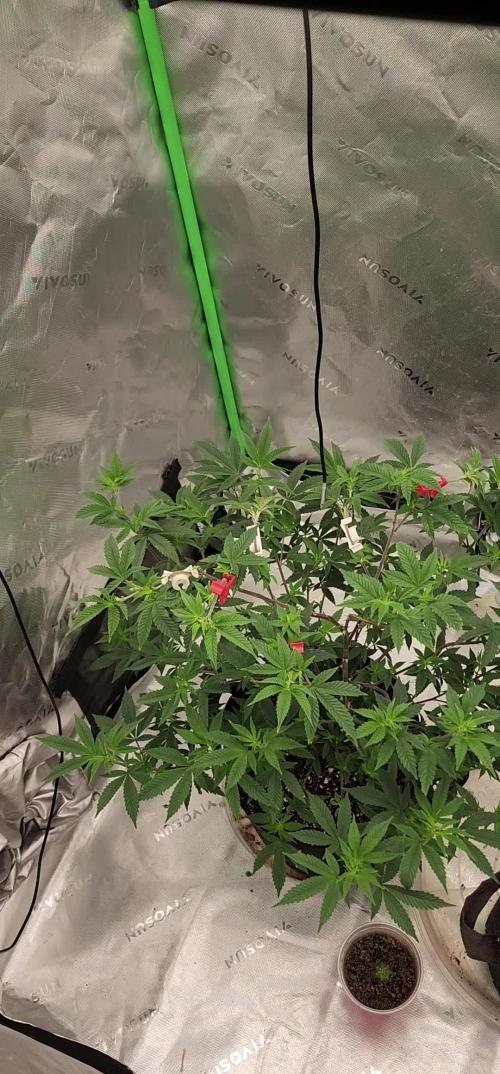
Growing nicely thinking about flipping her soon..what do you guys think


Likes
60
Share


@julian100614
Follow
Su 5 semana empezó con una nueva casa, mas grande, mas amplia para seguir creciendo como hasta ahora 💪💪
Por el momento vamos a continuar con los nutrientes de vegetacion, en este caso de CANNA 👌