


Likes
Comments
Share

@Smoking_Joe_Frazier
Follow
10.08.2026
Almost there
Hi Growmies,
welcome back to week 9 of my Fast Buds Auto Grow. This grow is clearly heading towards the finish line.
Weather and Conditions
I’ve never had a grow where the weather has been this consistently hot. I actually think it’s been a little too hot, as days with 35°C or more seem to slow the growth down.
Even in my tomato greenhouse, most of the plants are showing some heat damage, so a few degrees less wouldn’t hurt.
But with the finish line getting closer, I’ll take dry and hot weather over rain any day. Maybe these conditions will even help me avoid any nasty mold problems during the final weeks.
Growth
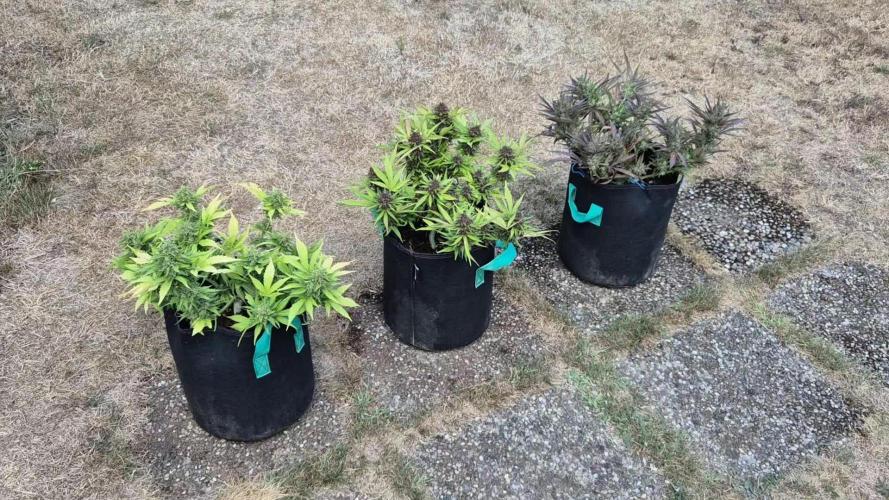
All three ladies are slowly bulking up, although the progress isn't particularly dramatic anymore.
The buds are getting really rock hard, while the smell seems to have reduced a little compared to the last couple of weeks.
I guess the girls are now putting most of their remaining energy into finishing and ripening.
Papaya Cookies
She is just beautiful. The combination of purple buds and orange pistils is pure eye candy. She has become a real beauty and I absolutely love looking at her.
I guess she'll be ready for harvest next week.
Tangie
She's the biggest girl in the garden. I expected her to take the longest because of her Sativa genetics, but this particular pheno seems to be a pretty fast one.
The smell is still classic Tangie — that fresh orange aroma I already loved earlier in the grow.
Apricot
Apricot will definitely be the smallest yielder of the three. Towards the end, most of her bud sites have started to foxtail. I assume this is a reaction to the extreme heat, especially since she has absolutely no sunshade.
But when it comes to smell and trichome production, she is absolutely crazy. She's still incredibly frosty and smells amazing. I think I'll cut her down next week as well.
Feeding
As I already teased last week, I've now switched completely to T.A. FinalPart for the final stage.
The idea is to help the plants finish while using up the remaining nitrogen stored in their leaves. And you can definitely see that happening now — the fan leaves are fading rapidly.
Pests
Still nothing to complain about.
The aphids and ants are still completely focused on the cucumbers, so I'll happily let them stay there. The grow gods are still on my side this year.
Final Thoughts
I checked the girls with my microscope and was surprised to already see around 10–20% amber trichomes.
Papaya Cookies and Apricot could probably be ready next week. Tangie might need another week, but I'll make that decision when the time comes.
For now, I'm just enjoying the final days of this grow.
Alright my friends, that's it for this week.
Catch ya next week!
Smoking_Joe_Frazier

Likes
17
Share


@Eddjack
Follow
Sta andando benissimo, ha reagito bene al topping al 6 nodo. Ora ha due belle cole principali, gli altri rami l'ho legati alle foglie a ventaglio in mondo da farli partire orizzontalmente. In oltre ho anche abbassato l'umidità al 50% per spingerla a bere dalla terra.si è ripresa subito dopo appena 24 ore ha ripreso tutto il suo vigore e bastato una bella inzuppata . Ora qualche altro giorno di riposo e la mando in fioritura .

Likes
7
Share


@KannaGrowing
Follow
Estamos en la tercera semana de crecimiento vegetativo.
Nuestras plantas ya tienen unos 15 centímetros aproximadamente, y han superado la fase crítica.
Recordamos que hasta ahora solo estamos regando con agua, aún no hemos incorporado los fertilizantes.
Seguimos manteniendo la humedad relativa bastante alta, y la temperatura entre 22 y 24ºC.
Pero aumentamos la potencia al 50% de ambas luminarias.

Likes
27
Share


@Lordshiva83
Follow
Olá companheiros, estas meninas da barney's farm, estão muito bem tiveram duas semanas a 24 /24h de luz agora passei a 20h de luz e 4h escuro, as meninas foram transplantadas para vaso de 26 litros, a shiskaberry está a crescer muito para cima por isso fiz um pequeno LST, abraço amigos, aceito sugestões ✌️🌱

Likes
64
Share


@Ju_Bps
Follow
Hello happy Growers!
This week was better than early,
I've founded few very litle banana spend the week,
I will continue to check this week,
Harvest will be in 2 or 3 weeks, I hope can take situation under control untill harvest.
If banana start to be too big, I'll remove the branch.
If no, buds start to be compact, Nice sweet smeel and sticky,
Probably my last fertilizer week, after I'll start flush
Plant start to take less water, sign harvest for soon :)
Have a good week my friends
Likes
17
Share


@Mr_nugs_lover_David
Follow
This wonderful ak 420 is developing very good, now she's been Transplanted ill start working on her lst to get a very beautiful ak420 bush. She's looking super healthy on her living soil by florganics and she's developing very fast. Let's see what happens.

Likes
17
Share


@Fitzwell
Follow
The start was easy as it gets just add water the first 20 days and LST every day. When i saw some of the lower leaves start to change color that's when i started to add nuits. after that it was just following the instructions foxfarm already had laid out for me. I cut back by half in the start of my feeds but by the end of my grow I was at full strength. Testing your run off is key. Cropking send me great seeds and genetics is a great foundation and starting point.
---------------------------------------------------------------------------------------------------------------------------------------------------------------------
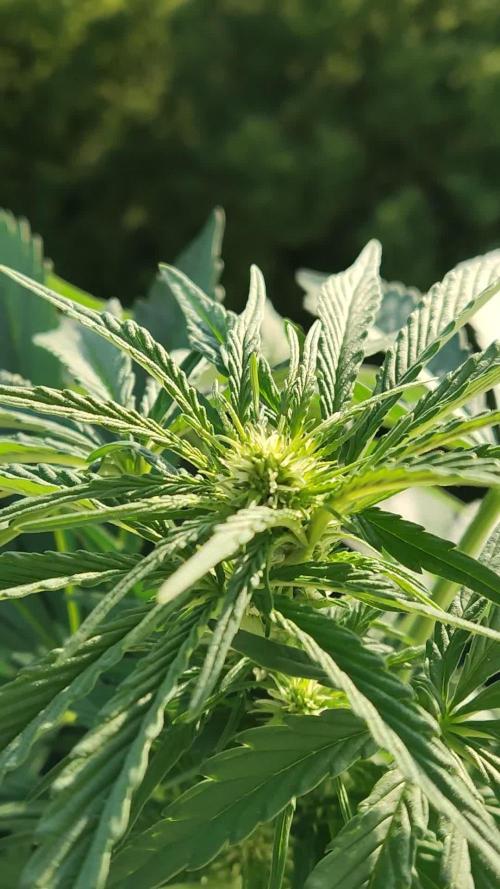
I was very happy I got almost 5 ounces off one plant.



Processing
Likes
11
Share


@OrganicAlphapak420
Follow
Fed only distilled water every 2-4 days as needed. Trimmed off the clovers n alfalfa. They wer getting in the way of my watering n it also helped reduce the humidity . I also put a layer of perlite underneath the pots to help reduce trap water n circulate air below the pots..they are done strething n are well into blooming. The super skunk in the bak right corner is beginning to show some atumn colors n it's a sign it's nearing harvest. It's the densed one. Clearly it'll be the 1st one done. The others still got a few more weeks to go. Hopefullythey'll be done b4 thanksgiving. I look foward to see how they turn out. .will update next week on their progress. .
Likes
5
Share


@alafmalaf
Follow
This week I basically gave the certs, fixed the light intensity and got my humidity control system all dialed in. The plants have seen more growth than ever! The seedlings are definitely growing way better than the older plants so I'm not sure what to do now I'm regards to flowering all of them or focusing my energy on a few
Likes
40
Share


@GYOweed
Follow
Still super green.
Just started getting white trichomes.
I may need extra few days to flush and do 48hr dark

Likes
111
Share


@Salokin
Follow
Hello Growmies,
Here we are at week 17 of flowering with our Northern Lights by Zamnesia, and the excitement is palpable. Let's dive into the updates from this incredible stage of growth.
Our Northern Lights is flourishing beyond expectations. The buds are incredibly dense and continue to swell daily. This remarkable growth is a testament to the resilience and genetic quality of the plant.The trichomes are predominantly cloudy now, with a few beginning to turn amber. This is a crucial indicator of maturity and potency, suggesting that harvest time is approaching. The tent's aroma is becoming increasingly potent, a sign of the buds' maturing profile. I'm keeping the tent closed more often now to manage the strong smell. This intense aroma is a clear indicator of the quality and health of our plant. Looking back at the initial issues we faced, it's incredible to see how beautifully our Northern Lights has turned out. Her resilience and our adaptive approach have led to this stunning result. The EC level is now stable at 1.3, and she seems to be responding well to it. Over the next two weeks, I plan to gradually decrease the nutrient levels and then start the flushing process. This gradual transition is essential for the final quality of the buds. Your continuous support and engagement have been pivotal in this journey. Your shared experiences, tips, and encouragement have been invaluable. I'm eager to hear your thoughts and insights as we approach the final stages.
Thank you for being part of this adventure. Your involvement has made this journey even more enriching. Stay tuned for more updates as we near the end of this flowering stage. Here's to the continued success and beauty of our Northern Lights!

Likes
23
Share

@Prilyfe13
Follow
07/09/2026
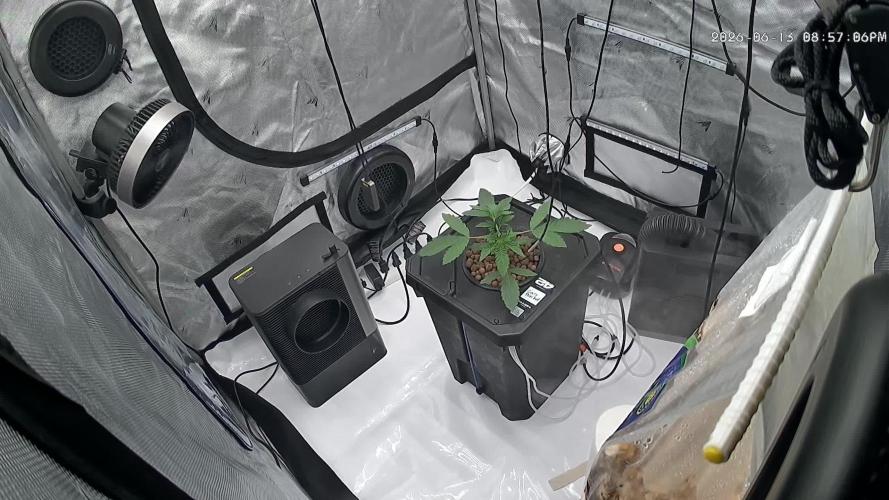
New week folks! This week is kinda busy. I have to either lift the light or drop the intensity. I personally would turn the light up to level 6. For the time being that is. I think I get to use a much higher intensity with the thingy I have. We'll see. It's a 500 watt light, so I have plenty light to work with.
She is growing quite rapidly at least the leVes are all getting bigger.
Readings:
pH: 6.31
EC: 2.21
TDS: 1.57
Evening Readings:
Temp: 68°
I think I'm gonna change the water out instead of mixing a new gallon. I really don't want to though. It's wasting my poor nutrients.
DLI: 42 mol
PPFD: 631 PPFD
09/10/2026
The goal this week is clearing out the big leaves and cover leaves.
Readings:
pH: 6.3 (very steady) but it needs to be closer to 5.8 just don't know how.
EC: 2.18 cU? The thing changed on me.
TDS: 1.55 ppm?
Temp: 70.1° ice bottle added. I'd like to keep it below 70°, like 65° would be good.
Update: I have decided to defoliate my plant today. I've already removed a few branches that just won't reach through the canopy. I'm also taking all the big leaves off. The ones with purple stems seem to be a sign of readiness to me. That was quick. Lol there's a whole bunch. So I've got my work cut out for me.
07/11/2026
Readings:
pH: 6.26
EC: 2.27 ?
TDS: 2.28 ?
Temp: 68.2°
07/12/2026
Readings:
pH: 6.3
EC: 2.19 mS
TDS: 1.6 ppt?
Temp: 69.1° will drop a bit more. With the ice bottle, it'll cool down much faster. Granted it was 70° when I first opened the bucket.
I took some more foliage and a few lower sites and branches that weren't going to make it.
07/13/2026
Readings:
pH: 6.33
EC: 2.44
TDS: 1.74
Temp: 67.5°
Honestly I'm not sure how it changes, but I have people trying to explain. Lol. My meter reads in both ppm and cm. I'm still not seeing how the TDS is higher than the EC. I'm confused.
I've been topping her off with a half mix of nutes for now. Also I also increased the Hydroguard to 5 ml per gallon. I will get this brown stuff somehow.
Hopefully it will clear up before I flip to flower.
But there is so much root mass. I don't think it's getting all the bubbles. I have 3 air stones in there. It can't be oxygen related. Environmental is also out of the question. My system is pretty on point now. The water temp is fine as well. Just around 67°.
I feel like I'm missing something. I'll update if I remember.
07/14/2026
Readings:
pH:
EC:
TDS:
Temp:
She's about a half inch away from the net. She'll definitely be touching the net at some point today or grown over the net. That would be cool. I have a few promising tops. They are a little low, but I'm hoping for the next week and a half to really get some growth. And the trellis is gonna be used hardcore. I'm gonna weave this fucker like a bad sweater maybe. LMAO.
She also looks great! The leaves are still kinda canoeing. Is the light actually that bright?! I need a person here to look at it and say yep or nope. Lol anyway, it looks more like they are opening up them old wrinkles. That has to be it. There's no way a photoperiod takes less than a DLI of 31.2 mol at this age. Nope.
A+ environment. AI is coming through! 76° and 60% humidity.
Readings: After a 1 gallon top off.
pH: 6.26
EC: 2.69
TDS: 1.92
Temp: 67.8°
I think I'm gonna do a plain water bucket with hydroguard for a couple days for the flowering period.
07/15/2026
Readings:
pH: 5.88
EC: 2.41 mS
TDS: 1.84
Temp: 67.5°
Light changes:
I added the light from the net distance.
DLI: 41.2 mol.
PAR: 621 ppfd
Distance:: 24"
07/16/2026
We have touchdown! More like kissed.. Not completely, but there's a few leaves that grew over the net along with a top or two. Still touchdown.
Ice bottle was replaced this morning. I also topped her off about 3/4 gallon. It brought the roots down a bit so they're fully under water. Just below the net pot. I know it should be 1" to 2" inches between the water and the net cup, but the roots are also important. Not to mention how fast she's taking the water down. She'll need another half gallon tomorrow morning. Maybe more.
When I changed the ice bottles out, the roots blocked the bottom of the bucket, so I had to put my ice bottle in the one spot. With roots under it. I might be able to move them. With a paint stick.
Lucky I have 3 air stones in the bucket. The only place it's not bubbling is by the access panel. The rest is a bubbly haven for dirty roots. The only thing is, the roots are officially too big for the bucket. Again. Sweeet. Now I just need a bigger bucket. Lol.
A quick look at the leaves. They look fantastic. Beautiful rich green. Spreading out the wrinkles to make her big and strong.
I had to pull some off as I went looking around at the plant. So far, I don't have any dead or dying leaves. So that's good.
Oh and she SMELLS.iem wow. She smells. Good aroma. Powerful too. And we haven't even hit flower yet. Oh no. Not sure how I'm gonna keep the smell locked in while I'm working on the plant. Lol. No bueno indeed.
Readings:
pH: 6.3
EC: 2.93
TDS: 2.08
Temp: 65.1°
Update:
So I took a decent amount of lowers off today. All the bud sites that will be larf. Still needs to be cleared out. I also took a few leaves off. Everything that was pointing inward. I still have more to go, but I'm gonna wait for next week to pull the rest off.
08/19/2926
I added a time lapse video today. It's a month long instead of the weekly I was considering. You know, for more "meat" as it were.
Processing
Likes
22
Share


@DankBudz
Follow
Well day 63 in flower and still maybe only 25% red hairs.
022320 - day 68 flower, still 50% white hairs, almost time to start watching trichs 😁.

Processing
Likes
6
Share


@Lennys_Laboratory
Follow
Clocks changed to 12/12 . They're Looking Beautiful ⚡️

Likes
16
Share


@Mrg7667
Follow
Day 53
I dont know how i skipped a whole week? But it happens
Plants are looking a little rough, i flushed 2-3 times with just greatwhite and water. Its weird because they got yellow so fast but the tips still look clawed im some spots so im scared to go back to full feed. Slowly added 1ml bioheaven and alga mic then 2ml/l bioheaven and alga mic. Tryingnto get back up to normal feeding

Likes
26
Share


@KingSalomonsWeed
Follow
Duftet. DUFTET hervorragend. Total irre. Caramel Schokolade, vanille süß.
KLEBRIG. ALLES!
GRINS
BUD MACHINE!
Day 51 laut breeder fertig. Ok noch 5 tage.
Aber fertig, ja. Defenitiv. Lasse sie trotzdem noch im Reaktor, denn sie dürfen gerne noch ein wenig reifen. Heute nochmal mit dünger. Den Rest ihrer Zeit dann nur noch Wasser.
19.09.16 16? Ok 17? Egal.
TRICHOME CHECK was successfull..
Har har ok mostly milky. A lot of trychomes not ready.. Buds re not rock hard. Like you touch a dog. Not the fat ones i mean.
And they grow up. Everyday. The buds. I mean theyre not the biggest. But i saw gelato buds spend in dispenserys
(www). Who re smaller than mine.
They grow up in height, tall and weight. Trichomes re the same as always... 😛
Har har.. GANJA THERE EVERYWHERE.
STEAM.
SOME LEAVES(heavy you can see there where she eats aphids. NO JOKE.(@sugarleaves)
First trichomes surrounded it. Than one day later you see them stuck in some trichoms. Than Abracadabra NO JOKE after a few days and nights only some darker trichomes left there. By the time they go brighter again as the others, but bigger).
Sticky smell girl. Mjam
HALLEJUULIA 13 FINGERS A LEAF!
Ganjaloveriamtobringsomedelicious GELATO41FASTfromSEEDSTOCKERStomyworld.
Im satisfied :)
Day 54 of flower. Anything going well.
Did a little pre chop. 3 buds like( with milky trichoms) because of room problems.
They hang dark inside the tent.
And switched my blue light off.
Now only white and red. For faster ripening
20.09.,growing growing growing.
21.09 trichomes re ready. Milky most but ready. 8 weeks of flower, and they're ready. GOOD WORK SEEDSTOCKERS
But i will give her1or 2 more weeks.
Because this strain is so
OUTSTANDING..
She DESERVES a little more time because of some inaccuracies from me......................
And i really want this indica Punch.
For this is better to become some amber trichoms... And weight.. 😛 💪
DAY 58 OF FLOWER.
She is ok. Ripening.
But the aphids.
NOW ITS TIME TO GO TO WAR
☣️ ☣️ BIO LOGICAL WEAPON ☣️ ☣️
BASIL WATER
B weapon for aphids.
Day 59 of flowwring: in progres.
And found the first trichoms going amber.!!!!!!! YES.!!!!!
Day 61. Nuggets or Buds? BUDS!
Day 63. Waiting.
Day 65 Chop of Buds the Rest needs more time. Where re my buds? Fallen, washed, now about to dry.


Likes
300
Share

@Ju_Bps
Follow
Hello growmies 👩🌾👨🌾🌲🌲,
👋 Plants growing good, look happy and healthy.
💪 Have been topped and did a defoliation 🍃
Will be transplanted next week
💧 Give water each 2/3 day
And vaporise plant with water + Plagron Roots (1ml/l)
0.5 l Water + Roots + Grow + Zym (1 + 4.5 + 1 ml/l)
0.5 l Water + Roots + Grow + Zym (1 + 4.5 + 1 ml/l)
PH @6
💡Mars Hydro - FC 3000
27% 58 cm
Mars Hydro Fan kit
Setting 4
Have a good week and see you next week 👋
Thanks community for follow, likes, comments, always a pleasure 👩🌾👨🌾❤️🌲
Mars Hydro - Smart FC3000 300W Samsung LM301B LED Grow Light💡💡
https://www.mars-hydro.com/fc-3000-samsung-lm301b-led-grow-light
Mars Hydro - 6 Inch Inline Fan And Carbon Filter Combo With Thermostat Controller 💨💨
https://www.mars-hydro.com/6-inch-inline-duct-fan-and-carbon-filter-combo-with-thermostat-controller
Fast Buds - Tropicana Cookies FF🌲🌲
https://2fast4buds.com/us/seeds/tropicana-cookies-fast-
Likes
31
Share


@Cultivate
Follow
Done some LST, maybe too much lol ( I’m still learning). Topped all 4 successfully
. Finally feel like I’m getting some where I have learned a hell of a lot just from these few weeks. This is the first time I’ve ever done any type of training in a strain and photoperiods so I’d rather focus on learning than just yeild.
Likes
71
Share


@Roberts
Follow
Quebec Blast is starting to bulk. I did a solution change today. Hopefully I didn't go too strong. She is growing in a New Level Hydro bucket, under a Spider Farmer SE5000 light. It is her start of 5th week of flowering. Everything is going as normal. Solution changes about 3 to 4 days apart. Thank you New Level Hydro, Spider Farmer, and Quebec Seeds. 🤜🤛🌱🌱
Thank you grow diaries community for the 👇likes👇, follows, comments, and subscriptions on my YouTube channel👇. ❄️🌱🍻 Happy Growing 🌱🌱🌱
https://youtube.com/channel/UCAhN7yRzWLpcaRHhMIQ7X4g
SE5000
https://amzn.to/3qFpAML
Spider Farmer Official Website Links:
US&Worldwide: https://www.spider-farmer.com
UK: https://spiderfarmer.co.uk
CA: https://spiderfarmer.ca
EU: https://spiderfarmer.eu
AU: https://spiderfarmer.com.au
Coupon Code: saveurcash
Www.newlevelhydro.com
Www.hygrozyme.com
