


Likes
Comments
Share

@GERGrowDesigns
Follow
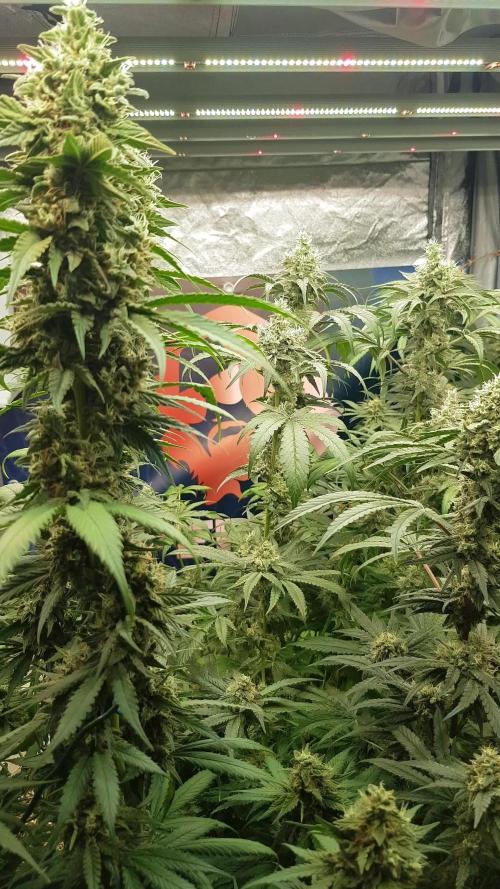
-fast Diarie Finish up sorry ( allready Harvested )-
[Be Back soon !]

Processing
Likes
25
Share


@curvylex
Follow
Week 3 In the beginning of Week 3 I used 1/2 teaspoon of Grow Big which was a mistake! They really just needed to be left alone! Showed the tiniest bit of nute burn on the tips and when I saw that I went straight to checking PPM which was at like 1500 (yikes) and flushed until I got it down by 300 ppm. Should have waited until the 3rd set of leaves to feed! Luckily it was caught early and they are flourishing with no further issues.
The side lighting from the T5 bulb really seems to be helping. They are really going along nicely, here's hoping I can get them through the net few weeks in the same fashion :)
Moved the light down from 28 inches in the beginning to 17/18 inches by the end of week 3. The plants seem to love it and aren't showing any signs of heat/light stress


Likes
21
Share


@Stash074
Follow
This week went well. Overall the ladies are healthy. They ended up stretching a lil more. I do know this will be the final week of stretch before focusing on producing buds. Which will be my goal over the next week,more defoliation. Also I've been using liquid kool bloom with feedings..we shall see if it makes a difference.. will keep yall updated in my next upload ..Happy growing 😎🍃
Likes
43
Share


@DrDuhboto
Follow
The plants are all doing amazing !
When you open the tent it smells like fruit loops.
There is some red color in one of the phenos now and it looks gorgeous.
The red one seems to also be intent on producing the largest buds.
I took a look under the microscope and saw purple trichomes :)
The buds are all insanely sticky and resinous. I am using chopsticks to tuck the larger colas under the scrog because if I touch it my hand smells all day lol.
No signs of nutrient stress or light stress at all.
The plants are getting watered every 3rd day.
I am really enjoying the Medi One lineup from Green Planet, I have noticed a huge difference in overall plant health and vigor since I switched to it.
Likes
7
Share

@Bowser45
Follow
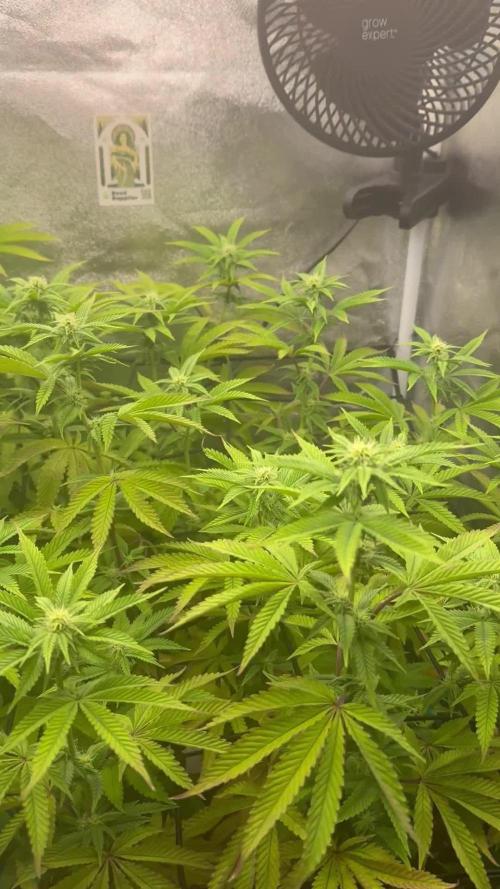
This week the strech reached almost 70cm , and the ladies almost grew into the growlight one day so i moved it higher up to stay at a distance if 30cm. i alo defoliated more this time and started strecheing some branches out so everything gets enought light down. they seem to really like the feeding schedule too. The werent any nutrient issues anymore. trhichome production also started and is already about to cover the surrounding keafes. they are going to be pretty frostyy🍀❄️❄️

Processing
Likes
9
Share


@LittleBigTrees
Follow
These are about a month old.
I've no idea what they are as there from a long time ago and were mixed with a few varieties of autos and photoperiod. Hopefully they work out and are not Spanish sativa as that just gives me a headache after more than 0.25g in a day?? Anyone else ever have that?
Powerplant does the same if I use more than 0.50g in a day.
The only two strains that have that effect on me!


Likes
5
Share


Likes
9
Share


@KarlysCannabis
Follow
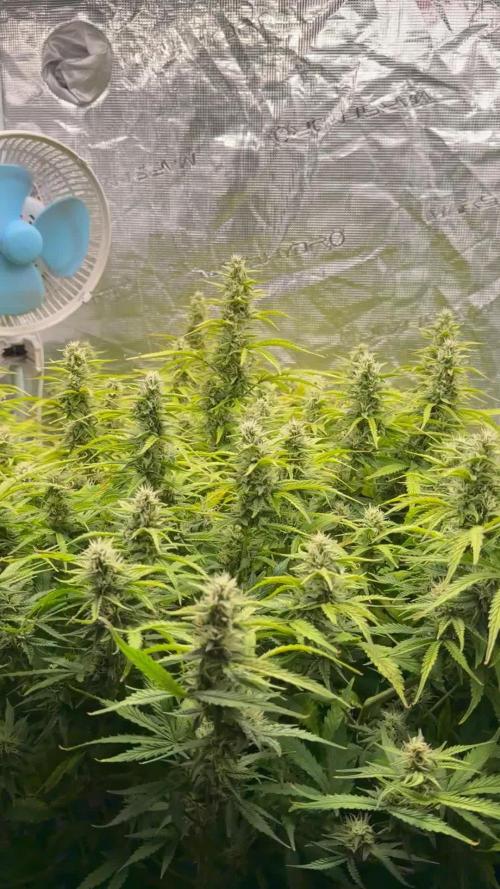
Veg week 4 - Everything is growing well! I picked the biggest plant and tagged it, hopefully she's female!!




Likes
26
Share


@RasendeRollo92
Follow
Willkommen in der Woche 16!
Die Blüte ist in vollem Gange. Das Wetter ist aktuell sehr wechselhaft, aber den Ladys geht es gut. Aktuell sind weder Mängel, noch Überschüsse zu erkennen. Gedüngt wird mit der Hälfte vom Plagron Schema. Bin zufrieden.


Likes
27
Share


@Ganjagrandaddy
Follow
Flip day 4: I have not diaries as flowering yet as they are not yet showing heads. I consider this transition period to be full veg and get a more accurate timing for flowering. once they show
I will be flowering.
All three have been responding well to their switch.
Wedding Cake is a chunky and good sized girl now and after stretch should be my perfect grow size to room size. She will be a heavy budding girls by the look of her stems at this point. nodes are stacked closely so will stay sticky too.
Black ghost. o.g has thankfully woke up a little more now she realises winter is coming and she needs some cock !!!. lol She has thickened intensely below the canopy and does have some very strong looking side branching fighting through too. Her leaves are very indica thick and dwarf her GG#4 neighbours. I can see her as a finished girl and i think she will surprise me with yield too.
Gorilla Glue #4 is growing in expected and classic "skinny minney" style with her ebony looking branching and svelte appearance. She ain't fooling me as she is creeping up in size and height. The leaf colour is a little bit "veiny" but let's see how she stretches. I expect big things from this sneaky lady too.
They are a credit to Original sensible seeds and so far a very responsive group.
Be Safe and healthy

Processing
Likes
3
Share


@MOTB666
Follow
These girls are doing great. Running out of room to move my light so hopefully they're done growing up lol.
Small nugs are starting to form and the smell its starting to get strong smells very nice.
Got a bigger dehumidifier to help with humidity was staying between 50-70 the last couple weeks finally getting down to 40.
They're appetite is really ramping up now and they're drinking about a gallon a day between the three of em.

Likes
3
Share


@French__flair
Follow
N'hésitez pas à me contacter si vous avez des questions!
Pour préparer votre solution, dans votre réservoir ou arrosoir :
Mettre en premier la base (Iguana)
Ensuite Ancient Earth
Et enfin les bactéries
ASSUREZ-VOUS D'UTILISER UNE EAU DE BONNE QUALITE (EC < 0,2) POUR DE MEILLEURS RESULTATS.
J'utilise un substrat non enrichi pour permettre le meilleur départ à mes plantes.
Il s'agit du Promix de Plagron, il a une EC proche de 0, c'est pour cette raison que je commence les engrais assez fort dès le début. Les plantes sont très gourmande sous LED haute intensité et l'enracinement est rapide.
J'arrose tous les 3 jours environ avec 2 arrosages à l'engrais et 1 à l'eau par semaine. Je n'attend pas que le substrat sèche complétement sinon ça réduit l'efficacité de l'arrosage, ça détruit la faune et éventuellement facilite la cristallisation des minéraux.
Au niveau du volume d'arrosage, il faut prendre en compte 1/3 de la taille du pot. Pour un pot de 1L je vais donc arroser environ 300ml. Pour un Pot de 10L je vais arroser environ 3L.
Il est important d'arroser doucement pour éviter que l'eau ne coule tout de suite au fond.
Il est important d'avoir au moins 15% de drain pour s'assurer d'évacuer tous les nutriments non consommé et faire la place aux nouveaux.
IL EST PRIMORDIALE D'EVACUER L'EAU AU FOND DES COUPELLES, c'est une eau qui est chargée en nutriments non consommé et on ne veut pas qu'elle remonte dans les pots car cela risquerait de créer des blocages.
Au niveau de la technique de taille de formation, je réalise tout de suite une FIM que je reproduirai dès que l'apex aura repoussé. La première FIM est la plus longue mais les suivantes sont très rapide car la plante s'habitue à la technique et cela la stress beaucoup moins. En général il faut reproduire la FIM tous les 3 à 4 jours en fonction de la vigueur. C'est une technique très facile à mettre en œuvre et ne demande aucun matériel. C'est aussi la plus rapide pour obtenir des buissons.
N'hésitez pas à me contacter si vous avez des questions concernant la FIM!
Je retire également les feuilles supérieur (pas toute pour éviter de ralentir la plante) qui cache les secondaires pour augmenter l'efficacité de la FIM sur la croissance des secondaires.
Likes
28
Share


@Bread_n_Buds
Follow
Here we are again ready to start again, always under the sign of Zamnesia, we make our fantastic plants and we show you what we are capable of. We have 5 autoflowering strains and 5 photoperiodic ones and now we present them to you.
This time we are faced with an absolute novelty from Zamnesia, a plant from the latest generation of an immense series that Zamnesia is bringing out, ready to try them all. Here we have excellent parents, the primette result is great, let's also try the Karen Kush. I was amazed by the perfect branding for this strain and so let it be Karen.
To explain my germination method which is a combination of experiences acquired in the field and readings of the right advisors, I have chosen to divide it into phases so whoever wants can follow them and understand better step by step.
- Preparatory Phase ---- Check the average temperature in the room, humidity status to understand if it is the case to start or wait, I decided for the end of August because the temperatures start to drop towards the 22-25 degrees recommended for germination.
Then another thing more or less credible depending on the sensitivity is the control of the lunar phases. I believe in it a lot, it is a method that ancient farmers used to understand when it was best to plant depending on the attraction of the moon. To make my life easier I use a simple app that advises you on the right time to plant, harvest and put in the jar (depending on the lunar phases).
- Phase 1 --- Soaking in water. There are many authoritative friends who advise against this method due to the risk of drowning, but I have always been fine and I follow the rule if it opens in water the seed is almost certainly healthy and will come out of the ground 90% normally.
- Phase 2 --- Opening the seed in water. As soon as the seed opens and the root comes out a little, you have to be very very careful not to leave the seed in the water open for too long. This is why there is a risk of drowning. So as soon as the root comes out, it must be planted. Do not wait for it to stretch out a lot, you can wait a little longer in the absorbent paper, but not in water.
- Phase 3 --- In the meantime, while I soaked the seeds, I prepared my pots: I use small biodegradable pots (choose the ones with holes underneath for drainage). A few hours before working with the opened seeds, I moistened the soil with water adjusted to the right pH (5.8 - 6.2) and Plagron Power Roots. The small root is now open and we can make a little hole with a toothpick, widen it and insert the seed. Not too deep with the root facing downwards. From Serious Seeds we learned the dome technique: if you put a small dome of soil on the seed the water will settle on the sides avoiding overwatering problems.
- Phase 4 --- The plant emerges from the soil. So far I have not put the light, now I turn it on at minimum after half a day of soil to give direction to the seedlings. The first week the light will be gradually brought from 40% to 60% to go to 70% - 75% in the remaining weeks of veg. During the first week maximum, I keep the cycle of 24 hours to avoid stretching. Be careful not to exceed the first week at least with photoperiodic plants.
- Germination % --- In water 20/20 seeds have opened for good luck I'm waiting to talk when they come out of the ground but it seems that we are going towards an excellent percentage of germination..."Not too bad"...
- Soil and Food --- The soil used is entirely organic in every part and is the Plagron Promix that will be used with the 100% organic pack provided by Zamnesia complete with all the main fertilizers for your plant buy it at the link --
https://www.zamnesia.io/it/11457-plagron-easy-pack-natural.html
// Strain Description // Formidable genetics: These seeds contain the genes of Monster Bud Kush and White Widow. High THC content: With 24%, the effects are pronounced and intense. Fast flowering: This indica-dominant hybrid needs just 8–9 weeks to reach harvest. Excellent yield potential: This plant is very generous, if grown in the right way!
- Get a seed of this fantastic strain --- https://www.zamnesia.io/it/10780-zamnesia-seeds-karen-kush.html
- Soil and Fertilizers entirely organic --- https://plagron.com/en
- Growbox --- https://www.secretjardin.com/
- Music and sound --- I made my girls listen to 432hz frequencies and music from www.radionula.com
- Z --- You can find these seeds, much more from the world of cannabis, mushrooms and an incredible series of accessories and gadgets on the reference site not only mine but of many growers ---- https://www.zamnesia.io

Likes
12
Share


@CanadianFillmore
Follow
Week 7 begins for Amnesia lemon haze. She's bulking up, frosting up nicely and she has a nice light lemon pine cleaner like smell.
Switched out big bud coco for overdrive.
Thanks for stopping by, tune in next week for another episode 👽🌳🔥