


Likes
Comments
Share
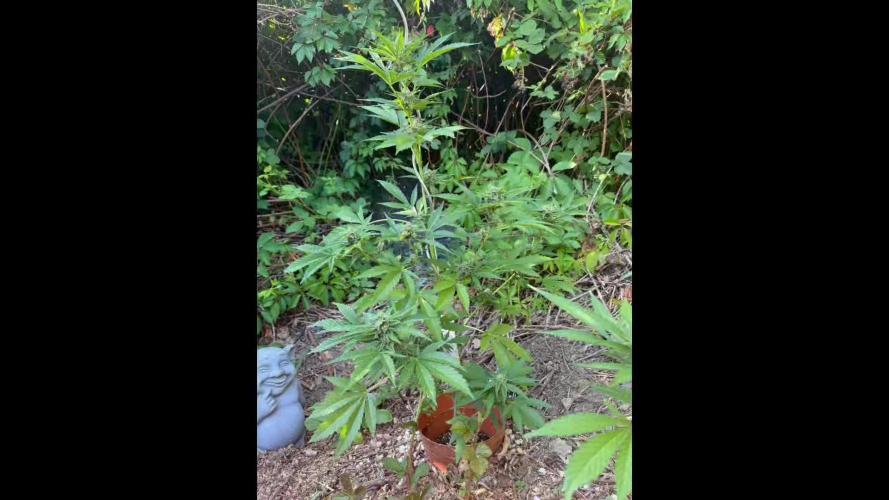

@GreenHobbit
Follow
The Hobbit Hole Outdoor Grow 2026 – Woche 9
Eine weitere Woche liegt hinter dem Hobbit Hole und trotz zwei Tagen mit anhaltendem Regen entwickelt sich der Outdoor-Grow weiterhin hervorragend. Natürlich war ich etwas nervös, denn ohne festes Dach über den Pflanzen steigt in dieser Blütephase das Risiko für Schimmel deutlich an. Umso erleichterter war ich, als alle drei Ladies nach dem Wetter vollständig abgetrocknet waren. Bei der Kontrolle konnte ich keinerlei Anzeichen von Bud Rot oder anderer Fäulnis entdecken – genau so hatte ich es mir erhofft.
Gelato bleibt weiterhin die Spitzenreiterin. Sie ist nach wie vor die am weitesten entwickelte Pflanze und ihre Hauptcola legt inzwischen sichtbar an Volumen zu. Auch die Seitenblüten werden Woche für Woche kräftiger. Im unteren Bereich beginnen inzwischen einige der ältesten Fächerblätter gelb zu werden. Da ausschließlich die älteren Blätter betroffen sind und die Blüten selbst kerngesund aussehen, werte ich das als normalen Nährstoffumschichtungsprozess während der Blüte. Die ersten vereinzelten bernsteinfarbenen Trichome lassen sich bereits entdecken, insgesamt dominiert aber noch ein milchiges Bild. Bis zur Ernte wird sie also noch etwas Zeit brauchen.
Cinderella entwickelt sich immer mehr zur Harzkönigin des Hobbit Holes. Schon jetzt sind die Zuckerblätter extrem dicht mit Trichomen überzogen und jedes Makrofoto macht einfach Spaß. Sie wirkt insgesamt etwas schlanker als die Gelato, gleicht das aber mit einer beeindruckenden Harzproduktion aus. Ich bin sehr gespannt, wie stark die Blüten in den nächsten Wochen noch anschwellen werden.
Purple Punch holt ebenfalls weiter auf. Die Colas wirken inzwischen deutlich kompakter als noch vor wenigen Wochen und die ersten dunkleren Farbtöne zeigen sich bereits an einzelnen Zuckerblättern. Sie entwickelt ihren ganz eigenen Charakter und könnte am Ende geschmacklich noch eine echte Überraschung werden.
Auch bei der Düngung gab es eine kleine Anpassung. Da sich im Bereich des Hobbit Holes Brombeeren und wilder Wein ebenfalls über die Nährstoffe freuen, werde ich künftig bei jedem zweiten Gießen nach Hesi-Schema düngen, um den zusätzlichen Verbrauch im Boden auszugleichen.
Insgesamt bin ich mit Woche 9 mehr als zufrieden. Nach den Regentagen sehen alle drei Pflanzen gesund aus, die Blüten legen sichtbar an Masse zu und die Harzproduktion nimmt Woche für Woche weiter zu. Jetzt beginnt die Phase, in der sich Geduld auszahlen wird – die nächsten Wochen werden entscheiden, welches Potenzial wirklich in den drei Ladies steckt.

Likes
28
Share


Likes
19
Share


@pifflestikkz
Follow
Day 17
17/07/24 Wednesday
De-chlorinated tap water pH 6 with calmag 5ml -5L.
Very humid week, noticed a green turning colour on top of soils where the humidity has been far to high.
I have installed door netting and recently left open all day and night now so they can condition over night in colder temps.
Growth wise, explosive little seed 👌💚
Day 19
19/07/24 Friday
Lite Feed today, 250ml each pot small run off.
Seeing excellent start to these babies. Let's get it 👌💚
Day 21
21/07/24 Sunday
De-chlorinated tap water pH 6 with calmag 5ml to 5L.
Watering in 1L each day from now.
Updated video

Likes
5
Share


@CanarianGrow92
Follow
The plants are starting to recover from the N excess 2 weeks ago, this delayed a bit the starting of flower from some plants but im sure that the rest of flowering will be ok, i gave only water this week and applied a small amount of guanokalong nutrients as these are slowly absorbed to ensure the plant continues to receive some nutrients until next 2 weeks when we will start to give some extra PK
Likes
16
Share


@valiotoro
Follow
Hello everyone 👋
She grew fast and with a beautiful green colour on the leaves!
She has responded superbly to low stress training and topping & i defoliated her aswell and seems didn't even notice 😎
Wish you all a good day and happy growing 😁


Likes
4
Share

@Cukito
Follow
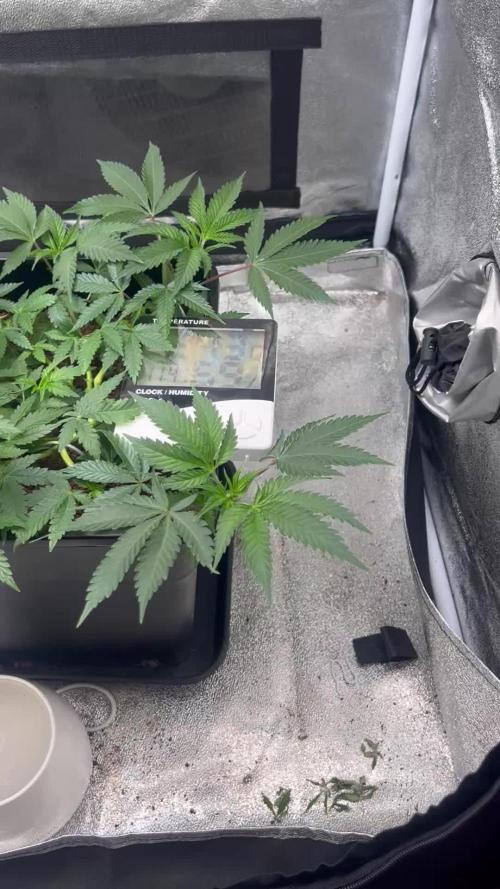
Everything doing just as should be. I'll put the scrog screen as soon as I can go to the growshop!! I will put her to flower in two weeks!! (I hope)

Likes
19
Share


@sunshinegroww
Follow
Unfortunately these ladies had to be cut earlier before finish as im moving abroad and plans happened alot quicker then I was expecting,anyway very strong genetics from FastBuds
I will be back very soon with some autodoors grows
Will upload the last photos of their life once again amazing genetics
Likes
25
Share


@Ultraviolet
Follow
Permanent Marker weed strain possesses the genetics for high anthocyanin production, which is responsible for its signature deep purple. While the genes are present, the expression of these colors is often enhanced by "thermal stress" (lower temperatures) during the final three weeks of flowering, which triggers the production of these pigments.
👋 Raising the Carbon-to-Nitrogen (C:N) ratio in the growing medium to avoid over-immobilizing nitrogen, on the flip side, being careful not to trigger early autophagy. Moderate, controlled increases in sugar support the energetic demands of flowering and act as a signal trigger, but excess sugar is more likely to inhibit flowering or damage the plant. Balance, like everything else. Visually, when the chloryphyll green gets darker, it is a subtle indicator that the concentration of nitrogen is increasing / more is being stored than is being used. I noticed when you push very high intensity lighting, it slowly fades the green as the plant degrades chloryphyll faster than it can be replenished. When the green of the leaf continually gets darker, it is an indication that the concentration levels of nitrogen are increasing, and I dont want to increase light intensity.
Turn down the nitrogen faucet. C:N ratio dictates the rate at which nitrification occurs, if at all.
The Carbon-to-Nitrogen (C:N) ratio acts as a critical biological "on/off switch" (or regulator) for nitrogen turnover by determining whether microbes
immobilize (consume/tie up) or mineralize (release) nitrogen during the breakdown of organic matter. This ratio regulates microbial activity by defining the balance between available energy (carbon) and building materials (nitrogen). The C:N ratio in a medium acts as a critical regulator of nitrification, effectively functioning as an "on/off" switch for the dominance of either autotrophic nitrifying bacteria or heterotrophic bacteria.
The shade of green in chlorophyll is subtly linked to the enzyme Rubisco through a co-evolutionary, functional relationship designed to optimize photosynthesis. Chlorophyll absorbs blue and red light for energy, reflecting green light, a process that ensures the "light-dependent" reactions provide the correct, controlled amount of energy (ATP and NADPH) needed by Rubisco to perform its "light-independent" carbon fixation. Because Rubisco is a relatively inefficient and slow enzyme—often considered the bottleneck of photosynthesis—chlorophyll and the overall structure of the leaf have evolved to manage energy distribution to prevent overwhelming the Calvin cycle.
While chlorophyll absorbs mainly red and blue light, it is not perfectly efficient, and leaves appear green because some green light is reflected or transmitted. This reflection allows light to penetrate deeper into the leaf, preventing the surface chloroplasts from becoming overloaded and enabling a more efficient distribution of energy to the high volume of Rubisco located throughout the leaf's mesophyll.
The rate of chlorophyll-driven electron transport (light reactions) is matched to the potential rate of carbon fixation (Rubisco activity). If Rubisco were faster, leaves might be darker; however, the "shade of green" represents a balance that prevents chlorophyll from producing more energy than the inefficient Rubisco can process. The green color itself is a byproduct of a photosynthetic system tailored to feed a slow, yet crucial, enzyme (Rubisco) just enough energy to maximize carbon assimilation without inducing excessive oxidative stress or inefficiency.
The shade of green in leaves is directly linked to the concentration of chlorophyll, which is in turn strongly correlated with the amount of
Rubisco (Ribulose-1,5-bisphosphate carboxylase/oxygenase) and, consequently, the rate of carbon fixation. Darker green leaves generally indicate a higher concentration of both chlorophyll and Rubisco, signifying greater capacity for photosynthesis.
Increase output or reduce input. Subtle tells.
While an excess of nitrogen (specifically ammonium) can cause an imbalance, nitrification—the microbial conversion of ammonia to nitrate—is highly sensitive to a variety of environmental, chemical, and physical factors. Because it depends on specific, slow-growing bacteria (Nitrosomonas and Nitrobacter) and archaea, anything that stresses these organisms can disrupt the process.

Likes
2
Share


@EyeMKing
Follow
As week 2 comes to an end 4 of the 5 have shown great growth 1 is behind (#5) but it also has a mutation and has a few 4 leafers on it. #3 is shorter and has wider leaves.

Likes
10
Share


@BodyByVio
Follow
This week I Supercrop all the plants and spred them out over both lights. One more week of Veg and they are ready to explode
Check me out on Instagram @growmorestressless
Likes
154
Share


@Tropicannibis_Todd
Follow
Well growmies ive been looking forward to the FastBud Tester 2311 , the more she went into flower the more the frost would build up , and that's when the terps came out 👉 Sweet , fruity 👈 Buds are tight and full of frost 👈 Couldn't of asked for better Genetics 😉
The smell coming from this girl during the entire grow was just dreamy 👈. Of course I have no clue to what she is but I like it......
Amazing Job FASTBUDS 👏 I would definitely recommend once they release this one 👍
👉 Big thanks to all my Growmies out there in GD land 👈 Much appreciated 🙏
Thanks To MarsHydro for the TS1000
👉I used NutriNPK for nutrients for my grows and welcome anyone to give them a try .👈
👉 www.nutrinpk.com 👈
NutriNPK Cal MAG 14-0-14👉 All Weeks
NutriNPK Grow 28-14-14👉 Weeks 2 & 3
NutriNPK Bloom 8-20-30👉 Weeks 4 to 8
NutriNPK Bloom Booster 0-52-34👉 Weeks 4 & 9 👌👌
Processing
Likes
4
Share


@Ageddd
Follow
------------------------
HARVEST 1:
------------------------
Harvested this girl because she stopped eating and was drinking less water, and the weird flowers, so she was finishing, and im looking for something psycoactive, so the trichs are cloudy too... I expected less flowers, but there are some material behind leaves.
The smoke is really nice flavored, and it hits you with psychoactivity. Despite the production and weird buds it is really tasty and gets you in a really nice sativa mood.
The flavor would be like: An apple with Gasoline touches (i suppose its because of the Sour Diesel heritage)
15 gr.
------------------------
HARVEST 2:
------------------------
This plant was harvested in the optimal point to me, with cloudy trichs and a nice production. She really added weigth in the last weeks.
The smell is really like the original Lemon, has deep citrous notes.
Taste is very good, more powerful than the smell(Will complete this in a couple months when properly cured in jars).
I like the psychoactivity, its a nice day smoke, and a tasty one.
Overall a very good plant, i love the therpene profile (citrous/fruity), it is so refreshing when you smell the citrous flavour.
90 gr.
Processing
Likes
14
Share


@Headsong
Follow
My Girls stared Flowers I'm really excited I can't for all those Flowers OG Kush its at Really tall she is 38 inches After 52 days on Veg from the seeds .the root makers Make really big Differentnt when is about Root sistem the people know about Cannabis Plants they know the root sistem is everything's for the every Kind the Plant if you star you Plants whit good healthy and root sistem You Grow Veg amazin something you never see it.. You can look up in one of the moat Famous weed Maganzine HIGH TIMES
They said you wanna Big Yield? Prevent you don't grow Root bound Sistem .. the Root Makers Make Nice root sistem whit the Air Pruning sistem .. Sorry for my Englis it not perfect but I hope can understand

Likes
3
Share


@Earthsower
Follow
She has recovered from the under feeding and sprung back with vigour. The scent on her main stem has returned with lime green foil also the peak of her canopy has split open creating an umbrella shape. Her stem is about 5cm wide and she stands approximately 35cm. She is receiving 500 ml of water each week!

Likes
16
Share


@Nimas
Follow
Hello 🍀
10 weeks and waiting for the blooming phase. The plants are stretching and looks healthy!!
💥 Today (6/9/25) was the day I moved the girls in a new home 🏡
⬆️ Was to tall for the balcony
💚 A friend gave me this tent 1.2x1.2x2.2 I hade a Lumatek 200w and the new set up is ready ✨️
🌙 Tonight the first 12/12 💤
Cheers 🍀❤️
Likes
5
Share


@Lazuli
Follow
Shes only getting calmag and overdrive for 4 days, next week i chop it down
Likes
8
Share


@RainerWinklerGrow
Follow
This should be up to week 2-3 of flower, where the Mimosa x Orange Punch, which had the earlier Mutation, started herming on the mutated part, which i noticed a bit too late and it pollinated some of the other buds, i cut all of the affected bud sites of, in the end the furthest away runtz got pollinated but the others luckily barley did and only had like 5-10 seeds in total.


Processing
Likes
1
Share


@Esebees
Follow
Las plantas ya se ven mejor, han crecido bastante bien, aunque la Runtz#1 parece ir peor