




@H0BBYGAERTNER
Volgen
WEEK #23 — THE FINAL COUNTDOWN
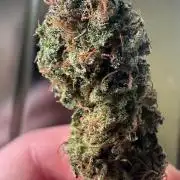
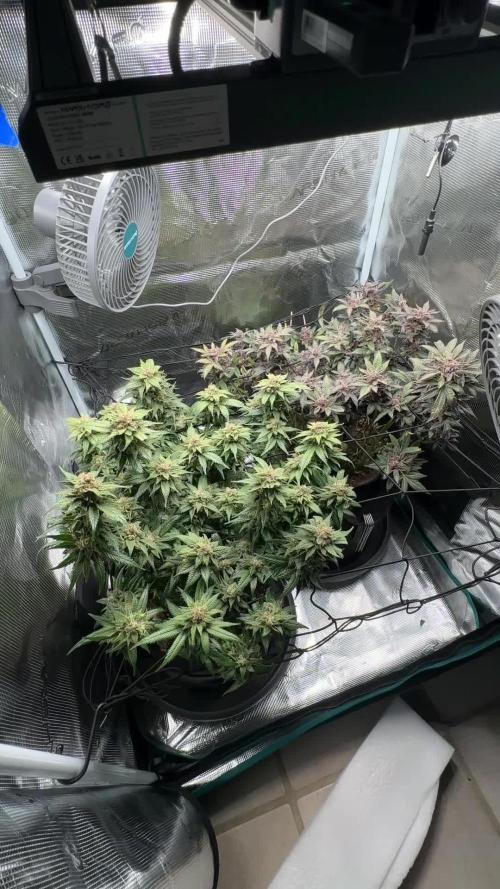
Spoiler: Just moments before the axe. Slush Mint Cake has lost a few stems already during the week, great evening occupation. Im still not so sure about her. The blossoms and general impression looks totally ready imo, and some leaves even turned „necrotic“/crispy. The smell is heavy and nice, with a certain, kinda insane spiciness. But there are almost no amber colored trichomes. Like really just a few scattered ones. But all things must end. Worst case the result is not perfect, i guess, and will it even get better on the other hand with a few more days? Well, i have one seed left, so i can find out next time. 😎
Reasons for that could be plenty: the switch of fertilizer last minute and connected change of ph. And again, also might be because of the tacky LED-controller: i realised touching it the wrong way just resets it (fml). And how have i found out? Because the light was switched on way later as it was supposed to be. The solution then was to re-apply the „scene“ in the App and it magically works again. Manual timer switch has been ordered already. 0 points, dear Mars Hydro (maybe it's bad luck and incompetence from my side, take it with a grain of salt).
And that's — i guess — also the reason (spoiler) why i found some bananas in the Bottom half of Skywalker Haze. And i surely do not blame the genetic for that (at all). Hmpf 💩. Well, still lucky this happened right before the showdown, so it want matter all that much, i suppose.
Back to Business: SMC very, very pretty. Rich and loaded all over, pictures speak for themselves i think (have a look at last entry as well, please).
For Skywalker: clear visible Amber trichomes, especially on the top buds. White ones not so easy to distinguish from the clear ones (at least for me) The outer most tips of the leaves turned light, so another sign of the advanced state of the plant. I Like. Some cute pink tips as well. Similar to SMC rather small buds, but hey, if qualityquantity thats Fine for me. 🤩
Also a very pretty plant, with a more classic look, dense, a slightly more proportion of leaves. Smell? Yes its true: lemony-herby all oover, in a way also spicy Rich (lemon Pepper).
In fact both plants have been harvested, for Skywalker mainly the top Part, as the bottom buds were light and soft. As i have mentioned before, probably should have removed them After Stretch, but: All buds are equal, the deserve it. Let's see what will happen.
So far: Bravo Dutch Passion for both These extraordinary strains, looking forward to the final results and the effect of both.
See you in about 3-4 weeks with the "harvest" posts, peace! 🙏



@Khalico20
Volgen
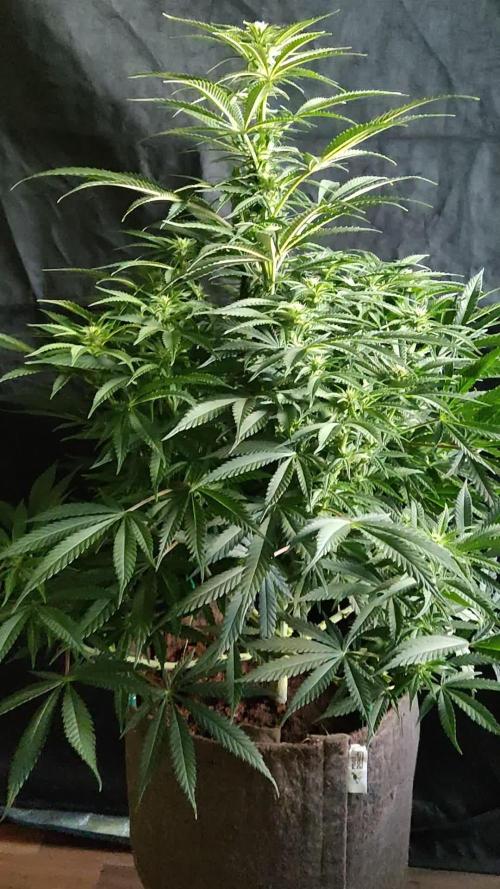
Esta muy sana, empieza la 4° semana de flora aún estra en preflor falta poquito para que empiece la falta del boost uso biocanna flora y boost
Solo en la preflor uso el delta 9 de cannabiogen va de fábulas para que arranque bien la flora
Alguna sugerencia que le vendría bien aparte de los 2 que le echo lo echo así muchas becas y queda un producto muy muy al paladar pero alomejor le vendría bien algún aditivo?
Gracias de antemano
Buen rollito!!


@The_Lonely_Farmer
Volgen
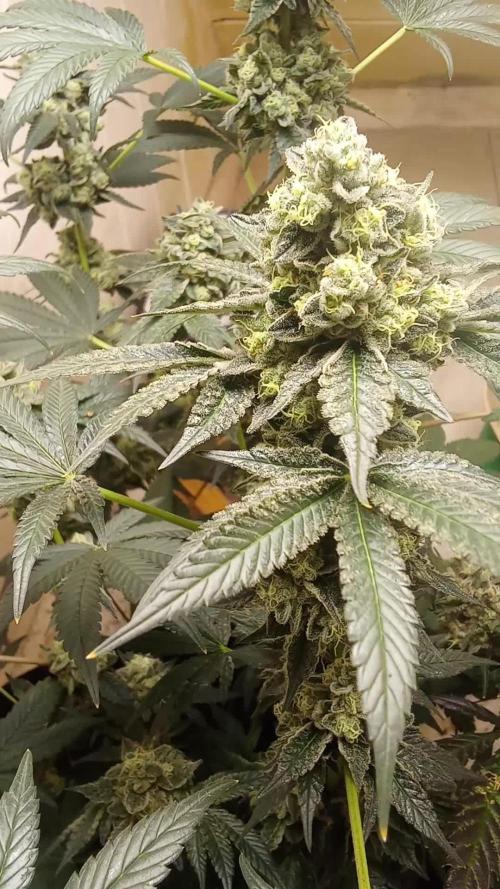
So we have harvested the wedding cheesecake abruptly as I think one might have started too herm possibly as I saw signs hence the abrupt chop of all as only days away from end of week 8. There are no seeds or any disinformation yet I saw under scope slight growing signs of possible coming g of herm so didnt waste time too chop... will inspect once dry all should be okay 🤞
The buds smell absolutely delicious theres more of a creamy cakey aroma bursting through more than anything like a creamy woft through the air.
The girls grew amazingly considering I went from auto feed too hand feed although didnt seem too have a negative affect end result shows so I'd like too re run the wedding cheesecake ff again solely by hand/autopot this time all way through.
Buds form grameat with great resilience too conditions out of control as I myself have a heatwave and they seemed too handle well.
Over all I would strongly recommend this monster of a grower too all, she is a beautifull strain with such a great growing process.
I will keep one girl for flower and the not so perfect girl for hash or too be pressed once cured for a month or so...
These were flushed only a week unfortunatley due too early chop but as in coco I'm sure I'll be fine after a cure even for the hash girls.


@ZoobZoob_farmZ
Volgen
.💪🌱🌲☀️👌Truffle gas #1 × (Animal Cookies x Do Si Dos )
Hi everyone 👋 for the smell 👃 this one verry gas, diesel And earthy And slightly minty
Useful links👇👇👇
https://artgenetix.world/
https://marshydro.eu/products/mars-hydro-ts-1000-150w-led-grow-lights/?lang=fr
https://shop.greenhousefeeding.com/4-bio-nutrients
https://www.royalqueenseeds.fr/47-growing
https://biotabs.nl/fr/produit/bio-pk-5-8/





@Ultraviolet_
Volgen
Remember that, however you are played, or by whom, your soul is in your keeping alone. Even though those who presume to play you be kings or men of power, when you stand before God, you cannot say, 'But I was told by others to do thus,' or that virtue was not convenient at the time. This will not suffice. Remember that.
Day:18
84°F and 65% RH (VPD) for the vegetative stage. Approximately 1.15kPa(assuming leaf temperature is about 2°F cooler than the air), which falls right into the ideal vegetative sweet spot (0.8kPa to 1.2kPa). At 1.15kPa, plants can draw water and nutrients efficiently without risking stress or wilting. It keeps the leaf pores (stomata) open, allowing for ideal carbon dioxide intake and maximizing vegetative growth. VPD is determined by the leaf's temperature, not just the ambient air. Because leaves usually run 1° to 3°F cooler than room air under bright grow lights, my actual VPD will be slightly lower, closer to the 1.0kPa mark. As she transitions from vegetative growth to flowering, one can gradually lower the humidity (to around 45–60%) and drop temperatures slightly to prevent disease from settling inside dense buds when they appear.
Night:6
At 70°F and 60% relative humidity, Vapor Pressure Deficit (VPD) is 0.86 kPa. This is right on the cusp of whats optimal for the vegetative stage. During the nighttime, plants generally close their stomata and undergo cellular respiration rather than photosynthesis. Transpiration slows to a near stop, making VPD less critical at night than during the day. However, maintaining a nighttime VPD between 0.8 and 1.0 kPa is highly beneficial in that it ensures the air is dry enough to prevent powdery mildew or bud rot, but moist enough to keep the plant from undergoing unnecessary stress. This range keeps the environment comfortable for cellular processes and prevents large atmospheric swings. Keeping it all flowing.
(Not pushing them yet, these are photoperiods)
The optimal soil (root zone) temperature for cellular root respiration and nutrient uptake in cannabis is between 68F & 72F This narrow range balances biological energy production (cellular respiration) with the dissolved oxygen levels in the soil, maximizing plant growth and health. Warmer soils hold significantly less dissolved oxygen. When soil temperature exceeds 74F oxygen depletion occurs, inhibiting cellular respiration almost entirely, At 68-72F root cells generate optimal adenosine triphosphate (ATP) via respiration to power root-tip elongation and the active transport of water and nutrients.
Too Hot (Above 78F) Root respiration increases, demanding more oxygen, while the water's oxygen-carrying capacity drops. This creates a prime environment for anaerobic pathogens and Pythium (root rot).
Too Cold (Below 60F) Root metabolism and cellular respiration slow to a crawl. This severely impairs nutrient and water absorption, leading to yellowing, wilting, and phosphorus deficiencies.
A lot depends on whether it's automatic or photoperiod; with photoperiod, there is not as much of a need to push "hard" as the real countdown only begins once the flower is initiated. Automatics, on the other hand, the chronological "clock" begins ticking the moment the seed germinates. It is of critical importance that the seedling growth gets off to the races, understanding that early growth is like compound interest, which will pay off come harvest. This reality is why getting autoflowers "off to the races" early on yields such exponential benefits. The "compound interest" is directly related to the surface area of the leaves. Larger, faster-growing seedlings process more light and build bigger root networks early on, which translates into an explosion of vertical and lateral growth during their short vegetative window.
The margins for error are so thin with autoflowers; this early-stage momentum depends on several critical practices. Seedlings exposed to increased atmospheric CO2 levels early in life will develop at an increased rate. To effectively "extend" or optimize the capacity of Photosystem II (PSII) for increased photosynthetic efficiency. In standard oxygenic photosynthesis, Photosystem II (PSII) is naturally limited to the red-light spectrum, peaking at 680nm. Extending its light-harvesting capacity past 700nm into the far-red region requires bypassing the natural limits of standard chlorophyll a. Adding 730 nm (far-red) LEDs alongside standard red/blue lights has been shown to increase canopy photosynthesis by 20–30% in several crops by acting synergistically with shorter wavelengths. However, the limitation is that excessive, pure IR/Far-red light (without accompanying red light) can trigger the "shade avoidance response," causing plants to grow tall, weak, and spindly rather than robust. Utilizing infrared light (specifically the 700-750 nm far-red range) is a viable method to boost photosynthetic efficiency. It acts as a bridge to allow PSII to utilize a broader spectrum of light, breaking the traditional 700 nm barrier. UVR8-mediated signaling (often in conjunction with CRY proteins) triggers protective mechanisms that maintain the stability of the photosynthetic apparatus (including LHCII and reaction center proteins), thus ensuring that the efficiency of Photosystem II remains higher in UV-B-exposed plants compared to plants lacking this receptor. ΦPSII indictates the rate of electron transfer from water to plastoquinone, which drives the production of ATP and NADPH. There is a close link between ΦPSII and the true rate of CO2 fixation (Φ*co2).
ETR stands for Electron Transport Rate. It measures the speed at which electrons are moved through the thylakoid membranes in a plant's chloroplasts during the light-dependent reactions of photosynthesis. Infrared light (particularly Near-Infrared or NIR) improves cellular energy by interacting directly with the electron transport chain (ETC) in mitochondria. This process boosts adenosine triphosphate production, which acts as a metabolic coefficient multiplier by accelerating enzyme activity dramatically.
Extend then multiply.
Far-Red photons interact with plant photoreceptors to accelerate the plant’s biological "clock" or trigger a shade-avoidance response. Autoflowers don't use the plant's biological clock, although the IR will initiate a shade avoidance and make them stretchy. You can just add equal measures of 660nm-680nm to negate the shade avoidance effect. Replacing nights' "darkness" with a combination of IR+ and 660nm. Because autoflowers don't require a dark period to flower, many growers just blast them with light. 18/6 24/0. However, this ignores the plant's metabolic rhythms, where daytime photosynthesis (light reactions) must be perfectly balanced with nighttime carbon fixation and assimilation (Calvin cycle) to avoid bottlenecking plant development. Cellular respiration is a 24/7 process, but it can only function while the plant has the free oxidative capacity to do so. A 100% photosynthetically active leaf cannot perform cellular respiration. The viral trend of defoliation of every leaf that isn't "getting enough light" is of great detriment overall, putting 100% of the cellular respiratory "workload" and responsibility on the 0/4/6 hours of darkness in sub-optimal conditions for enzymatic activity. Photosynthesis captures nearly 100% of the initial energy as carbon, while cellular respiration is the process that unlocks 90% of that captured energy into usable ATP so the plant can use it. Respiration is considered roughly 30% to 40% efficient. It captures enough of the potential energy in glucose to synthesize around 30 to 38 ATP molecules per glucose molecule. The remaining 60% to 70% of the energy in the sugar is not captured in ATP; instead, it naturally escapes into the environment as heat, which helps regulate plant temperature. In plants, the primary enzymes of the Electron Transport Chain (ETC) and the ATP synthase complexes are typically adapted to function optimally in warmer temperatures (roughly 25°C to 35°C depending on the specific plant strain). As temperatures rise within this physiological range, molecular collisions increase, speeding up respiration and ATP production. The cannabis plant has a branched respiratory pathway. During heat or cold stress, plants activate Alternative Oxidase (AOX). AOX burns sugars to dissipate energy as heat rather than coupling it to ATP production. This pathway actually functions optimally at elevated temperatures to help protect the cell from the damaging build-up of Reactive Oxygen Species (ROS) during heat stress. Enzyme activity generally scales with heat; there is a strict biological limit. If canopy temperatures in a grow room exceed 40°C, the enzymes and their supporting lipid membranes lose stability. Not saying you need to go crazy, just optimize nights the same as we optimize days.
Phosphorus is the driving force behind early seedling development. It acts as the "energy hub" of the plant, directly driving cell division, robust root growth, and the creation of DNA. Without an adequate, easily accessible supply early on, the plant's overall growth potential and final yield can suffer permanently.
E=MC2 looks like a simple multiplication problem; it describes a fundamental physical truth: mass and energy are the same thing. The equation doesn't just calculate a value; it reveals that mass is effectively "congealed" energy. Energy is just numbers. Energy isn't a physical "substance" you can hold or touch. It is essentially an abstract, calculated number that we assign to a system to predict how it will change, interact, or move. A numerical label we attach to matter to track how it behaves. Because the universe runs on laws of symmetry (specifically, that the laws of physics don't change over time), a single global number must be conserved. We call that number "energy".
We don't grow; we facilitate energy conversion.
How well a seedling grows is essentially down to how much knowledge one can acquire to increase the level of conversion to occur. Applying knowledge effectively requires intuition, which comes from hands-on experience. A seasoned stoner learns to read subtle signs—like a slight change in leaf turgor (stiffness), subtle color shifts, or the specific texture of the soil—before a textbook diagnosis can be made. Ultimately, growing is the application of botanical science blended with active observation. Knowledge dictates your potential, but adaptability and attentiveness to the plant's immediate environment determine your results.
1.618 nature mathematically optimizes quantum energy transfer and light absorption efficiency within the photosynthetic machinery, as it naturally dictates energy scaling hierarchies and resonance dynamics. External vibration or electromagnetic wave that perfectly matches a plant's natural frequency directly influences plant growth. Low-frequency sound waves and targeted electromagnetic fields stimulate cellular processes and boost photosynthetic efficiency
Does it produce better yields?
How long is a piece of string? As long as you cut it. But isssss the juice worth the squeeze? The quantum framework of the IVM seems to think so. Good enough for the quantum firmware, good enough for the DNA software. Genetics are not dictated; they are expressed; the rate of that expression is dictated by the environment in which growth occurs.
Quantum Coherence in Photosynthesis occurs When a photon of sunlight strikes a leaf, the energy it carries must travel to a reaction center to be converted into chemical energy. This process operates at nearly 100% efficiency. If the energy moved in a traditional "bunching" or random hopping manner, a large portion of it would be lost as heat. Instead, plants utilize quantum superposition. The energy particle (exciton) doesn't just take one path; it exists in a wave state and explores multiple pathways simultaneously. It essentially "chooses" the most efficient route to the reaction center simultaneously. Research shows that molecular vibrations and the specific network arrangements of chlorophyll molecules (like the naturally evolved Chlorophyll A & B ratios) actively protect against energy overflow, optimizing light capture across different light intensities. Enzymes are the biological catalysts that speed up chemical reactions within a plant's cells, allowing them to grow, metabolize, and repair. Rather than relying solely on the classical kinetic energy of molecules colliding, plants use quantum tunneling. Subatomic particles like electrons and protons (hydrogen ions) can literally "teleport" through energy barriers that they normally wouldn’t have the energy to climb over. This makes vital metabolic reactions happen far faster than classical physics could ever explain.
Chloryphyll b has peak absorption at 460nm (Blue) and at 647nm(Red). If we take the blue peak wavelength 460nm and a UV-B, UVR8 peak absorption wavelength 285nm, Tryptophan-285 (W285) Sensing protein. 460/285=1.618 Φ If we take chlorypyhll b's Red absorption peak 647nm and a UV-A of 400nm, we get 647/400=1.618 Φ. "Structure of light". The cryptochrome photoreceptor (CRY) is a UV-A/blue light receptor that shares this dual sensitivity with several other biological structures and functions, including significant sequence similarity and a common evolutionary ancestor with DNA photolyase enzymes. These are light-activated enzymes that use blue/UV-A light to repair DNA damage caused by UV-B radiation in plants. Synergistic. But Shhh, it's a secret.
Effective quantum efficiency of photosystem II, often denoted as ΦPSII, represents the proportion of light absorbed by Photosystem II (ΦPSII) that is actually used in photosynthetic electron transport. It is a key indicator of how efficiently a plant is using light for photosynthesis, as opposed to losing it as heat or fluorescence. ΦPSII (effective quantum yield of photosystem II) functions primarily as a "multiplier" (a coefficient of efficiency) rather than an additive factor when estimating the overall photosynthetic electron transport rate (ETR). Multipliers are considered far more beneficial than additions because they generate exponential growth, leverage existing resources to their full potential, and create sustainable, self-multiplying capacity, rather than just incremental, linear increases. This fascinating observation is rooted in the intersection of subatomic geometry, fractal scaling, and quantum dynamics. In specific molecular arrangements—such as in conjugated polymer networks or biomolecular architectures—the Golden Ratio (PHI) naturally dictates energy scaling hierarchies and resonance dynamics. Mathematically tied to the fine-structure constant, which defines the strength of the electromagnetic interaction. The Golden Ratio can be mapped geometrically as the Golden Angle (137.5 degrees) in atomic structures, linking the charge of the electron to fundamental quantum constants like Planck's constant.
Electromagnetic.
The Golden Angle (137.5): This angle is derived from the Golden Ratio (1.618). It is the smaller of two angles created when a circle is divided such that the ratio of the arcs equals the Golden Ratio.


@MeaCulpa
Volgen
The first thing I did was disinfect everything and put it in the shower.
Then I calmly rewired the tent and filled the pots. 20% clay balls at the bottom as drainage.
On top 50% Biobizz All- and 50% Biobizz Lightmix. I mixed the whole thing well beforehand.
3 seeds came out great, one is currently fighting through and I don't think anything will happen to the last.
I planted them all today. Let's see if the last one can still make it.


@Waveform
Volgen
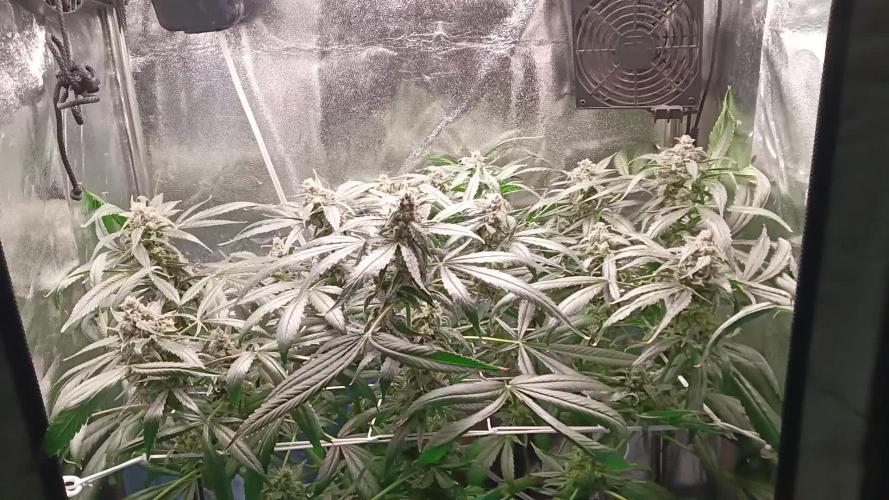
Day 53 has broken for the ladies, and I am very pleased with their progress. The buds are visibly getting stronger every day. A few brown leaf tips appeared, but at this stage I don’t care much for them. Overall, they still look very much alive.
Day 57: Uppermost leaves are curling up. Could be they are saturated with light and I should reduce the lighting period a bit, could be that the water drop installment provided them with a bit too much water, although they don’t show any more fresh signs of over-watering or fertilisation. But I had to remove water that flooded the bottom of the tank … I’ll reduce their lighting period to 14 hours. Rest of the ladies looks very healthy so I don’t want to stress them too much. It would be better to raise the left light a bit but I cannot. So, although the label says they would grow taller, I can be glad they did not gain more height.
Day 58: Buds are really getting massive, and they started to smell a bit more. They even gained 1 cm and tallest bud is now at 89.
It’s a very sweet but deep odour, really enjoyable. Lady #2, while being a bit smaller, looks like being in winter. Sugar leaves are enormous on her.
I added a detail photo from timelapse video showing some of the curled and slightly burnt leaves. They are not many, and damage does not seem to progress. Anyway, ladies are already late in the game and I am rather surprised they still look very healthy.


@PEAKYPLANTERS
Volgen
We have reached the end of another journey full of lessons learned along the way!
shorts_status_processing


@420cfm
Volgen
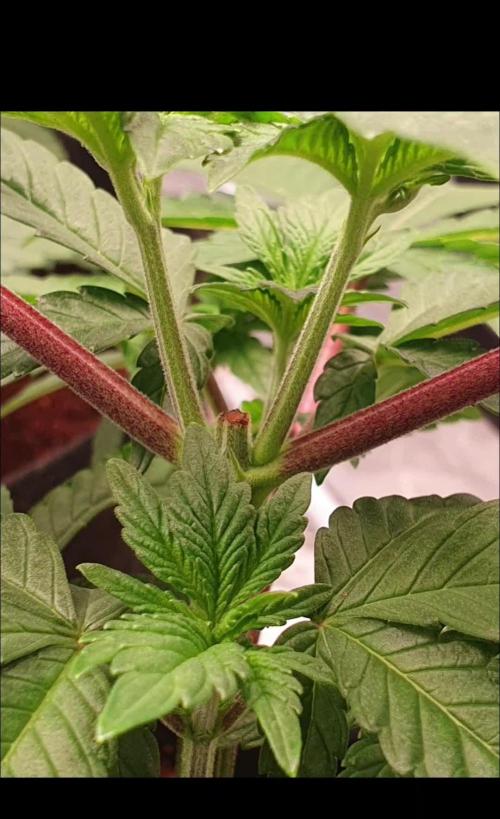
Week 8! Home stretch now. I'm seeing a few nanners so I'm tempted to pull this week instead of next. Will give them a few days to see how they do with the new reservoir refill and go from there! Lots of crystal build up even if the nanners kick my butt.


@Gram_Solo
Volgen
Week 4
Looks like they were stuned slightly after topping, but 5 days later and they are looking good.
Hopefully fill the tent out a lot now will start some LST once nodes a big 🙌🙌
Few more weeks of Veg!


@MadeInGermany
Volgen
Hi everyone 🤗.
The last 5 women are nearing their end 😍.
They will be harvested in the next 2-3 weeks.
The rest of the ones that have already been harvested are currently fermenting 😍.
The finished harvest pictures come when everyone is finished together 👍.
This ends the last diary that was kept with several varieties.
From now on only single strain diaries are coming, all individually ;-).
I wish you a nice week, stay healthy 🙏🏻 and let it grow 🌱


shorts_status_processing


@Tazard
Volgen
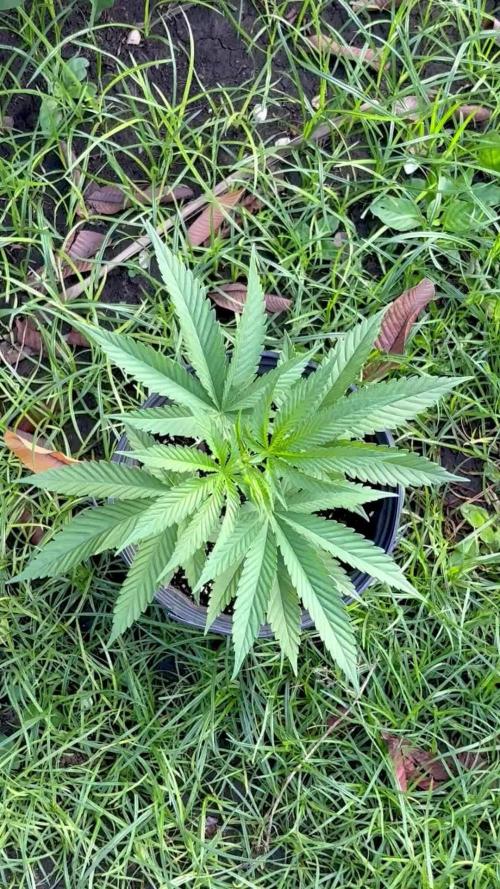
She’s off to a beautiful start. When she has 5 sets of leaves (or when she shows deficiencies) I’ll adjust her nutrients to about 2x current strength.
In 2018 at the first ‘Copa Del Sol’ Cannabis Cup in Lima, Peru, Dutch Passion won 1st Prize in the Outdoor category with Passion Fruit.


@Mmc94
Volgen
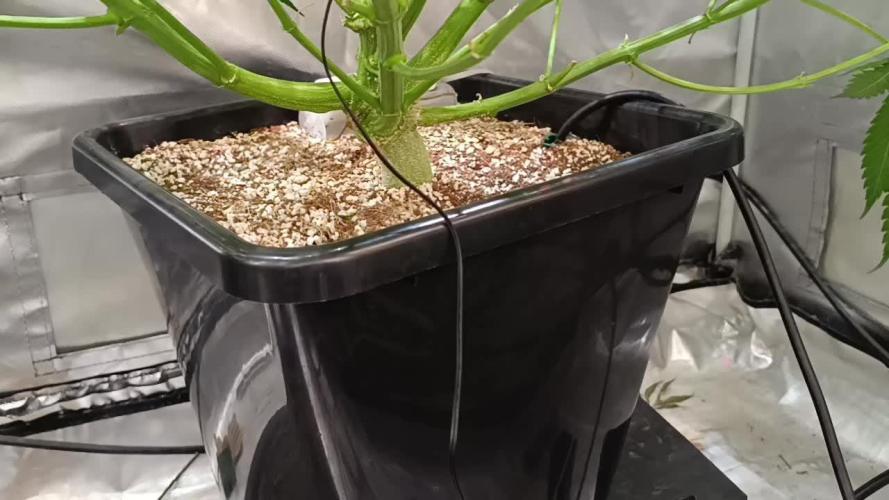
Day 82 Getting to the end ,maybe 2 weeks 3 max to chop, fattening up nicely, drinking as normal now smells really nice (not sure if it's strong as I'm a bit to nose blind ) to her usual sent 🤣 , will swap nuits again for last week or 2 to a 1 part simple no N finisher , I don't think I'll bother to flush ,will see 😅


@Easygrower
Volgen
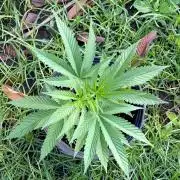
Hello growers day 59 in the garden with crystal meth what can I say the buds on her ain’t massive but they are pure purple smells so sweet I’m going to start flushing for the next week or two and we will see how it goes until next week be sure and happy grow and happy 420 to all the growers ✌️