


Likes
Comments
Share

@all_about_420
Follow
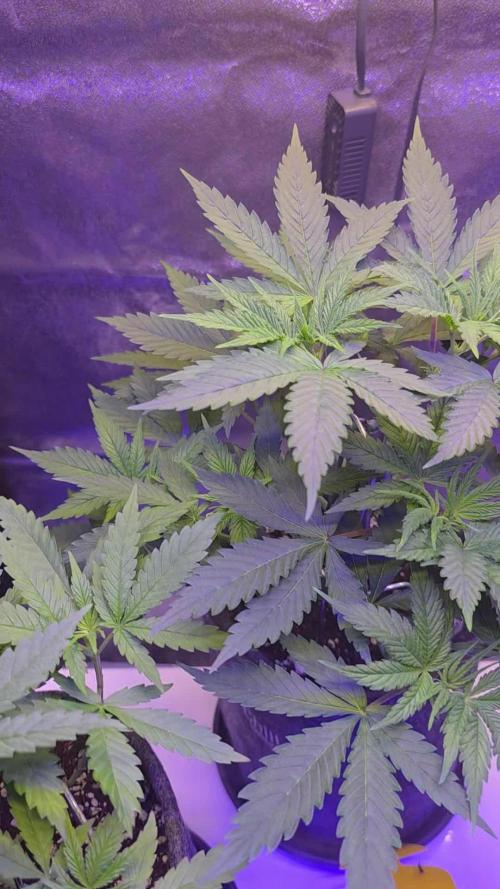
Die vierte Woche stand ganz im Zeichen des gezielten Pflanzentrainings. Zu Wochenbeginn wurde der kräftige Haupttrieb gecuttet (Topping), um die apikale Dominanz zu brechen. Die exklusive Bob Marley Genetik hat diesen High-Stress-Eingriff ohne nennenswerte Verzögerungen weggesteckt. Bereits zur Wochenmitte war eine deutliche Erholung sichtbar, woraufhin direkt die ersten Low-Stress-Training-Maßnahmen (LST) folgten, um die neu entstehenden Haupttriebe flach zu halten und die Lichtverteilung zu optimieren. Zum Wochenende hin präsentiert sich die stämmige Dame extrem vital, stark verzweigt und mit einer perfekt geöffneten Struktur. Die Energie verteilt sich nun absolut gleichmäßig auf die neuen Triebe – ein voller Erfolg im Training.

Likes
19
Share


@Wolf47
Follow
Pics are from 1/18-1/24
Girls are still behaving really well!! My “fan leaf” OCD has been kept in check, and am proud of myself!! The only other annoying thing, is that, one plant is almost twice as long, as the other 3!!
Processing
Likes
3
Share


@ZEEMAN
Follow
She is defo fatting up looking alot better just giving her mineral water till flowering boosters arrive

Processing
Likes
37
Share


@organically
Follow
Week 5 - Day 2 - 11.12.2017
-
Hay lovers of Green, i will give you a big update.
While trying to fix the PH and Humidity issues last week, i've already found some nice root developments and decided to transplant to support the regeneration - 6.12.2017 -.
The Plants were unhealthy and shocked.
After 2 Days they started to reviltalize and stable - 08.12.2017 - and i found a suprise, the adjoining Auto Dinamex's start to Preflower.
-
Today the sweetys are healthy,vital,bushy and got nice stems, in height arround 18 cm
The BCC'S internod distances are longer and the stems are thinner as the ICED G's.
-
■ Blueberry Cheesecake [ Cheese x Blueberry Multiple Hybrid ]
■ ICED Grapefruit [ ICE [Skunk Special x White Widow x Blueberry] X Grapefruit [ C99 x Cinderella x Sativa ]
-
■ Timeline ■
Germination start [ 04.11.2017 - 17:15]
Germinated / into Coir Pellets [ 06.11.2017 ]
PreVegetative start [ 07.11.2017 ]
Transplanted into 1L Airpots [ 19.11.2017 ]
Vegetative start [ 26.11.2017 ]
Transplanted into 7L TeKu [ 06.12.2017 ]
-
PreFlowering start [ xx.xx.xxxx ]
-
Flowering start [ xx.xx.xxxx ]
Harvesting Part 1 [ xx.xx.xxxx ]
Harvesting Part 2 [ xx.xx.xxxx ]
-
■ Growroom ■
Size » 90x90x170 ~ 0,8 m²
-
PreVegetative Lightning
» 24 ▪️ LED ~ 33W - daylight - 3700lm
Vegetative Lightning
» 24 - 20/4 ▪️ HID ~ 250W - 5600K - 18.000lm
Flowering Lightning
» 12/12 ▪️ HID ~ 400W - 2100K - 56.500lm
-
Supply air ▪️ mesh window - negative pressure
Exhaust air fan ~ max.420m³/h ]
Circulating air fans ~ 3x16W max.2250 rpm
-
Pots ▪️ Coir Pellets --> 1 L Airpots --> 7 Liter TeKu.
Medium ▪️ Organic Soils!
Composition ▪️ bark humus,wood fibers,coconut fibers,coconut husks,compost,guano,hornmeal,clay minerals,trace elements,calcium carbonate,perlite.
-
■ Supported by ■
» Female Seeds - so easy !
» Cellmax - Organic Growing.
//////////////////////////////////////////////////////////////////
👋 Greetings your organically
» tried and true, since simple is the best! 👍


Likes
2
Share


@Gumbassman
Follow
She is B-E-A-UTIFUL, she has a very nice smell to her. Small burns from nut. But plenty bud sites and biggest of the bunch.

Likes
14
Share


@MrReeferMadness
Follow
Start of the thrid week today. I was behind on my dairy the first two weeks so there may some date differences in weeks 1+2
Gorrila zkittlez - doing great so far getting nice and bushy. Doing LST on the three off the every 3rd day and that's about it.
Psychosis - she has still been growing and new stems appear evey few days. Two of the leaves had yellowing in them for 2 week so I've put in down to the lack of cal/mag in the system.
Today I was going to replace the nutrient water but instead I decided to leave it and and cal/mag to the res.
The reason for not changing water is down to the volume I am using. I have a 225L tank, 6 20L pots with a 20L brain unit. So I'm roughly using 300/310L if I'm at full capacity (365-15%) due to me obv not using the full capacity of the red or bucket for many reasons.
I only need 50/100 litres at this stage per week so instead of changing it every 7/10 days. I have filled the system with more than enough supply as to not need to change it so frequently.
Ps. The nuits/ec/ph have been holding steady for weeks now hence another reason for keep the water res from week 1
I will be changing the nuit strength and water at some point soon of course... Maybe give it another 7 day depending on how the plants are doing 🤙👍


Likes
2
Share


@Enki_Weed
Follow
Tag 9 seit Keimung. Der Keimling hat den Umzug in die DWC-Anlage gut überstanden und scheint sich wohlzufühlen. Die Beleuchtung liegt bei 250 µmol/m²/s, die Nährstoffzufuhr ist minimal, der pH-Wert stabil bei 5,7. Luftfeuchtigkeit liegt bei 60-65%, die Temperatur bei 27°C. Alles in allem ein positiver Start!

Likes
7
Share


@Kirsten
Follow
💚 ORION F1 ORGANIC DRY AMENDMENTS 💚
The plant has well exceeded my 💚 ORION F1 LIQUID NUTRIENTS 💜
So far really happy, has taken very well to the topping.
She has shown good growth which I'm very pleased to see.
This is what I watered this week:
18.6.25:
I watered with 1.2L of dechlorinated water PH'd to 6.1 and containing the following nutrients per 2 litres;
♡ 0.5 ml Ecothrive Trace
♡ 1/4 Tsp Ecothrive Biosys
PH: 6.1
PPM: 373
23.6.25
I gave 3 ltrs of dechlorinated water PH'd to 6.3 with no nutrients.
PPM: 307
PH: 6.3
28.6.25:
I watered with 2ltrs of dechlorinated water PH'd to 6.5 and containing the following nutrients per 2 litres;
♡ 1/4 Tsp Ecothrive Biosys
♡ 2ml Ecothrive Trace
PH: 6.5
PPM: 418
Thanks for stopping in this week 💚😊🍃✌️🌱
Likes
42
Share


@KrautFabrik
Follow
Day 69: flush 💦
Day 75: water (no flush)💦 & changed place🔚
Pictures are taken on day 77📸
--------------------------------------------------
She is getting a nice purple 🍇😁
I will chop her next weekend ⚔️


Processing
Likes
4
Share


@XoticGROW666
Follow
DAY 30 of flower 🌸🌼
Tall gelato41 pheno
Terps & nose comin of her is stupid Candy icecream lik 🍬🍭🍦🍧🍨🥜
Had a pheno lik this lik couple years ago bring
Most gelato strains I kno of got spicy & nutty herb lik terps but this pheno got that candy terps brings mi back to so much memories!! just the nose on her 🍬 yum yum can’t wait till see her fatting up
Likes
18
Share


@DeepRootsGrowTrees
Follow
PURPLE KUSH / KANNABIA SEEDS
WEEK #8 OVERALL
WEEK #7 VEG
This week this lady is doing good she's
fully recovered from transplant and growing strong she's been topped and has the bud clips for LST here's another great week of growing!! Stay Growing!!
Thank you for stopping by and taking a look it's much appreciated!!
Thank you KANNABIA!!!
BUDTRAINER.COM / BUD CLIPS
PURPLE KUSH / KANNABIA SEEDS

Likes
10
Share


@FrulaFrulaki
Follow
Some more training nothing special. I can really see the difference with one of my plants as its less dense and has some yellowing on its leaves, so I added Bloom and Top-Max to the nutrient mix as I suspected a Zinc deficiency, but to be safe I went with the full spectrum. The soil was probably depleted of nutrients anyway,

Likes
21
Share


@BB_UK
Follow
This girl has only been in action! She has got up to the scrog now and I’m confident in her stretch capabilities as she’s about to preflower, it’s the things with photos, even at 4 weeks well let’s say 12-12 from seed as I’ve done this! They tend to flower when they’re ready! But as I said she’s doing amazing and I’m feeding her with an irrigation method as she’s so far at the back I set up a system that’s working tf and helps me take it easy when feeding! May do it to them all on a lazy vibe next time lol maybe lol defoliated her lower fan leaves too and as time goes on I can see I’ll be in some difficulty to prune her and the other rear plants but I will figure it out I’m sure! 😎
Processing
Likes
4
Share


@Thechefgrower
Follow
It's very hot today, It's clover must be covered not microbes die by sunlight.


Likes
6
Share


@Kardo
Follow
Hat einen sehr starken Haupt Ast und hat viel potenzial sie zeigt sich super
Processing
Likes
37
Share


@MG2009
Follow
These girls sprouted and then had no light for 2 and a half days, so a little leggy. Put them under 25% power LED to see how they respond will increase as needed over next few days, to 100% blue spectrum.. The genetics are either, selfed (G T H), or stray Skywalker that also selfed.. Soo a selfed GTH or sky ghost train. I think I like the possibilities.🙏
03/27/2018 Day 6, 100% blue spectrum, 25% red, perking up watered.
Likes
20
Share


@Tracie67
Follow
It's been a pretty easy week. Enjoying watching the buds get thicker! Just going to coast to the end at this point....hoping to harvest within the next 2 weeks. Already getting excited for my next grow...thinking Ethos Planet of the Grapes or Ethos Crescendo.
Likes
2
Share


@Ultraviolet_
Follow
18 hours in seconds, 60x60x18 = 64,800 seconds, now multiply by the 833μMol/s reading off the PAR metre. μMol/s (micromol) is the unit in which P.A.R. is expressed.
64,800x833=53,784,000μMol
53,784,000μMol = 54 Mol
54 DLI @ 800ppm, powerful combination. Pushing photosynthesis to peak capacity, accelerated growth and increased biomass. Applied net, stretching her around for a week. Maintaining a minimum air velocity of 0.3m/s within the inner canopy.
E=MC2 looks like a simple multiplication problem; it describes a fundamental physical truth: mass and energy are the same thing. The equation doesn't just calculate a value; it reveals that mass is effectively "congealed" energy. Energy is just numbers. Energy isn't a physical "substance" you can hold or touch. It is essentially an abstract, calculated number that we assign to a system to predict how it will change, interact, or move. A numerical label we attach to matter to track how it behaves. Because the universe runs on laws of symmetry (specifically, that the laws of physics don't change over time), a single global number must be conserved. We call that number "energy".
How well a seedling grows is down to how much knowledge one can acquire to increase the level of conversion to occur. Applying knowledge effectively requires intuition, which comes from hands-on experience. A seasoned stoner learns to read subtle signs—like a slight change in leaf turgor (stiffness), subtle color shifts, or the specific texture of the soil—before a textbook diagnosis can be made. Ultimately, growing is the application of botanical science blended with active observation. Knowledge dictates your potential, but adaptability and attentiveness to the plant's immediate environment determine your results. The human eye is capable of distinguishing more shades of green than any other color in the visible spectrum.
1.618
Nature mathematically optimizes quantum energy transfer and light absorption efficiency within the photosynthetic machinery, as it naturally dictates energy scaling hierarchies and resonance dynamics. External vibration or electromagnetic wave that perfectly matches a plant's natural frequency directly influences plant growth. Low-frequency sound waves and targeted electromagnetic fields stimulate cellular processes and boost photosynthetic efficiency. An angular frequency aligned with the Golden Ratio is often used in wave mechanics and quantum physics to optimize energy transfer. .
Does it produce better yields? All I know is the IVM loves being aligned with it.
"Frequencies utilizing this ratio naturally minimize resistance (or impedance) and allow for highly efficient resonance, which can facilitate an increase in Electron Transfer Reactions (ETR) or energy pathways in molecular structures."
Quantum coherence in photosynthesis occurs when a photon of sunlight strikes a leaf; the energy it carries must travel to a reaction center to be converted into chemical energy. This process operates at nearly 100% efficiency. If the energy moved in a traditional "bunching" or random hopping manner, a large portion of it would be lost as heat. Instead, plants utilize quantum superposition. The energy particle (exciton) doesn't just take one path; it exists in a wave state and explores multiple pathways simultaneously. It essentially "chooses" the most efficient route to the reaction center simultaneously.
Research shows that molecular vibrations and the specific network arrangements of chlorophyll molecules (like the naturally evolved Chlorophyll A & B ratios) actively protect against energy overflow, optimizing light capture across different light intensities. Enzymes are the biological catalysts that speed up chemical reactions within a plant's cells, allowing them to grow, metabolize, and repair. Rather than relying solely on the classical kinetic energy of molecules colliding, plants use quantum tunneling. Subatomic particles like electrons and protons (hydrogen ions) can literally "teleport" through energy barriers that they normally wouldn’t have the energy to climb over. This makes vital metabolic reactions happen far faster than classical physics could ever explain!
Chloryphyll b has peak absorption at 460nm (Blue) and at 647nm(Red). If we take the blue peak wavelength 460nm and a UV-B, UVR8 peak absorption wavelength 285nm, Tryptophan-285 (W285) Sensing protein. 460/285=1.618 Φ If we take chlorypyhll b's Red absorption peak 647nm and a UV-A of 400nm, we get 647/400=1.618 Φ. "Structure of light". The cryptochrome photoreceptor (CRY) is a UV-A/blue light receptor that shares this dual sensitivity with several other biological structures and functions, including significant sequence similarity and a common evolutionary ancestor with DNA photolyase enzymes. These are light-activated enzymes that use blue/UV-A light to repair DNA damage caused by UV-B radiation in plants. Synergistic.
Effective quantum efficiency of photosystem II, often denoted as ΦPSII, represents the proportion of light absorbed by Photosystem II (ΦPSII) that is actually used in photosynthetic electron transport. It is a key indicator of how efficiently a plant is using light for photosynthesis, as opposed to losing it as heat or fluorescence. ΦPSII (effective quantum yield of photosystem II) functions primarily as a "multiplier" (a coefficient of efficiency) rather than an additive factor when estimating the overall photosynthetic electron transport rate (ETR). Multipliers are considered far more beneficial than additions because they generate exponential growth, leverage existing resources to their full potential, and create sustainable, self-multiplying capacity, rather than just incremental, linear increases. This fascinating observation is rooted in the intersection of subatomic geometry, fractal scaling, and quantum dynamics. In specific molecular arrangements—such as in conjugated polymer networks or biomolecular architectures—the Golden Ratio (PHI) naturally dictates energy scaling hierarchies and resonance dynamics. Mathematically tied to the fine-structure constant, which defines the strength of the electromagnetic interaction. The Golden Ratio can be mapped geometrically as the Golden Angle (137.5 degrees) in atomic structures, linking the charge of the electron to fundamental quantum constants like Planck's constant.
An electromagnetic wave is neither electric nor magnetic, but a combination of both. 137.5
The Golden Angle (137.5) This angle is derived from the Golden Ratio (1.618). It is the smaller of two angles created when a circle is divided such that the ratio of the arcs equals the Golden Ratio.
An electromagnetic wave (like light or radio waves) is not a static electric field or a static magnetic field, it is a self-propagating combination of both. An oscillating electric field creates an oscillating magnetic field, which then regenerates the electric field. They feed off each other and travel together through space at the speed of light, carrying energy without needing a material medium.
The Fine-Structure Constant Alpha (Α/α): In quantum physics, is the approximate denominator of the fine-structure constant (often represented by the Greek letter Alpha (Α/α). It is a fundamental, dimensionless number that dictates how strongly charged particles (like electrons) interact with the electromagnetic field. Its value has puzzled physicists for over a century, as it bridges quantum mechanics, electromagnetism, and relativity.
In quantum mechanics, Omega (Ω/ω) usually represents angular frequency. When applied to "quantum coherence"—the ability of particles to exist in overlapping states without immediately degrading—is key to calculating how long these states last.
The Golden Angle, the value 137.5° is the geometric Golden Angle. It is derived from the Golden Ratio (1.618) and is famously responsible for the beautiful, mathematically optimized spiral patterns found in nature (such as sunflower seeds, pinecones, and leaf arrangements). Because of this, theoretical physicists and mathematicians have long speculated about why nature relies so heavily on the number 137 and the golden angle to govern everything from subatomic light interactions to the macroscopic geometry of the universe.
Quantum coherence allows particles to maintain superposition and entanglement. In realistic, open environments, interactions with a noisy background typically cause decoherence, destroying the system's quantum information. A major challenge in quantum physics and quantum computing is preventing this decoherence at large scales. In quantum optics and driven systems, the Greek letter Omega (Ω/ω) often represents the Rabi frequency, which dictates the strength of the coherent driving laser or electromagnetic field interacting with the quantum system.
The interaction of light and water generates specific Coherent Domains. Trapped electromagnetic fields cause water molecules to vibrate in unison at a coherent frequency, separating the liquid into structured quantum areas and an unstructured phase. When water interacts with hydrophilic (water-attracting) surfaces, the energy from UV and Infrared light can drive the formation of larger, structured layers known as Exclusion Zone (EZ) water. Exclusion Zone (EZ) water represents a structured, negatively charged phase of water critical to cellular biology. Driven by light energy and hydrophilic surfaces, this ordered state acts as a natural biological battery, with far-reaching implications for cell function and human health. In this domain, water molecules arrange themselves into a highly ordered, negatively charged lattice that excludes solutes and particles. At higher energy levels, UV light acts as a catalyst for photochemical reactions. Photons can provide enough energy to break the hydrogen and oxygen bonds in molecules, resulting in free radicals and a plasma of quasi-free electrons. This transfer of electrons forms the fundamental basis for redox reactions and energy metabolism in ALL biological systems.
