






@sellem
Volgen
All cut up and dried! Harvest was easy enough as i defoliated a lot before. First bit of trimming was done rough around the edges before hanging her up.
Grow has been a pleasure, even though i subjected her to varying degrees of stress she put up with it nicely. I fipped to early for my likings, but she still produced!
The smoke is ultra-soft even after just a few days of curing. The fruity, almost tropical smell is already fully present after just a week in the glasses. The smoke hits fast and hard, but even for me as a wuss its very relaxing, did not induce any paranoia for me. Started as a slightly euphoric high, it quickly settled into a couchlock-like feeling, though i still had energy to go around and do things, only - of course - now stoned as a rock. very pleasent experience and well rounded effects. I can picture this one to be a go-to smoke after a stressful day at work to relax and play video games to. Awesome.


@JohnnyGrower
Volgen
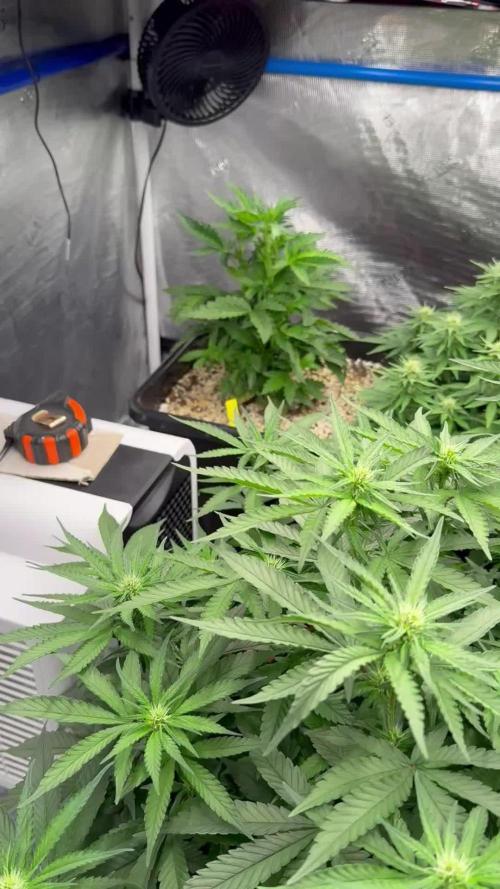
Esta semana comenze la aplicación de big bud organic y nirvana, además de el b-52 que ya venia aplicando y las bases connoiseur, he rallado una cantidad enorme de brotes bajos que cogian mucho vigor y no iban a prosperar como los apicales.



@madlangs
Volgen
No problems
8.11.25
WW 54cm and 34cm
Pineapple 34
Afgooey 41
n lights 48cm & 67cm
Sleepy Joe 54cm
Papaya zoap 68cm
Pure glitter 26cm
Ppfd 950





@Ultraviolet_
Volgen
Remember that, however you are played, or by whom, your soul is in your keeping alone. Even though those who presume to play you be kings or men of power, when you stand before God, you cannot say, 'But I was told by others to do thus,' or that virtue was not convenient at the time. This will not suffice. Remember that.
Day:18
84°F and 65% RH (VPD) for the vegetative stage. Approximately 1.15kPa(assuming leaf temperature is about 2°F cooler than the air), which falls right into the ideal vegetative sweet spot (0.8kPa to 1.2kPa). At 1.15kPa, plants can draw water and nutrients efficiently without risking stress or wilting. It keeps the leaf pores (stomata) open, allowing for ideal carbon dioxide intake and maximizing vegetative growth. VPD is determined by the leaf's temperature, not just the ambient air. Because leaves usually run 1° to 3°F cooler than room air under bright grow lights, my actual VPD will be slightly lower, closer to the 1.0kPa mark. As she transitions from vegetative growth to flowering, one can gradually lower the humidity (to around 45–60%) and drop temperatures slightly to prevent disease from settling inside dense buds when they appear.
Night:6
At 70°F and 60% relative humidity, Vapor Pressure Deficit (VPD) is 0.86 kPa. This is right on the cusp of whats optimal for the vegetative stage. During the nighttime, plants generally close their stomata and undergo cellular respiration rather than photosynthesis. Transpiration slows to a near stop, making VPD less critical at night than during the day. However, maintaining a nighttime VPD between 0.8 and 1.0 kPa is highly beneficial in that it ensures the air is dry enough to prevent powdery mildew or bud rot, but moist enough to keep the plant from undergoing unnecessary stress. This range keeps the environment comfortable for cellular processes and prevents large atmospheric swings. Keeping it all flowing.
(Not pushing them yet, these are photoperiods)
The optimal soil (root zone) temperature for cellular root respiration and nutrient uptake in cannabis is between 68F & 72F This narrow range balances biological energy production (cellular respiration) with the dissolved oxygen levels in the soil, maximizing plant growth and health. Warmer soils hold significantly less dissolved oxygen. When soil temperature exceeds 74F oxygen depletion occurs, inhibiting cellular respiration almost entirely, At 68-72F root cells generate optimal adenosine triphosphate (ATP) via respiration to power root-tip elongation and the active transport of water and nutrients.
Too Hot (Above 78F) Root respiration increases, demanding more oxygen, while the water's oxygen-carrying capacity drops. This creates a prime environment for anaerobic pathogens and Pythium (root rot).
Too Cold (Below 60F) Root metabolism and cellular respiration slow to a crawl. This severely impairs nutrient and water absorption, leading to yellowing, wilting, and phosphorus deficiencies.
A lot depends on whether it's automatic or photoperiod; with photoperiod, there is not as much of a need to push "hard" as the real countdown only begins once the flower is initiated. Automatics, on the other hand, the chronological "clock" begins ticking the moment the seed germinates. It is of critical importance that the seedling growth gets off to the races, understanding that early growth is like compound interest, which will pay off come harvest. This reality is why getting autoflowers "off to the races" early on yields such exponential benefits. The "compound interest" is directly related to the surface area of the leaves. Larger, faster-growing seedlings process more light and build bigger root networks early on, which translates into an explosion of vertical and lateral growth during their short vegetative window.
The margins for error are so thin with autoflowers; this early-stage momentum depends on several critical practices. Seedlings exposed to increased atmospheric CO2 levels early in life will develop at an increased rate. To effectively "extend" or optimize the capacity of Photosystem II (PSII) for increased photosynthetic efficiency. In standard oxygenic photosynthesis, Photosystem II (PSII) is naturally limited to the red-light spectrum, peaking at 680nm. Extending its light-harvesting capacity past 700nm into the far-red region requires bypassing the natural limits of standard chlorophyll a. Adding 730 nm (far-red) LEDs alongside standard red/blue lights has been shown to increase canopy photosynthesis by 20–30% in several crops by acting synergistically with shorter wavelengths. However, the limitation is that excessive, pure IR/Far-red light (without accompanying red light) can trigger the "shade avoidance response," causing plants to grow tall, weak, and spindly rather than robust. Utilizing infrared light (specifically the 700-750 nm far-red range) is a viable method to boost photosynthetic efficiency. It acts as a bridge to allow PSII to utilize a broader spectrum of light, breaking the traditional 700 nm barrier. UVR8-mediated signaling (often in conjunction with CRY proteins) triggers protective mechanisms that maintain the stability of the photosynthetic apparatus (including LHCII and reaction center proteins), thus ensuring that the efficiency of Photosystem II remains higher in UV-B-exposed plants compared to plants lacking this receptor. ΦPSII indictates the rate of electron transfer from water to plastoquinone, which drives the production of ATP and NADPH. There is a close link between ΦPSII and the true rate of CO2 fixation (Φ*co2).
ETR stands for Electron Transport Rate. It measures the speed at which electrons are moved through the thylakoid membranes in a plant's chloroplasts during the light-dependent reactions of photosynthesis. Infrared light (particularly Near-Infrared or NIR) improves cellular energy by interacting directly with the electron transport chain (ETC) in mitochondria. This process boosts adenosine triphosphate production, which acts as a metabolic coefficient multiplier by accelerating enzyme activity dramatically.
Extend then multiply.
Far-Red photons interact with plant photoreceptors to accelerate the plant’s biological "clock" or trigger a shade-avoidance response. Autoflowers don't use the plant's biological clock, although the IR will initiate a shade avoidance and make them stretchy. You can just add equal measures of 660nm-680nm to negate the shade avoidance effect. Replacing nights' "darkness" with a combination of IR+ and 660nm. Because autoflowers don't require a dark period to flower, many growers just blast them with light. 18/6 24/0. However, this ignores the plant's metabolic rhythms, where daytime photosynthesis (light reactions) must be perfectly balanced with nighttime carbon fixation and assimilation (Calvin cycle) to avoid bottlenecking plant development. Cellular respiration is a 24/7 process, but it can only function while the plant has the free oxidative capacity to do so. A 100% photosynthetically active leaf cannot perform cellular respiration. The viral trend of defoliation of every leaf that isn't "getting enough light" is of great detriment overall, putting 100% of the cellular respiratory "workload" and responsibility on the 0/4/6 hours of darkness in sub-optimal conditions for enzymatic activity. Photosynthesis captures nearly 100% of the initial energy as carbon, while cellular respiration is the process that unlocks 90% of that captured energy into usable ATP so the plant can use it. Respiration is considered only roughly 30% to 40% efficient. It captures enough of the potential energy in glucose to synthesize around 30 to 38 ATP molecules per glucose molecule. The remaining 60% to 70% of the energy in the sugar is not captured in ATP; instead, it naturally escapes into the environment as heat, which helps regulate plant temperature. In plants, the primary enzymes of the Electron Transport Chain (ETC) and the ATP synthase complexes are typically adapted to function optimally in warmer temperatures (roughly 77°F to 95°F, depending on the specific plant strain). As temperatures rise within this physiological range, molecular collisions increase, speeding up respiration and ATP production. The cannabis plant has a branched respiratory pathway. During heat or cold stress, plants activate Alternative Oxidase (AOX). AOX burns sugars to dissipate energy as heat rather than coupling it to ATP production. This pathway actually functions optimally at elevated temperatures to help protect the cell from the damaging build-up of Reactive Oxygen Species (ROS) during heat stress. Enzyme activity generally scales with heat; there is a strict biological limit. If canopy temperatures in a grow room exceed 104°F, the enzymes and their supporting lipid membranes lose stability. Not saying you need to go crazy, just optimize nights the same as we optimize days.
Phosphorus is the driving force behind early seedling development. It acts as the "energy hub" of the plant, directly driving cell division, robust root growth, and the creation of DNA. Without an adequate, easily accessible supply early on, the plant's overall growth potential and final yield can suffer permanently.


@Elpicor
Volgen
To get higher temperatures I placed the growbox near the radiator, dimmer still at 25%, boiled tap water also this week, this guaranteed me an ideal for the beginning, from now on I will use mountain water which will allow me to use less fertilizer.


@Oimjr
Volgen
So far, so good. I used a but of koolbloom. I'm pretty new to this, so I don't know of it will help. But here goes. Not much longer I think. May e a few more weeks.
Water change on 3/9. 4 gal well water 1 tsp maxi bloom 1 tsp Kool bloom ph to 5.8. Looking good!


@Hashy
Volgen
********************************************
Week 13 Late flower (week 9 flower)
********************************************
Light cycle=12/12
Light Power=120w 50%
Extractor controller settings (during lights on).
High temp= 26c
Temp step=0c
High Rh= 46%
Rh step=0%
Speed max=10
Speed min=3
Extractor controller settings (during lights off).
High temp= 20c
Temp step=0c
High Rh= 50%
Rh step=0%
Speed max=10
Speed min=3
Smart controller settings (during lights on).
Lights on=9.00am
Smart controller settings (during lights off).
Lights off=9.00pm
VPD aim=1.0-1.5
DLI aim=40-45
EC aim=1.0-1.8
PH aim=6.0-6.5
💧💧💧💧💧💧💧💧💧💧💧💧💧💧💧💧
NPK= 5-14-20
Method= Automatic
Feed=Late Flower nutes
Neutralise=0.1ml/L
Plagron bloom=2.5ml/L
Plagron Power buds=1ml/L
Green Sensation=1ml/L
Easy Ph down=0ml/L
(1ml=24 drops, 1 drop=0.04ml)
Easy Ph Up=0.0ml/L
(1ml=24 drops, each drop is 0.04ml)
Ec=1.2 PH=6.3/6.0
Runs=10
Run times=3mins (0.75L/0.375L each)
Gap times= 17mins
Total runtime=30mins(6.0L/3.0L each)
Total flowrate= 0.25L/0.125L/min each
Auto start time=10.00am
Auto stop time=1.03pm
💧💧💧💧💧💧💧💧💧💧💧💧💧💧💧💧
********************************************
********************************************
📅3/5/25 Saturday(Day 85)
📋 Removed Radiator summer conditions from now on.
Small defoliation
💧
Automatic Water
Ec=0.2 PH=6.6/6.5
Volume=10L
Volume left=2.5L
Volume used=7.5L
Volume each=3.75L
Total runoff=0.6L
Ec=2.1 PH=6.4/6.4
💧
📅4/5/25 Sunday(Day 86)
📋
📅5/5/25 Monday(Day 87)
📋
📅6/5/25 Tuesday(Day 88)
📋
📅7/5/25 Wednesday(Day 89)
📋
💧
Automatic Late flower nutes
Ec=1.2 PH=6.2/6.0
Volume=5L
Volume left=1L
Volume used=4L
Manually
Volume =1L
Total used=5L
Total runoff=0.8L
Ec=2.5 PH=/6.6
💧
📅8/5/25 Thursday(Day 90)
📋
📅9/5/25 Friday(Day 91)
📋Day 63 of flower
********************************************
Weekly roundup.
📋My lung room is a little less crowded now I can take the radiator out of there. It's now the job of keeping the room cool as the season has changed. She's in late bloom now as pistils are starting to brown. The Fat bastard name really suits this plant, nice big flowers, I do have a bit of fox tailing going on the very top of the main cola but that can be expected for how close she is to the light. Still a way to go yet but she is doing great.
Back soon.
Take it easy.
********************************************


@Cannabis_Sativa
Volgen
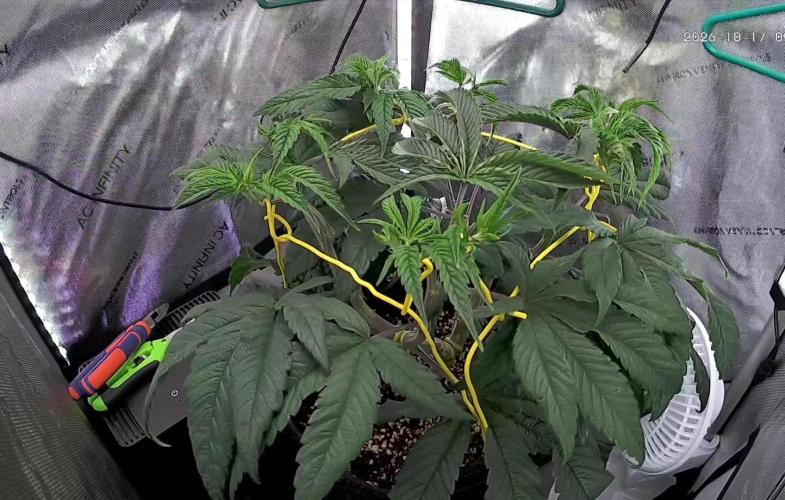
In the mid flowering stage smells are amazing like citrus. The roots are full fill in soil, its hard rooted on the top on soil

@BobbersDown
Volgen
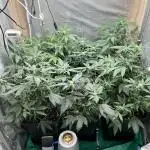
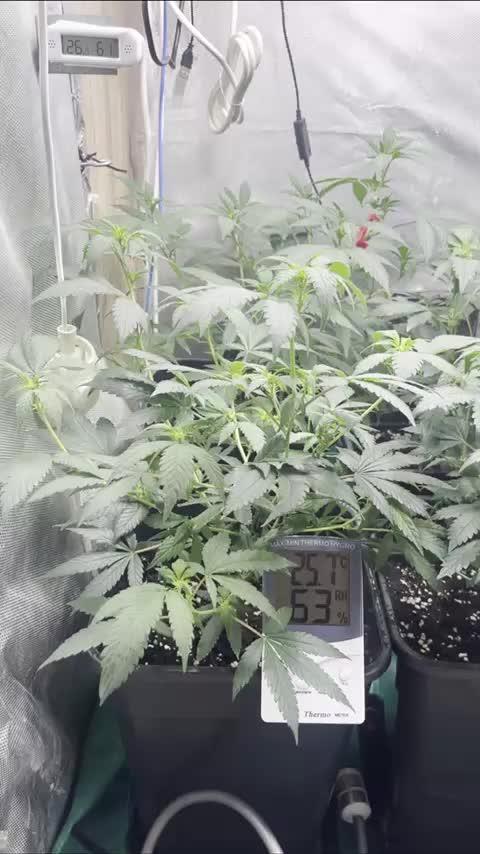
Flipped to flower so figured I'd include a last veg update. She's growing like crazy now, smelling a bit skunky and seems to be ready for shower. Very happy with the mainline structure.


@Raster893
Volgen
terminamos la segunda semana desde el cambio de ciclo a 12/12. Las plantas han conseguido rellenar todo el espacio disponible y se le ha realizado un leve defoliacion de no mas del 5% total de vegetacion, ahora deseando que llegue el dia 21 para hacer la defolacion de bajos


@Diips
Volgen
Its starting to look more like a forest from each day that goes on. frost also starting to appear already and we are still early in flower ;)
d.66 all good in the hood, ill will try to pull those 2 who are very close to the light more back to the wall, so the lower stalks can get light and space
d.66 a little bit of bamboo and lst done without problems 🌞


@eldruida_lamota
Volgen
Que pasa familia, de nuevo estamos aquí con la cuarta semana de crecimiento, a ver si las aguanto una semana más o las pasamos a flora, se decidirá a lo largo de estos días.
Vaya color más bonito que se marcan están muy sanas y vigorosas, Agrobeta hace sus funciones a la perfección mantienen una planta sana de principio a fin, cubriendo todas las necesidades, palabra que no es la primera vez que los uso.
Agrobeta:
https://www.agrobeta.com/agrobetatiendaonline/36-abonos-canamo
Mars hydro:
Code discount: EL420
https://www.mars-hydro.com/
Bueno las maximas de temperatura no superan los 25 grados y las mínimas no bajan 19, así que no me puedo quejar.
Los niveles de humedad también son los correctos van entre 50%/60% de humedad relativa.
Por supuesto el Ph lo estamos dejando alrededor de 6.
Hasta aquí es todo poco más la verdad ya con ganas de empezar la floración , buenos humos 💨💨💨


@KcKush
Volgen
*Increased PH to 850
*Noticed some yellowing maybe I need to increased feeding.
*Starting to push out a weak citrus smell.
*did a foliar and burned all the pistils :).


@Loucifer512
Volgen
Ok so I did a drip system on these plants for about a couple weeks took it out now half the plants want to be watered more then usuall and if not they start to droop other then that it’s fine hopefully they will do better when they get transplanted to 5 gallon pots


@Buddyhighs
Volgen
Another good week doubling size, loads of starts of buds blossoming. Both seem to to have grown more of an appetite water a feed every day this week.
Stage 5: budding/flower
Day36: water and tied down and defoliate
Day 37: feed
Day38: last spray
Day39:water
Day40: water
Day 41:feed more defoliation
Day 42: water


@nossogrow
Volgen
as you guys can see our Mary is growing beautiful and it's already smelling really good
we had a emergency but it was looking good despite not having been watered all weekend
so we had a lot defoliation, we took of lots of leafs and more LST




@Stork
Volgen
Day 16 Tue
PH 5.8
EC 0.7
DLI 18h
PPFD
Water 24
Day 17 Wed
PH 5.7
EC 0.6
DLI 18h
PPFD
Water 23
Day 20 Sat
Add ph up
PH 5.3 - 5.9
EC 0.6 - 0.7
DLI 18h
PPFD
Water 23


@artems
Volgen
We started to change color! Thats amazing guys! This is my first purple flower! Cant wait to check it out. Look on photos!
What do you think about defoliation or banding? Wanted to leave it with our any trainings, but now Im not sure...
