Likes
Comments
Share
@grimm420
Follow
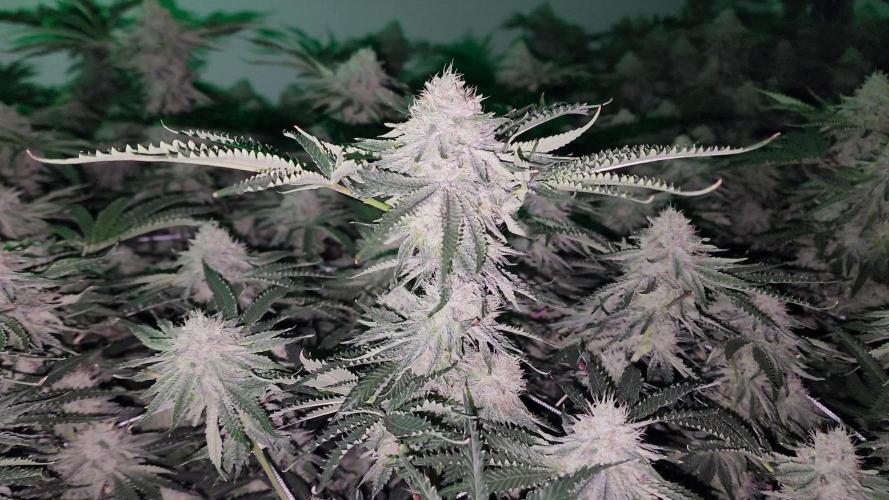
This is the only plant I’ve seen with so many pistils like that, I really think she’s gunna yield like crazy, looking forward to beautiful flowers!
Likes
3
Share
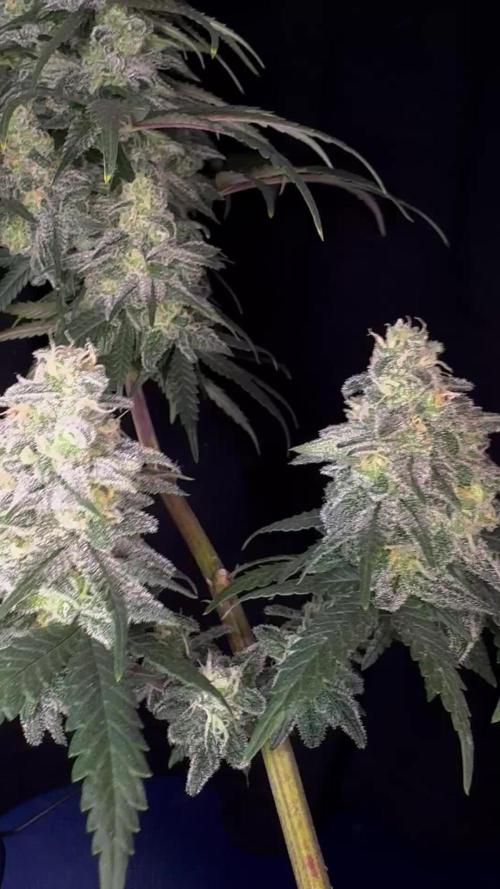
this time we got a different phenotype, the whole plant has started to turn purple, not just sporadically like in the last ztrawberriez grow. It looks beautiful and will be harvested soon
Processing
Likes
10
Share
@Coboiii
Follow
Day 64, all defolitate, and a few cut on Cream Cookie that I try to clone... Tangie Matic is doing her shit, loving the photoperiod.. 😎 The others are slower but I'm optimist about them 😅 See ya next week ✋
Processing
Likes
22
Share
De nuevo familia traigo la cuarta semana de floración de estas critical a granel, que me regaló grow barato. Aunque sean a granel tampoco vamos a desecharlas, ya que aun así podemos conseguir muy buenas flores. Este cultivo va fenómeno también. Ya empiezan a desprender su aroma tan característico, buen porte predominante indica 55/65 días están. . La humedad esta al 45% la temperatura está entre 21/25 grados , y como siempre el ph , ya que es de lo más importante,está en 5,8/6,0. . AgroBeta: 1 ml x L Flowering black line , vía radicular. 0,2 ml x L Beta shark, vía radicular. 0.5 gr x L mega PK , vía radicular. 0,8 ml x L Terminator, vía radicular. 0,5 gr x L Engordacogollos, vía radicular. 0,3 ml x L Tucán , vía radicular. 0,1 ml x L Betazyme, vía radicular. 0,3 ml x L Tricoma, vía radicular. 0,05 ml x L Gold Joker, vía radicular. 0,2 ml x L Silver, vía radicular. . Hasta aquí todo familia 🕸️ , un saludo y buenos humos fumetillas💨💨💨.
Likes
28
Share
@BigDaddyK
Follow
change Mondays Takes about 10 weeks of flower 🌸
Likes
24
Share
@nonick123
Follow
Día 108 (16/09) Tras el flush las plantas muestran tímidamente nuevos pistilos blancos! 😍 Hoy no es necesario regar! Día 109 (17/09) Me he encontrado a OnionOG #1 y a Purple Punsh completamente sedientas! Con las hojas caídas! Riego con 1,25 litros de H2O a cada una de ellas (el resto no necesitan riego) Día 110 (18/09) Riego con 500 ml H2O Las plantas con el bloqueo empiezan a mostrar nuevos pistilos, sobre todo en las partes inferiores Día 111 (19/09) Riego con 250 / 500 ml H2O Se vuelven a formar pistilos blancos en todas las plantas que han sufrido el bloqueo! 😍💥 OnionOG #1 va como un cohete formando y apilando flores 💪 🚀 😍 Día 112 (20/09) Día lluvioso. Riego ligero 250 ml H2O Día 113 (21/09) Otro día lluvioso. Riego ligero con 250 ml Día 114 (22/09) Detecto algunas moscas blancas apoderándose de las plantas y decido hacer una aplicación foliar de piretrinas (Spruzit a 15 ml / l) Riego con 1 Litro de Té Floración de Lurpe Solutions. Preparación: 24 horas con bomba de aire (oxigenación) con ingredientes: Healthy Harvest 8 ml/L + Insect Frass 16 ml/L + Kelp Hidrolizado 0,3 g/L 💦Nutrients by Lurpe Solutions - www.lurpenaturalsolutions.com 🌱Substrate PRO-MIX HP BACILLUS + MYCORRHIZAE - www.pthorticulture.com/en/products/pro-mix-hp-biostimulant-plus-mycorrhizae
Likes
10
Share
@CervantiS
Follow
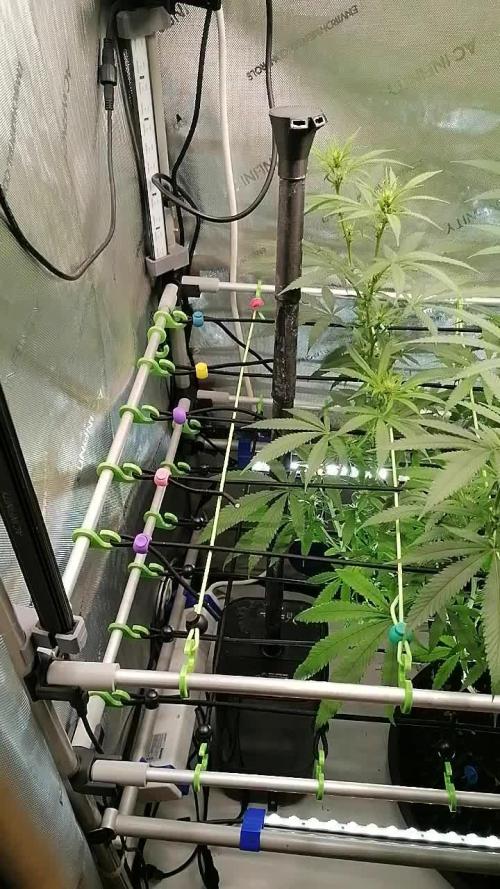
Feb.2 Diy Growbox: 60*60*160 cm Light: 150w led Light Cycle: 18/6 Soil: CocoPerlite in diy Hydrobucket Extractor: 120mm PC vent Running 24/7 Dear Growdiary, She is loving the new light, very nice progression, I keep all new growth away, so i only have 8 strong branches. Its a small space, and its sharing it with my brothers Cheese.
Processing
Likes
73
Share
Blue Shark is still doing great, it's not the tallest, but definitely has the best deep green color and the largest leaves. Got a handful of the Coast of Maine fertilizer around the base watered in with some lime water. Bugs are looking for snacks so I used a bit of neem oil spray and put up a sticky trap. I've had so many bugs this year it's crazy. The cucumber beetles are out in full force and fornicating whenever I catch sight of them, and I've never had them as a pest before! Also, please forgive my slurring speech in the video, it's been a long week and my brain is completely addled😜
Likes
Comments
Share
@Kannisho
Follow
Harvest day, I want to thank you for joining me until the last day of cultivation
Likes
93
Share
@Roberts
Follow
Auto Opium is still doing some stretching. There really has not been any changes. Just waiting on her to start developing some colas when she is ready. Everything is going good. Thank you Divine Seeds, and Medic Grow. 🤜🏻🤛🏻🌱🌱🌱 Thank you grow diaries community for the 👇likes👇, follows, comments, and subscriptions on my YouTube channel👇. ❄️🌱🍻 Happy Growing 🌱🌱🌱 https://youtube.com/channel/UCAhN7yRzWLpcaRHhMIQ7X4g
Likes
17
Share
7 Feb: Watered with a tiny bit of pH-Down, also 0.5ml Acti-Vera + 0.5ml Bio-Heaven. I plan to feed her 2L of this mixture (total of 1+1ml nutrients) for the remainder of this week. I will feed more if I have given all feed and the soil is still dry, otherwise no. I just now calculated that it would mean around 285ml of water per day for 7 days in a row, I think that is a bit too much. 8 Feb: I asked a grow question regarding if I should trim (defoliate) my flower. Thanks to everyone who took time to answer! In conclusion I will not defoliate my flower. 9 Feb: Watered 10 Feb: Today I started using nutrients and I deliberately decided to use the minimum amount possible. I will then see how my plant reacts and either continue with nutrients and slowly increase to "correct" dosages, or switch back to plain water for a little while longer. Also, if you look at the text above after "7 Feb", you see that I used nutrients there as well. However I used tiny, tiny dosages and I also shared the water with my other plant: https://growdiaries.com/diaries/133066-grow-journal-by-depplover49. The feed ran out in just 3-4 days and the plants seem to like it so that's why I had to refill my watering can today. 11 Feb (Day 29): Today was my best performance yet when it comes to mixing nutrients. I measured the pH-levels of the water, added one nutrient, checked the pH-levels again, then repeated until I was done. I also used two different meters since I believe they're both not really a 100% working. I am thinking about investing in a better one, these two were like $15 each and I heard that they can break after a while. Anyways, I checked the soil using both meters and the green one show 6.9 and the red one 6.9-7.0. I'm quite sure it's at 6.9 and my feeding mixture is about 6.5. I am hoping to be able to report a lowered pH-level in a few days (if that's how it works hehe). 12 Feb (Day 30): She is getting wider and bigger, her leaves are erect, she responds very well to nutrients and pH is 6.8-6.9. The green pH-meter is saying 6.8! 13 Feb: Damn she grew 7cm last night, a bit more than 2 inches.
Likes
18
Share
Bueno pues el sábado 4 y el domingo 5 de marzo realice las defoliaciones y el lunes 06/03/23 puse las luces a 12/12 para inducir la floración. Las autos ya estaban en prefloración hace 1 semana. Son 12 plantas en macetas de 7L con 44 días desde que se empezaron a germinar las semillas. Uso la gama completa de nutrientes, Boom nutrients Están bajo la luz del panel LED 780W ResinX de GBLIGHTING Pretendo poner una malla de scrog y en floración avanzada otra, para sujetar todo bien.
Likes
2
Share
67 days since April 16th, 2026 We become aware at such times of man's wonderful ability to bring seemingly unrelated elements into harmonic balance, and receive a glimpse into a world where everything exists in conscious sympathetic attunement to everything else. When we listen to a piece of music that seems to strike a beautiful chord somewhere inside us, or view a painting that simply glows with harmonic awareness well executed, we probably do not spare much time to contemplate the wonderfully intricate combination of vibrations that our sensors make it possible for us to perceive. We tend to appreciate the relationship between the parts of something by an awareness of the harmony or dissonance of the whole. This ability enables us to say "what a beautiful house!" instead of "analysis has proven that this collection of building materials exhibits certain elements of harmonic proportion." While this ability to instinctively appreciate the beauty of true harmony has an important role to play in evolution, a more analytical understanding of the laws involved can be most useful. This is especially so if we wish to create works of art where each part exists in true harmony, not only with the other part of that particular whole, but with the universe within which the creator and the created exist. Everything vibrates. From the most dense matter to the most subtle cosmic rays, everything which our senses allow our thoughts to become aware of, can be specified in terms of wavelength or frequency of vibration. These two terms define the same thing, but from different points of view. The following are the approximate wavelengths of various energy carriers: Cosmic rays 0.000,000,001 mm Gamma rays 0.000,000,1 mm X rays 0.000,500 mm Ultraviolet rays 0.003 mm Visible light 0.006 mm Infrared 0.01 mm Sound waves 1 meter Radio waves 300 meters Violet light 400 nm to 450 nm Blue light 450 nm to 500 nm Green light 500 nm to 570 nm Yellow light 570 nm to 590 nm Orange light 590 nm to 610 nm Red light 610 to 700 nm 1 nanometer (nm) = 0.000,000,1 cm = 1/10,000,000 cm If a guitar string is plucked and we hear a sound, it is not too difficult for the human mind to associate this sound with the vibration of the guitar string. With color it is quite different. It is difficult for us to conceive that the color of a substance is not an inherent property of the substance itself, but an indication picked up by our senses of that substance's ability to absorb or reflect the light which happens to be shining on it at that moment. Neither the matter nor the light is colored. What happens is that the brain learns to differentiate between the frequencies reflected or transmitted by the substance the eyes are focused on. The same thing happens with sound. When we say "Oh! Listen, they're playing my favorite song," what we really mean is: "My brain has stored within it a particular pattern of frequencies. I have compared the new information being received with this stored pattern and have deduced the answer that the two patterns are similar within certain specified tolerances." The 'pleasure' involved could have something to do with our running the pre-recorded pattern at the same time, in 'sympathy' with the new pattern as it is received. The word sympathy describes very well our ability to appreciate color and sound. It also describes the reason behind certain elements of harmony. For instance, if a substance vibrating at 100 cycles per second (tone 1) is in the proximity of another substance vibrating at 200 cycles per second (tone 2), we could perceive, if we had the right equipment, a certain sympathetic relationship between the two. We will see from this that there is a uniform doubling of the first tone seen in the second. At various points along the waves, the two are the same in amplitude. At other points, they are at opposite poles to each other. This doubled frequency has more points of similarity to the original than any other frequency except the original itself. If the equipment we had available for measuring these two frequencies was a soundboard amplifier and a pair of ears, then we would hear what would sound to us like one tone. If we had the opportunity to hear one at a time, we would hear that although they sound the same, one is higher in pitch than the other. This characteristic of 'the same but different in pitch', musicians have called the octave. Any two tones produced where one has exactly doubled the frequency of the other is called an octave. Speaking in ratios, an octave would appear then as the ratio 2:1 or 1:2, depending on whether we are talking of an octave up or down. A single note produced by almost any instrument will contain more than one wavelength or frequency. It will have a dominant frequency, the wavelength of which we would call the note's 'fundamental' or 1st harmonic. It will also have a varying number of upper harmonics, gradually fading in intensity into infinity or silence. Natural harmonics always have the same pattern of intervals between them. The interval between the 1st and 2nd harmonic is a perfect octave; between the 2nd and 3rd a perfect fifth; between the 3rd and 4th a perfect 4th; and so on, the intervals becoming smaller and smaller until they lose any relationship with the western 12 tone scale as it exists at the moment. Just as an octave has certain elements of sympathy with its fundamental, so some intervals have been noted to be more perfectly in sympathy with the fundamental than others. The ratio of the 'perfect 5th' or interval of 7 semitones, as it occurs in the harmonic series, is 3:2 or 2:3, while that of the 'perfect fourth" is 4:3 or 3:4. All the tones in the western 12 tone scale can be expressed in terms of the ratio between the upper tone and its fundamental. This would seem to be an ideal way of generating a scale from any given fundamental and several attempts have been made to do this, the Pythagorean system being probably the most well known. Although when working with a single tone instrument playing on its own, the Pythagorean formula works wonderfully well, if we had several instruments tuned this way together and asked them to play almost any western music, we would find that at times they sounded quite out of tune to each other. The lack of flexibility of the various scale systems based on the harmonic series has led to what is known as the 'tempered' scale. This uses as its primary unit of interval the ratio of the octave or 2:1. It then proceeds to divide the interval between any fundamental and its upper octave into 12 smaller intervals by applying the ratio: two to the one-twelfth power, to one (21/12:1). This equals 1.059463094, so by multiplying any frequency by this number, we will obtain the tempered semitone next up from our fundamental. We will also find that any tone twelve semitones up from any other tone, in a scale generated in this way, will have exactly double the frequency. If we took the note middle C on a piano and halved the wavelength, we would have the note C one octave above. If we halved this, we would have the C above, and so on. However, within about 6 octaves, we would find that although a 'sound' was being produced, no human ear could perceive it. If we kept on going, halving and producing upper octaves of our fundamental C, we would proceed through the infrared band, into the visible light spectrum. If we happened to be outside during the day, we would, for one octave only, see the note C with our eyes. The next octave above would already be in the ultraviolet band, and outside the eye's sensitivity range. If we can think of color as being an indication of a substance's vibratory rate or wavelength, we may begin to see a relationship that could exist between the color and sound spectrums. The logical extension of what has so far been said is that there exists a scale in the color spectrum that corresponds exactly to the scale in the sound spectrum, each color tone being an octave of the equivalent note in the sound range. This is not the end of the story but only the beginning. If we can for the moment accept that any wavelength in one band has upper and lower octave stretching out to infinity, then the next question is 'fine, but what shall we use as our fundamental? A particular color? A particular sound frequency?' The musicians among us will probably say 'A 440'. This means that the note A should vibrate at 440 Hertz, or 440 times per second. They would tell us that this is standard pitch has been adopted by most orchestras around the world; pianos are tuned to it, instruments are constructed to formulas based on it, and so to them it would probably seem the most appropriate place to begin. Some of these musicians may know of the battle that is still raging with regards to this being the standard, but few would know why A = 440 Hz was chosen except that it worked when it was set to be a suitable compromise between the many different pitches in use at the time. 432 Hz is said to be mathematically consistent with the patterns of the universe. Studies reveal that 432 Hz tuning vibrates with the universe’s golden mean PHI and unifies the properties of light, time, space, matter, gravity, and magnetism with biology, the DNA code, and consciousness. When our atoms and DNA start to resonate in harmony with the spiraling pattern of nature, our sense of connection to nature is said to be magnified. Another interesting factor to consider is that the A=432 Hz tuning correlates with the color spectrum, while the A=440 Hz is off. Audiophiles have also stated that A = 432 Hz music seems to be non-local and can fill an entire room, whereas A=440 Hz can be perceived as directional or linear in sound propagation. Once you adopt the idea that sound (or vibration in general) can have an equalizing and harmonizing effect (as well as a disturbing effect), the science of harmony can be applied to bring greater harmony into one's life or tune to specific energies. There is a form of absolute and relative harmony. Absolute harmony can, for example, be determined by the tuning of an instrument. The ancients tuned their instruments at an A of 432 Hz instead of 440 Hz - and for a good reason. There are plenty of music examples on the internet that you can listen to in order to establish the difference for yourself. Attuning the instrument to 432 Hz results in a more relaxing sound, while 440 Hz slightly tenses up the body. This is because 440 Hz is out of tune with both macro and micro cosmos. On the contrary, 432 Hz is in tune. To give an example of how this is manifested microcosmically: our breath (0,3 Hz) and our pulse (1,2 Hz) relate to the frequency of the lower octave of an A of 432 Hz (108 Hz) as 1:360 and 1:90. It is interesting to note that 432 Hz was the standard pitch of many old instruments and that it was only recently (19th and 20th century) the standard pitch was increased. This was done in order to be able to play for bigger audiences. Bigger audiences (more bodies) absorb more of the lower frequencies, so the higher pitch was more likely to “cut through”. One of the oldest instruments of the world is the bell ensemble of Yi Zeng (dated 423 BC), tuned to a standard F4 of 345 Hz, which gives an A= 432 Hz. The frequency of 345 Hz is that of the platonic year! Similarly, many old organs are tuned in A=432 as well; for example, St. Peter’s Capella Gregoriana, St. Peter’s Capella Giulia, S. Maria Maggiore in Rome. Maria Renold’s book “Intervals Scales Tones and the Concert Pitch C=128 Hz” claims conclusive evidence that 440 Hz and raising concert pitch above scientific “C” Prime=128 Hz (Concert A=432 Hz) disassociates the connection of consciousness to the body and creates anti-social conditions in humanity. The difference between concert pitch A=440 Hz and Concert A=432 Hz is only 8 cycles per second, but it is a perceptible difference of awareness in the human consciousness experience of the dream we share called existence.
Likes
35
Share
Week 6 everything was on par with week 5 of flower however, girl #1 has officially pulled away from girl number #2. Girl #1 is 27 Inches tall while girl#2 is 16 inches tall. Toward the end of week 5 girl #1 started flowering and her bud sites are becoming more defined as she progress. I maybe be wrong but it seems like girl #2 maybe is slower and gonna flower in the next 2 weeks hopefully. She definitely is indica dominant with her short bushy stature. But, I thought the indica dominate pheno had fast flowering when compared to the sativa pheno. I did do some more defoliation of the fan leaves on each girl and any leafs blocking the light to increase the budsites potential. also I removed the more undeveloped lowers. Doesn’t looked to have stressed them out with all my defoliation. These ladies smell has increased very much. Everything is still on par with week 5. I’m very grateful to have this opportunity to have all you experienced growers view my diary. Thank you very much and it means the world to me seeing I have any views.
Likes
12
Share
Eigentlich gibt es nicht viel zu berichten, die Bananen haben sich nicht weiter gebildet und die Buds werden schön fett und Saftig 😍 Heute hab ich versucht ein paar trichome vor die Linse zu bekommen, was ziemlich gut funktioniert wenn man die Lupe einfach vor die Handycam hält 👍🏻 26.07 Painkiller 3 wird langsam auch zu einer stattlichen Pflanze, sie bräuchte bestimmt noch 2 Wochen länger aber leider muss ich sie alle gleichzeitig ernten da das Zelt zum trocken benötigt wird… Echt schade
Likes
2
Share
Likes
2
Share
The plants are growing at a good rate now and drinking a litre each per day. I feed them by hand and each plant gets 2litres every other day. Didn't do anything else this week other than install the trellis on the last day. This plant is on the laft in the timelapse video.
Likes
10
Share
Well, it's been three weeks since the last visit to the site, and I have to say that the girls have grown significantly in size! Defoliation has proven beneficial for them! It's also clear how well Plagron bat guano is working. As you can see, the plants have already begun to flower and gain mass. I want to note that the Fast Version from Sweet Seeds really started flowering earlier than the regular versions, giving me a two-week head start. This gives hope to avoid mold during harvest. Overall, I am very pleased! I'm considering adding Bud Candy from Advanced Nutrients to enhance sugar production in the flowers and make them taste better!
Likes
97
Share
~_~_~_~_~_~_~_~_~_~_~_~_~_~_~_~_~_~_~_~_~_~_~_~_~_~_~_~_~_~_~_~_~_~_~_~_~_~_~_~_~_~_~_~_~_~_~_~_~_~_~_~_~_~_~_~_~_~_~_~_~_~_~_~_~_~_~_~_~_~_~_~_~_~_~_~_~_~_~_~_~_~_~_ ❤️💡🌱😽💨 Its been a great week! Everyone has fully recovered and buds are covered in frost..at this rate they may end with more crystals than Bruce Banger..all plants are eating trace amounts with every watering. We stopped giving them vit-B but are continuing with a few ml/gal of calmag..I think we found the sweet spot with the SP-3000, these plants pray hard most of the day..we're not cut out for these long flowering strains but I really think these will be worth the wait..thanks as always for dropping by, we'll be sure to update if anything changes..happy harvests everyone!! 💡🌱 ⚡Mars Hydro/SP-3000⚡ Specifications ⚙️: Diodes: Samsung LM301B / Osram 660nm (960 total!) Driver: Meanwell 300watt 🔌 (300W±5% @AC120V-277V) PPF: 824umol/S ☢️ PPE: 2.8 µmol/j 〰️〰️ Lifespan: 50k+ hrs ⌛ Weight: 10.1 lbs (4.6kg) Veg Coverage: 3 x 5 ft 🌱 Flowering Coverage: 2 x 4 ft 🌼 -The SP-3000 uses an aluminum heatsink (no fan) and the driver can be placed outside the tent 🌡️⬇️ -IP65 waterproof ratings, tolerant to high humidity grow environments 💦 .. -Up to 15 can be daisy-chained together and all controlled from a single light! 💡~💡~💡~💡~💡 ~_~_~_~_~_~_~_~_~_~_~_~_~_~_~_~_~_~_~_~_~_~_~_~_~_~_~_~_~_~_~_~_~_~_~_~_~_~_~_~_~_~_~_~_~_~_~_~_~_~_~_~_~_~_~_~_~_~_~_~_~_~_~_~_~_~_~_~_~_~_~_~_~_~_~_~_~_~_~_~_~_~_~_
Likes
4
Share
@AustinRon
Follow
El Diablo Week 11 - Flower 9 [Twenty20Mendocino] (X-Factor X Whiskey Zulu) Overview - - We’ve lowered Lighting to 50%, in an attempt to to lower overall temperature through end of grow. - Full Watering every 4 - 7 days (If not harvested) Objective - Trained Plant - @3Nodes - Bend apical meristem to Node 1 Height, 7 STEMS . . . Week 11 : [ Fri Apr 11, 2025, ED 1Q25 78:F:11:1] [ Thu Apr 17, 2025, ED 1Q25 84:F:11:7] 24/0 @ Germination through 24 Hour Open Cotyledons (then 18/6) Germination: 25 Jan 2025 #3A Earliest Harvest Date: Thu Apr 10 2025 #3B Latest Harvest Date: Mon April 21, 2025 __ Fri Apr 11, 2025 ED 1Q25 78:F:11:1 Observation: We’re wrapping up - but see clear signs of More NITROGEN than I’d like …
We’re STILL pushing fresh Pistils. Would like to have a few more days of High Potassium (RLA - Resin Bloom) in hopes of hastening senescence. Pre-Lights Out 1L - Resin Bloom @8ml/gal, 2 to go Full Watering 2 Liters - [x] Photosynthesis Plus: [ 4.5, ml] # [ 6, ml, gal] - [x] Resin Bloom: [ 7, ml] # [ 8, ml, gal] Then, for each Liter Delivered - Quillaja 60 Powder: [scant] __ Sat Apr 12, 2025 # First Harvest Oppty ED 1Q25 79:F:11:2 No Water Today __ Sun Apr 13, 2025 ED 1Q25 80:F:11:3 No Water Today __ Mon Apr 14, 2025 ED 1Q25 81:F:11:4 No Water Today __ Tue Apr 15, 2025 ED 1Q25 82:F:11:5 No Water Today __ Wed Apr 16, 2025 ED 1Q25 83:F:11:6  No Water Today __ Thu Apr 17, 2025 ED 1Q25 84:F:11:7 Watering Today (If No Harvest Yet) : 2 Liters - [x] Photosynthesis Plus: [ 4.5, ml] # [ 6, ml, gal] - [x] Resin Bloom: [ 7, ml] # [ 8, ml, gal] - [x] Quillaja 60 Powder: [scant]