


Likes
Comments
Share

@MrWeeedWorld
Follow
🍑 Apricot Automatic – Woche 8 | Blütewoche 3
Diese Woche zeigt sich endlich das wahre Ziel dieses außergewöhnlichen Projekts.
Was ursprünglich als drei einzelne Apricot Automatic Pflanzen begann, entwickelt sich immer mehr zu einer einzigen lebenden Skulptur. Mein Ziel war es von Anfang an, drei Pflanzen so miteinander wachsen zu lassen, dass sie später wie eine einzige riesige Pflanze wirken – und genau das beginnt jetzt Realität zu werden.
Die ersten drei Blütewochen haben den Stretch fast abgeschlossen. Nun richtet die gesamte Pflanze ihre Energie vollständig auf die Blütenbildung. Überall entstehen neue Budsites und an jeder Verzweigung schieben sich frische weiße Blütenfäden in Richtung Sonne.
Besonders spannend ist dabei die gleichmäßige Entwicklung. Statt einer dominanten Hauptcola entstehen unzählige gleich hohe Triebe, wodurch sich später eine unglaublich gleichmäßige Blütendecke bilden dürfte.
Trotz des wechselhaften Wetters zeigt die Apricot keinerlei Schwächen. Regen, Wind und kühlere Nächte scheinen sie kaum zu beeindrucken. Das satte Grün der Blätter, die kräftigen Stämme und die vitale Entwicklung sprechen für eine ausgesprochen robuste Genetik.
Noch ist von den typischen Apricot-Terpenen nur eine leichte fruchtige Süße wahrnehmbar, doch mit jeder Woche wird das Aroma intensiver werden.
Dieses Projekt ist für mich weit mehr als ein normaler Outdoor-Grow. Es ist ein kleines Experiment, das zeigen soll, was möglich ist, wenn drei Pflanzen perfekt miteinander harmonieren und gemeinsam zu einer Einheit erzogen werden.
Die Grundlage für eine spektakuläre Blüte ist gelegt – jetzt beginnt der Teil, auf den ich mich seit Wochen freue.
Vielen Dank an Fast Buds für diese fantastische Genetik und an Plagron, die auch draußen wieder für kräftiges Wachstum und gesunde Pflanzen sorgen.
Three roots... one plant... one dream. 🍑💚
--------------------------------------------------------------------------------------------------------------------------------------------------------------------
🍑 Apricot Automatic – Week 8 | Flower Week 3
Week 8 marks a very exciting point in this unique outdoor project.
What started as three individual Apricot Automatic plants is slowly transforming into what I imagined from day one—a single giant plant made from three perfectly trained sisters growing together as one.
The stretch is almost complete, and all of their energy is now shifting toward flower production. Every branch is stacking fresh white pistils, and new bud sites are appearing across the entire canopy.
The most rewarding part is how evenly the plants have developed. Instead of producing one dominant main cola, the training has created a balanced canopy with dozens of equally promising flowering tops that should mature together over the coming weeks.
Even with changing outdoor conditions, the Apricot girls continue to impress. Rain, wind and cooler temperatures haven't slowed them down at all. Healthy green foliage, strong stems and vigorous growth prove just how resilient this Fast Buds genetic really is.
The famous Apricot aroma is only beginning to reveal itself with subtle fruity sweetness, but I know the coming weeks will unlock the full terpene profile.
This grow is much more than simply growing three autoflowers outdoors. It is an experiment to demonstrate what can happen when three plants are carefully trained to become one living masterpiece.
The foundation has now been built.
From here on, the flowers will tell the rest of the story.
A huge thank you to Fast Buds for these amazing genetics and to Plagron for keeping this outdoor project thriving from the very beginning.
Three plants. Three root systems. One beautiful masterpiece. 🍑🌿🏆

Likes
23
Share


@XperencdGmanXG
Follow
seems like i put too much K on this time, guess it was not enough time between because overall temps fell and i didnt take that into consideration. IF your soil temp is lower, then bacteria will slow down taking a longer time to break the minerals down. Going to back off on all feedings for at least a week.

Likes
11
Share


@eldruida_lamota
Follow
Que pasa familia, vamos con la cosecha de estas Gorilla cookies Auto de FastBuds.
Por dónde empezar, es una autofloreciente que es muy fácil de cultivar, tiene un periodo corto de crecimiento y de floración igual no es largo.
En cuanto a la alimentación , pues la aplique una vez por semana y a sido suficiente, se a comportado muy bien en interior, la flor pues no es muy prieta porque no deja de ser una autofloreciente, pero es una flor que está bien explotada y que va repleta de tricomas.
El periodo de luz pues de principio a fin a 18 horas, fue sucficiente para completar el ciclo de vida como esperaba.
Mars hydro:
Code discount: EL420
https://www.mars-hydro.com/
Agrobeta:
https://www.agrobeta.com/agrobetatiendaonline/36-abonos-canamo
Hasta aquí todo, Buenos humos 💨💨💨
Processing
Likes
60
Share


@Rezdestroyer
Follow
Okay. So she stopped packing on weight right after her first real weight gain. Bad salt build up within the soil, ph off from 6.2 to 7.2 run off. Going to add recharge or some compost tea on next grow to help with that. Also, I think I could have gotten away with giving less nutrients.
She smells amazing. Smells like trash from a far but as soon as you touch her, her aroma opens up to the fruitiest scent I have ever smelled!
Another odd thing which might have to do with genetics. Many of the buds are hanging off to the right side of the stem. Like they have grown to one side of the stem and look like they are about to fall off. Mayne this had something to do with her not getting much bigger than she has? See last few photos and video.
About a week or two left. Last feed a few days ago. Water from here on out.
Likes
Comments
Share


@MG2009
Follow
Everything went well More pics of her coming along with weight. I decided that since seeds are popping out, found a couple seeds on the floor, and no need to wait for the fade she served her purpose well. And she brings forth the next Generation !
Red Sky Cake !
Likes
2
Share


@KannaGrowing
Follow
Esta semana, aumentamos a tope la potencia de los balastros, 660w.
Realizo la segunda y última poda baja en toda la sala, así nos aseguramos de que las plantas concentran los nutrientes en la parte alta, que es donde reciben más luz, además de facilitarnos el riego y el control de las mismas.
En los riegos alternados entre abono y agua cada tres días, eliminamos Bio Vega.
También realizo un segundo tratamiento foliar de Propolix, justo antes de que se apaguen las luminarias.

Likes
18
Share


@Canadian
Follow
This one has been delightful to grow full of buds everywhere with very little Fan leafs can't wait to cure and tested.
I have cut down in jar everything the wait was 97 grams please consider that when they comes to my scale weight i wait until the main stem breaks with a loud crunch and the buds are really dry to the touch reason for it I have a very busy life and at the end of the day this is just a hobby so I cannot be opening those jars many times a day at most one in the morning and one in night so I want to avoid mold on them.so I push in a Boveda pack to keep them nice
Thank you for reading I will update the other details when ready have a happy grow.

Likes
110
Share


@FatnastyzBudz
Follow
1-16
standard feed.
Cal/mag, Grow, Voodoo for roots.
PH 5.9 ppm 312 80ml.
1-17
Same feed, but with runoff.
in PH 5.9 ppm 317
runoff 5.9 380
1-19
ph 5.8 ppm 347
runoff PH 5.6 ppm 371

Likes
12
Share


@BlaKX
Follow
Gorilla Punch Auto 🦍 🥊:
22.6 - 30.6 = 34,5 cm
Mimosa Cake Auto 🍹🍰:
22.6 - 30.6 = 52,5 cm
Nothern Light Auto 🌌🌠:
22.6 - 30.6 = 63cm
Sie sind förmlich explodiert was das Bud Wachstum und Harz Produktion angeht!!!
Ich habe leider die Mimosa Cake und NL tauchen müssen weil das Substrat zu trocken war und ich grade in der wichtigsten Phase ein anständiges feuchtes Substrat habe ohne Salz ansammelung am Topf Boden.
Die Hitze macht an sich keine Probleme mehr dafür aber mittlerweile die Luftfeuchtigkeit und zwar von draußen wenn das Licht für 6std. Ausgeht mittags um 12uhr-18uhr herrscht oft eine Luftfeuchtigkeit von 50-60% aber ansonsten so 45%-50% RLF.
Hab nur PK13/14 zusätzlich verwendet und den booster 1ml erhöht.
Ansonsten bin ich wirklich zufrieden und stolz auf meine 3 Autoflower:)💚💜🍀🏻
Likes
2
Share


@CanadianFillmore
Follow
Plants look healthy, except for a few older leaves, which appear to have some issues. Added big bud this week, lots of bud sights on each plant.

Likes
2
Share


@The_Doctor_Green
Follow
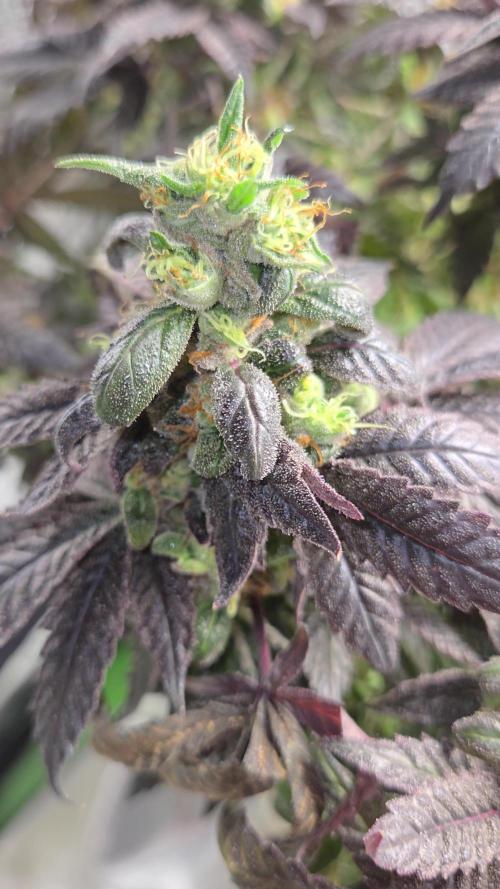
Semana 10, en esta semana lavamos raices y dejamos de regar con nutrientes.
Pienso que en unos 7 días mas,empezare a cortar.
Tiene un olor a frutas muy rico y suave.



Processing
Likes
18
Share


@OutForReal
Follow
Tuesday
Gorilla 🦍 Girls : You can see a nice damping off from an under watered lady 🦍👍 So guys when it happens during the afternoon while you’ve already watered on the morning you know it will be a time consuming grow knowing that’s they are half way 😩
Who told me to grow a super vigorous hybrid clone in a 5L pot ??? Hahaha At least I know who to blame ☺️
Ultra Lemon Haze : Well they are both ultra well growing , I had to pinched them hard to control dem.
Glueberry OG : Dead !!! She were infested by fungus gnats larvae , even with only bottom watering she did not made it .... I have a clone so you’ll see her again soon enough
Lemon Skittlez Strawberry : Fattening and getting pales but smelling incredibly good
Lemon skittles #skittles pheno : I am growing a candy 🍭
Grapefruit : I am ripping her with a 2ec mix of only PK which is supposed to be like pulling on the trigger and get a dead shot 🤘🏼. She is still full of red spiders 🕷️


Likes
2
Share


@dubby_m
Follow
D101: harvested the plant! Very happy with the grow :) Wettrimmed all the buds and hung them for drying. i will report after drying and curing!


Likes
33
Share


@Prof_Weed
Follow
Heute startet die 9. Woche,nicht wie hier vermerkt die 12. Woche.
In so 2,5 Wochen starte ich dann mit Final Part von Terra Aquatica und Flash Clean um zu flushen.
Die Buds werden fetter und die Pflanze ist super gesund.
Ec Wert des Wassers steigt von anfänglich 1.5 immer auf 2.5 sobald der Wasserstand runtergeht. Muss nach 2,3 Tagen immer ein wenig Wasser dazugeben.
Die Temperaturen sind für Indoor immer noch zu hoch,die Luftfeuchtigkeit ebenfalls.
Werde das nächste Mal Indoor erst im Oktober starten, wollte aber mal sehen wie das im Sommer funktioniert.
Likes
52
Share


@Ultraviolet
Follow
Lacewings seemed to have mostly killed themselves by flying into hot light fixtures. I may have left the UV on which was smart of me :) Done very little to combat if anything but make a sea of carcasses, on the bright side its good nutrition for the soil.
Made a concoction of ethanol 70%, equal parts water, and cayenne pepper with a couple of squirts of dish soap.
Took around an hour of good scrubbing the entire canopy.
Worked a lot more effectively and way cheaper.
Scorched earth right now, but it seems to have wiped them out almost entirely very pleased.
Attempted a "Fudge I Missed" for the topping. So just time to wait and see how it goes.
Question?
If I attached a plant to two separate pots but it was connected by rootzone, one has a pH of 7.5 ish the other has 4.5. Would the Intelligence of the plant able to dictate each pot separately to uptake the nutrients best suited to pH or would it still try to draw nitrogen from a pot with a pH where nitrogen struggles to uptake?
Food for stoner thought experiments!
Another was on my mind.
What happens when a plant gets too much light?
Well, it burns and curls up leaves.
That's the heat radiation, let's remove excess heat, now what?
I've always read it's just bad, or not good, but when I look for an explanation on a deeper level it's just bad and you shouldn't do it.
So I did.
How much can a cannabis plant absorb, 40 moles in a day, ok I'll give it 60 moles. 80 nothing bad ever happened.
The answer, finally. Oh great........more questions........
Reactive oxygen species (ROS) are molecules capable of independent existence, containing at least one oxygen atom and one or more unpaired electrons.
"Sunlight is the essential source of energy for most photosynthetic organisms, yet sunlight in excess of the organism’s photosynthetic capacity can generate reactive oxygen species (ROS) that lead to cellular damage. To avoid damage, plants respond to high light (HL) by activating photophysical pathways that safely convert excess energy to heat, which is known as nonphotochemical quenching (NPQ) (Rochaix, 2014). While NPQ allows for healthy growth, it also limits the overall photosynthetic efficiency under many conditions. If NPQ were optimized for biomass, yields would improve dramatically, potentially by up to 30% (Kromdijk et al., 2016; Zhu et al., 2010). However, critical information to guide optimization is still lacking, including the molecular origin of NPQ and the mechanism of regulation."
What I found most interesting was research pointing out that pH is linked to this defense mechanism. The organism can better facilitate "quenching" when oversaturated with light in a low pH. Now I Know during photosynthesis plants naturally produce exudates (chemicals that are secreted through their roots). Do they have the ability to alter pH themselves using these excretions? Or is that done by the beneficial bacteria?
If I can prevent reactive oxygen species from causing damage by "too much light".
The extra water needed to keep this level of burn cooled though, I must learn to crawl before I can run.
Reactive oxygen species (ROS) are key signaling molecules that enable cells to rapidly respond to different stimuli. In plants, ROS plays a crucial role in abiotic and biotic stress sensing, integration of different environmental signals, and activation of stress-response networks, thus contributing to the establishment of defense mechanisms and plant resilience. Recent advances in the study of ROS signaling in plants include the identification of ROS receptors and key regulatory hubs that connect ROS signaling with other important stress-response signal transduction pathways and hormones, as well as new roles for ROS in organelle-to-organelle and cell-to-cell signaling. Our understanding of how ROS are regulated in cells by balancing production, scavenging, and transport has also increased. In this Review, we discuss these promising developments and how they might be used to increase plant resilience to environmental stress.
Temperature stress is one of the major abiotic stresses that adversely affect agricultural productivity worldwide. Temperatures beyond a plant's physiological optimum can trigger significant physiological and biochemical perturbations, reducing plant growth and tolerance to stress. Improving a plant's tolerance to these temperature fluctuations requires a deep understanding of its responses to environmental change. To adapt to temperature fluctuations, plants tailor their acclimatory signal transduction events, specifically, cellular redox state, that are governed by plant hormones, reactive oxygen species (ROS) regulatory systems, and other molecular components. The role of ROS in plants as important signaling molecules during stress acclimation has recently been established. Here, hormone-triggered ROS produced by NADPH oxidases, feedback regulation, and integrated signaling events during temperature stress activate stress-response pathways and induce acclimation or defense mechanisms. At the other extreme, excess ROS accumulation, following temperature-induced oxidative stress, can have negative consequences on plant growth and stress acclimation. The excessive ROS is regulated by the ROS scavenging system, which subsequently promotes plant tolerance. All these signaling events, including crosstalk between hormones and ROS, modify the plant's transcriptomic, metabolomic, and biochemical states and promote plant acclimation, tolerance, and survival. Here, we provide a comprehensive review of the ROS, hormones, and their joint role in shaping a plant's responses to high and low temperatures, and we conclude by outlining hormone/ROS-regulated plant-responsive strategies for developing stress-tolerant crops to combat temperature changes.
Onward upward for now.
Next!
Adenosine triphosphate
(ATP) is an energy-carrying molecule known as "the energy currency of life" or "the fuel of life," because it's the universal energy source for all living cells.1
Every living organism consists of cells that rely on ATP for their energy needs. ATP is made by converting the food we eat into energy. It's an essential building block for all life forms. Without ATP, cells wouldn't have the fuel or power to perform functions necessary to stay alive, and they would eventually die. All forms of life rely on ATP to do the things they must do to survive.2
ATP is made of a nitrogen base (adenine) and a sugar molecule (ribose), which create adenosine, plus three phosphate molecules. If adenosine only has one phosphate molecule, it’s called adenosine monophosphate (AMP). If it has two phosphates, it’s called adenosine diphosphate (ADP).
Although adenosine is a fundamental part of ATP, when it comes to providing energy to a cell and fueling cellular processes, the phosphate molecules are what really matter. The most energy-loaded composition for adenosine is ATP, which has three phosphates.3
ATP was first discovered in the 1920s. In 1929, Karl Lohmann—a German chemist studying muscle contractions—isolated what we now call adenosine triphosphate in a laboratory. At the time, Lohmann called ATP by a different name. It wasn't until a decade later, in 1939, that Nobel Prize–-winner Fritz Lipmann established that ATP is the universal carrier of energy in all living cells and coined the term "energy-rich phosphate bonds."45
Lipmann focused on phosphate bonds as the key to ATP being the universal energy source for all living cells, because adenosine triphosphate releases energy when one of its three phosphate bonds breaks off to form ADP. ATP is a high-energy molecule with three phosphate bonds; ADP is low-energy with only two phosphate bonds.
The Twos and Threes of ATP and ADP
Adenosine triphosphate (ATP) becomes adenosine diphosphate (ADP) when one of its three phosphate molecules breaks free and releases energy (“tri” means “three,” while “di” means “two”). Conversely, ADP becomes ATP when a phosphate molecule is added. As part of an ongoing energy cycle, ADP is constantly recycled back into ATP.3
Much like a rechargeable battery with a fluctuating state of charge, ATP represents a fully charged battery, and ADP represents a "low-power mode." Every time a fully charged ATP molecule loses a phosphate bond, it becomes ADP; energy is released via the process of ATP becoming ADP.
On the flip side, when a phosphate bond is added, ADP becomes ATP. When ADP becomes ATP, what was previously a low-charged energy adenosine molecule (ADP) becomes fully charged ATP. This energy-creation and energy-depletion cycle happens time and time again, much like your smartphone battery can be recharged countless times during its lifespan.
The human body uses molecules held in the fats, proteins, and carbohydrates we eat or drink as sources of energy to make ATP. This happens through a process called hydrolysis
.
After food is digested, it's synthesized into glucose, which is a form of sugar. Glucose is the main source of fuel that our cells' mitochondria
use to convert caloric energy from food into ATP, which is an energy form that can be used by cells.
ATP is made via a process called cellular respiration that occurs in the mitochondria of a cell. Mitochondria are tiny subunits within a cell that specialize in extracting energy from the foods we eat and converting it into ATP.
Mitochondria can convert glucose into ATP via two different types of cellular respiration:
Aerobic (with oxygen)
Anaerobic (without oxygen)
Aerobic cellular respiration transforms glucose into ATP in a three-step process, as follows:
Step 1: Glycolysis
Step 2: The Krebs cycle (also called the citric acid cycle)
Step 3: Electron transport chain
During glycolysis, glucose (i.e., sugar) from food sources is broken down into pyruvate
molecules. This is followed by the Krebs cycle, which is an aerobic process that uses oxygen to finish breaking down sugar and harnesses energy into electron carriers that fuel the synthesis of ATP. Lastly, the electron transport chain (ETC) pumps positively charged protons that drive ATP production throughout the mitochondria’s inner membrane.2
ATP can also be produced without oxygen (i.e., anaerobic), which is something plants, algae, and some bacteria do by converting the energy held in sunlight into energy that can be used by a cell via photosynthesis.
Anaerobic exercise means that your body is working out "without oxygen." Anaerobic glycolysis occurs in human cells when there isn't enough oxygen available during an anaerobic workout. If no oxygen is present during cellular respiration, pyruvate can't enter the Krebs cycle and is oxidized into lactic acid. In the absence of oxygen, lactic acid fermentation makes ATP anaerobically.
The burning sensation you feel in your muscles when you're huffing and puffing during anaerobic high-intensity interval training (HIIT) that maxes out your aerobic capacity or during a strenuous weight-lifting workout is lactic acid, which is used to make ATP via anaerobic glycolysis.
During aerobic exercise, mitochondria have enough oxygen to make ATP aerobically. However, when you're out of breath and your cells don’t have enough oxygen to perform cellular respiration aerobically, the process can still happen anaerobically, but it creates a temporary burning sensation in your skeletal muscles.
Why ATP Is So Important?
ATP is essential for life and makes it possible for us to do the things we do. Without ATP, cells wouldn't be able to use the energy held in food to fuel cellular processes, and an organism couldn't stay alive.
As a real-world example, when a car runs out of gas and is parked on the side of the road, the only thing that will make the car drivable again is putting some gasoline back in the tank. For all living cells, ATP is like the gas in a car's fuel tank. Without ATP, cells wouldn't have a source of usable energy, and the organism would die.
Eating a well-balanced diet and staying hydrated should give your body all the resources it needs to produce plenty of ATP. Although some athletes may slightly improve their performance by taking supplements or ergonomic aids designed to increase ATP production, it's debatable that oral adenosine triphosphate supplementation actually increases energy.
An average cell in the human body uses about 10 million ATP molecules per second and can recycle all of its ATP in less than a minute. Over 24 hours, the human body turns over its weight in ATP.
You can last weeks without food.
You can last days without water.
You can last minutes without oxygen.
You can last 16 seconds at most without ATP.
Food amounts to one-third of ATP production within the human body.

Likes
Comments
Share


@JararacaHaze
Follow
We’ve reached the eighth week, and the plants continue to tell their stories. Two of them have revealed themselves as males, fulfilling their role in genetics, while the others keep growing vigorously. The dynamics of the garden change, but the journey remains steady and promising.
During flowering, I stick to my consistent approach: I don’t change how I provide water and biofertilizers. I believe regularity is the key to a healthy and balanced transition. Additionally, I’m not a fan of heavy defoliation; I prefer to respect the plants’ natural rhythm, removing only the leaves that fall off easily, as if the plants themselves are telling me they no longer need them.
Observing each stage of this cycle is an exercise in patience and learning. Each plant has its own personality, and watching them is like uncovering a secret only nature can reveal. I can’t wait to see how the garden will bloom in the coming weeks!


Likes
29
Share


@Rangaku
Follow
Pulled and trimmed and drying out , had a great run with no dramas , top Genetics on display here the fruit is fruity , sticky and packs a real punch . Will grow again no doubt . Thanks heaps weedseedexpress
