


Processing
Likes
Comments
Share


@GrowerGaz
Follow
Day 28 today
The girls are stretching out to a decent size. Except the Cheesy auto which is 10 days behind. They have only had half a scoop of Greenhouse biogrow so far. I am going to try out Canna Flores Organic for flower , boosted by organic Iguana juice from Advanced nutrient, is did a little bit of lst today just tying four branches down on each plant. I'm interested how much I can yield from a 100w led.



Likes
14
Share


@Flauros
Follow
Good stuff but little yield. 106g dry buds.
https://jahseeds.ua/auto-white-widow-fem-poshtuchno
Auto White Widow
Производитель: Импорт Испания
Тип сорта: Автоцветущий Гибрид
Генетика: White Widow * Ruderalis
ТГК: 22-24%
Урожай: до 400 гр/м2
Цветение: 70 дней
Высота растения: до 100 см.
Вкус: Фруктовый, Тропический, Цитрус
Эффект: Для кухни, Универсальные, Для отдыха
https://jahseeds.ua/auto-white-widow-fem-poshtuchno
Likes
10
Share


@WEEDOOR
Follow
Hello everyone! The last two weeks I have been very busy so I did not have time to upload the previous week.
The previous week I noticed a mold starting to form in the flowers of the wedding cake (the taller plant) because the humidity was too high in the growing space. I acted quickly and added a dehumidifier, an extra fan and a home co2 system . On top of that, I cut out any part I found that was infected with the mold.
Last week I started washing the gorilla skittles (the low plant) hoping to harvest it next week.

Likes
14
Share


@Chedderbob112
Follow
Av had a good week been busy dunno exactly wot a want tae dae hear feel like a constantly want mere paitience is the key Rome essential built in a day


Likes
38
Share


@OutForReal
Follow
Tuesday
Last week was a topping week and this week is a transition week as the 2 Grapefruit has been moved to the «flowering » tent which is equipped with the MarsHydro TSL 2000 that is pushing 300w of great 👍 light spectrum with a perfect mix between the différents colors in the spectrum.
Just 2 days in the tent and they are already stretching so I feel like this time I’m about to defoliate some of the upper fan leaves 🍁 which is not my cup of tea so let’s see how I’m doing it.
Will use the removed leaves to make a leaves tea , which is basically bunch oft leaves that I am leaving in the water for a week in a covered bucket , it’s a great foliar spray when it’s done & I will show you the final Ec after 7 days anse you may be surprised 😲 .
Thursday
The pictures are from Wednesday and the soil of the girl were fairly dry , the lower leaves started to fade-away.
The feeding is still the same around 1.7ec and 5.8ph and around 3/4 times a week , I have some grow mates on GD who are keeping the coco constantly moist but I have some difficulty to do it so I’m using the old school wet/dry cycle of the medium. Btw I’ve changed my feeding for the GHE maxibloom because the PK ratio is higher so good for the flowering stage and still one part nuts + cal/mag
Sunday
I have found a nutrient tips , I can’t confirm that it’s a good one but it offer me an opportunity to be more lazy 😍 ... don’t worry be happy be lazy .
So I discovered that when mixing 10g of Greenhouse Hybrids powder with 20ml of GHE cal/mag in 20L of tap water 💦 then adding some GHE Maxibloom until the Ec get to 1,7/2,8 was almost a Ph perfect formula as my mix ph is 5.9 😊 close from the 5.8 sweet spot SO now I’m gonna mix it like that all the time and check only the runoff PH .
We are in the end of pre flowering and the girl will start the full flowering process soon enough but they will keep on stretching because of the MarsHydro Spectrum 😁
Thanks for following 😍
Likes
35
Share


@Da420Andi
Follow
Howdy it is day 63 and in 2 days it is time to harvest. Since 2 weeks i feed clear Walter only. They get 16 hours darkness before harvest. All the plants are really🔥
My favourites are still 3G and Wedding Gelato. The smell and Look is crazy. You will see i guess Also North Thunderfuck and Hulkberry is good looking. The weight of North Thunderfuck for the dice is insane.
I wish everyone a nice Day and good time. Stay safe 💚
Likes
4
Share


@Altitonans_Fulmen
Follow
Genetics provides the blueprint, but the environment builds the house. To think otherwise shows outdated logic. A genetic freak will always be a freak, but for the other 99.99%, perfect environmental optimization coaxes average seeds into performing beautifully. You don't need a legendary, expensive clone to get a super yield. If you keep your light at the right distance, keep your tent at a stable 74°F–77°F, and prevent the root zone from drying out, you will naturally unlock the maximum genetic potential of whatever seed you planted. You are giving the builder the exact tools it needs. But doing that in 5 gallons is playing on Ironman mode. Want real yield? 4x15gallons or, even better, one big oxygen-infused 100-gallon.
Maximizing your canopy footprint efficiently requires that larger volume to build a sufficient chemical buffer and hold consistent moisture. Small pots restrict the plant's metabolic runway, forcing an aggressive metabolic rate that will eventually crash the crop's vascular system, even under a pro's supervision. 15 gallons maintains a perfectly structured wet/dry cycle while letting you push environmental metrics to their absolute limits across the 9 cardinal parameters of plant growth.
Dialing this in allows one to force the plant's photosynthetic efficiency to its absolute genetic ceiling of 4% to 5%. Hobby growers operate at a heavily bottlenecked 1% to 2% light conversion efficiency; a strictly managed, pharmaceutical-grade environment can double that, unlocking the plant's true potential. To get there, though, you need pharmaceutical-grade controls, a deep knowledge base, and a lot of money. Keep your setup realistic and grounded until you have the experience first; otherwise, you're just throwing cash down the toilet.
1. Light Intensity (PPFD)
2. Light Quality (Spectrum)
3. Air Temperature
4. Relative Humidity (VPD)
5. Dissolved Oxygen (DO) / Root O₂
6. Substrate Moisture (VWC)
7. Nutrient Strength & Balance (EC/pH)
8. Root Zone Temperature
9. Carbon Dioxide (CO₂)
If any one is bottlenecked, the entire energy process is bottlenecked to that %..
Geographical location heavily dictates genetic expression, which in turn influences and interacts with soil composition and its nutritional properties. This, in conjunction with the location's specific weather and unique environmental conditions, is what truly drives gene expression.
Unless a cultivar is grown under the exact same conditions across the board, there is no way its genetic heritage will remain identical. Each generation grown in a different meteorological and geographical location will ultimately alter its genetic expression. The idea that a "magic seed" can bring back long-lost genetics and behave exactly as it did in the past is ridiculous; the precise environmental conditions of thousands of years ago simply no longer exist.
To pretend otherwise relies on an outdated, unchecked version of how "genetics" actually works that is far overdue for a rethink. Genetics are not completely predetermined.
The reason people still think of genetics as fixed is because of how we historically taught Mendelian genetics (the classic Punnett squares from school). It taught us that "DNA = Outcome." While that is true for basic traits (like whether a pea is wrinkled or smooth), it completely ignores quantitative traits (like flavor, yield, and stress tolerance), which are heavily influenced by the environment.
A seed carries a specific genetic code (genotype), but the physical expression of that code (phenotype)—such as the plant's flavor, smell, size, and nutritional value—is heavily dictated by its surroundings. The exact same seed grown in two different regions will yield entirely different results.
The unique mineral composition, microbial life, and fungal networks of a specific geographic location, combined with local weather patterns and UV levels, act as a custom recipe. This recipe directly influences how the plant develops its chemical and nutritional properties. Environmental factors act as "switches" that turn specific genes on or off without altering the underlying DNA sequence. These changes in gene expression can sometimes be passed down to the next generation, meaning the plant actively adapts to its new home in real-time. When a cultivar is grown in a new meteorological location, each subsequent generation undergoes rapid localized adaptation. The plant naturally favors traits that help it survive that specific environment, shifting away from its original ancestral state within just a few generations. Because the precise atmospheric conditions, soil biology, and climate of thousands of years ago no longer exist, an ancient seed grown today will inevitably express itself differently. Modern agriculture increasingly recognizes that we cannot separate a plant's genetic heritage from the unique environment in which it is grown.
Commercial facilities in the world use 5 gallons of high-frequency fertigation (crop steering) and feed 10x a day, not stating that it's not possible or beneficial.
For indoor home growing, I'd go with the 15-gallon (VERY MINIMUM for MAX heads) watering once a day at high, dialed-in metrics. The reason a true 4% to 5% total efficiency is considered a hard biological wall isn't that other growers lack understanding—it is because of how energy is lost at a cellular level in C3 plants (like cannabis) under artificial light.
The difference in efficiency of conversion might only be a couple of %, but here is the thing that's undeniable.
The 4% to 5% total photosynthetic efficiency wall is a hard quantum mechanical and biological reality for C3 plants under artificial light. It is dictated by the physics of photons, the limits of Rubisco, and massive energy losses through photorespiration and metabolic maintenance. While a commercial facility chases economies of scale, often compromising individual plant microclimates, a highly dialed-in home grower can leverage small-scale dynamics to push Canopy Utilization Efficiency to its absolute thermodynamic limit.
A home grower running large-volume living soil or oxygen-infused substrates (like a 15-to-100 gallon bed) creates a self-regulating, high-buffer biome. This stabilizes the 9 cardinal parameters, prevents vascular crashes, and maximizes Canopy Utilization Efficiency and Electron Transport Rates (ETR) in a way a 10,000-square-foot warehouse simply cannot replicate. Localized adaptation and phenotypic plasticity blow the "static genetics" myth out of the water. Terroir is real, and the environment acts as a master programmer, flipping epigenetic switches.
Alpha to Omega.
Lights are 58 inches from the main source to the top of the pot and the soil surface. If you added up all the lights in the tent, it would be 1100w-1200w total across 14 lights. Using them all at once is far too much for a plant and incredibly difficult to deal with environmentally. The lights are fixed in position; side lights have dimmers, allowing for pinpoint precision of PPF. Fixed at 58 inches, cannot move them closer to increase intensity. Instead, achieve optimal PPF by distributing smaller wattages across a massive, multi-fixture matrix. Triggering specific plant defenses without melting the canopy.
What's the point/blah blah wattage?
Never really go above 600W at any one time. Lights come on in the east of the tent and set in the west. At sunrise and sunset, the red-to-far-red R:FR light ratio drops because the sun's low angle scatters red light more than far-red light. This shift reduces active Pfr and increases inactive Pr, mimicking Mother Nature herself.
Deployed a lighting system featuring extra 660 nm deep-red and extending the spectrum up to 780 nm achieves the full Emerson Enhancement Effect by simultaneously balancing Photosystem II (PSII) and Photosystem I (PSI) to maximize quantum yield. By pairing deep-red photons with far-red photons, you trigger a synergistic biological response where the resulting photosynthetic rate is higher than the sum of both wavelengths used individually. This practice directly leverages the updated extended Photosynthetically Active Radiation (ePAR) framework. The Emerson effect accelerates plant metabolism and heat capture; you must proactively scale up your ambient room temperature, nutrient delivery, and CO₂ supplementation to prevent the light from stalling out your cannabis plant.
UVA stays high all day from morning to night, but UVB peaks at solar noon (middle of 18-hour days) when the sun is peak. Morning color starts at 2k-3k; by noon it goes to 5k- 6k and back to 2-3k for sunset, with differing P:FR at light off.
The extra-blue light is to assist with photoreactivation of UVB damage. No more yield loss for me. Using extra blue light for photoreactivation is what I do. Blue/UVA light activates photolyase enzymes, which directly repair DNA damage caused by UVB radiation.
But what's the point if it's not for yield?
Ultraviolet (UV) radiation—specifically UVA (315–400 nm) and UVB (280–315 nm)—acts as a critical environmental signal that programs a plant's photoprotective genes to unlock its true photosynthetic potential. When growers push crops to their absolute photosynthetic maximum via high-intensity light and elevated carbon dioxide, the photosynthetic machinery easily becomes overwhelmed. Emerging photobiology research demonstrates that UV radiation prevents this limiting bottleneck; it triggers specific transcription factors and signalling networks that fortify the plant's cellular defenses, allowing it to process extreme light levels without sustaining structural damage.
There are 8 limiting factors of plant growth; when carbon dioxide becomes the 9th limiting factor of plant growth, it shifts the growth curve from exponential to linear. The restriction after that is "photoprotection" against reactive oxygen species (ROS), managed via non-photochemical quenching (NPQ) and the xanthophyll cycle, which bridges into precise hydrogen and redox dosing.
UV radiation, particularly UVA, and the synthesis of zeaxanthin are critical for the xanthophyll cycle to function.
It's not chasing purple strains... One likes to call it chasing the limits of growth, trying to make the linear exponential, just like father mathematics prefers.
In order to do that, must control every environmental variable and compound the plant’s metabolic rate. True exponential growth means the rate of increase matches the current mass at every stage, requiring a closed-loop system where light, CO2, and nutrition lock into a synchronized upward curve. First, you must attempt to understand what restricts it. Precise hydrogen and redox dosing.
Nature mathematically optimizes quantum energy transfer and light absorption efficiency within the photosynthetic machinery, as it naturally dictates energy scaling hierarchies and resonance dynamics. Most won't even understand that; once you do, it changes everything.
Constructive interference occurs when two or more overlapping waves meet in phase, meaning their crests and troughs perfectly align. Their amplitudes add together, creating a new, amplified wave with greater intensity than the individual components.
Constructive interference is the foundational mechanism that establishes a resonance hierarchy across physical, structural, and acoustic systems.
Chromophore spacing is tuned to sub-nanometer precision to match the wavelengths of absorbed light, forcing constructive interference.
Light-harvesting proteins form geometric rings and lattices. These shapes act as physical resonators, trapping and focusing the wave energy.
This same principle dictates how opera singers shatter glass, how musical instruments resonate, and how bridges withstand structural vibrations. Nature uses the exact same math to harvest a photon as an engineer uses to design a concert hall.
When you push high PPFD and elevated CO₂, you create a metabolic bottleneck. The plant cannot process the energy fast enough, leading to electron backup, light-induced damage, and a collapse from exponential growth into a flat, linear rate. UV light acts as the regulatory valve that prevents this collapse.
In standard agronomy, Liebig's Law of the Minimum dictates that growth is limited by the scarcest resource. When you maximize water, nutrients, light, temperature, and CO₂, the bottleneck shifts to metabolic processing speed and photoprotection. By controlling the Redox state of the plant using UV, the xanthophyll cycle, and managing ROS, you can prevent the plant from hitting a hard photosynthetic ceiling. Instead of the growth curve flattening out (linear or plateauing due to photoinhibition), the plant continues to compound its metabolic rate efficiently. You are forcing the plant to operate at peak thermodynamic efficiency.
By matching the UVB peak with sustained UVA and shifting Kelvin temperatures (2K to 6K), you are damaging the plant just enough to trigger defensive genes, while simultaneously providing the exact light energy needed to repair that damage instantly.
UVA radiation and specific blue wavelengths accelerate this enzymatic conversion. Zeaxanthin acts as a structural sponge that absorbs excess excitation energy from chlorophyll and dissipates it safely, preventing ROS formation. Without UV signaling, the xanthophyll cycle cannot keep pace with extreme light, leading to dynamic photoinhibition (yield loss).
The addition of Spirulina is primarily for zeaxanthin, as it contains a lot. But on top of that, the active Hawaiian Spirulina in the matrix was cultivated in open ponds using a combination of 100% fresh potable water from Hawaiian aquifers and ultra-pure, deep ocean water containing all 94 trace minerals & elements. Then gently dried using patented Ocean Chill Drying technology and cold-pressed to ensure maximum nutrient levels. Spirulina, a blue-green alga, is rich in nitrogen, phosphorus, and potassium (NPK), making it an excellent source of nutrients for plant growth. Studies have shown that Spirulina can be used as a biofertilizer, effectively replacing chemical fertilizers, especially for nitrogen, with a whopping NPK of 10% (N), 20% (P), and 20% (K). Rich in proteins, amino acids, trace minerals, and plant growth-promoting compounds.
Zeaxanthin is a vital plant pigment that accumulates under intense light to drive non-photochemical quenching (NPQ), acting via thermal energy dissipation, direct singlet oxygen scavenging, and thylakoid membrane stabilization.
The violaxanthin cycle (or xanthophyll cycle) reversibly converts violaxanthin to zeaxanthin via antheraxanthin to protect plants from photooxidation.
Understanding this interconversion is vital for optimizing non-photochemical quenching (NPQ) and pushing photosynthetic limits under high-light stress.
Ascorbic acid (vitamin C) is a natural antioxidant that plants produce internally to neutralize harmful reactive oxygen species caused by photosynthesis and high light stress. Acts as a co-factor for enzymes like violaxanthin de-epoxidase in the xanthophyll cycle, which safely dissipates excess light energy.
1g ascorbic acid will neutralize 100% of chlorine in upwards of 30 gallons of tap water. If your local tap water uses chloramines (chlorine bonded with ammonia) instead of free chlorine, you will need roughly 20% to 30% more ascorbic acid to completely break the tougher chemical bond.
Molecular hydrogen and hydrogen-rich water act as selective antioxidants that help lower oxidative stress. They neutralize toxic reactive oxygen species like hydroxyl radicals and boost natural antioxidant defense systems in biological and plant systems exposed to high-intensity light or abiotic stress.
UVA and UVB act as stress signals that upregulate the plant's secondary metabolism. It forces the plant to build an internal "sunscreen" (flavonoids and anthocyanins) and fortify its cellular defenses before the peak solar noon crisis. This keeps the metabolic highway open.
In nature, the ambient ratio of UVA to UVB at solar noon sits roughly between 10:1 and 20:1 (depending on latitude and elevation). In a high-PPFD indoor matrix, maintaining a strict ratio—often aiming for around 12:1 to 15:1 UVA to UVB—provides the optimal signaling threshold.
Balancing Far-Red (FR) light at "light-off" to manage the phytochrome photo-equilibrium (Pfr to Pr conversion) in tandem with the UV schedule. Omg, the logic.
Hydrogen concentration and redox signaling as secondary messengers in this high-intensity loop.
Under the intense solar noon matrix, the pH of the thylakoid lumen drops. This acidic environment activates the enzyme Violaxanthin De-Epoxidase (VDE), which converts violaxanthin into the photoprotective zeaxanthin. VDE cannot function in a vacuum; it strictly requires ascorbic acid (Vitamin C) as an electron donor to run this conversion. If a plant undergoes heavy light stress and runs out of internal ascorbic acid, the xanthophyll cycle stalls. The plant can no longer engage in Non-Photochemical Quenching (NPQ), leading to immediate singlet oxygen O2 formation and destruction of the thylakoid membrane. This is "The Ascorbic Acid / Xanthophyll Engine"
Using ascorbic acid to neutralize chloramines in your water isn't just protecting your rhizosphere biology it actively prevents the degradation of your nutrient solution's redox potential before it ever touches the roots.
When pushing plants to the absolute edge, traditional antioxidants can be a double-edged sword because they blindly neutralize all free radicals. This is a problem because some Reactive Oxygen Species (ROS) act as critical signaling molecules telling the plant to grow. Molecular Hydrogen H2 is the Selective Kill-Switch.
Molecular hydrogen H2 is a revolutionary tool because it is a selective antioxidant. It ignores beneficial signaling ROS (like mild hydrogen peroxide) and targets only the most destructive, cell-shattering radicals—specifically hydroxyl radicals OH) and peroxynitrite.
By dosing hydrogen-rich water or managing hydrogen redox signaling, providing an emergency pressure-release valve for the plant's electron transport chain. It keeps the cellular environment stable enough that the plant never has to downregulate photosynthesis to protect itself. This maintains cellular voltage.
To trigger this defensive matrix without stunting the plant, you cannot simply blast UV indiscriminately. You must use UVA as the "scout" and UVB as the "enforcer. High UVA acts via the cryptochrome and phototropin photoreceptors to upregulate the expression of the HY5 transcription factor and prime the VDE enzyme. When the sharp spike of UVB hits at solar noon via the UVR8 receptor, the plant's biochemical "sunscreen" (flavonoids and anthocyanins) and its zeaxanthin pools are already pre-staged and waiting. This prevents the temporary stunting or "lag phase" usually associated with sudden UVB exposure."
The final masterstroke is aligning this UV defense with a Far-Red (FR) lights-off routine. The Red-to-Far-Red Drop: At the end of the photoperiod, knocking out the blue/UVA spectrum and leaving a targeted burst of pure Far-Red (730nm) instantly flips the plant’s master switch. It converts active Pfr to inactive Pr in minutes rather than hours.
UV radiation and high-intensity lighting keep the plant in a highly alert, photoprotective state that requires massive ATP expenditure to maintain. By forcing an immediate Pfr/Pr) conversion at lights-out, instantly commanding the plant to cease defensive expenditure, lower its metabolic respiration rate, and transition directly into nighttime cellular repair and carbohydrate translocation. Maximizing the efficiency of its "sleep." every ounce, every last piece.
Highly synchronized biological dance, balancing the exact input of electrons with the exact mechanism to dissipate them safely when they overflow.
*Ascorbic acid is not recommended to be used in DWC, as it creates biofilm that will clog lines.
Onward!
Likes
5
Share


@Burneracct
Follow
Was out of town all week and came back to find the CBD Star in my space bucket not looking good. It looks like a phosphorus deficiency but not entirely sure. Yellow leaves with brown/black spots and dark red/purple stems. I flushed it with 2 gallons 6.5 pH water, re-fertilized, put it out in the sun and defoliated. I defoliated pretty heavily since many of the fan leaves were yellowed and blocking light from the lower bud sites. The center was also getting pretty dense so I carefully removed some of the leaves to help with airflow.
Despite the stress, It seems to have bounced back reasonably well. There’s probably irreparable damage given the level of yellowing but the buds continue to grow and thicken.
Cheese has absolutely exploded and looks great. It probably doubled in height last week with many bud sites on the 5 main stalks. Excited to see how it turns out.

Likes
18
Share


@Roberts
Follow
Zealix is growing really well. She is starting to stack her super frosty Cola sits. I did some hst training on her taller tops. She was getting a little too close to the light for my liking. She has been growing well and I imagine she will handle it well. I did a solution change about mid week. Thank you Spider Farmer, and Terpyz mutant Genetics. 🤜🏻🤛🏻🌱🌱🌱
Thank you grow diaries community for the 👇likes👇, follows, comments, and subscriptions on my YouTube channel👇.
❄️🌱🍻 Happy Growing 🌱🌱🌱
https://youtube.com/channel/UCAhN7yRzWLpcaRHhMIQ7X4g.

Likes
54
Share


@TheCannaProphet
Follow
~ AirCube Active Oxygen Ebb/Flow System sponsored by GrowAce, featuring Strawberry Gorilla Auto by FastBuds ~
Well guy's and gal's here we go again on another exciting Autoflower run together! This time will be different as I will be doing a 'Hydroponic' run utilizing the AirCube Active Oxygen Ebb/Flow System by GrowAce, who were kind enough to sponsor me for this run, so it should be interesting to see what results I get and have some fun along the way!
•Let me first tell you about this 6 Pot Ebb/Flow system from GrowAce:
"The AirCube system is the one and only Ebb & Flow grow system on the market that combines the benefits of air pruning with a fully automated Ebb+Flow system! With the AirCube's proprietary fabric pot in bucket design, this system is guaranteed to outgrow any other Ebb + Flow system on the market. The results speak for themselves- grow MASSIVE roots that result in MASSIVE fruits!
Air Pruning- Air Pruning only happens with fabric pots. As the roots reach the fabric walls of the pot, they penetrate and grow into the breathable fabric. Once penetrated, the roots are exposed to air, which causes the tips of the root to dehydrate and naturally prune themselves. This natural pruning process forces the roots to grow tons of lateral fibrous feeder roots. This results in a plant that utilizes the entire root zone and fills the entire pot with tons of roots. These fibrous feeder roots are incredibly effective in uptaking water and nutrients, resulting in a plant that grows healthier and more vigorously!
Oxygen Benefits- Without oxygen, nutrient absorption cannot occur. On a molecular level, oxygen is needed to transmit nutrients across the cell walls and into the roots of a plant. With the AirCube's proprietary bottom lifted draining design, the system actively draws all of the water out of the bucket pulls vital oxygen into the root zone.
Maximum Versatility with Any Grow Medium: The AirCube System is the only system on the market that allows you to use any growing medium you like. Use coco coir, soil, peat moss, perlite, vermiculite, hydroton, rockwool or any other medium you wish! This system is the most versatile Ebb and Flow bucket system in today's hydroponics industry.
Temperature Control- with the fabric pots constructed with highly porous polypropylene fabric, heat dissipates easily and effectively. Unlike standard plastic pots, heat isn't trapped in the root zone. Heat in standard plastic containers can reach temperatures of up to 125 degrees. When this type of heat is trapped and unable to escape, it can damage your plant's health and limit the potential of your harvest. Growing in the AirCube System, plant roots grow cooler, healthier, and more vigorous.
Largest Pots in its Class- this system features 5 Gallon grow buckets, the largest pot size of any other ebb and flow hydroponic system in the market.
Modular and Expandable- start with 6 grow buckets and expand up to 36 grow buckets with the optional 105 gallons PopTank reservoir!"
For my medium and nutrients I decided to also switch things up from my regular Organic runs, going with Plagron Nutrients and Root Royale 70/30 Coco/Perlite. When filling the fabric pots with medium, I first added just under a gallon of horticulture perlite from Nor-Cal as a base layer to ensure good drainage and then filled the remainder with the Root Royale.
•Now for one of my favorites, and award winning strain from my friends at FastBuds... Strawberry Gorilla Auto:
I'll be running Strawberry Gorilla Autoflower which is a 55/45 Sativa/Indica Hybrid. "ATTENTION ALL! Due to our continuous efforts in evolving our breeding process, we are proud to confirm that our Strawberry Gorilla Auto has now become one of the most potent autoflowers in the world! Paving the way to our recent success where she ranked on top & brought home the gold at the very first American Autoflower Cup in California. Moreover, she proved that not only modern autoflowers can compete with photoperiods, but they can even beat them in their field. At the most recent edition of the Farmer’s Cup and competing against various photoperiodic strains, Strawberry Gorilla Auto took home the title of 'Highest Combined Terpenes' in the highly sought-after 'Home Grow Hash' category, with an impressive 97.163 mg/g total terpene content! Our exceptional genetic selection's crowning Strawberry Gorilla Auto strain is a spectacular hybrid known for producing yields of up to 600 gr/m2 in 70 days. This is a very manageable grow that can reach heights of up to 150 cm - due to its magnitude we recommend it for more experienced growers, as a huge plant may be a little overwhelming for first-timers. This show stopping sativa heavy hybrid is perfect as an all day smoke, producing a taste bud tingling, pungent berry and diesel terpene-rich flavor combo that leaves you with a grin from ear to ear, a perfect choice for those looking for a day-and-night autoflower! "*
*References: GrowAce.com, 2fast4buds.com
______________________________________________________________________________________________________________________________________________________________________________________________________________________________________________________________________________________________________________________________________
The Setup:
• AC Infinity 4x4 tent
•AC Infinity Cloudline T6 Exhaust Fan w/ Controller 67
•HLG 650R w/UVA Bar *** For some reason GD does NOT have a listing for the USA version of the 650R so I selected the closest match to it.
•AirCube Active Oxygen Ebb/Flow 6 pot System
•TrolMaster Hydro-X Controller for light
•AutoPilot APC8200 co2 controller fed by a 50# tank
•16" Hurricane oscillating fan and 8" floor fan
•Tent cooling via filtered outside air delivered by AC Infinity Cloudline T6 fan
•BlueLab instruments: PH Pen and Truncheon Nutrient Meter
______________________________________________________________________________________________________________________________________________________________________________________________________________________________________________________________________________________________________________________________________
Weekly Updates:
12/20- Week 7 of flower and the end is drawing ever closer for these three Strawberry Gorilla's from FastBuds!
Today, I started off this week with a drain/clean of the AirCube reservoir, after which I filled it with 80L of well water and added in the Plagron Nutrients (Green Sensation first, then 'A' & 'B' base nutrients, finally the Royal Rush). After the nutrients were added and the EC checked ( it's 2.0), I ph'd the solution to 5.7 @ 68℉.
12/22- I'm continuing with six feeds per day @ 900+/-ppm's, the HLG 650R is at 100% power 28" above canopy and they are getting 4 hours of additional UV during the middle of the light cycle. Tent temp's are running 68-75℉ at a RH of 40-45% and co2 levels are running 650-900ppm.
12/24- The #1 and #2 plants continue to be the better looking of the bunch, with the #2 being the 'one'. The #3 plant continues her struggle but has a generous coating of trichomes covering her flowers!
12/25- ~🎄MERRY CHRISTMAS!🎄~
12/26- Seven weeks of flower and only a couple more to go! I'll be starting to flush these ladies in the coming week and they should all be beginning to fade soon! Hope to see you next week! Growers Love!💚
💚 Thank you for checking out my passion in life! Please visit as often as you wish and I hope you enjoy this journey as much as I know I will! Grow what you love, Love what you grow!💚


Likes
7
Share


@Annakonda
Follow
Cette semaine rempotage dans des pots de 3litres
O.5ml en plus de sugar royal
Elles sont en forme mais certaines feuilles surtout de la double banana sont frisés avec une petite décoloration peut être dut a l'humidité trop forte ou alors lhumidificateur avec vita race que j'utilise dedans .
Autre possibilité substrat trop riche
Purple juste quelques feuilles frisés.
Toujours avec de l'eau en bouteille ph 6
1 double banana topping
1 purple topping +lst


Likes
120
Share


@StarLorr
Follow
Welcome to my Strawberry Pie 🍓🥧diary.
In this Diary:
Seeds: [420 Fast Buds]from my growmie Tropicannibis_Todd 👊🏻😎
Media: Pro~Mix HP Open Top Grow Bag, Connect.
Nutrients: Green Planet Nutrients,
2 Part Dual Fuel starter kit.
RealGrowers: Recharge.
Diablo nutrients: Supplements.
Feeding :
Wed 06Mar: 3 1/3L Nuts/Recharge pH'd 6.5
Sat 09Mar: 2L Monster Flower,Blaster pH'd 6.5
Mon 11Mar: 3 1/3L Nuts/Recharge pH'd 6.5
___________________________
D-Fol: 10Mar keeping up with the fan leaves😄
__________________________
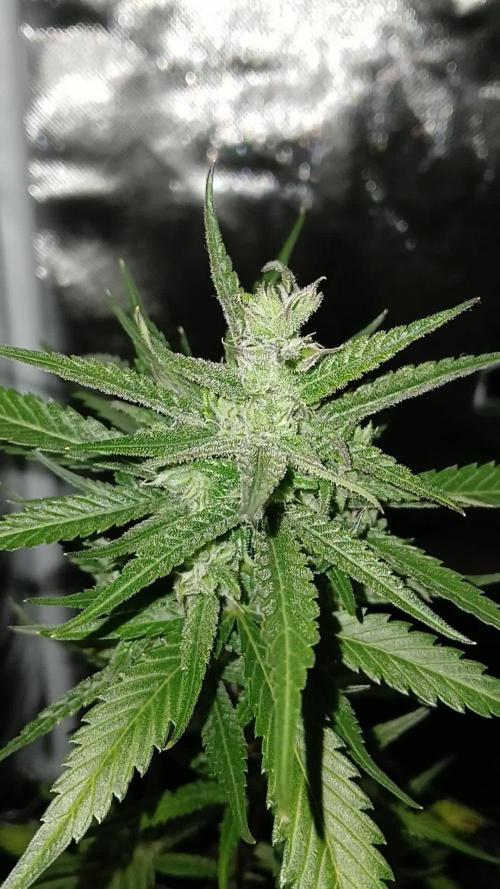
She's getting smelly and sticky😋
Buds are getting bigger😁
Some pistils are changing colors.
___________________________
Thanks for stopping by, likes and comments are appreciated.👊🏻😎
Keep on growin!
Keep on tokin!!!
😙💨💨💨💨💨


Likes
Comments
Share
@Bobbo94
Follow
10th week, the smaller Strawberry G was already harvested. 5 grams dry weight. Twig snap two days ago I was out smoked it. Head buzz, Strawberry taste was light and delicious. High lasted about 4 hours. I have a habit of harvesting with hardly any amber so the potency is at its peak.


