


Likes
Comments
Share


Likes
31
Share


@THCpapa
Follow
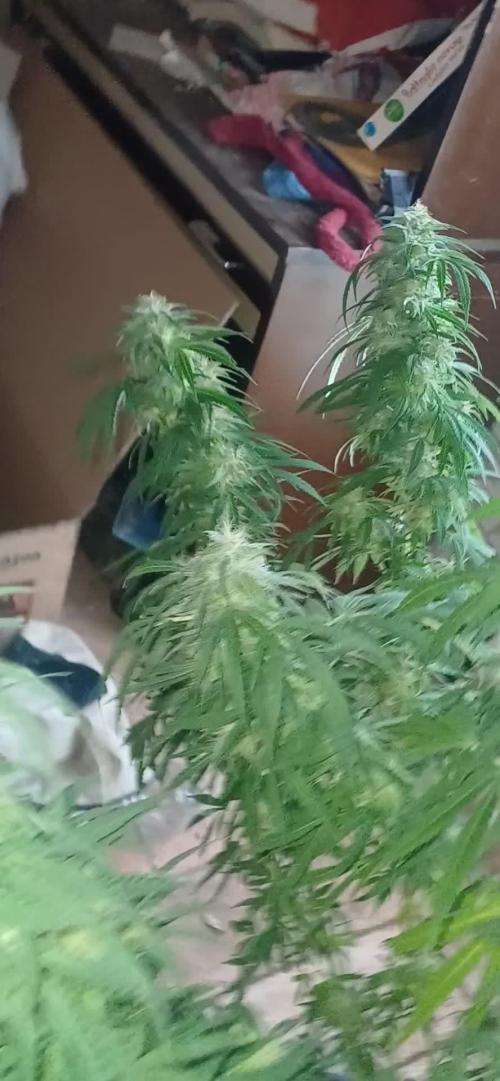
Week 7 in the comedy of my garden journey, and my green squad has decided to embrace the art of being vertically challenged – they're like the plant version of a pocket-sized superhero team. "Short and sassy" seems to be their new motto.
In an attempt to uplift their spirits, two of the ladies scored a new, roomier 3-gallon final home – it's like they moved from a cozy apartment to a botanical mansion, hoping a change of scenery would inspire some vertical ambition. They're probably comparing their new homes and deciding who has the fanciest leafy chandelier.
However, the plot thickens as one plant emerges with a leafy fashion statement that's a bit too avant-garde – discoloration that could rival a Picasso painting. Is it a magnesium deficiency or an oxygen rebellion? The plant might as well be holding a tiny protest sign that says, "Give me answers or give me wilting!"
Playing the role of a plant detective, I cranked up the fans, turning my grow tent into a botanical wind tunnel. It's like a leafy hurricane is sweeping through, and my plants are either loving the breeze or planning their escape. As a bonus, I threw in a leafy spa day – deformation and topping, because who doesn't love a good horticultural makeover?
But wait, there's more! In the midst of the botanical sitcom, the humidity decided to play the villain in this leafy drama. It's like the humidity gauge is staging a rebellion of its own. So, armed with misters and perhaps a leafy motivational speech, I'm on a mission to turn my grow tent into a tropical paradise and give my plants the humidity vacation they didn't know they needed.
Week 7 – where the plants are short, the homes are upgraded, the leaves are avant-garde, and the humidity is throwing a curveball. Stay tuned for the next episode of "The Green and the Humid" – because in the world of my garden, every week is a new episode filled with laughs, surprises, and a touch of leafy chaos! 🌿🌧️🎭


Likes
8
Share


@Ms_Herbalist
Follow
Full of resin 😍 smells amazing
Curr it properly and you can smell the papaya and gassy tones

Likes
9
Share


@GEORGE_21
Follow
Semana 5/ semana 1 de floración, sigo regando 1L a diario a cada una, están muy saludables. Aumente el
Ventilador a nivel 2 y abrí la ventana para mantener la humedad del closet bajo 50. Todo ok!!
Likes
Comments
Share


Likes
7
Share


@Kushizlez
Follow
Day 52-64
(Day 54) I’m going to thoroughly inspect each plant and remove bananas if found. So far it’s only been the one on #7 but I don’t want to take a chance.
I’m also going to give a watering with some runoff.
(Day 55) Can’t find anymore bananas but that one. I will probably find a few bag seeds but who knows. It’s way too late for pollen to really have effect anyway.
These 5 plants finish nice and early compared to my other tent flipped on the same day. I would never take this strain 65+ days like last time. I would do 56-60 days next time I flower this strain
(Day 58) Holy shit this tent is fading like crazy now. They are starting to show some beautiful autumn colors. #1 #5 and #7 are definitely done. #3 and #6 could use a little more time so I’ve decided to take them down on the 24th.
I haven’t seen anymore bananas and the one that popped out on #7 has shriveled up and receded.
(Day 63) I’m seeing what look like seed pods starting to form in some of the main colas on my picture perfect pheno. #7 is showing 3 or 4 little bananas too. All of the top buds are definitely done so I’m going to harvest as soon as the lights come on tomorrow. I’m going to give one last watering right now and then harvest. I’ve noticed that harvesting a watered plant will extend the dry time by a few days and that’s exactly what I’m looking for. A nice slow dry. Plants are being full plant hung + dry trimmed and tent is being kept at 60-65 degrees and 60-65% RH.
Cutting everything down was a pain in the ass. I had to individually cut each square the scrog net so it wouldn’t contract and squish all the buds. I chopped down my other tent as well so I have no other plants in flower right now.
Processing
Likes
22
Share


Likes
218
Share


@DevilsBud
Follow
Week 8 off flowering Critical
On to a next week it's getting closer to the end Growmies 😱😱😱 . But i am ready for it 💪🏻the Critical will be done one week before cookies gelato so last week of feed then flush week for the Critical
Day 49
Short and dense and heavy that's how the buds are getting . I got the critical seed for free and wasn't keen of growing them because literally every shop here sell it . But the critical is surprising me in good way and very potent skunk smell buds also getting solid as rock 💪🏻
Day 50!
Critical is getting there i looped some tops and the clear ones getting Milky but the amber is not seen on buds yet patience will win the race! I would be flushing after this week but i am holding that of and wait and 👀
Day 51
Took some pictures of the critical close up and it's definitely looking good gave 1.5L nutrients pH 6.6
Day 52
Critical is looking already jummy tricomes on the buds are getting insane but it could be me it's my first time ever grow and not seen it before but i like how it looks and smell's couple more weeks
Day 53
Good day Growmies what a wonderful day it has bin for the plants and for my self very happy with the results i get under my lovely marshydro TS-1000
Is too notch 👌🏻 have great weekend folks
Day 54
Easy Sunday so nothing going on today
Day 55 end of week 8 Flowering
Hallo folks it's end of week 8 gave them nutrients this morning and on to the next week MA FAKAS 😎
Come look at my other diaries! I appreciate it a lot 🤘🏻
Also want to thank everybody for the comments likes etc you know who you all are 👍🏻😍👍🏻
visit www.marshydro.eu
for your best gear and use the PROMO CODE: DEVILSBUD
Some handy info about the
marshydro TS-1000
Increase Yield&Crop Quality in Led Grow
Newest SMD Led technology provides the highest Par/Lumen output, makes you get 30% higher yield compare old led lights, can get up to 2.5g/watt yied.
High Efficiency Energy Saving Plant Light
Only 150 watts true output with so you don't have to check your light bill every month 😎 342 pcs LEDs, more scientifically and energy-efficient! Perfect for 3'x3' (100x100cm) veg stage and 2'x2' (60x60cm) bloom stage, higher intensity in a Mars Hydro grow tent.
Sunlike Full Spectrum Led Indoor Growing
Infinite close to natural sunlight, suit for all plants whole satge indoor growing, rapid plant response from seed to flower, achieve maximum quality and quantity, much better than traditional HPS grow systems.
High Reflective&Noise Free Fanless Led Grow System
Quickly heat dispersing material aluminum reducing light lost to aisles and walls, increase the light intensity up to 20%, allowing your plants to receive more energy and without burning your plants for maximum headroom.


Likes
3
Share


@Joaka
Follow
no se si sera normal pero se siente poco olor aun, esperemos que con el tiempo incremente su olorsh
Likes
13
Share


@NanoLeaf
Follow
End of week 9
One word - Voluptuous!
The neighbours are definitely smelling it now, luckily the terpene profile on all of these plants make it smell more like a citrus farm.
Another smooth sailing week and I have noticed some of the ladies are drinking less and the leaves are fading more and more every day.
I am preparing for harvest as the girls are almost screaming to be cut down but I’ll be patient. I’ll be using my grow tent as the drying room because I can keep the environment in check. Making sure all my effort is not ruined by a rookie mistake such as not drying properly.
Removed some dead leaves and thats about it.
I’ve basically just been checking my PH and watering through this entire grow.
It’s cool being easy and easy being cool!


Likes
38
Share


@Green_Mountains
Follow
11 weeks completed! The plants seem healthy and doing their thing. I will be harvesting this week. There is definitely some amber in the trichomes. I gave them a tiny feed mid week since they had seemed to be a little stalled out (first feed in 1.5 weeks). I watered them last night.
I'll check the trichomes when I but them to bed in 2 days and see if that is when I'll leave them in the dark for 48 hours and then harvest.
If they are still not ready then... I'll water again when I wake them up and then I'll check them 2-3 days after that!
Either way, I cannot see this not happening in the next 4-5 days!!
Looking forward to harvest!!
Plans are already underway for my next grow. Probably going with Seedsman's Strawberry Auto Cheesecake.
Likes
4
Share


@RhodiesGrow
Follow
Watermelon Zkittlez is looking much better by the end of this week. Getting ready to take off for sure.
Day 7: Watermelon Zkittlez showing second leaves coming in. Still slightly yellow, might be hungry or slightly over-watered. Will feed nutes in the next few days and see. Temp: 75º RH 75% PPFD: 300 VPD: .41 kPa
Day 8: Just misting no water or nutes yet. Looking good. Temp: 75º RH 75% PPFD: 300 VPD: .41 kPa
Day 9: Fed 2ml Cal-Mag, 2 ml FloraMicro, 1ml FlorGro, 1ml FloraBloom PH 6.2. Temp: 75º RH 70% PPFD: 400 VPD: .72 kPa
Day 10: Responging well to nutes. Looking much darker green today, must have been hungry for nutes. Temp: 70º RH 75% PPFD: 400 VPD: .72 kPa
Day 11: Growing and looking darker green today. New leaf growth. Temp: 77º RH 55% PPFD: 500 VPD: .67 kPa
Day 12: Temp: 73º RH 62% PPFD: 500 VPD: .67 kPa
Day 13: New leaf growth. Temp: 75º RH 60% PPFD: 500 VPD: .62 kPa
Day 14: New leaf growth. Fed 4ml FloraMicro, 6ml FloraGro, 3ml FloraBloom and 2ml CalMag. Temp: 78º RH 61% PPFD: 500 VPD: .76 kPa

Likes
19
Share


@nonick123
Follow
Día 69 (01/07) Riego con 1 Litro sólo H20 - ph 6.2
Día 70 (02/07) ¡ Cosecha Banana Purple Punch Auto ! 😁
💦Nutrients by Aptus Holland - www.aptus-holland.com
🌱Substrate PRO-MIX HP BACILLUS + MYCORRHIZAE - www.pthorticulture.com/en/products/pro-mix-hp-biostimulant-plus-mycorrhizae
Likes
10
Share


@SamDo
Follow
Week 28 – Flowering Week 5
This week represents an important transition phase in the Pineapple Upside Down’s flowering cycle.
Early floral sites are clearly evolving into real buds.
Density is starting to build, and the plant is visibly shifting from initial flower formation toward true bud stacking.
This change is now easy to observe in photos, making this a critical stage not to miss.
To support this transition, PK levels were slightly increased.
The goal is not to force growth, but to ensure the plant has sufficient resources to bulk steadily and without stress.
Light intensity remains unchanged from the previous week.
PPFD has not been increased yet, as the plant is responding well and stability remains the priority.
Nutrient management and environmental consistency are the main focus this week.
pH is monitored closely and maintained within a 5.8 to 6.2 range to ensure optimal uptake during this sensitive phase.
No other major interventions were made.
The strategy remains simple: observe, maintain balance, and allow the plant to progress naturally into heavier bud development.
See you next weeek.

Likes
28
Share


@Budcrack
Follow
End off week 11, concluding week 7 off flowering:
Hi(gh) Guys! Thanks for viewing my weekly update (i hope again?)! The girls are doing great. I have to come back on a previous statement, i said that 3 girls are ahead of the rest and up for an early harvest, although that is both true, actually there straight on schedule, and i think the rest is behind. The manual on this strain says they need 9 weeks and flowering week 7 is now concluded. They start to gain weight all three and the stems are beginning to bend. This upcoming week they will get their last nutrients, but week 9 they will only get water, so i can flush properly for the upcoming week and a half. End of week 9 they will be terminated, because my vaporizer is idle for too long already!
As for the rest, they will need at least 2 or 3 weeks longer, because everywhere i look i see loads of white hairs, and i’m seeing forward to show you some off my biggest nugs ever! This is my first time on this website and i’m having a lot of fun. Earlier i'd grow my best round ever with 9 Gorilla Glue #4 ladieboys, what nice buds did they produce. But i guess the OG is going to be at least as close. That’s good for me because this is my favorite strain.
Please leave a comment, and like my post. My account needs a little more love!
Please come and see for another update next week.
(p.s. sorry for that shakie video, I was sitting on top of an little pebble with my knee, but I liked the video anyway…)

Likes
55
Share


@Ultraviolet
Follow
What's in the soil? What's not in the soil would be an easier question to answer. 16-18 DLI @ the minute. +++ as she grows.
Probably not recommended, but to get to where it needs to be, I need to start now.
Vegetative @1400ppm 0.8–1.2 kPa 80–86°F (26.7–30°C) 65–75%, LST Day 10, Fim'd Day 11
CEC (Cation Exchange Capacity):
This is a measure of a soil's ability to hold and exchange positively charged nutrients, like calcium, magnesium, and potassium. Soils with high CEC (more clay and organic matter) have more negative charges that attract and hold these essential nutrients, preventing them from leaching away.
Biochar is highly efficient at increasing cation exchange capacity (CEC) compared to many other amendments. Biochar's high CEC potential stems from its negatively charged functional groups, and studies show it can increase CEC by over 90%. Amendments like compost also increase CEC but are often more prone to rapid biodegradation, which can make biochar's effect more long-lasting. biochar acts as a long-lasting Cation Exchange Capacity (CEC) enhancer because its porous, carbon-rich structure provides sites for nutrients to bind to, effectively improving nutrient retention in soil without relying on the short-term benefits of fresh organic matter like compost or manure. Biochar's stability means these benefits last much longer than those from traditional organic amendments, making it a sustainable way to improve soil fertility, water retention, and structure over time. Needs to be charged first, similar to Coco, or it will immobilize cations, but at a much higher ratio.
a high cation exchange capacity (CEC) results in a high buffer protection, meaning the soil can better resist changes in pH and nutrient availability. This is because a high CEC soil has more negatively charged sites to hold onto essential positively charged nutrients, like calcium and magnesium, and to buffer against acid ions, such as hydrogen.
EC (Electrical Conductivity):
This measures the amount of soluble salts in the soil. High EC levels indicate a high concentration of dissolved salts and can be a sign of potential salinity issues that can harm plants.
The stored cations associated with a medium's cation exchange capacity (CEC) do not directly contribute to a real-time electrical conductivity (EC) reading. A real-time EC measurement reflects only the concentration of free, dissolved salt ions in the water solution within the medium.
98% of a plants nutrients comes directly from the water solution.
2% come directly from soil particles.
CEC is a mediums storage capacity for cations. These stored cations do not contribute to a mediums EC directly.
Electrical Conductivity (EC) does not measure salt ions adsorbed (stored) onto a Cation Exchange Capacity (CEC) site, as EC measures the conductivity of ions in solution within a soil or water sample, not those held on soil particles.
A medium releases stored cations to water by ion exchange, where a new, more desirable ion from the water solution temporarily displaces the stored cation from the medium's surface, a process also seen in plants absorbing nutrients via mass flow. For example, in water softeners, sodium ions are released from resin beads to bond with the medium's surface, displacing calcium and magnesium ions which then enter the water. This same principle applies when plants take up nutrients from the soil solution: the cations are released from the soil particles into the water in response to a concentration equilibrium, and then moved to the root surface via mass flow.
An example of ion exchange within the context of Cation Exchange Capacity (CEC) is a soil particle with a negative charge attracting and holding positively charged nutrient ions, like potassium (K+) or calcium (Ca2+), and then exchanging them for other positive ions present in the soil solution. For instance, a negatively charged clay particle in soil can hold a K+ ion and later release it to a plant's roots when a different cation, such as calcium (Ca2+), is abundant and replaces the potassium. This process of holding and swapping positively charged ions is fundamental to soil fertility, as it provides plants with essential nutrients.
Negative charges on soil particles: Soil particles, particularly clay and organic matter, have negatively charged surfaces due to their chemical structure.
Attraction of cations: These negative charges attract and hold positively charged ions, or cations, such as:
Potassium (K+)
Calcium (Ca2+)
Magnesium (Mg2+)
Sodium (Na+)
Ammonium (NH4+)
Plant roots excrete hydrogen ions (H+) through the action of proton pumps embedded in the root cell membranes, which use ATP (energy) to actively transport H+ ions from inside the root cell into the surrounding soil. This process lowers the pH of the soil, which helps to make certain mineral nutrients, such as iron, more available for uptake by the plant.
Mechanism of H+ Excretion
Proton Pumps: Root cells contain specialized proteins called proton pumps (H+-ATPases) in their cell membranes.
Active Transport: These proton pumps use energy from ATP to actively move H+ ions from the cytoplasm of the root cell into the soil, against their concentration gradient.
Role in pH Regulation: This active excretion of H+ is a major way plants regulate their internal cytoplasmic pH.
Nutrient Availability: The resulting decrease in soil pH makes certain essential mineral nutrients, like iron, more soluble and available for the root cells to absorb.
Ion Exchange: The H+ ions also displace positively charged mineral cations from the soil particles, making them available for uptake.
Iron Uptake: In response to iron deficiency stress, plants enhance H+ excretion and reductant release to lower the pH and convert Fe3+ to the more available form Fe2+. The altered pH can influence the activity and composition of beneficial microbes in the soil. The H+ gradient created by the proton pumps can also be used for other vital cell functions, such as ATP synthesis and the transport of other solutes. The hydrogen ions (H+) excreted during photosynthesis come from the splitting of water molecules. This splitting, called photolysis, occurs in Photosystem II to replace the electrons used in the light-dependent reactions. The released hydrogen ions are then pumped into the thylakoid lumen, creating a proton gradient that drives ATP synthesis.
Plants release hydrogen ions (H+) from their roots into the soil, a process that occurs in conjunction with nutrient uptake and photosynthesis. These H+ ions compete with mineral cations for the negatively charged sites on soil particles, a phenomenon known as cation exchange. By displacing beneficial mineral cations, the excreted H+ ions make these nutrients available for the plant to absorb, which can also lower the soil pH and indirectly affect its Cation Exchange Capacity (CEC) by altering the pool of exchangeable cations in the soil solution.
Plants use proton (H+) exudation, driven by the H+-ATPase enzyme, to release H+ ions into the soil, creating a more acidic rhizosphere, which enhances nutrient availability and influences nutrient cycling processes. This acidification mobilizes insoluble nutrients like iron (Fe) by breaking them down, while also facilitating the activity of beneficial microbes involved in the nutrient cycle. Therefore, H+ exudation is a critical plant strategy for nutrient acquisition and management, allowing plants to improve their access to essential elements from the soil.
A lack of water splitting during photosynthesis can affect iron uptake because the resulting energy imbalance disrupts the plant's ability to produce ATP and NADPH, which are crucial for overall photosynthetic energy conversion and can trigger a deficiency in iron homeostasis pathways. While photosynthesis uses hydrogen ions produced from water splitting for the Calvin cycle, not to create a hydrogen gas deficiency, the overall process is sensitive to nutrient availability, and iron is essential for chloroplast function.
In photosynthesis, water is split to provide electrons to replace those lost in Photosystem II, which is triggered by light absorption. These electrons then travel along a transport chain to generate ATP (energy currency) and NADPH (reducing power). Carbon Fixation: The generated ATP and NADPH are then used to convert carbon dioxide into carbohydrates in the Calvin cycle. Impaired water splitting (via water in or out) breaks the chain reaction of photosynthesis. This leads to an imbalance in ATP and NADPH levels, which disrupts the Calvin cycle and overall energy production in the plant. Plants require a sufficient supply of essential mineral elements like iron for photosynthesis. Iron is vital for chlorophyll formation and plays a crucial role in electron transport within the chloroplasts. The complex relationship between nutrient status and photosynthesis is evident when iron deficiency can be reverted by depleting other micronutrients like manganese. This highlights how nutrient homeostasis influences photosynthetic function. A lack of adequate energy and reducing power from photosynthesis, which is directly linked to water splitting, can trigger complex adaptive responses in the plant's iron uptake and distribution systems.
Plants possess receptors called transceptors that can directly detect specific nutrient concentrations in the soil or within the plant's tissues. These receptors trigger signaling pathways, sometimes involving calcium influx or changes in protein complex activity, that then influence nutrient uptake by the roots. Plants use this information to make long-term adjustments, such as Increasing root biomass to explore more soil for nutrients. Modifying metabolic pathways to make better use of available resources. Adjusting the rate of nutrient transport into the roots. That's why I keep a high EC. Abundance resonates Abundance.


Likes
5
Share

@edenminded
Follow
Week 12 Update: Solo Tent, Heatwaves, & GG Curing!
Hey everyone! I almost completely missed the Week 12 with all the excitement going on, and I also forgot to snap photos this week, so I'm dropping a video instead to show you the current state of the tent.
Here is what's happening:
The Gorilla Glue is officially out of the tent! The chop was a success, and after navigating some tricky humidity levels during the dry, she is now safely in jars. The curing process is going perfectly with Integra Boost packs holding a steady 60% RH. I will be making a separate, detailed Harvest Post for the GG very soon with all the final weights and macro shots, so stay tuned for that!
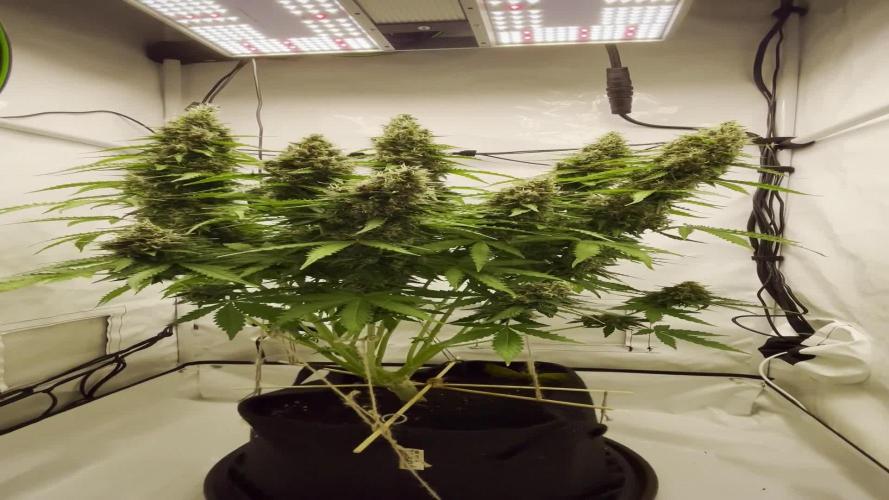
With GG gone, Crystal Candy now has the entire tent, all the airflow, and the 150W light entirely to herself. As you can see in the video, she is taking full advantage of it. She is flowering beautifully, the buds are swelling up nicely, and she is marching steadily toward her own harvest window.
The biggest struggle right now is the weather. Summer is arriving early here, and the ambient temperatures are pushing my tent up to 32°C (89.6°F) during the day. I am trying my best to counteract it and cool things down, but without much success so far.
Despite the heat, CC seems to be taking it like a champ. I'm keeping the fans on max to ensure massive airflow and prevent any mold issues like the minor scare I had with GG.
Fingers crossed the heat doesn't cause any foxtailing. She is getting closer every day! ✌️