


Likes
Comments
Share


@Altitonans_Fulmen
Follow
Sequence: A sequence is an ordered list of numbers. For example, 1, 2, 3, 4 is a sequence.
Series: A series is the sum of the terms of a sequence. For example, 1 + 2 + 3 + 4 is a series.
Summation: The addition, and also the resulting value, are called the "sum" or the "summation".
Use summation:
207,360=9
103,680=9
51840=9
25920=9
12960=9
6480=9
3240 =9
1620=9
00=0
09=9
18=9
27=9
36=9
45=9
54=9
63=9
72=9
81=9
90=9
180=9
360=9
720=9
1440=9
2880=9
5760=9
The number 25,920 is relevant in the context of astronomical phenomena, specifically the Earth's axial precession, a cycle that takes about 25,920 years to complete as the Earth's axis "wobbles," causing the Earth to shift its orientation relative to the stars.
The equation 144 × 180 = 25,920 is a well-known mathematical connection in Isotropic Vector Matrix (IVM) geometry and sacred geometry. It correlates the 64 Tetrahedron Grid with the Earth's precession of the equinoxes.
The exterior surface of the 64-tetrahedron matrix (a fundamental structure in unified physics and sacred geometry) is composed of 144 external triangles.180 Degrees: The sum of the internal angles in every planar triangle is 180°.
25,920 Total Degrees / Years: Multiplying 144 × 180 yields 25,920, which perfectly mirrors the 25,920-year cycle of the Earth's axial precession (also known as the "Great Year").
In astrology, there are 144 possible combinations for Mercury's placement in the 12 signs and 12 houses. This number results from the 12 zodiac signs multiplied by the 12 astrological houses (12x12=144).
12x12=144, A dodecahedron is a polyhedron with 12 faces, and in coordination chemistry, it refers to a geometry where ligands surround a central metal atom (in this case, Magnesium) in a specific, 8-coordinate arrangement. Dodecahedrane is a hydrocarbon, meaning it's composed solely of carbon and hydrogen atoms. The carbon atoms are arranged at the corners of a dodecahedron, a 3D shape with 12 pentagonal faces. The water molecules in the dodecahedron form hydrogen bonds that are individually slightly weaker than in either the dimer or the tetramer. However, because three-quarters of the O -H groups in the dodecahedron form hydrogen bonds, it has a more negative energy per molecule than either the dimer or the tetramer. Magnesium (Mg2+) is the essential, central metal ion in the chlorophyll molecule, crucial for photosynthesis by enabling light absorption and energy transfer. It is chelated by four nitrogen atoms within the porphyrin (or chlorin) ring structure.
Chlorophyll appears green because it reflects light in the green region of the visible spectrum, specifically between 490 and 570 nm.
The main resonance electronic frequency of a neutral Magnesium (Mg) atom corresponds to the transition from the ground state to the first excited state. Resonance Line Wavelength of Mg2+: 285.1nm (UVB light). The central atom of the chlorophyll molecule is Magnesium (Mg2+), which is coordinated within a porphyrin ring. The electronic "resonance frequency" of this central atom—meaning the frequency at which its electrons absorb energy—is primarily driven by the electronic transitions (ETR) of the surrounding conjugated chlorin ring structure, rather than a discrete atomic transition of the Magnesium atom itself. The resonant electronic frequencies of the chlorophyll porphyrin (technically, a chlorin) ring are determined by the energy required to promote π-electrons within its conjugated system, primarily appearing in the blue and red regions of the visible spectrum.
In standard physics, Chloryphyll b has peak absorption at 460nm (Blue) and at 647nm(Red). If we take the blue peak wavelength 460nm and a UV-B, UVR8 peak absorption wavelength 285nm Tryptophan-285 (W285) Sensing protein. 460/285=1.618 Φ, If we take chlorophyll b's Red absorption peak 647nm and a UV-A of 400nm, we get 647/400=1.618 Φ. The cryptochrome photoreceptor (CRY) is a UV-A/blue light receptor that shares this dual sensitivity with several other biological structures and functions, including significant sequence similarity and a common evolutionary ancestor with DNA photolyase enzymes. These are light-activated enzymes that use blue/UV-A light to repair DNA damage caused by UV-B radiation in plants. Synergistic.
Dodecahedrane (C20H20) is a hydrocarbon with a cage-like structure where carbon atoms form 12 pentagonal faces (a regular dodecahedron). It is highly symmetric (icosahedral), contains no delocalized electrons (no aromaticity), and has minimal angle strain, but significant torsional strain. Water Dodecahedron (H2O) forms hydrogen-bonded cages. While individual hydrogen bonds in this structure are weaker than in the linear dimer or tetramer, it has a more negative total energy per molecule. This is because three-quarters (75%) of the groups are involved in hydrogen bonding, creating a very stable, closed-shell configuration. a 3D carbon hydrocarbon (C20H20) to stable water clusters in hydrate, while the Magnesium ion acts as the central activator within a conjugated ring in biological systems, with its electronic absorption dominated by the ring, not the atom itself.
72 Years per Degree: The 25,920-year precession cycle is divided by 360 degrees, resulting in roughly 72 years per degree (25920 / 360 = 72).
The number 72 is connected to the golden ratio in pentagonal geometry. The angles of a golden triangle, an isosceles triangle where the ratio of the longer side to the shorter side is 1.618, are 36°,72° 72°. The central angle of a regular pentagon is also 72(360°/5=72°).
72 beats per minute is the average resting human heart rate, and the average human lifespan historically mirrors one "degree" of this cosmic clock.
The ancient philosopher Pythagoras taught that "geometry is space regularized, and music is time regularized."
When you freeze a specific musical frequency, it manifests physically. This is visibly demonstrated in the field of Cymatics, where sound frequencies vibrated through sand on a plate form perfect, intricate geometric patterns. Higher frequencies create more complex sacred geometry.
Trigonometry: The golden ratio can be expressed using trigonometric functions of angles related to 72°, such as in the formula for the cosine of 36° or the sine of 54°
•The Tetrahedron totals 720°, (7+2=9)
•The Octahedron totals 1440°, (1+4+4=9)
•The Cube totals 2160°, (2+1+6=9)
•The Icosahedron totals 3600°, (3+6=9)
•Dodecahedron totals 6480°. 6+4+8= 18 1+8=9
6480+3600+2160+1440+720=144,000
The Sacred Cubit (or Royal Egyptian Cubit) is an ancient unit of measure, typically 20.6 to 25.26 inches, derived from the length of the forearm from the elbow to the tip of the middle finger. It was used to design sacred structures like the Giza Pyramids. Discovered and popularized by Slim Spurling in the 1990s, this technology involves measuring a specific length of wire—typically 20.6 inches (52.4 cm) based on measurements from the King’s Chamber of the Great Pyramid of Giza—and twisting/looping it into a "tensor ring". Within the context of Tensor Technology and sacred geometry, the Sacred Cubit is considered to create or resonate at a frequency of 144 MHz (megahertz).
Proponents, such as Bruce Cathie and Jain 108, define the speed of light (c) as a "harmonic" value of 144,000 minutes of arc per grid second within a hypothetical universal grid system, rather than the standard physical constant of approximately 3x10^8m/s.
144x3 = 432
Unlike the standard tuning of 440 Hz, which is used in most music today, 432 Hz is said to be mathematically consistent with the patterns of the universe. It is often referred to as the “frequency of the universe” or the “miracle tone.”
•The Cube (Hexahedron - earth) is 2160 degrees, 216 x 2 is 432
Everything is energy. Energy is represented by numbers. Numbers are frozen music. Music is moving sacred geometry of the Uni-verse. Here the tension comes from the interaction between spins, causing them to magnetically resonate. For these interactions, we found a series (scale) of resonant notes: The first two notes show a perfect relationship with each other. Their frequencies (pitch) are in the ratio of 1.618…, which is the golden ratio famous from art and architecture. It reflects a beautiful property of the quantum system — a hidden symmetry. Actually, quite a special one called E8 by mathematicians.
•The E8 structure itself has relationships to Phi (1.618).
The golden ratio is the limit of the ratio of consecutive numbers in the Fibonacci sequence. The number 144, which is the 12th Fibonacci number, appears in calculations related to the 25,920-year cycle in some esoteric contexts 144°x180°=25,920° total degrees in a 64-tetrahedra structure's surface). The outer surface of a structure made from 64 tetrahedrons, often referred to as the 64 Tetrahedron Matrix or the Isotropic Vector Matrix (IVM), is composed of 144 equilateral triangles. This complex geometry is significant in sacred geometry and some unified field theories. The 64 Tetrahedron Matrix is a three-dimensional representation that is related to the two-dimensional "Flower of Life" symbol, where the arrangement of spheres around each tetrahedron creates the dense sphere-packing lattice of the Isotropic Vector Matrix.
The golden ratio has been reported to appear in the overtones of magnetic resonance at the quantum scale. Some theories propose a mathematical framework where the golden ratio is central to the absorption and emission of light photons (electromagnetic energy) by electrons. This dynamic process is linked to the fine structure constant, a fundamental physical constant relating the electron's charge, Planck's constant, and the speed of light. The ratio of certain color frequencies in the visible light spectrum (e.g., infrared to green and green to ultraviolet) has been posited by some researchers to approximate the golden ratio, suggesting an underlying harmonic principle.
Philosophical and theoretical frameworks suggest that the golden ratio acts as a "universal resonance constraint" for frequency in a unified mathematical model of reality and consciousness. Electromagnetic vibrations, such as those from electrons and photons, are thought by some to travel along biological structures like proteins and DNA, where the golden ratio is found in geometric patterns, suggesting a link to biological electromagnetism. The golden ratio emerges in discussions regarding quantum gravity, black hole physics, and even the potential shape of the universe (a dodecahedron based on 1.618) The geometry is considered fractal, meaning it can be scaled infinitely while maintaining its fundamental properties and structure.
An infinity mirror dodecahedron is a geometric light sculpture that uses the principles of an infinity mirror to create an illusion of infinite space or a "tunnel of light" within a 12-faced shape.
We become aware at such times of man's wonderful ability to bring seemingly unrelated elements into harmonic balance, and receive a glimpse into a world where everything exists in conscious sympathetic attunement to everything else. When we listen to a piece of music that seems to strike a beautiful chord somewhere inside us, or view a painting that simply glows with harmonic awareness well executed, we probably do not spare much time to contemplate the wonderfully intricate combination of vibrations that our sensors make it possible for us to perceive. We tend to appreciate the relationship between the parts of something by an awareness of the harmony or dissonance of the whole. This ability enables us to say "what a beautiful house!" instead of "analysis has proven that this collection of building materials exhibits certain elements of harmonic proportion." While this ability to instinctively appreciate the beauty of true harmony has an important role to play in evolution, a more analytical understanding of the laws involved can be most useful. This is especially so if we wish to create works of art where each part exists in true harmony, not only with the other part of that particular whole, but with the universe within which the creator and the created exist.
Everything vibrates. From the most dense matter to the most subtle cosmic rays, everything which our senses allow our thoughts to become aware of, can be specified in terms of wavelength or frequency of vibration. These two terms define the same thing, but from different points of view.
The following are the approximate wavelengths of various energy carriers:
Cosmic rays 0.000,000,001 mm
Gamma rays 0.000,000,1 mm
X rays 0.000,500 mm
Ultraviolet rays 0.003 mm
Visible light 0.006 mm
Infrared 0.01 mm
Sound waves 1 meter
Radio waves 300 meters
Violet light 400 nm to 450 nm
Blue light 450 nm to 500 nm
Green light 500 nm to 570 nm
Yellow light 570 nm to 590 nm
Orange light 590 nm to 610 nm
Red light 610 to 700 nm
1 nanometer (nm) = 0.000,000,1 cm = 1/10,000,000 cm
If a guitar string is plucked and we hear a sound, it is not too difficult for the human mind to associate this sound with the vibration of the guitar string. With color it is quite different. It is difficult for us to conceive that the color of a substance is not an inherent property of the substance itself, but an indication picked up by our senses of that substance's ability to absorb or reflect the light which happens to be shining on it at that moment. Neither the matter nor the light is colored. What happens is that the brain learns to differentiate between the frequencies reflected or transmitted by the substance the eyes are focused on. The same thing happens with sound. When we say "Oh! Listen, they're playing my favorite song," what we really mean is: "My brain has stored within it a particular pattern of frequencies. I have compared the new information being received with this stored pattern and have deduced the answer that the two patterns are similar within certain specified tolerances." The 'pleasure' involved could have something to do with our running the pre-recorded pattern at the same time, in 'sympathy' with the new pattern as it is received.
The word sympathy describes very well our ability to appreciate color and sound. It also describes the reason behind certain elements of harmony. For instance, if a substance vibrating at 100 cycles per second (tone 1) is in the proximity of another substance vibrating at 200 cycles per second (tone 2), we could perceive, if we had the right equipment, a certain sympathetic relationship between the two.
We will see from this that there is a uniform doubling of the first tone seen in the second. At various points along the waves, the two are the same in amplitude. At other points, they are at opposite poles to each other. This doubled frequency has more points of similarity to the original than any other frequency except the original itself. If the equipment we had available for measuring these two frequencies was a soundboard amplifier and a pair of ears, then we would hear what would sound to us like one tone. If we had the opportunity to hear one at a time, we would hear that although they sound the same, one is higher in pitch than the other. This characteristic of 'the same but different in pitch', musicians have called the octave. Any two tones produced where one has exactly doubled the frequency of the other is called an octave. Speaking in ratios, an octave would appear then as the ratio 2:1 or 1:2, depending on whether we are talking of an octave up or down.
A single note produced by almost any instrument will contain more than one wavelength or frequency. It will have a dominant frequency, the wavelength of which we would call the note's 'fundamental' or 1st harmonic. It will also have a varying number of upper harmonics, gradually fading in intensity into infinity or silence.
Natural harmonics always have the same pattern of intervals between them. The interval between the 1st and 2nd harmonic is a perfect octave; between the 2nd and 3rd a perfect fifth; between the 3rd and 4th a perfect 4th; and so on, the intervals becoming smaller and smaller until they lose any relationship with the western 12 tone scale as it exists at the moment. Just as an octave has certain elements of sympathy with its fundamental, so some intervals have been noted to be more perfectly in sympathy with the fundamental than others. The ratio of the 'perfect 5th' or interval of 7 semitones, as it occurs in the harmonic series, is 3:2 or 2:3, while that of the 'perfect fourth" is 4:3 or 3:4. All the tones in the western 12 tone scale can be expressed in terms of the ratio between the upper tone and its fundamental. This would seem to be an ideal way of generating a scale from any given fundamental and several attempts have been made to do this, the Pythagorean system being probably the most well known. Although when working with a single tone instrument playing on its own, the Pythagorean formula works wonderfully well, if we had several instruments tuned this way together and asked them to play almost any western music, we would find that at times they sounded quite out of tune to each other.
The lack of flexibility of the various scale systems based on the harmonic series has led to what is known as the 'tempered' scale. This uses as its primary unit of interval the ratio of the octave or 2:1. It then proceeds to divide the interval between any fundamental and its upper octave into 12 smaller intervals by applying the ratio: two to the one-twelfth power, to one (21/12:1). This equals 1.059463094, so by multiplying any frequency by this number, we will obtain the tempered semitone next up from our fundamental. We will also find that any tone twelve semitones up from any other tone, in a scale generated in this way, will have exactly double the frequency.
If we took the note middle C on a piano and halved the wavelength, we would have the note C one octave above. If we halved this, we would have the C above, and so on. However, within about 6 octaves, we would find that although a 'sound' was being produced, no human ear could perceive it. If we kept on going, halving and producing upper octaves of our fundamental C, we would proceed through the infrared band, into the visible light spectrum. If we happened to be outside during the day, we would, for one octave only, see the note C with our eyes. The next octave above would already be in the ultraviolet band, and outside the eye's sensitivity range. If we can think of color as being an indication of a substance's vibratory rate or wavelength, we may begin to see a relationship that could exist between the color and sound spectrums.
The logical extension of what has so far been said is that there exists a scale in the color spectrum that corresponds exactly to the scale in the sound spectrum, each color tone being an octave of the equivalent note in the sound range.
This is not the end of the story but only the beginning. If we can for the moment accept that any wavelength in one band has upper and lower octave stretching out to infinity, then the next question is 'fine, but what shall we use as our fundamental? A particular color? A particular sound frequency?' The musicians among us will probably say 'A 440'. This means that the note A should vibrate at 440 Hertz, or 440 times per second. They would tell us that this is standard pitch has been adopted by most orchestras around the world; pianos are tuned to it, instruments are constructed to formulas based on it, and so to them it would probably seem the most appropriate place to begin. Some of these musicians may know of the battle that is still raging with regards to this being the standard, but few would know why A = 440 Hz was chosen except that it worked when it was set to be a suitable compromise between the many different pitches in use at the time.
432 Hz is said to be mathematically consistent with the patterns of the universe. Studies reveal that 432 Hz tuning vibrates with the universe’s golden mean PHI and unifies the properties of light, time, space, matter, gravity, and magnetism with biology, the DNA code, and consciousness. When our atoms and DNA start to resonate in harmony with the spiraling pattern of nature, our sense of connection to nature is said to be magnified.
Another interesting factor to consider is that the A=432 Hz tuning correlates with the color spectrum, while the A=440 Hz is off. Audiophiles have also stated that A = 432 Hz music seems to be non-local and can fill an entire room, whereas A=440 Hz can be perceived as directional or linear in sound propagation.
Once you adopt the idea that sound (or vibration in general) can have an equalizing and harmonizing effect (as well as a disturbing effect), the science of harmony can be applied to bring greater harmony into one's life or tune to specific energies. There is a form of absolute and relative harmony. Absolute harmony can, for example, be determined by the tuning of an instrument. The ancients tuned their instruments at an A of 432 Hz instead of 440 Hz - and for a good reason. There are plenty of music examples on the internet that you can listen to in order to establish the difference for yourself.
Attuning the instrument to 432 Hz results in a more relaxing sound, while 440 Hz slightly tenses up the body. This is because 440 Hz is out of tune with both macro and micro cosmos. On the contrary, 432 Hz is in tune. To give an example of how this is manifested microcosmically: our breath (0,3 Hz) and our pulse (1,2 Hz) relate to the frequency of the lower octave of an A of 432 Hz (108 Hz) as 1:360 and 1:90.
It is interesting to note that 432 Hz was the standard pitch of many old instruments and that it was only recently (19th and 20th century) the standard pitch was increased. This was done in order to be able to play for bigger audiences. Bigger audiences (more bodies) absorb more of the lower frequencies, so the higher pitch was more likely to “cut through”. One of the oldest instruments of the world is the bell ensemble of Yi Zeng (dated 423 BC), tuned to a standard F4 of 345 Hz, which gives an A= 432 Hz. The frequency of 345 Hz is that of the platonic year! Similarly, many old organs are tuned in A=432 as well; for example, St. Peter’s Capella Gregoriana, St. Peter’s Capella Giulia, S. Maria Maggiore in Rome.
Maria Renold’s book “Intervals Scales Tones and the Concert Pitch C=128 Hz” claims conclusive evidence that 440 Hz and raising concert pitch above scientific “C” Prime=128 Hz (Concert A=432 Hz) disassociates the connection of consciousness to the body and creates anti-social conditions in humanity.
The difference between concert pitch A=440 Hz and Concert A=432 Hz is only 8 cycles per second, but it is a perceptible difference of awareness in the human consciousness experience of the dream we share called existence.
Likes
11
Share

@NidoR420
Follow
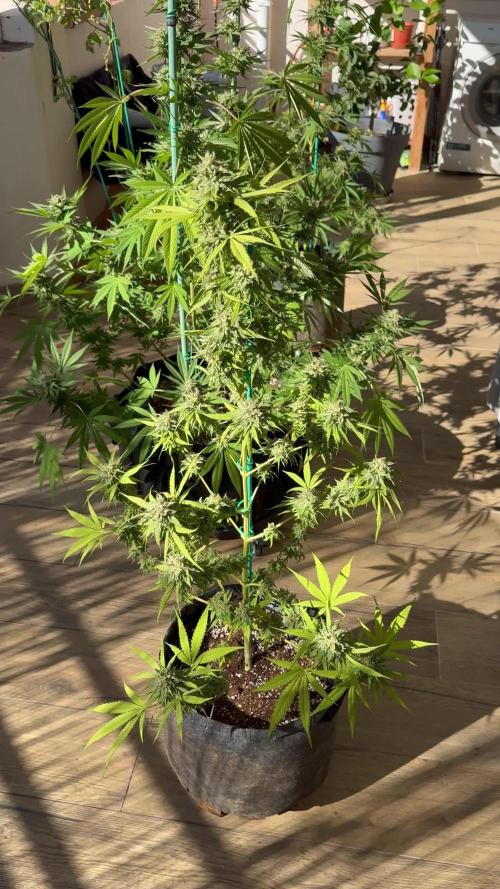
The caterpillars were in fact not gone, as I suspected. Already two bud rots on Ozz, both with a caterpillar inside. Let’s see the extent of the damage but’m I expecting the worst. On the other hand her two sisters don’t show any signs of pest. They also smell much better (very tropical), not a fan of Ozz smell now
I stop feeding them as I will harvest the two smaller in 1/2 weeks and Ozz one week after


Likes
39
Share


@Bluemels
Follow
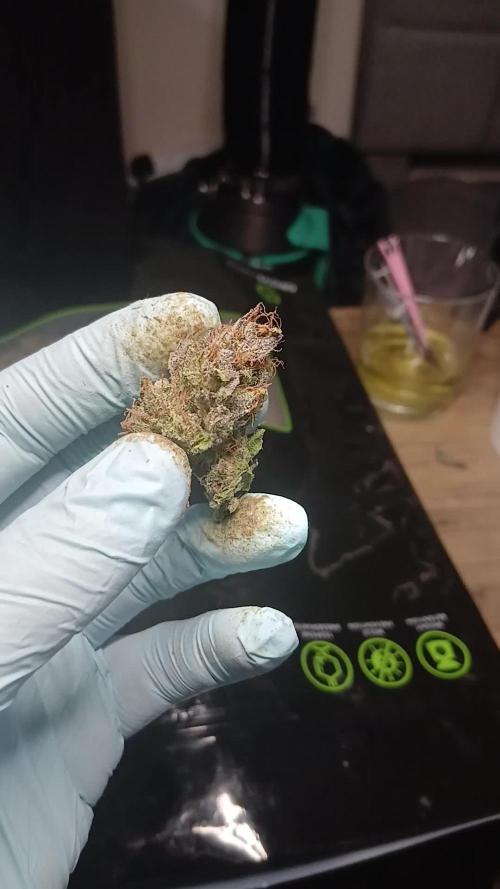
An Tag 42 habe ich alle Haupzweige runtergebogen um mehr Struktur zu schaffen 💪
Tag 46 letzte Entlaubung vor der Blüte 😜
Tag 47: die Shogun hat sich besstens vom ausgeizen erholt! Die übrigen Triebe sind schon deutlich kräftig geworden.
In 2 Tagen schick ich sie in die Blüte 😎

Likes
5
Share


@StonedandSteady
Follow
VIVOSUN®️ @vivosun.official VS2000w & VS1000w Grow-Thank You so Much J Bro!!! I'm Honored and Very Grateful of you and your Company for taking me on to your Team/Family! I #FlippedToFlower today Friday 6/24/22 ShoutOut to our Bro @soillife420_2 for Gifting us this VS®️ VS1000w LED Grow Light! Sponsored VS®️ VS2000w LED Grow Light with Samsung LM301 Diodes & Sosen Brand Driver, Dimmable Lights, Sunlike Full Spectrum with Grow Room Glasses for Seedling Veg & Bloom Plant Growing Lamps for 4x2 Veg & 3x3 Flower Grow Tent or Grow space! Lower Cost & High Efficiency: VS®️ VS2000w LED grow lights use the latest LED plant light technology including Samsung LM301 Diodes, high-energy efficiency with 2.9μmol/J; Extremely high output but consumes only 200W of electricity, making it more efficient than traditional HID lamps and other plant lamps on the market! It comes equipped with 3000k Warm white Diodes that Boosts Bloom, 5000k Cool white lights that Promotes Germination and 660nm Red lights for Higher Yields! Thier attached to a Durable, Waterproof Aluminum Heat Sink with Low Noise and only weights 9.03lbs. with a 5 year Warranty! SuperCropped3rdTime #TransPlanted into 3GallonPots from 1GallonPots #Lollipopped ToppedThe3rdTime #LeafTucked Transferred into our 6×5ft. #ChronicCave BasementFlowerArea and Growing under our Brilliantly Bright VIVOSUN®️ VS2000w-VS1000w with the 12/12 lighting schedule, Dimmed⬇️=50% around 35-40" Over Canopy's We Love to use Team @tnbnaturals @tnb_naturals #TNBNaturals #TheEnhancer #Co2DispersalCanister for Vigorous and Great Growth for our Grows! ShoutOut to Bro @dr._weedman I'm Growing from Team @ilovegrowingmarijuana_strains #HeroMixpack #ILGM #SkywalkerOG-Fem #BruceBanner-Fem #BlackWidow-Fem and started Up a New phenoz of those, my Team @nirvana_seeds nirvanashop.com #Zkittlez-Fem and a New pheno of that! Thanks Again Everyone!!! #BudBrothers4-L Happy Growing! Cheers Famz!!! Much Props and Much Pars!💯VS®️💡's+⛺'s=🏆's
#LoveWhatYouGrow
#BringGreenToYourLife
#vivosun #vs1000 #vivosungrowlight #vivosungrowtent #vs2000 #vs3000 #vs4000 #vs1000e #vsf4300 #hcf1600 #hcf3200
https://linktr.ee/vivosun.official
https://www.linkedin.com/uas/login?session_redirect=%2Fcompany%2F77743591%2F
https://youtube.com/c/VIVOSUN
https://instagram.com/vivosun.official?igshid=YmMyMTA2M2Y=
https://www.facebook.com/198734887125319/posts/1724749361190523/?extid=a&mibextid=baczqb
https://mobile.twitter.com/VIVOSUN/header_photo
https://pin.it/2uORZDs
https://www.tiktok.com/@vivosunglobal?lang=en&is_from_webapp=1&sender_device=mobile&sender_web_id=7110614037704197678
https://www.amazon.com/stores/page/A2F7F49B-7130-4423-BF67-59CE3EC5A44F?maas=maas_adg_01A961034EF443FE5006848DB5A6C70B_afap_abs&ref_=aa_maas&tag=maas&ingress=3&visitId=3e0468ed-290c-4c15-9d06-7a22afdff345&mc_cid=e5417eb03f&mc_eid=69bad0aef8
https://www.amazon.com/stores/page/3EDD8CEC-742A-44F6-90C4-0930E78DD730?ingress=2&visitId=6cfb6992-f86f-4c85-a5ad-4cb5d1c06d07&ref_=ast_bln
Limited-time deal: VIVOSUN 6-Pair 1/8 Inch Adjustable Grow Light Hanger, Heavy Duty Rope Hanger with Reinforced Metal Gears, 8-Ft Long and 150 lbs Weight Capacity Rope Rachet for Grow Light, Inline Fan https://a.co/d/1WezHcI

Likes
81
Share


@UnorthadoxDude
Follow
Hey! Welcome to week 8! Karen is mid way through her flowering stretch. Please check back to last week as I update daily so the week is now complete. I count about 20 colas now.
Day 51: Have reconfigured the tent, see video. Karen is now 36cm and still stretching. Karen has more light now. Smell is still there hits you when you open the tent. Fertigated 2l.
Day 52: Height: 39cm. Karen's scent is heavenly. I have reconfigured again and installed some upgrades. Better reflector. Much bigger carbon filter. Increased airflow. Better config. More efficient pot layout. Karen is lovely.
I am grateful to her and for her, so I wrote her a little poem, I hope she liked it.
"Karen! Oh Karen! The phoenix of flowers,
Three lowly weeks she struggled in vain,
Shadowed and starved for five hundred hours,
He slowly wept to witness her pain.
Karen! Oh Karen! I P-H'd your showers,
and in the fourth week you started to gain,
Hallowed and hard you survived as you cowered,
I thought you meek, I was wrong once again.
Karen! Oh Karen! Forgave me my howlers.
She set a pace, a pace she maintained,
Now shes a girl at the peak of her powers,
And so I'm a geek, with buds on the brain."
Day 53: Approx 48h into a simulated dry spell.
Alright I think it is time for Karen to get her first MAJOR defoliation. I will update shortly with photos and info. I will also be doing some gentle LST to separate the colas a bit.
Day 53.5: Defoliation and LST. Finally got chance to photograph that bunda. Enjoy!
Day 53.75: Bit of a fail. Messed up the timer and the lights ended up being off for about 3 or 4 hours. Because I was cooling the room (open window) to keep temperature in the tent down, without any light the temperatures absolutely plummeted as it is sub-zero outside. By the time I realised and turned the lights on, the temp in the main tent had dropped to 14 degrees celsius. Whoops! How is that for mistreating your girl? Defoliated about 80% of her leaves, 4 nodes, significant LST, then stuck her in the cold and dark for 1/6 of a day. Not to mention she is now almost 3 days into a "dry spell". There do not seem to be ill effects, and Karen has already begun to respond to the LST; all the colas that had been changed in angle are now upright again.
The dry spell I keep mentioning, there is a method behind my madness, I have spotted one or two small flies and I think they may be fungus gnats. I am starting to suspect that the 2nd seedling in the Purple OG Punch Auto grow was actually beheaded by fungus gnat larvae. So I am drying out the mediums as much as I dare. I am closely monitoring the plants, so far the only one I have had to break the drought for is Enigma; all the girls in big pots haven't even noticed it's dry yet. How far am I going to push it? Well I will judge it on a plant by plant basis, but quite honestly I am hoping to see physical signs of thirst before I breakdrought. Of all the plants the two I think will respond most strongly to this will be Karen and Bertha, because of where they are. Karen here is actually probably 4 weeks into flowering rather than two, so about now is a good time to give her a little hydration stress. I do not think I will push it past 5 days, as RH is 34%. By now all the plants will be compensating for the lack of moisture and the high temperatures and low humidity. They will be taking more and more moisture out of the coco, and as the coco dries further and further down, those plants that have space will start desperately growing roots to find moisture. Mark my words, 24 hours after I end this drought, every plant in the tent will throw out crazy growth.
Day 54: Ended drought and fertigated 6l, no run off, I will re-fertigate tomorrow. Karen is still stretching her height post LST is now 37cm. The two tallest colas seem to have stopped but the other colas are still stretching.
Day 55: Alright so it has been 5 hours since lights on, and Karen is looking in good shape, all her drooping leaves have perked back up and she has added quite a bit of foliar growth. The colas are all still rising, except perhaps the two tallest. This girl is absolutely loaded with pistils, I'm starting to see trichomes on the sugar leaves, but trich production hasn't started in earnest yet. She has a least 20 colas, and 6 of them are thicker/taller than the primary cola at her tip. Every one of her nodes has reinforced itself with a bulbous growth and these cola branches are swelling rapidly. I am increasingly of the opinion that, all being well, this girl is going to surprise us all with her yield. My first grow, which was just mucking about really, I got 60-70g of the two main plants, and they were just bare sticks with 2 colas. Although her height is less than theirs was, 2/3 of their height was bare stick... whereas every mm of her is befoliaged and living. So in terms of the height of the actual cola I think they were about comparable in usable space on a per cola basis. The main difference being that Karen has 20+ colas whereas they had 2 primary and 2 lower. I know that it is probably unrealistic to expect more than 70g from a single auto grown indoors. Nevertheless my gut tells me this baby could achieve at least 100g, perhaps as much as 150g. The next few weeks will determine that, but given where we were in week 3 I will be grateful for any yield of quality bud. I have dropped the lights down to 18/6 from 'tonight' onwards.
I really have no idea how long we have left for Karen. According the the "brochure" she flowers for 7-8 weeks, with a total crop time of 9 weeks. The problem is I don't know what a total crop time is? Does that mean from seed to finish? If so Karen is clearly not going to be anywhere near that timescale.I am going to go ahead an assume that, for my plant anyway, the first 4 weeks were veg weeks. I think it is fair to count week 5 and 6 as flowering because pistils were popping out very early in week 5 if not before. So that makes this week four of flowering. I am going to assume 8 weeks rather than 7, so I think we have another 4 full weeks give or take a week. On that basis I am expect harvest week to be around week 12 or so. I am not fixed on this though, I am determined not to harvest this girl early.
Day 55: Photos taken 00:00 9/3/23 Strong 24h of veg growth as predicted.
Day 56: Existing leaves continue to swell. Stretch appears to be slowing. I've taken so many media this week that I cannot scroll down far enough to select a recent thumbnail. Probably Karen's biggest week in terms of changes. She is looking like she is going to impress. Height 39cm.

Likes
21
Share


@Fullmeltalchemist
Follow
Alright I've updated this postmortem and cure just to give an idea of what I was up to during the dry and cure weeks. This grow was a ton of work and I'm very please with the results. I learned a ton about soil and environment control and really feel like I'm gaining confidence and coming into my own as a cultivator.
I've been playing a lot with ice water hash and rosin and have set some neat goals for the future like hunting ice water hash cultivars, going perpetual and expanding the amount of canopy I can work with by building a network of remote-operated satellite flower tents in friends' and family's abodes . I'm not sure I'll go through all this effort of documentation here again, but please follow along on my instagram, stay in touch and chill out with me sometime @Fullmeltalchemist.00
All in all, I was running 1000w of quantum board across three tents and pulled just over 1100 grams, which was a big goal of mine.
Thanks for all the advice and love growmies! And thanks growdiaries for the platform. It's been coo.


Likes
23
Share

@PapaBlob
Follow
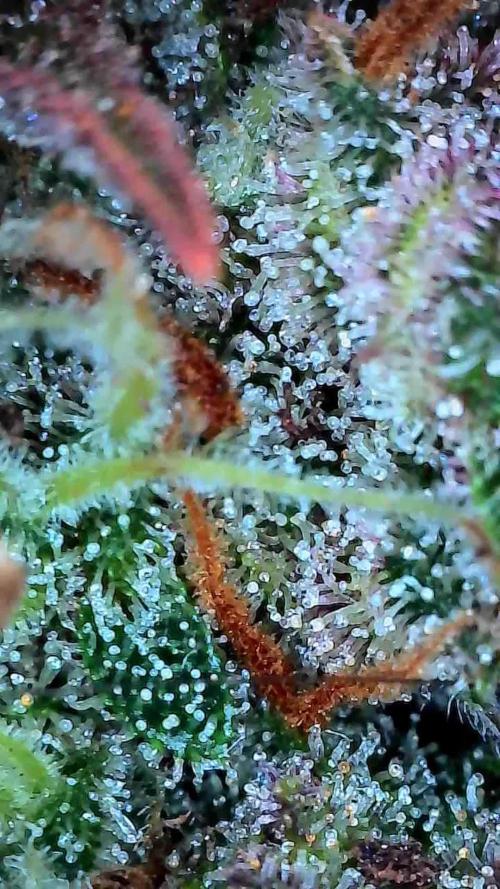
08/04 Comme prévue, la plante était prête pour la récolte. Donc, je l'ai dépouillé, et découpé, et tout, et tout.. Elle m'a fait une belle boulette de doigt. 😁👍
Likes
6
Share

@StonedandSteady
Follow
AutoFlowers at 9 weeks of Bloom, Finishing out Great and Glorious as All get Out, 1st week of Veg Update!
Everything looks Gorgeously Great and looking Beautifully Grown at their 9th Week of Flower! Veg Update on #AutoBlueberry #NukeHeads #PurpleBlueberryMuffinCherries-Fem #BubbaKush-Fem and #BlueberryDiesel-Fem breed by Broski #Soluna668 #NoGreedSeeds 5th Feed of #HumboldtCountysOwn
#AutoBlueberry
#AutoWhiteRussian and #AutoMontreal *Fems* breed by Team #DivineSeeds #DivineSeedsSquad #DivineSeedsBreedingCompany Looking Magnificent and Amazingly Great in thier 9th week of Flowers! Thier Growing under the #Growatt600w and in my #TopoLite 24×24×48 Grow Tent! I'm also using #TNBNaturals #TheEnhancer Co2 Despersal Canister and using thier Ph⬆️⬇️ for my Decolinated Tap Water!
#AutoWhiteRussian breed by Outstandingly Awesome Team #DivineSeeds #DivineSeedsSquad #DivineSeedsBreedingCompany
Yo!!! This Lil Beauty popped open in under between 16-18 hours of Germination using this Wet Papertowel Method, this New Heat Mat, Baked potato ToGo Container and Regular Tap Water Helped Tremendously! Heck Yeah Growmies and Growmets!!! Let's Grow!!!
DivineSeeds:
#AutoWhiteRussian
Origin:Afghanistan
Type:Indica/ Sativa/ Ruderalis
Flowering:65 days
THC:24 %
Harvest:400-600 g/m2
Height:100-150 cm
#AutoMontreal breed by Top of The Line Team #DivineSeeds #DivineSeedsSquad #DivineSeedsBreedingCompany
Yo!!! This Lil Beautiful Bean Popped under between 20 hours of Germination using this Wet Papertowel Method, this New Heat Mat, Baked potato ToGo Container and Regular Tap Water Helped Tremendously! Heck Yeah Growmies and Growmets!!! Let's Grow!!!
DivineSeeds:
#AutoMontreal
Origin:Canada
Type:50% Indica/ 40% Sativa/ 10% Ruderalis
Flowering:65 Days
THC:23%
Harvest:550-750 g/m2
Height:120-160 cm
https://divineseeds.net/
https://instagram.com/divine.seeds?igshid=osxe2v7en33v
HumboldtCounty'sOwn:
Email: info@humboldtbottling.com
Phone: (707) 725-4119
Toll free: (866) 872-9434
Humboldt Bottling
Po Box 429 · Fortuna, CA 95540
HumboldtCounty'sOwn Website Link: https://humboldtcountysown.com/
HumboldtCounty'sOwn Instagram Link: https://instagram.com/humboldtcountysown?igshid=1qj809qkkwych
I love and Appreciate Everyone!!! Thanks Again Teams! Cheers Famz!!! Much Props and Much Topz!💯

Likes
9
Share


@Haoss
Follow
These seeds are grown in Georgia, LAGODEKHI x OG KUSH, seeds of the same variety should be grown in coconut and soil

Likes
17
Share


@Jahasus_Group
Follow
In a 1m x 1m tent, Lumii 315w , (using marshydro SP150 in flower stage), secret Jardin fan, carbon filter, intake fan 5”, humidifier.
So out of the four seeds popped last week three where successful in rooting.
Added a sprinkle of great white shark to help with root stimulation and just water.
Root are starting to show on the side of the cup so almost time to transplant to bigger pots (moving into fabric pots)
Transplanted in to fabric 20l pots with feeding powder at a low dosage. But unfortunately one transplant didn’t go to plan and part of the tap root snapped (but not going to give up on her yet)
1L of water in cups
4L of water in fabric pots 20L
33g bio grow
Likes
14
Share


@GERGrowDesigns
Follow
Welcome to Flower Week 9 and harvest of Fast Buds Papaya Sherbet
For this Project , I’ve chosen the Feminized Photo strain Papaya Sherbet :
Here’s what I’m worked with:
• 🌱 Tent: 120x60x80
• 🧑🌾 Breeder Company: Fast buds
• 💧 Humidity Range: 35
• ⏳ Flowering Time: 58 Days
• Strain Info: 30%THC
• 🌡️ Temperature: 26
• 🍵 Pot Size: 16l
• Nutrient Brand: Narcos
• ⚡ Lights : 600W x 2
A huge thank you to Fast Buds for allowing me to try my Best with this amazing collection from Automatic and Photo Strains they managed to Sponsore . Big thanks for supporting the grower community worldwide! Your genetics and passion speak for themselves!
Let’s grow together – and don’t forget to stop by again to see the latest updates!
Happy growing!
Stay lifted and stay curious!
Peace & Buds!
Likes
Comments
Share


@GrowDiaries
Follow
Best Breeder 2025
Hats off to Cookies—our GrowDiaries.com growers picked them as Best Breeder 2025! Huge props to our community for voting! #GrowDiaries
@spannabis_official @cookiesbarcelona @cookiessf
Likes
7
Share


@Elguacho420
Follow
Buenas a tod@s... Décima semana de floración de estás green poison, décima y última semana, ya pueden despedirse, la semana q viene ya entran a poda, está semana un buen lavado de raíces un poco de defoliación y listo, la planta tiene cogollos compactos y pesados, buen aroma, bastante recina... A mí me gustan, aún q no tengan buen aspecto, no juzguemos las apariencias 😉 tiene muy buena pinta, contento con el resultado pero a seguir mejorando... Buenos humos para tod@s 💨💨💨😎⚕️
🇦🇷🤝🏻🇪🇦

Likes
40
Share


@MrJones
Follow
47th Parallel Crowly's Comet
🔹⊱╮🔹╰⊰🔹 GROW Started 03.10.24 INFORMATION 🔹╰⊰´🔹⊱╮🔹
🌞Environment - Maintaining 80F and 65%Humidity
🌾Training - Nothing this week just letting the seedlings veg out.
⚱️2-Gallon 📊6.2 PH
💧 Feeding - Using Horti Grow 8-11-21, Bloom 5-15-26, Late Bloom 0-24-26, Cal 12-0-0
🌞Medic Grow Smart 8 760 Watts
🕷️ IPM - CannControl from Mammoth and Mosquito Bits as needed
🔹⊱╮🔹╰⊰🔹 PLANT UPDATES 🔹╰⊰´🔹⊱╮🔹
📝 Notes - These girls have completely transformed into their new buckets and have started to drink up, increasing the amount of fertigation, (Nutrients and H20), and defoliation to expose the lower growth.
🗓️03.29.24 Maintaining Temps and Humidity - Plants are Looking Great!
🗓️03.30.24 Today fed with Hort-Grow @ 3.3 GRMS Per Gal, and Horti-Cal @ 2.5 GRMS Per Gal. I defoliated the plants to water them better and the middle growth could get more light and develop.
🗓️03.31.24 Maintaining Temps and Humidity
🗓️04.01.24 Today fed with Hort-Grow @ 3.3 GRMS Per Gal, and Horti-Cal @ 2.5 GRMS Per Gal. Check out the amazing growth and recovery after the defoliation!
🗓️04.02.24 Maintaining Temps and Humidity, watching these ladies are just nailing the veg phase.
🗓️04.03.24 Today fed with Hort-Grow @ 3.3 GRMS Per Gal, and Horti-Cal @ 2.5 GRMS Per Gal
🗓️04.04.24 Maintaining Temps and Humidity, closing out week 2 of veg and these ladies will need to be defoliated again, this new nutrient line from Greenpnaet is killing it, and so easy to use!
╰⊰🔹╰⊰´🔹⊱╮🔹╰⊰🔹╰⊰🔹STRAIN INFORMATION🔹⊱╮🔹╰⊰🔹╰⊰🔹╰⊰🔹⊱╮
Crowley's Comet / https://www.47thgenetics.com/product-page/crowley-s-comet-10-fem-birdseeds
It's everyone's favorite piece of space rock, Crowley's Comet! The culmination of reversing our Matterhorn cut off Mr. Crowley to Intergalactic Runtz, and the results were out of this world (I had to do it). These ladies were slow to start, but once they hit their stride they put any worries we had to rest. Compact, short-framed, and robust. They pack beautifully boulder-like flowers that reek of garlic and sickly sweet cotton candy. Dark green to a mosaic of purples, yellows, and silvers. Frost production is off the charts, the internode spacing is tight, and they certainly will impress in their last few weeks of flower. This is one of our favorite crosses in the new fem lineup. If you're looking for your hype fix, here you go.
Yield: Heavy to XL
Flower Time: 63 days
Feeding Schedule: Heavy
Likes
78
Share


@Hou_Stone
Follow
👨🚀🌿👨🚀🌿👨🚀🌿👨🚀🌿👨🚀🌿👨🚀🌿👨🚀🌿👨🚀🌿👨🚀🌿👨🚀🌿👨🚀🌿👨🚀🌿👨🚀🌿👨🚀🌿👨🚀🌿👨🚀🌿👨🚀🌿
Aucune technique cette semaine, je laisse juste mes bébés grandir en les arrosant /5 jours.
1 fois sur 2 j'ajoute à mon eau 1gr/L eau de BioEnhancer
J'ai activé le mode 12/12 à la fin de cette semaine. La prochaine semaine sera la floraison !🌺
Venez me voir sur instagram 🌟🤩
https://www.instagram.com/hou_stone420/
👨🚀🌿👨🚀🌿👨🚀🌿👨🚀🌿👨🚀🌿👨🚀🌿👨🚀🌿👨🚀🌿👨🚀🌿👨🚀🌿👨🚀🌿👨🚀🌿👨🚀🌿👨🚀🌿👨🚀🌿👨🚀🌿👨🚀🌿
Likes
28
Share


@SooSan
Follow
Dans l'ordre :
Blueberry
Dutch Passion
Blueberry
00 Seed
Blueberry
PEV Seed
Blueberry
Bulk Seed
Animal Cookies x Blue Monkey
Exotic Seed
Red Hot Cookies
Sweet Seed
DoSiDos x Purple Punch
PEV Seed
Purple Shot
Exotic Seed


Likes
67
Share


@AsNoriu
Follow
Day 57. Think returning to good pH finally works, they are damaged a lot, but all first wave and few in this managed to escape almost without harm. Funky colours plants are most pickiest and that was proven again ... I always screw up with them ;)))
Last heavy feed of Biobizz and only water. Max 3 weeks till chop and it doesn't matter if some won't be ready.
My time to leave has come ...
One Strawberry is making my heart sing, I knew SB will be special. I highly recommend her without even smoking ... Added few more photos to prove it. It's a big can and I am tall men, so this cola is NUTS ;) 9 week plant, I will chop her this Tuesday I think ....
I have now 1400W in the grow room. Mars Hydro SP150 and SP3000 are in the game too. Hope it will rush girls a bit 😉😉😉😉😉😉
Those two totally frozen, white stem , almost dead girls - RECOVERED !!! Weed is insanely resilient plant. I know that it will be 5-10 g max, but still ... All branches white from frost, I saw such colours only when bud rot was eating them, those btw most probably doomed here too ...
Happy Growing !!!
Likes
17
Share


@Papastroumf
Follow
Day 43 : Watering with co2 tab / 5L. Also added food again because i think they need it. Increased ppm to 850. Maybe the next one will be pure water. Ventilation works all the time when lights are on. Temp and humi are stable and this is good for the girls. Patience is the key always. Also removed some burned leaves from all ladies.
Edit (Day 47) : Watering with co2 tab every 5L. I watered with juices again at 850ppm because i felt that they need it. Only DsD drank pure water because of burns. NL stopped also vertical growth, started to fatten her buts. :D Her main cola will be huge.

Likes
2
Share


@Selectamikoo
Follow
Der Samen ist aus haze Gras entsprungen kein breeder. Wahrscheinlich amnesia oder silver haze. Zumindest rauche ich diese Sorten meistens und daher denke ich der Samen stammt von diesen Sorten ab.
Letztes Jahr war es das selbe und es waren Photoperiodische sativa strain.
Falls jemand weiß welche Sorte es wird kann mir gerne schreiben.
Heute umgetopft in seiner endgültigen Größe.