


Likes
Comments
Share
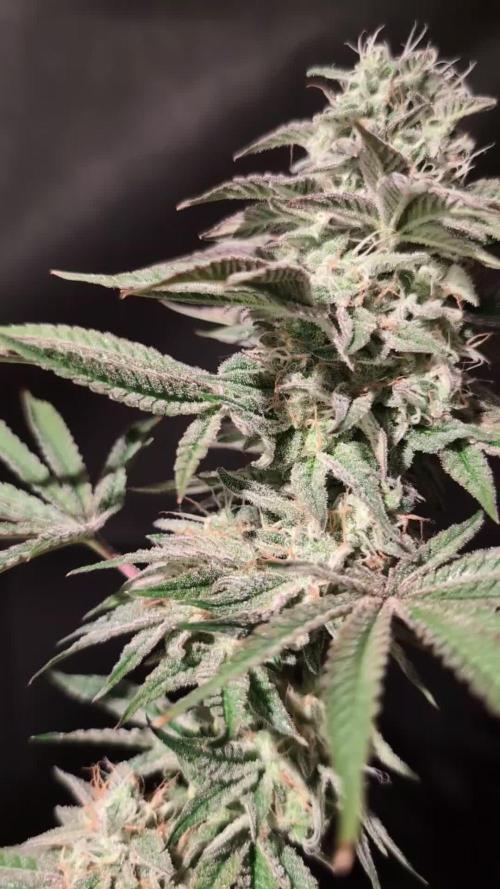

@GoodTimesOrganics
Follow
Hi liebe Community and Welcome Back! 🌿💚
Willkommen zur siebten vergangenen Blütewoche! Blütetag 57.
Hier im Weedefix Grow, erreichen wir aktuell eine höhe von 142cm. Und eine Breite von 62cm.
Die Blütenstruktur findet allmählich ihr finale Form.
Es zeichnet sich ein durchgängis schönes und gesundes Wachstum ab..
Das Icing zieht sich bei diesem Pheno etwas stärker durch, dafür ist die Blütenstruktur etwas kleiner.
Diese Woche wurden nochmal wie angegeben 5ml Wachstum pro l Wasser zugegeben und damit gegossen. Hier habe ich die Zufuhr etwas erhöht, um die PK Komponenten des Düngers einzubringen.
Das Aroma der Pflanze ist etwas chemischer/ skunkiger als bei der anderen.
Langsam erreichen wir die Zielgerade und bei diesem Phenotyp landen wir beim Ertrag auf jeden Fall im L Bereich.
Die Umgebungsgegebenheiten sind aktuell Ok, doch etwas zu hohe Luftfeuchtigkeit wegen des Wetters.
—————
🌞 Temp: 27
🌚 Temp: 18°C bis 19°C
💨 RH: 64%
VPD: 1,10kPa
💡ppfd: 830 mpm
—————
Viele Grüße 👋


Likes
6
Share


@Walter_the_Ragamuffin
Follow
Things are still going strong! I think this is the official halfway point of flowering, and the plants are in high gear bulking up and focusing on creating big, dense buds. I did notice a few brown spots on all of the Cherry Gorilla’s leaves - most notably CG#3 - I consulted some of my local grow buddies as well as the manager of my local store and they gave me some very detailed instructions - I am going to be adding 1/2 teaspoon of Cal-Mag to my water mix until week 7 AND stop diluting my food mixes - my plants are HUNGRY was the official diagnosis! I think that should be a pretty easy fix and am looking forward to the results. So I am told, I should be able to see results from the Cal-Mag flush within a week or so. Also - I was also given some words of encouragement from some long timers who saw the videos of my tent, and they are saying everything looks great and I should be proud! Again - super stoked on the progress. Planning on a big defoliation after next water to get the girls focusing mostly on the flowers, and significantly removing all of the newly developed undergrowth and under canopy buds. Stay tuned for more updates! Appreciate the views, likes and follows!
Likes
10
Share


@oldschoolS2
Follow
Day 28 after flip of zombie kush!
Starting to focus on buds!
We all ready can smell it not sweet more floral smell .
See u next week growmies!

Likes
2
Share


@Ultraviolet_
Follow
Remember that, however you are played, or by whom, your soul is in your keeping alone. Even though those who presume to play you be kings or men of power, when you stand before God, you cannot say, 'But I was told by others to do thus,' or that virtue was not convenient at the time. This will not suffice. Remember that.
Day:18
84°F and 65% RH (VPD) for the vegetative stage. Approximately 1.15kPa(assuming leaf temperature is about 2°F cooler than the air), which falls right into the ideal vegetative sweet spot (0.8kPa to 1.2kPa). At 1.15kPa, plants can draw water and nutrients efficiently without risking stress or wilting. It keeps the leaf pores (stomata) open, allowing for ideal carbon dioxide intake and maximizing vegetative growth. VPD is determined by the leaf's temperature, not just the ambient air. Because leaves usually run 1° to 3°F cooler than room air under bright grow lights, my actual VPD will be slightly lower, closer to the 1.0kPa mark. As she transitions from vegetative growth to flowering, one can gradually lower the humidity (to around 45–60%) and drop temperatures slightly to prevent disease from settling inside dense buds when they appear.
Night:6
At 70°F and 60% relative humidity, Vapor Pressure Deficit (VPD) is 0.86 kPa. This is right on the cusp of whats optimal for the vegetative stage. During the nighttime, plants generally close their stomata and undergo cellular respiration rather than photosynthesis. Transpiration slows to a near stop, making VPD less critical at night than during the day. However, maintaining a nighttime VPD between 0.8 and 1.0 kPa is highly beneficial in that it ensures the air is dry enough to prevent powdery mildew or bud rot, but moist enough to keep the plant from undergoing unnecessary stress. This range keeps the environment comfortable for cellular processes and prevents large atmospheric swings. Keeping it all flowing.
(Not pushing them yet, these are photoperiods)
The optimal soil (root zone) temperature for cellular root respiration and nutrient uptake in cannabis is between 68F & 72F This narrow range balances biological energy production (cellular respiration) with the dissolved oxygen levels in the soil, maximizing plant growth and health. Warmer soils hold significantly less dissolved oxygen. When soil temperature exceeds 74F oxygen depletion occurs, inhibiting cellular respiration almost entirely, At 68-72F root cells generate optimal adenosine triphosphate (ATP) via respiration to power root-tip elongation and the active transport of water and nutrients.
Too Hot (Above 78F) Root respiration increases, demanding more oxygen, while the water's oxygen-carrying capacity drops. This creates a prime environment for anaerobic pathogens and Pythium (root rot).
Too Cold (Below 60F) Root metabolism and cellular respiration slow to a crawl. This severely impairs nutrient and water absorption, leading to yellowing, wilting, and phosphorus deficiencies.
A lot depends on whether it's automatic or photoperiod; with photoperiod, there is not as much of a need to push "hard" as the real countdown only begins once the flower is initiated. Automatics, on the other hand, the chronological "clock" begins ticking the moment the seed germinates. It is of critical importance that the seedling growth gets off to the races, understanding that early growth is like compound interest, which will pay off come harvest. This reality is why getting autoflowers "off to the races" early on yields such exponential benefits. The "compound interest" is directly related to the surface area of the leaves. Larger, faster-growing seedlings process more light and build bigger root networks early on, which translates into an explosion of vertical and lateral growth during their short vegetative window.
The margins for error are so thin with autoflowers; this early-stage momentum depends on several critical practices. Seedlings exposed to increased atmospheric CO2 levels early in life will develop at an increased rate. To effectively "extend" or optimize the capacity of Photosystem II (PSII) for increased photosynthetic efficiency. In standard oxygenic photosynthesis, Photosystem II (PSII) is naturally limited to the red-light spectrum, peaking at 680nm. Extending its light-harvesting capacity past 700nm into the far-red region requires bypassing the natural limits of standard chlorophyll a. Adding 730 nm (far-red) LEDs alongside standard red/blue lights has been shown to increase canopy photosynthesis by 20–30% in several crops by acting synergistically with shorter wavelengths. However, the limitation is that excessive, pure IR/Far-red light (without accompanying red light) can trigger the "shade avoidance response," causing plants to grow tall, weak, and spindly rather than robust. Utilizing infrared light (specifically the 700-750 nm far-red range) is a viable method to boost photosynthetic efficiency. It acts as a bridge to allow PSII to utilize a broader spectrum of light, breaking the traditional 700 nm barrier. UVR8-mediated signaling (often in conjunction with CRY proteins) triggers protective mechanisms that maintain the stability of the photosynthetic apparatus (including LHCII and reaction center proteins), thus ensuring that the efficiency of Photosystem II remains higher in UV-B-exposed plants compared to plants lacking this receptor. ΦPSII indictates the rate of electron transfer from water to plastoquinone, which drives the production of ATP and NADPH. There is a close link between ΦPSII and the true rate of CO2 fixation (Φ*co2).
ETR stands for Electron Transport Rate. It measures the speed at which electrons are moved through the thylakoid membranes in a plant's chloroplasts during the light-dependent reactions of photosynthesis. Infrared light (particularly Near-Infrared or NIR) improves cellular energy by interacting directly with the electron transport chain (ETC) in mitochondria. This process boosts adenosine triphosphate production, which acts as a metabolic coefficient multiplier by accelerating enzyme activity dramatically.
Extend then multiply.
Far-Red photons interact with plant photoreceptors to accelerate the plant’s biological "clock" or trigger a shade-avoidance response. Autoflowers don't use the plant's biological clock, although the IR will initiate a shade avoidance and make them stretchy. You can just add equal measures of 660nm-680nm to negate the shade avoidance effect. Replacing nights' "darkness" with a combination of IR+ and 660nm. Because autoflowers don't require a dark period to flower, many growers just blast them with light. 18/6 24/0. However, this ignores the plant's metabolic rhythms, where daytime photosynthesis (light reactions) must be perfectly balanced with nighttime carbon fixation and assimilation (Calvin cycle) to avoid bottlenecking plant development. Cellular respiration is a 24/7 process, but it can only function while the plant has the free oxidative capacity to do so. A 100% photosynthetically active leaf cannot perform cellular respiration. The viral trend of defoliation of every leaf that isn't "getting enough light" is of great detriment overall, putting 100% of the cellular respiratory "workload" and responsibility on the 0/4/6 hours of darkness in sub-optimal conditions for enzymatic activity. Photosynthesis captures nearly 100% of the initial energy as carbon, while cellular respiration is the process that unlocks 90% of that captured energy into usable ATP so the plant can use it. Respiration is considered only roughly 30% to 40% efficient. It captures enough of the potential energy in glucose to synthesize around 30 to 38 ATP molecules per glucose molecule. The remaining 60% to 70% of the energy in the sugar is not captured in ATP; instead, it naturally escapes into the environment as heat, which helps regulate plant temperature. In plants, the primary enzymes of the Electron Transport Chain (ETC) and the ATP synthase complexes are typically adapted to function optimally in warmer temperatures (roughly 77°F to 95°F, depending on the specific plant strain). As temperatures rise within this physiological range, molecular collisions increase, speeding up respiration and ATP production. The cannabis plant has a branched respiratory pathway. During heat or cold stress, plants activate Alternative Oxidase (AOX). AOX burns sugars to dissipate energy as heat rather than coupling it to ATP production. This pathway actually functions optimally at elevated temperatures to help protect the cell from the damaging build-up of Reactive Oxygen Species (ROS) during heat stress. Enzyme activity generally scales with heat; there is a strict biological limit. If canopy temperatures in a grow room exceed 104°F, the enzymes and their supporting lipid membranes lose stability. Not saying you need to go crazy, just optimize nights the same as we optimize days.
Phosphorus is the driving force behind early seedling development. It acts as the "energy hub" of the plant, directly driving cell division, robust root growth, and the creation of DNA. Without an adequate, easily accessible supply early on, the plant's overall growth potential and final yield can suffer permanently.
Likes
2
Share


@HobbyistJames
Follow
I’m measuring plant biomass this time around: plant HEIGHT, leaf WIDTH and CANOPY width for as long as possible, before tent space MAXED OUT. Target maximum plant height - 36”- 40”. Allowance for canopy width expansion of 2 plants in a 2x4x6 tent - varying between 24” - 36” from late vegetative stage through flowering. This is a stretch as far as space goes. One single plant would have be enough to fully fill the entire canopy of multiple colas. In other words, although one can legally grow up to 4 medicinal plants in Canada, and I chose to grow 2 of them, that does not necessarily mean extra yield. Plants are thriving and read to be flipped into flowering stage next. Light intensity increases and so does DLI. PPFD=683 and DLI=44.1. Photoperiod changes to 12/12 in week 6

Likes
11
Share


@samuraifroggig
Follow
Flushed twice this week 4gl of RO then added 1 gal of 40% nutes right after.

Likes
61
Share


@DutchFarmer
Follow
Trichome check I’ve discovered she is around 30% Amber. 🛋️🔒
Going to have to chop her down now.
She sure is frosty ☃️❄️🏂
No purple in sight 👀 😬😒😪😢😭
30% amber GGGGGGGGGodaaam 🤯🤯🤯🤯🤯

Likes
15
Share
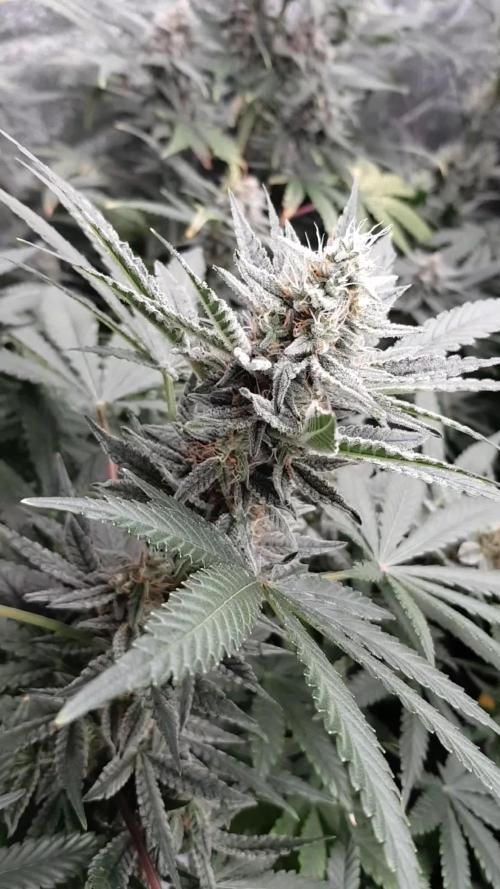

@GERGrowDesigns
Follow
Dear Growers ,
Welcome to Week 6 or Flower week 3 // Day 42-49 from Sweet Seeds Strawberry Banana Gelato Xl Auto.
Incase of Moving to a New Home . I Decided to skip 3-4 Weeks from every Diarie of the 12x12 Automatic Project . Everything should be Normal in the next Weeks .
Project Setup & Conditions:
• Brand/Manufacturer: Sweet
• Tent: 222cmx150cmx150cm
• Light: 2x 720 Watt Full Spectrum
• Humidity: 50%
• Soil: Narcos Organix Mix
• Nutrients: Narcos Products
• pH Value: 6
If you want Germinitation results like mine , check out Kannabia Seeds with my link [https://www.kannabia.com/de?ref=61966] and grab the germination device or the strains I used . Trust me – it’s worth it for sure !
Get another 20% Discount at all products using the code [GGD] at the Checkout .
Stay curious and keep up Growing —we look forward to welcoming you back for the next chapter soon!

Likes
32
Share

@MrGrowDiarie
Follow
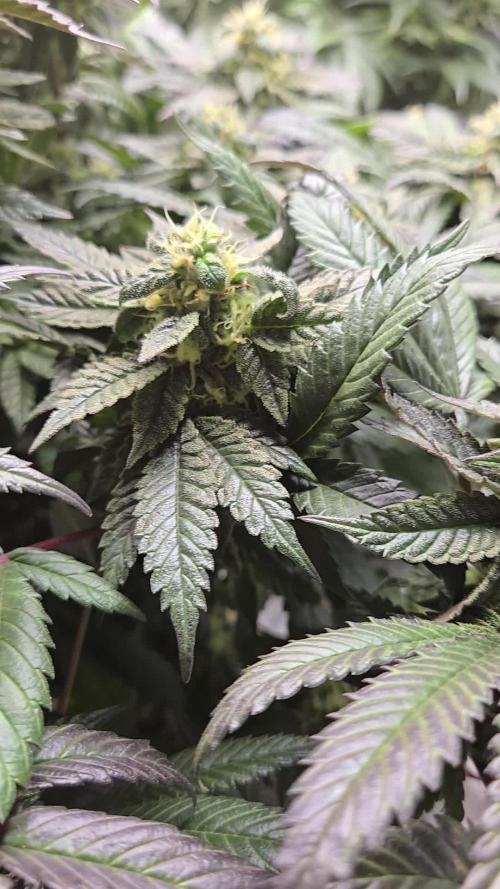
Day 107
Today marks day 107 of the grow, and the plants are looking mature and well into the flowering stage. The front plant shows a stunning display of dark green to purple hues across the fan leaves, a clear sign of late flower coloration - possibly influenced by genetics and cooler night temperatures. The buds are dense and frosty, with trichomes covering nearly every surface, giving a rich, sticky appearance. The pistils are starting to darken and curl inward, indicating that the plant is approaching its final weeks before harvest.
The canopy is nicely even, suggesting that training earlier in the grow paid off well. Some lower fan leaves are showing slight discoloration and minor nutrient wear - normal at this stage as the plant redirects energy toward finishing its buds. The leaves' darker tone and slightly glossy texture suggest nutrient levels are still balanced, though it might be time to begin thinking about tapering off feeding soon and preparing for a flush.

Likes
60
Share

@squalino
Follow
🌿 Journal de Culture :
Mac 1 – "Spirit" (Plante #2) –
Floraison Explosive
Date du jour : 15/06/2026
Âge de la plante : J+72 (Semaine 11)
Taille actuelle : 136 cm
Évolution : +2 cm par rapport à la semaine dernière
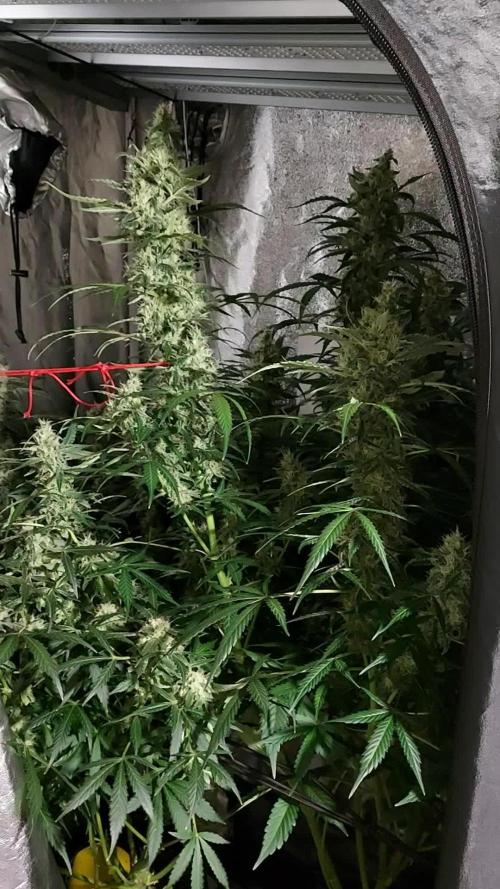
On franchit un cap impressionnant cette semaine. Le stretch est définitivement de l'histoire ancienne, et Spirit concentre désormais toute sa féroce énergie dans une production de résine et de matière qui dépasse toutes mes attentes.
📊 État de Santé & Descriptif des Fleurs
Compacité phénoménale :
C'est un truc de malade ! Les têtes ne sont même pas encore totalement finies d'être formées qu'elles sont déjà incroyablement compactes et dures au toucher. La densité qui s'annonce est impressionnante.
Production de trichomes :
Les fleurs deviennent de plus en plus résineuses de jour en jour. Elles commencent à se couvrir d'un beau manteau blanc qui scintille sous la lampe.
Profil aromatique :
L'odeur a légèrement évolué ; elle est maintenant très sucrée, extrêmement agréable en nez et pas du tout agressive pour le moment. Un vrai parfum de confiserie.
Guerre de l'espace :
C'est une plante magnifique, mais elle exprime clairement son besoin d'espace. Faute de place et sans un LST plus agressif dès le départ, elle a pris le dessus dans la tente. Elle fait de l'ombre à sa sœur Bee Apee, lui masquant facilement la moitié de la lumière. Pas le choix pour cette fois, on fait avec les moyens du bord, mais c'est une sacrée leçon sur le tempérament de cette génétique.
⚙️ Paramètres Environnementaux
Climat & Tente :
Toujours stable (24°C jour / 21°C nuit, humidité maîtrisée au déshumidificateur pour sécuriser les buds compacts).
Lumière :
Maintenue à 75% d'intensité. La cime principale se stabilise à environ 13-15 cm du panneau LED, tandis que la canopée secondaire profite des 35 cm réglementaires.
Arrosage :
Toujours géré en flux continu via le système Autopot à l'eau claire avec un pH stabilisé à 6,3 depuis le retrait du bulleur.
Nutrition & Entretien (Aujourd'hui)
Apport hebdomadaire :
Pour soutenir ce gonflement massif, j'ai donné aujourd'hui mon arrosage manuel de 5 ml de Bio PK 5-8 de Biotabs.
Observation :
Gourmande comme elle est, elle absorbe ce booster de phosphore et de potassium instantanément. Le feuillage reste majoritairement bien vert, preuve qu'elle utilise chaque goutte de nutriments pour densifier ses structures florales.
📝 Résumé de la situation
Spirit est une force de la nature. Malgré le manque de place flagrant dans la tente et la compétition lumineuse avec sa sœur, elle produit des fleurs dures comme de la pierre à un stade pourtant intermédiaire de la floraison. Les calices se gonflent, l'odeur sucrée s'installe et la couche de résine s'épaissit. On reste vigilants sur l'humidité pour protéger ces buds serrés, et on la laisse continuer son excellent travail.
🙏 Remerciements
Un grand merci à @mia_biotabs et à Mrs_Larimar pour vos conseils avisés qui se traduisent aujourd'hui par des fleurs ultra-compactes, ainsi qu'à vous tous qui suivez l'évolution de ce monstre de résine !
Le gonflement bat son plein, restez connectés pour la suite !

Likes
20
Share


@NoProbation4Weed
Follow
Last week only watering one time and let the plant dry our for 3-4 days. There is not much to trim as the buds are rock solid and big.


Likes
5
Share


@Nemessis
Follow
Calmag enter this week, the fruit are more big. Next week im gonna enter the PK from Aptus. One of my plants has a magnesium deficiency I think, I hope that with the calmag it will be fine. The smells are already magnificent, the Glookie looks like a packet of candy! The fruits will start to grow nicely by the weekend with the high PK intake

Likes
8
Share


@Greenthumb2021
Follow
My tallest plant has some really thick dense white pistols. She's still growing. But slowing down now. My other plant is still slow to flower. May be due to the cat eating half the plant in week one of flowering.


Likes
14
Share


@BOMbolenath
Follow
Very easy plant to harvest, didn't have too much leaves, so very easy to take out fan leaves and prepare to dry.
Processing
Likes
58
Share


@Dahoola
Follow
-----------
Week 5:
----------
Beginning of the 2nd week of flowering. I have noticed that the 3 biotabs that went into the ground last week, released just a little too much fertilizer in these early days of flowering. You can see that there is slight discoloration in her leaves. We go from the darker green to the lighter lime green, which indicates that she is getting just a little too much P. I fear this will probably continue for the next few weeks. Fortunately, she has a good start and basis and this will not have too many negative effects. Pushing her a little bit doesn't hurt either. Although I think I might consider using only 2 biotabs in 25l soil in the next round. First, let's wait and see how this evolves. Furthermore, of course nothing to complain. Nice further development of her budsites and she also has 2 main branches fighting for dominance. . Unwards to the second week of bloom.
Until next week!

Likes
3
Share


@Ed916
Follow
Girls are growing out great even with a few mistakes this week. I keeping for getting to get a clamp for the exhaust fan. Came home twice to Temps in the 90s. But the girls are just pushing
Likes
6
Share


@LAShugars
Follow
Getting there! Continuing to feed her Pride Lands Flower and GreenGro flower finisher. Add seaweed, humic acid and silica to the water. I’m thinking one more feeding and then just water and blackstrap molasses.
I sure am going to miss this girl
Likes
11
Share


@JuicyBuds__BLM
Follow
6/21
Wellllllllll she is still yellowing out like crazy. Very very very hungry girl. Moved the lights down to pull out some purp. I hardly have to defoliate at this point since she is consuming so many of her own leaves. I just carefully pull out the crispy leaves.
6/25
She is still yellowing out and is extremely hungry. Ive been feeding more than the recommended amount and shes still showing deficiencies. If you are growing in coco, i recommend you dont flush this girl. If youre running RO water, definitely dont flush this girl. Shes hungry till finish, no doubt.
The trichomes are ridiculous on her. Ridiculous. Ive never seen more frost on a cannabis plant. Ever. She just keeps putting on more and more weight and frost. All of her leaves are sprayed in trichomes. The picture i just uploaded is from today. Although her trichomes are still mostly milky, i think she is nearing the end of her life.
I will be uploading more pics tonight and a video to show all the foxtailing she is doing. All of her buds, even the ones down below, have the exact same pyramid-with-crown structure. Beautiful. A+++++
____PS____
Here she is in all her glory folks. I took a bunch of photos and a video to show her sputnik-crown structure and stacked trichomes. You can see the green girls in preflower in the background for reference of color developement. She is going to be finished very very soon. Man, i cannot wait to harvest and cure this girl.