


Likes
Comments
Share

@Skunky420
Follow
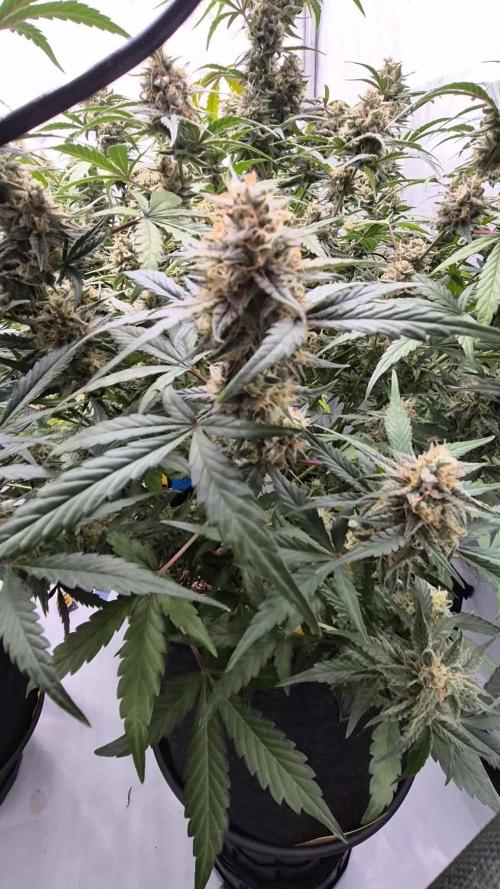
➡️ Day+63, the Purple Punch Auto outdoors received 2.5 liters of PK Booster Compost Tea yesterday. The buds are starting to develop little by little. We can see some brown pistils, probably due to the recent heat.
Some days, one or two dull stinging bugs reappear, but they don't seem to be doing much damage at the moment.
The Dosidos Autos plants are continuing to mature, but the least mature phenotype started senescence quite early, either due to the heat or because it should perhaps have received a third tablet or some Orgatrex or Silicium Flash on the soil surface a few weeks ago. It will still be mature enough to be harvested with the other two in a week.
As a precaution, for the past week all the plants, including those outside, have been receiving water that has been oxygenated with an air pump and cooled to 20-22°C with ice packs (I was worried it might be the beginning of Pythium at one point with temperatures between 28 and 29°C in the tent, and the lower leaves drooping slightly).
Currently at 750-800 PPFD


Processing
Likes
10
Share


@GrowerGaz
Follow
Just gave them some ffj fermented fruit juice , made with blackberry and raw brown sugar. As a bloom booster. Just water via autopots the rest of the week. Certainly very frosty and begining to stink.
Processing
Likes
16
Share


@KcKoolaidMan
Follow
OK so this weeks kicking off big time lots of flowering everything’s really taking off plants are really loving the nutrients super happy with this grow so far I switched bulbs at the beginning of this week to my HPS super excited about the next few weeks I’ll update soon thanks for stopping by!!
Quick update its dat 31 32-ish these things are really getting big the LST worked great some of them are kind of thin in the middle but got lots of tops nice bushes the OG Kush just looks killer has a kind of open spread out look I love it it’s going to produce some big buds I can tell!
It’s the end of the week I Defoliated again and tied a few more branches down one of the jacks still has a pretty low center but it’s starting to catch up all the plants seem to really be loving the feeling and are starting to really stack up the buds The next few weeks should be fun!

Likes
21
Share


@hydro_newb42
Follow
I added the 2nd SCROG this week, though the plant has not grown up to it yet. There was a good amount of stretching this week to go along with a lot of loli-popping. Great run so far.

Likes
37
Share


@DaddyPrime2
Follow
4/30 one of the plants has actually visibly stretched more in the last 48 hrs. Starting to impress me with the pistols. Still way smaller than their projections online but whatever 🤷🏽♂️
5/4 end of the week and I’m pretty okay with their size now 😂 they went through a sizable stretch. I’ll have to get my measuring tape back in the tent because each time I’m adding to this diary, I question whether I’m on the right week or not because they look like dwarfs compared to the end of the week


Likes
31
Share


@Chubbs
Follow
SuperSativaSeedClub
PurplePunchOG Auto
Week8
Weekly update on these three ladies. Been an eventful week for them. I decided to transplant from the original 1gal fabric pot to a 3gal fabric which I never do on autos but I was fighting keeping them happy in the smaller pots. So will see how they take it. Plus I lollipoped the bigger one taking off the lower nodes. All in all Happy Growing.


Likes
2
Share


@HighOhioAn
Follow
Apple strudel what can I say checking all the boxes for me cannot wait to see her buds her she is a chunky girl. The video you guys have on YouTube of the plant is absolutely amazing. Had my mouth watering every second 🔥
Likes
Comments
Share


@VividLeaf
Follow
(Ignore the plant tag - I found out this week from the person who gave me the clone that I had heard completely wrong)
She is growing so fast now. I topped and tied down the main stems that were out-growing the lower branches as an experiment but also defoliated the leaves covering any under canopy nodes that could be of potential to catch up.
I also turned on the Autopot system this week. The airdomes have been running 18/6 since week 2.
Likes
7
Share


@eldruida_lamota
Follow
Que pasa familia, vamos con la primera semana de floración de estas Black muffin F1 de Sweetseeds.
Vamos al lío, me quede con 3 por espacio, siempre pongo alguna semilla de más por si no abriese alguna por no perder ese hueco del indoor.
También se trasplantaron a su maceta definitiva, en este caso de 7 litros y el trasplante se realizó correctamente.
El ph se controla en 6.2 , la temperatura la tenemos entre 20/22 grados y la humedad ronda el 50%.
Hasta aquí todo, Buenos humos 💨💨💨


Likes
9
Share


@CaptStinkNug
Follow
No problems thus far. Plants looking healthy and buds are really starting to fatten up now. One of the Dirty Kush Breath's is starting to purple up and they have a sweet berry smell. Sugar cane has a similar sweet smell but more of a citrus smell. Only half way thru flower.....can't wait to see how big these buds get!

Likes
11
Share


@CannabisCultivate
Follow
This is not a harvest diary log, it is a dead plant log but unfortunately there is not an option for that as of yet and it doesn’t seem right to just delete her life. This beauty was fabulous until we decided to help her with her lean, we must have damaged her roots and death took over. It is a sad shame but another lesson has been learned.
Likes
14
Share


@Fildjoni
Follow
07.11
New flower week is here, for now all going good, still cant wait to see final product and how big and tick buds can be, but ride is joyfull and exciding.
Watering 1.3 l all 3 with nutrients and cal-mag, ph 6.2-6.5( i got ph meter without calibration fluid) but how much time i did mesuring i know how big ph is after i get water from tap [7.5-7.9(did mesuring 120 times minimum, before nutrients, after nutrients and after i add down if i need)] and yea, dont see much differnts on plants in few days without ph meter, but he is here in case, better check up,air flow is good , humidity good(above light zone 45-55%, down by plants 55-65%) and temp day 25°-27°,night 18°-24°.
I adjust pots every day 2 times minimum so every side get some correct light in all parts( maybe silly but i think its not anything bad to keep every side in some parts of day better lighted).
Wish me best for tomorrow i will need it, and them also in rest of the grow proces🍀💪🏻🍀🤞🏻🙏🏻
08.11
Today they was out to get some neem spray and see bit of light till weather is not bad, and to not spray in tent, better photos then last time i guess, they look happy and healty, today no watering i saw that soil is not dry
09.11
Today's subject..watering 1.3l pro plant with nutrients and cal mag, ph 6.2- 6.4.
How i see its good, going good and wish them best till end and more, weekend is here
10.11
Watering 1.3 l pro plant with cal mag and nutrients, ph 6-2-6.5
I saw some gold colors on end of the leafs
I think i forgot put down light intensity after spraying them with good amount of neem oil, i got some time to do it, and normal i am busy so, why not i guess
Hope its not some problems with plants, looks like burned a little not like sick and dry, and only top of leafs
Wish them bless and the best 🙏🏻🍀😋
11.11
Watering 1.4 l with nutrients and cal mag, ph 6.2-6.5
Plants looking good , still on big one bit of yellow color on leafs, hope it will go soon,
this 9 weeks was gone fast ,but this part like clock was stoped i wish till end good situation with them, good run, and all what they need🙏🏻🍀💚
12.11
I decide to try give them one day water with cal mag,ph 6.2, 1l to each of them,try to flash a little bit in hope that will help better recovery from damage, next time when i spray neem i will leave outside a bit dry and try to keep light intensity lower, bit of adjusting fen and vent, still recovering from burning down from light.. nervously waiting end😊😋😁💚🍀🙏🏻
13.11
Waterin 1.4l pro plant with cal mag and nutrients, ph 6.2-6.5
Smallest one chaching up with 2 bigger , realy happy how she turn tabels and cant wait to see how she will look on the end, plant are happy, good health with no problems, only that few of yelowing leafs that almost all had recoverd,like i said, realy happy with what i saw , now they have bit stronger smell(can feal it when i get in apartment, even if i put vent out i can taste it but ok, thats how should be, need to smell a little)
And from other stuff, today was first time snowing ❄️
Soo hard winter is in front of us, till then girls would be dryed and cured probably not 100% but enoguh to go outside, take a walk on cold and smoke one
Ladys stay hard till end and good 🍀🙏🏻💚❄️
P.S night temperature when lights are off is 15-17°[problem is with opened window becuse of vent,dont know what total resault of that would be(maybe i should let lights on night so i can have better temperature in tent, aka switch ciclus of light to be dark weil i work)] thoughts ?
Likes
5
Share


@Jays_Not_Here_Man
Follow
Had a little magnesium deficiency early in the week. That has been corrected, I’ve switched from Cal/Mag to Mag/Sulphur now. Plant is in its last week or two. She is smelling very strong of Limonene and Pinene, and is soooo sticky. She has been very thirsty, as she is only in a 3 gallon pot. Just cruising to the finish line now 🇨🇦❤️🌱😎💨

Processing
Likes
16
Share


@GRow_M8s
Follow
Day 45 --> Restart some light LST for the final weeks of Flowering.
🍇 Really intense aromas from stomper n GWK (like sour,sweet grape tannins).
⚠️ In this project we experimented with a super soil like mixture.
Biobizz all mix was 65% of the mixture which 1/3 of it was placed on the bottom of the pot and the rest 2/3 was mixed with 35% Canna terra. About 10% perlite was added on the mix and it was sprayed with EM microorganisms (Soil activator).
🏁 The target is a tasty organic flower fed only with tap water and a slow release organic fertilizer(6-3-18) which being applied on the end of the 3rd week and, becomes available to the plants 7 days after. In our case which we transplanted on day 9, we used it on day 30(9+21) from seed.
ℹ️ Facts
Until the 3rd week plants were growing under LST with no problem (Day 17-19) was when preflower started).
In the 4th week development slowed down and initially we though that was due to
some drop of temp like midway veg in ➡️ (RQS fem induction). After days were passing and the development of the plants was not satisfying (even though the plants didn't show any symptoms of deficiency or environmental stress) we noticed shiny leaves and dark green colour starting from Stomper#1 which was the smallest plant and was the only one that had some visible burned tips on the leaves.
GWK#2 was the only one that did not appear dark green colour or shiny leaves (like SS#1,#2 and GWK#1) but had drooping leaves without having overwatered her or noticing any issues.(Conditions on week 5 and 6 were a bit unstable as the weather got weird and we had high humidity and low temps).
Reaching 7th week plant development continues to be average, stems of the most plants became dark red without having low temps inside the tent even though plants look a bit better after they were let to dry a bit more.
🔬 Symptoms
1)Dark shiny leaves
2)Slow growth
3)burn tips
4)Drooping leaves
5) Dark Red stems
Matching the pieces of the puzzle we assume that we had NITROGEN TOXICITY and knowing that we do not use any liquid fertilizers it seems that our problem was that our super soil was too "hot" for our baby mephs.
If our rooting system of our plants reached the final layer of soil( Biobizz all mix on the bottom of the pot) in the 4th week, it was when it had the highest availability of nitrogen. Availability that seem to be "too hot" for Sour stomper and Grape walker kush in early Flowering.
Also in the last weeks we had cold weather so we had an electrical heater on increasing the temp of the room which led to higher temp and transpiration inside the tent.That being said it is likely that due to higher transpiration our plants let higher amount of N to enter the plant and that forced the plants to show us signs of it's toxicity.
For a start we let the pots dry to reduce the nitrogen availability and then in Day 45 we water with 6,5 ph tap water + EM microorganisms (700ml each pot).
ℹ️ Day 48 : Ideal humidity + temps and the plants have started to drink and eat a lot better the last days.
After the second water (700ml) of the week yesterday (D47) with microorganisms only, we find the first signs of deficiency on Sour stomper #2 today.
We were expecting this cause our dry fert has only (6-3-18) --> 3 phosphorus (slow release), so our leaves look like having phosphorus and calcium deficiency, we are thinking that the roots locked calcium too with the deficiency of P as these too are collaborating.
- So we are going to feed all the plants with organic liquid fert. from Plagron - green sensation PK (9-10) starting with stomper#2.
* Every plant in tent has its private watering schedule as the maturity and needs, have changed over the last week.
- If the problem continues we'll consider a cal mag solution.
* Will be appreciated any comments or same experiences!!
Last updated --> Day 49 end of the week.

Likes
26
Share


@shibbyguy
Follow
Quite happy with the width of the plant, going to veg for one more week and get some more height before I flip it.
Day 42 - No slime on roots for the first time and looking whiter then ever. Also the first week (week 6) I didnt run Rhizotonic, wondering if I had a bad batch or if it naturally makes the roots slimly🤔
Day 44 - Defoliated some larger fan leaves.
Day 45 - Noticed light timer not working, must of only failed a day or so ago at the most.
Day 46 - Replaced power board (also dodgy) and timer.
Day 47 - Nutrients levels have dropped to 800ppm, will top up tonight.
Day 48 - Nutrients levels back to 1200ppm. Topped 3 branches to level the canopy out slightly. Cut 4 smaller branches off underneath that weren't developing and never going to make it close to the top.
Day 49 - Topped one more stem. Have changed my mind about flowering, going to veg for one more week.

Likes
14
Share


@GoldenWeedGrower
Follow
D43/V39 - 13/05/23 - Changed water , added nutes until EC=0.9
D44/V40 - 14/05/23 - Defolation - Added water EC= 1.1 pH 6.5
D45/F01 - 15/05/23 - Start flowering. Monitoring water from maximum to above, for the week out
D46/F02 - 16/05/23 - Continuing LST. Flowering stage is now clear
D47/F03 - 17/05/23 - EC= 0.9, Added nutes until EC 1.1. pH 6.4 (added some drops of pH-)
D48/F04 - 18/05/23 - Added water and nutes EC=1.1, pH 6.5
D49/F05 - 19/05/23 - Nothing to report

